
A crypto casino is an online gambling platform that allows players to deposit, wager, and withdraw using cryptocurrencies such as Bitcoin, Ethereum, Litecoin, and stablecoins like USDT. For operators, launching a crypto casino means combining licensed iGaming software, crypto payment processing, wallet security, KYC/AML controls, provably fair or certified games, responsible gambling tools, and a measurable player acquisition engine.
Direct answer
To start a crypto casino in 2026, you need a gambling license, crypto-capable casino software, secure wallet infrastructure, a payment gateway, certified games, KYC/AML procedures, responsible gambling controls, hosting, support, analytics, and an affiliate marketing platform that can track registrations, KYC approvals, first deposits, repeat deposits, and NGR through server-side postbacks.
The fastest route is usually a white-label or turnkey crypto casino platform. The most controlled route is a custom or hybrid stack. The biggest mistake is treating crypto payments as “just another cashier option.” In reality, crypto changes compliance, treasury, fraud prevention, payout operations, affiliate tracking, and player trust.

Crypto gambling is no longer a novelty corner of iGaming. Bitcoin casinos, stablecoin casinos, crypto sportsbooks, crash games, provably fair dice games, and blockchain-based gaming platforms have created a separate operator category with its own economics, risks, and acquisition channels.
If you are planning to launch a crypto-friendly casino, the goal is not simply to “accept Bitcoin.” That is the shallow version. The real business challenge is building a platform where deposits clear quickly, withdrawals feel trustworthy, affiliate commissions are calculated correctly, fraud does not eat the margin, and compliance does not become a Friday-night horror movie.
This guide breaks down how to start a crypto casino from an operator’s point of view: business model, licensing, software, wallet architecture, game providers, affiliate acquisition, responsible gambling, security, costs, and the 90-day launch roadmap.
What Is a Crypto Casino?
A crypto casino is an online casino or sportsbook that supports cryptocurrency deposits and withdrawals. Some crypto casinos operate like traditional online casinos with an added crypto cashier. Others are crypto-native platforms built around blockchain payments, provably fair games, anonymous or low-friction onboarding, token-based rewards, and fast global settlement.
For players, the appeal is speed, privacy, lower friction, and sometimes the ability to verify game fairness. For operators, the appeal is broader market reach, lower payment processing friction in difficult GEOs, faster settlement, and new acquisition channels through crypto affiliates, streamers, Telegram communities, and niche review sites.
| Crypto casino element | What it means for players | What it means for operators |
|---|---|---|
| Bitcoin / crypto deposits | Players can fund accounts with BTC, ETH, USDT, LTC, or other coins. | The cashier needs wallet infrastructure, confirmation logic, AML screening, and reconciliation. |
| Fast withdrawals | Players expect near-instant payouts once checks are complete. | Operators need hot-wallet limits, risk scoring, payout queues, and audit logs. |
| Provably fair games | Players can verify that game outcomes were not manipulated. | Operators need transparent fairness mechanics, published explanations, and security reviews. |
| Crypto-native acquisition | Players discover casinos through affiliates, streamers, communities, and review sites. | Operators need affiliate tracking, promo-code attribution, creative approvals, and fraud controls. |
| Global accessibility | Players may access payment methods unavailable through cards or banks. | Operators must still enforce licensing, GEO restrictions, KYC/AML, and responsible gambling rules. |
Crypto Casino vs Bitcoin Casino vs Blockchain Casino
These terms are often used interchangeably, but they are not identical. If you want to rank, build, or market this category properly, the distinction matters.
| Term | Meaning | Operator implication |
|---|---|---|
| Bitcoin casino | A casino that accepts Bitcoin deposits and withdrawals. | BTC support is mandatory, but stablecoins may still be needed for payout stability. |
| Crypto casino | A broader casino supporting multiple cryptocurrencies such as BTC, ETH, LTC, DOGE, XRP, and USDT. | Requires multi-coin wallet logic, FX handling, and coin-specific risk controls. |
| Blockchain casino | A casino using blockchain mechanics for payments, fairness proofs, smart contracts, or tokenized rewards. | Requires deeper technical architecture and stronger security review. |
| Provably fair casino | A casino where players can verify outcomes using cryptographic proofs. | Requires fairness documentation, seed logic, and clear UX explanations. |
| White-label crypto casino | A ready-made casino platform operated under your brand. | Fast launch, but less control over core infrastructure and provider roadmap. |
| Turnkey crypto casino | A full casino solution including platform, games, payments, back office, and support modules. | Useful for operators who want speed without building every module from scratch. |
How Does a Crypto Casino Work?
A crypto casino works by connecting a player account system, crypto cashier, wallet infrastructure, casino game engine, compliance layer, affiliate tracking platform, and reporting stack. The player sees a simple flow: register, deposit, play, withdraw. The operator sees a far more complex chain of events.
Crypto casino transaction flow
- Player registers and receives an account ID.
- Player selects a coin such as BTC, ETH, LTC, or USDT.
- The cashier creates a deposit address or payment request.
- The transaction is monitored on-chain until the required number of confirmations is reached.
- The casino credits the player wallet in crypto or a fiat-equivalent balance.
- The player wagers on games through certified casino content or provably fair game modules.
- Withdrawals pass risk checks, including KYC, AML, responsible gambling, bonus abuse, and wallet screening.
- The payout is broadcast, logged, reconciled, and tied back to the player ledger.
That flow must be fast enough for players, strict enough for compliance, and transparent enough for finance. Weakness in any one layer creates problems later: payout delays, player complaints, affiliate disputes, wallet exposure, or regulatory risk.
How to Start a Crypto Casino in 2026: The Complete Operator Checklist
If you want to run a high-performing crypto casino, you need the foundations in place before you buy traffic. Acquisition cannot save a weak cashier, unclear bonus terms, slow withdrawals, or a platform that cannot reconcile player balances.

| Requirement | What you need | Why it matters |
|---|---|---|
| Crypto casino license | Gaming license matched to target GEOs, product type, crypto policy, and advertising strategy. | Determines legal reach, banking access, partner trust, and acquisition limits. |
| Casino software | Crypto-capable casino platform with wallet, games, back office, bonus engine, reporting, and API access. | The platform controls gameplay, player accounts, promotions, cashier flow, and data quality. |
| Crypto payment gateway | BTC, ETH, USDT, LTC, XRP or similar rails; deposit address logic; confirmation monitoring; payout automation. | Payment experience is one of the strongest trust signals for crypto players. |
| Wallet policy | Hot/cold storage, multi-sig treasury, withdrawal limits, address management, chain monitoring. | Protects player funds, operator reserves, and treasury operations. |
| KYC / AML / source-of-funds process | Identity verification, wallet screening, risk scoring, sanctions checks, enhanced due diligence triggers. | Crypto does not remove compliance obligations; it makes them more technical. |
| Game content | Slots, live casino, crash games, roulette, blackjack, baccarat, sportsbook, and crypto-native games. | Game mix decides retention, ARPU, volatility, and affiliate conversion rates. |
| Provably fair or certified RNG | Fairness certificates, RNG testing, game provider documentation, or provably fair verification tools. | Builds player trust and helps distinguish serious operators from sketchy crypto gambling sites. |
| Responsible gambling tools | Deposit limits, loss limits, session limits, self-exclusion, cool-off periods, risk triggers. | Protects players and reduces legal, reputational, and operational risk. |
| Affiliate marketing software | Scaleo or equivalent platform for S2S tracking, affiliate onboarding, commission plans, fraud filters, promo codes, and reporting. | Affiliates are often the fastest acquisition channel for crypto casinos, but only if tracking and payout rules are clean. |
| Fraud and bonus abuse controls | Device fingerprinting, IP analysis, wallet clustering, duplicate account detection, velocity rules. | Crypto casinos attract sophisticated abuse. Fraud prevention must be active from day one. |
| Hosting and infrastructure | CDN, DDoS protection, autoscaling, monitoring, backup, disaster recovery, uptime alerts. | Casino traffic spikes around campaigns, game drops, tournaments, and streamer events. |
| Customer support | 24/7 live chat, crypto withdrawal SOPs, multilingual macros, dispute escalation. | Players forgive fewer mistakes when money and crypto transactions are involved. |
| Analytics and BI | Dashboards for FTDs, deposits, withdrawals, NGR, affiliate ROI, game performance, and cashier drop-off. | You cannot optimize what you cannot measure. |
Crypto Casino Launch Models: White-Label, Turnkey, Custom, or Hybrid?
The biggest early decision is not the logo, game theme, or welcome bonus. It is the launch model. Your launch model decides how fast you go live, how much control you have, how much technical responsibility sits with your team, and how painful future migration may become.
| Launch model | Best for | Speed | Control | Main risk |
|---|---|---|---|---|
| White-label crypto casino | New operators, lean teams, fast market tests. | Fast | Medium-low | Vendor lock-in, limited customization, shared infrastructure constraints. |
| Turnkey crypto casino | Operators wanting a complete platform with software, games, cashier, and back office. | Medium-fast | Medium | Feature roadmap depends on provider; integration limits may appear later. |
| Custom crypto casino | Funded teams with technical leadership and a differentiated product vision. | Slow | High | High cost, longer certification, more operational responsibility. |
| Hybrid stack | Serious operators that want platform control but still use best-of-breed vendors. | Medium | High | Requires strong product, data, compliance, and integration management. |
Operator advice
If this is your first crypto casino, do not overbuild too early. Launch with a platform that gives you clean wallet controls, transparent data exports, reliable game integrations, and flexible affiliate tracking. You can always customize later. You cannot easily recover from messy ledgers, unclear ownership of player data, or a provider that blocks reporting access.
Crypto Casino License Options
A crypto casino license is not just a badge for the footer. It affects where you can accept players, how you advertise, what payment providers will work with you, how affiliates can promote you, and how investors or banks evaluate your business.
Licensing costs and approval times vary widely by jurisdiction, business model, company structure, target market, and legal advisors. The table below is a practical planning framework, not legal advice.
| Jurisdiction | Typical use case | Relative cost | Approx. timeline | Crypto stance |
|---|---|---|---|---|
| Curacao | Fast offshore launch, international operations, crypto-friendly brands. | Lower-medium | Several weeks to a few months | Often used by crypto casino operators, but regulatory expectations are tightening. |
| Anjouan / Comoros | Fast market entry for operators needing broad offshore coverage. | Lower-medium | Several weeks | Crypto-friendly, but reputation and banking access should be assessed carefully. |
| Malta Gaming Authority | Higher-trust EU-facing operation with stronger compliance expectations. | High | Several months | Stronger reputation, stricter compliance, more demanding process. |
| Isle of Man | Premium reputation, stronger banking credibility, serious long-term operators. | High | Several months | Strong framework but requires robust governance. |
| Local regulated markets | Operators targeting one specific country or state. | Varies, often high | Longer | Depends heavily on market. Some restrict or closely supervise crypto payments. |
The serious question is not “Which license is cheapest?” It is: which license supports your target GEOs, acquisition strategy, payment rails, affiliate rules, and long-term credibility?
Crypto Casino Licensing Checklist
- Define target markets before choosing a license.
- Confirm whether crypto deposits and withdrawals are allowed under the license.
- Prepare incorporation documents, shareholder IDs, and UBO disclosures.
- Document AML, KYC, source-of-funds, and sanctions-screening procedures.
- Obtain RNG, game fairness, or provider certifications.
- Prepare responsible gambling policies and player protection workflows.
- Create wallet policy documents covering hot wallet limits, cold storage, multi-sig, and internal approval rights.
- Map advertising and affiliate compliance rules by GEO.
💡 Read more: iGaming Regulations Around The World
Choosing Crypto Casino Software
Crypto casino software is the operating system of your gambling business. It manages player accounts, wallets, games, promotions, reports, payment flows, affiliate events, compliance controls, and support visibility.
Do not choose software only because the front end looks good. Ask how the platform handles ledgers, crypto deposits, on-chain confirmations, bonus wagering, failed withdrawals, API access, fraud checks, affiliate postbacks, and data exports.
Core Modules Every Crypto Casino Platform Should Include
| Module | What to check | Why it matters |
|---|---|---|
| Player Account Management | Identity, wallet balances, account status, limits, documents, risk flags. | Controls the player lifecycle and compliance state. |
| Crypto cashier | Deposit addresses, confirmations, withdrawals, coin support, fees, status messages. | The cashier is where crypto trust is won or lost. |
| Game aggregation | Slots, live casino, crash games, table games, sportsbook, provider integrations. | Content depth drives retention and affiliate conversion. |
| Bonus engine | Deposit bonuses, free spins, rakeback, cashback, wagering rules, expiry, abuse limits. | Crypto players compare bonuses aggressively; vague rules cause disputes. |
| Back office | Player search, transaction history, fraud review, manual adjustments, support notes. | Operations need fast, accurate visibility. |
| Affiliate tracking | S2S postbacks, promo codes, sub-IDs, CPA/RevShare/Hybrid commissions, fraud filters. | Crypto casinos often scale through affiliates and streamers. |
| Compliance tools | KYC, AML, GEO blocking, RG limits, audit logs, sanctions controls. | Compliance must be embedded, not bolted on later. |
| Analytics | FTD, NGR, deposits, withdrawals, bonus cost, player cohorts, affiliate ROI. | Operator decisions should be based on player value, not raw registrations. |
| API and data exports | REST API, webhooks, event streams, raw exports, schema documentation. | Without clean data, scaling becomes guesswork. |
Crypto Casino Software Provider Questions to Ask Before Signing
A good sales demo can make any casino software look polished. The real test is whether the provider can answer operational questions without hand-waving.
- How are crypto deposits credited? At first confirmation, after a fixed number of confirmations, or after risk checks?
- Can balances be displayed in crypto and fiat equivalent? Which FX rate is used and when?
- How are network fees handled? Are they charged to players, absorbed by the operator, or configured by coin?
- Can withdrawals be auto-approved below a risk threshold? What triggers manual review?
- How does the platform handle failed, stuck, or underpaid crypto transactions?
- Can affiliate commissions be calculated on verified FTD, deposits, or NGR?
- Does the platform support server-to-server postbacks? Which lifecycle events are available?
- Can promo codes be linked to affiliates, streamers, and offline campaigns?
- What raw data can be exported? Player events, transactions, game sessions, bonus usage, and affiliate events?
- What happens if you migrate away? Can you export player, wallet, transaction, and affiliate history cleanly?
Crypto Payment Architecture
Crypto payment architecture decides whether your casino feels instant or chaotic. The player expects a simple cashier. The operator needs a controlled treasury system with risk checks, chain monitoring, reconciliation, and clean reporting.
Coins to Support at Launch
| Cryptocurrency | Why support it | Operator watchout |
|---|---|---|
| Bitcoin (BTC) | Most recognized crypto brand; essential for Bitcoin casino positioning. | Fees and confirmation times can vary. |
| Ethereum (ETH) | Large user base and ecosystem familiarity. | Gas fees can frustrate smaller players. |
| Tether (USDT) | Stablecoin value, useful for payouts, accounting, and affiliate commissions. | Network choice matters: TRC20, ERC20, BEP20, etc. |
| Litecoin (LTC) | Fast, lower-fee alternative popular with gambling users. | Lower brand pull than BTC. |
| Ripple (XRP) | Fast and inexpensive transactions. | Regulatory perception and centralization concerns vary by market. |
| Dogecoin (DOGE) | Recognizable, community-driven, often used by casual crypto users. | Volatility and meme-driven demand. |
Hot Wallet vs Cold Wallet Policy
Keep enough funds in hot wallets to process routine withdrawals quickly, but not enough to put the business at unnecessary risk. Cold wallets should hold larger reserves, jackpot reserves, and operational float. Treasury moves should require multi-signature approval and be logged.
Practical wallet policy
- Keep only routine payout float in hot wallets.
- Use cold storage for reserves and larger balances.
- Require 2-of-3 or stronger multi-sig approval for treasury movements.
- Log every wallet transfer with business reason, approver, timestamp, and TXID.
- Run chain analytics before high-value withdrawals.
Crypto Treasury, Accounting, and Audit
Running a crypto-first casino is not only a payment challenge. It is a treasury, accounting, and audit challenge. The public blockchain gives you transaction visibility, but your internal ledger still needs to map every on-chain movement to a player, wallet role, balance, bonus, withdrawal, affiliate event, or business expense.
Build a daily reconciliation process that connects:
deposit intent → chain confirmation → player wallet credit → wagering → bonus usage → withdrawal request → risk check → payout approval → chain broadcast → landing confirmation
Every step should have a timestamped, immutable event trail. Fees should be captured explicitly. Some fees are payment-processing costs, some are operational treasury costs, and some may be passed to players depending on your policy.
For accounting, choose a reporting currency and apply consistent FX rules when recognizing deposits, bets, payouts, bonuses, and affiliate commissions. If you hold crypto-denominated balances, finance needs a policy for unrealized gains and losses at period end.
Crypto Casino Games: What Players Expect
A crypto casino cannot win on payments alone. Players still need content depth. The strongest crypto casino platforms usually combine traditional casino games with crypto-native formats.
| Game type | Why it matters | Operator note |
|---|---|---|
| Slots | Still the core casino revenue driver. | Offer a balanced portfolio: high-volatility streamer titles, evergreen titles, and mobile-friendly games. |
| Live casino | Builds trust and premium feel. | Latency, table language, dealer quality, and regional fit matter. |
| Crash games | Popular with crypto-native players and streamers. | High engagement, but needs strong responsible gambling controls. |
| Dice, mines, Plinko | Simple, fast, crypto-native gameplay. | Often expected in crypto-first casinos. |
| Roulette, blackjack, baccarat | Classic casino credibility. | Players expect fair rules, smooth UX, and mobile optimization. |
| Sportsbook | Strong crossover with crypto betting audiences. | Requires odds feeds, market risk controls, settlement logic, and compliance by jurisdiction. |
| Provably fair games | Differentiates crypto casinos from traditional online casinos. | Explain fairness clearly; do not hide it in technical jargon. |
Provably Fair Crypto Casino Mechanics
Provably fair gaming allows players to verify that an outcome was not manipulated after the bet was placed. It usually relies on server seeds, client seeds, hashes, and verification logic. Not every casino game is suitable for provably fair mechanics, especially when using third-party live casino or certified RNG providers, but crypto-native games often use this model as a major trust signal.
If you offer provably fair games, make the verification flow understandable. The average player should not need to be a cryptographer to check whether the result was fair.
Trust-building move
Create a public “How Our Games Are Verified” page that explains RNG certificates, provably fair games, game provider audits, payout rules, and what players can check themselves. This helps both users and search engines understand that your crypto casino is not just a payment wrapper.
KYC, AML, and the No-KYC Crypto Casino Question
Many players search for “no-KYC crypto casino,” but operators should approach that angle carefully. Low-friction onboarding can improve conversion, but full anonymity can create serious regulatory, fraud, and payment risks.
A practical model is risk-based verification. Low-risk players may be allowed to register and explore with minimal friction, while withdrawals, large deposits, suspicious wallet activity, bonus abuse, or risky GEO signals trigger verification.
| Verification model | Pros | Risks | Best use |
|---|---|---|---|
| Full KYC at registration | Strong compliance, fewer later withdrawal disputes. | Lower conversion, especially for crypto-native users. | Highly regulated markets. |
| KYC at withdrawal | Lower registration friction. | Can create frustration if players feel surprised. | Markets where delayed verification is permitted. |
| Risk-based KYC | Balances conversion and compliance. | Requires strong risk scoring and clear policy. | Most serious crypto casino operations. |
| No-KYC positioning | High marketing appeal in some crypto communities. | Regulatory, AML, banking, and affiliate compliance risk. | Only with expert legal review and suitable jurisdictions. |
Whatever model you choose, explain it clearly. Hidden KYC triggers are one of the fastest ways to create player complaints, bad reviews, and affiliate reputation damage.
Responsible Gambling for Crypto Casinos
Responsible gambling changes shape in a crypto environment. Crypto deposits are fast, global, and available 24/7. That convenience is part of the appeal, but it also means responsible gambling tools must be visible and technically enforced.
At minimum, your crypto casino should support deposit limits, loss limits, session reminders, cool-off periods, self-exclusion, age verification, and risk-triggered interventions. Limits should be calculated in a stable reporting currency as well as the player’s selected coin, because crypto price movements can distort perceived spend.
Crypto-Specific Responsible Gambling Signals
- Rapid deposit-withdrawal cycles.
- Multiple coin switches used to obscure spend.
- Late-night deposit spikes after large crypto price movements.
- Repeated failed withdrawals followed by immediate re-deposit.
- High-risk play after bonus losses.
- Multiple accounts linked by device, wallet patterns, or behavioral fingerprints.
Responsible gambling should also extend to affiliates. Crypto casino partners must use approved messaging, GEO-correct disclaimers, age restrictions, and responsible gambling language. Streamers, Telegram promoters, SEO affiliates, and review sites should not imply guaranteed wins, risk-free gambling, or “investment-style” upside.
How Crypto Casinos Acquire Players Through Affiliates
For many crypto casinos, affiliates are not a secondary marketing channel. They are the growth engine. Crypto players often discover new casinos through review sites, comparison pages, Telegram groups, streamers, YouTube creators, Discord communities, bonus directories, and niche SEO affiliates.
This makes affiliate software a critical part of the crypto casino stack. If you cannot track a player from click to registration, KYC, first deposit, repeat deposit, and NGR, you will either overpay weak traffic or underpay valuable partners. Both outcomes are bad.
Crypto Casino Affiliate Commission Models
| Model | How it works | Best for | Operator risk |
|---|---|---|---|
| CPA | Affiliate is paid a fixed amount for a qualified player, usually after FTD or KYC + deposit. | Fast acquisition and predictable partner offers. | Bonus abuse, low-LTV players, and incentive traffic if rules are weak. |
| RevShare | Affiliate earns a percentage of player revenue over time. | Long-term content affiliates and serious partners. | Requires accurate NGR calculation, negative carryover policy, and transparent reports. |
| Hybrid | Combination of CPA and RevShare. | Strategic affiliates with both volume and quality. | More complex reconciliation and dispute handling. |
| Tiered commission | Commission improves as affiliate hits quality or volume milestones. | Scaling top partners without giving away margin too early. | Needs clear qualification rules and automated tracking. |
| Crypto payouts | Affiliate commissions are paid in BTC, USDT, or other crypto. | Crypto-native affiliates and global partners. | FX, wallet validation, compliance, and payout audit requirements. |
Why Generic Affiliate Plugins Fail for Crypto Casinos
Crypto casinos need more than a basic link tracker. A serious affiliate platform must support server-side tracking, player lifecycle events, fraud filtering, sub-affiliate structures, promo-code attribution, custom commission rules, and finance-ready reports.
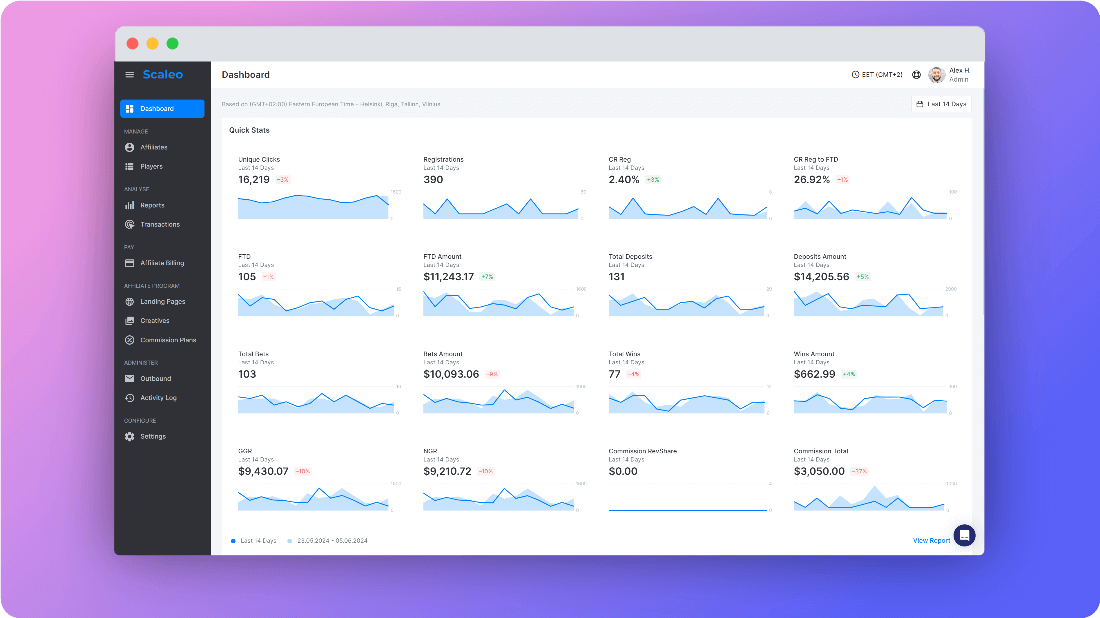
With Scaleo, crypto casino operators can manage affiliates, run cookieless S2S tracking, configure CPA/RevShare/Hybrid commissions, track registrations and FTDs, filter suspicious traffic, manage creatives, and report partner ROI from one dashboard.
Affiliate Tracking Events a Crypto Casino Should Measure
A crypto casino affiliate program should not pay only because someone clicked a link. Serious operators track verified value through the full player journey.
| Event | Why track it | Commission use |
|---|---|---|
| Click | Measures traffic volume and source quality. | Usually not payable alone. |
| Registration | Shows lead intent. | Useful for funnel analysis, rarely enough for CPA. |
| KYC approval | Confirms player eligibility. | Useful gate for CPA qualification. |
| First deposit | Core acquisition event. | Common CPA trigger. |
| Second deposit | Filters one-time bonus hunters. | Useful for quality-based bonuses. |
| Wagering activity | Shows real play, not just deposit behavior. | Can qualify higher CPA tiers. |
| NGR | Measures operator revenue after deductions. | Basis for RevShare. |
| Fraud flag | Identifies bonus abuse, duplicate accounts, bot traffic, wallet clusters. | Can hold or reject commissions. |
| Withdrawal | Useful for retention and risk analysis. | Helps identify arbitrage or abuse patterns. |
This is where server-to-server tracking matters. Browser cookies are fragile, especially in high-value regulated and crypto environments. S2S postbacks give operators cleaner attribution, better fraud controls, and fewer affiliate disputes.
Fraud and Bonus Abuse in Crypto Casinos
Crypto casinos attract legitimate players, but they also attract organized abuse. Bonus hunters, multi-accounting rings, VPN traffic, colluding affiliates, fake KYC attempts, wallet clustering, and fast deposit-withdrawal loops can damage margins quickly.
Build fraud prevention into the platform and affiliate program before launch. Retrofitting it later is expensive and politically painful, especially after partners are already used to loose rules.
| Risk | Signal | Control |
|---|---|---|
| Multi-accounting | Shared device fingerprint, similar behavior, wallet patterns, IP clusters. | Device fingerprinting, wallet graphing, account linking, manual review. |
| Bonus abuse | Low deposits, identical wagering pattern, instant withdrawal after bonus clearing. | Bonus caps, wagering rules, withdrawal gates, risk scoring. |
| Affiliate collusion | Affiliate sends suspiciously similar players or repeated low-value FTDs. | Affiliate-level fraud scoring, commission holds, traffic-source review. |
| Sanctioned wallet exposure | Funds linked to high-risk or sanctioned addresses. | Chain analytics, auto-holds, enhanced due diligence. |
| Bot or incentivized traffic | High registration volume, poor engagement, low play depth. | CAPTCHA, behavioral signals, traffic-source bans, CPA qualification rules. |
| VPN / GEO masking | Player location conflicts with IP, device timezone, documents, or payment behavior. | GEO detection, device intelligence, KYC checks, blocked jurisdictions. |
Crypto Casino Business Model and Revenue
A crypto casino earns revenue the same fundamental way as other casinos: through the mathematical edge in games and sportsbook margin. But crypto changes the operating model around payments, bonus economics, treasury exposure, affiliate acquisition, and player expectations.
- Casino GGR: wagered amount minus winnings paid to players.
- NGR: GGR minus bonuses, payment costs, game provider fees, chargebacks or adjustments, taxes, and other agreed deductions.
- Affiliate cost: CPA, RevShare, Hybrid, sub-affiliate overrides, and special partner bonuses.
- Crypto treasury cost: volatility exposure, network fees, wallet operations, chain analytics, and custody.
- Compliance cost: KYC, AML, legal, responsible gambling, and jurisdiction monitoring.
The healthier your tracking and reporting, the easier it is to protect margins. Crypto casinos can look profitable at deposit level while quietly bleeding money through bonuses, fast CPA payouts, failed fraud controls, and unmanaged withdrawal costs.
Crypto Casino Costs: What to Budget For
Costs depend on license choice, platform model, GEOs, game content, compliance requirements, internal team, marketing budget, and whether you choose white-label, turnkey, custom, or hybrid development.
| Cost bucket | Typical cost pressure | Where operators underestimate |
|---|---|---|
| License and legal | Application, company setup, legal review, compliance documentation. | Ongoing compliance and market monitoring. |
| Casino platform | Setup fee, monthly fee, revenue share, modules, custom development. | Data exports, API limits, custom reporting, migration costs. |
| Game providers | Aggregation fee, provider revenue share, certification, regional content. | Game availability by license and market. |
| Crypto payments | Gateway fees, wallet operations, chain analytics, custody, network fees. | Stuck transactions, fee spikes, AML holds, treasury management. |
| KYC / AML | Verification checks, document review, sanctions screening, source-of-funds review. | Manual review workload at scale. |
| Affiliate software | Tracking platform, postbacks, commission management, fraud controls, mailroom. | Finance reconciliation and affiliate dispute prevention. |
| Marketing | SEO, affiliates, streamers, communities, paid media where allowed. | Creative compliance, partner onboarding, bonus cost. |
| Infrastructure | Hosting, CDN, monitoring, security, DDoS protection, backups. | Peak traffic from streamer or affiliate campaigns. |
| Support | Live chat, multilingual agents, payment dispute resolution. | Crypto withdrawal questions and transaction tracing. |
90-Day Crypto Casino Launch Roadmap
A realistic launch plan should move from legal and architecture to platform configuration, payments, games, affiliate setup, compliance, QA, and controlled launch.
| Phase | What to complete | Success signal |
|---|---|---|
| Days 1–15 | Define GEOs, license path, business model, launch model, provider shortlist, budget. | You know where you can operate and what you are building. |
| Days 16–30 | Select platform, payment gateway, wallet policy, KYC/AML vendors, game aggregation. | Core vendors are selected and integration scope is clear. |
| Days 31–45 | Configure casino platform, cashier, bonus logic, responsible gambling tools, reporting. | End-to-end player flow works in sandbox. |
| Days 46–60 | Integrate Scaleo or affiliate tracking platform, postback events, promo codes, creative approvals. | Affiliate journey tracks click → registration → KYC → FTD → NGR. |
| Days 61–75 | Run security testing, wallet testing, game testing, withdrawal testing, fraud scenarios, compliance review. | No critical payout, tracking, or ledger defects remain. |
| Days 76–90 | Soft launch with selected partners, monitor cashier, support, player complaints, affiliate reports, and fraud alerts. | Controlled traffic converts without payout chaos or attribution disputes. |
Marketing a Crypto Casino
Crypto casino marketing works best when built around trust, speed, transparency, and proof. Generic “big bonus” messaging is weak. Crypto players compare withdrawal speed, supported coins, bonus rules, fairness, reputation, and affiliate reviews before depositing.
High-Value Content Topics for Crypto Casino SEO
- How to deposit with Bitcoin, Ethereum, Litecoin, or USDT.
- How crypto casino withdrawals work.
- Provably fair casino games explained.
- Crypto casino bonuses and wagering requirements.
- Bitcoin casino vs traditional online casino.
- Best crypto casino games for beginners.
- Fast payout casino policy.
- Responsible gambling tools for crypto players.
- How to verify a provably fair game.
- Crypto casino affiliate program terms.
💡 Explore: How To Use Telegram Bots To Automate Online Casinos’ Tasks?
Crypto Casino Affiliate Program Setup
If your crypto casino relies on affiliates, set the program up before the public launch. Affiliates need tracking links, promo codes, creative packs, approved claims, GEO rules, commission terms, payment methods, and transparent dashboards.
A strong crypto casino affiliate program should include:
- CPA, RevShare, and Hybrid commission options for different partner types.
- Crypto affiliate payouts in USDT, BTC, or fiat, depending on partner preference and compliance.
- Cookieless S2S tracking for registration, KYC, FTD, deposit, wager, and NGR events.
- Promo-code tracking for streamers, Telegram, Discord, and offline campaigns.
- Creative approval workflows so partners do not publish non-compliant bonus claims.
- Fraud filters to detect duplicate accounts, suspicious FTDs, bot traffic, and bonus abuse.
- Finance-ready reports that explain why a commission was approved, rejected, held, or adjusted.
Using Scaleo for Crypto Casino Affiliate Growth
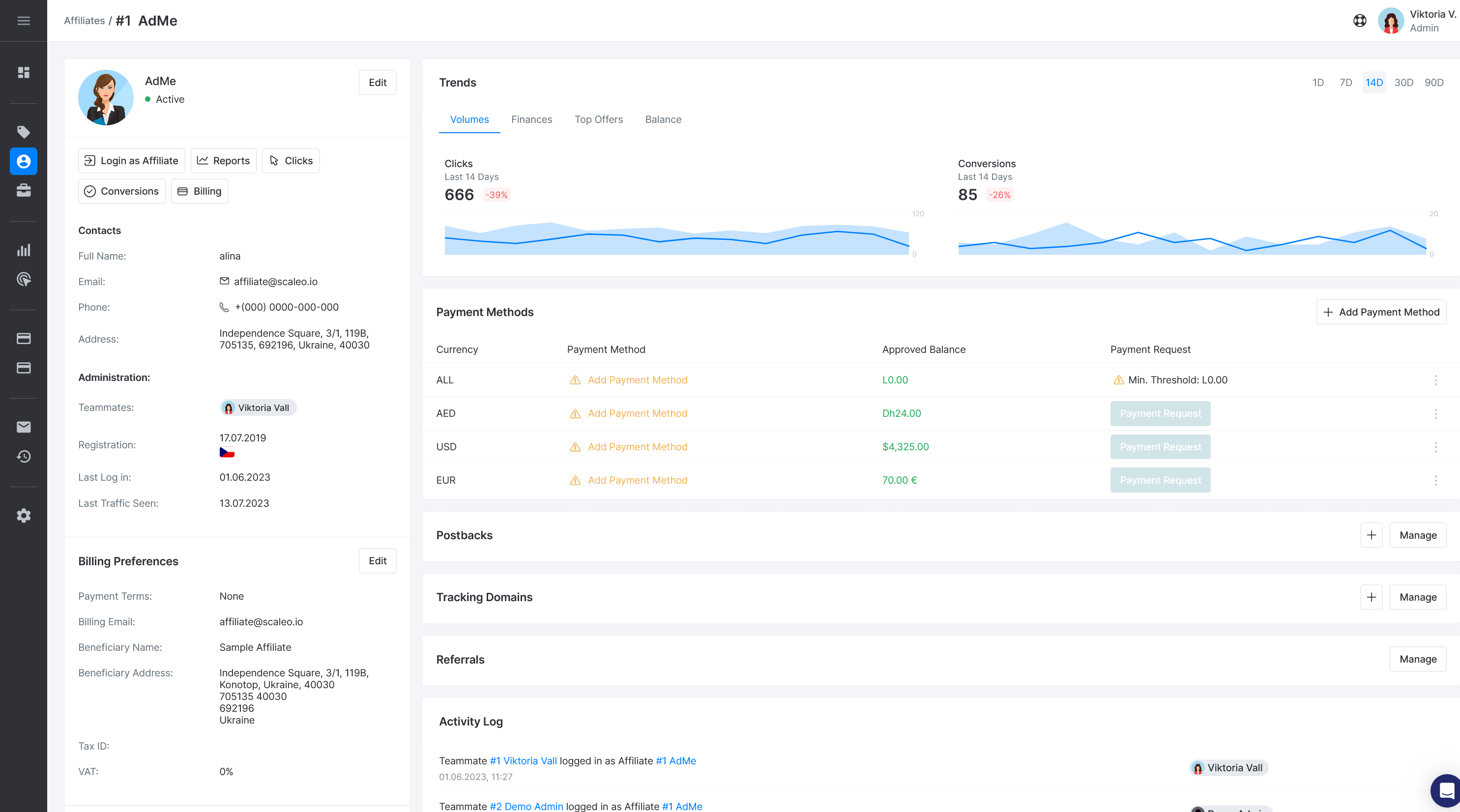
Scaleo helps crypto casino operators turn acquisition into a controlled partner channel instead of a messy spreadsheet operation. With Scaleo, you can track player events through server-side postbacks, configure CPA/RevShare/Hybrid commission plans, segment affiliates by quality, detect suspicious traffic, and give partners transparent performance dashboards.
For a crypto casino, this matters because affiliate disputes often come from unclear event definitions. Was the player registered? KYC-approved? First-deposit verified? Did the deposit reverse? Was the wallet flagged? Did bonus abuse invalidate the commission? Scaleo lets operators define and track the events that actually matter.
| Scaleo capability | Why crypto casino operators need it |
|---|---|
| S2S postback tracking | Track registrations, KYC approvals, FTDs, deposits, withdrawals, and NGR without relying on fragile browser cookies. |
| Rule-based commissions | Configure CPA, RevShare, Hybrid, tiered commissions, and custom qualification rules. |
| Fraud filtering | Identify suspicious traffic, duplicate patterns, and low-quality acquisition before payout. |
| Promo-code attribution | Track streamers, influencers, Telegram communities, and offline partner campaigns. |
| Affiliate dashboard | Give partners visibility into clicks, conversions, payouts, and performance. |
| Creative management | Control which banners, landing pages, and bonus claims partners are allowed to use. |
| Finance reports | Reduce commission disputes with clear payout logic and approved/rejected event history. |
Operational Management After Launch
Launching is only the beginning. Crypto casino operations require a weekly rhythm across payments, security, game performance, affiliate traffic, fraud, compliance, and support.
Weekly Operator Dashboard
| Area | Metric to monitor | Why it matters |
|---|---|---|
| Cashier | Deposit success rate, withdrawal time, failed transactions, coin mix. | Crypto players judge casinos heavily by payment reliability. |
| Affiliate channel | FTDs, NGR, CPA cost, fraud flags, top partners, dormant partners. | Protects acquisition margin. |
| Games | Top titles, retention by game, RTP variance, live casino uptime. | Improves content curation and CRM campaigns. |
| Bonuses | Bonus uptake, wagering completion, abuse flags, bonus cost as % of NGR. | Prevents promotions from becoming margin leaks. |
| Compliance | KYC pass rate, manual review time, blocked GEO attempts, RG triggers. | Keeps the business defensible. |
| Support | Withdrawal tickets, KYC complaints, bonus disputes, response time. | Reveals friction before reviews and affiliates amplify it. |
| Security | Login anomalies, wallet alerts, DDoS events, admin access logs. | Crypto gambling is a high-value target. |
Common Crypto Casino Mistakes
Most crypto casino failures are not caused by one catastrophic decision. They are caused by multiple small shortcuts that compound: vague bonuses, weak payment UX, unclear KYC, sloppy affiliate tracking, and poor fraud controls.
- Launching without clean affiliate tracking. You will not know which partners are profitable.
- Advertising “instant withdrawals” without defining risk checks. Players will accuse you of delaying payouts.
- Using vague bonus terms. Bonus abuse and disputes become inevitable.
- Adding too many coins too early. Each coin adds operational, liquidity, and support complexity.
- Ignoring stablecoins. USDT or similar rails can simplify accounting and affiliate payouts.
- Choosing software without raw data exports. BI and migration become painful later.
- Treating compliance as legal paperwork only. It must be encoded into product flows.
- Letting affiliates publish unapproved claims. One aggressive bonus page can create regulatory and reputational damage.
Crypto Casino RFP: Questions to Ask Vendors
Use these questions when evaluating platform providers, payment gateways, affiliate software, KYC vendors, and game aggregators.
- Which cryptocurrencies are supported natively, and which networks are available for stablecoins?
- How are deposits credited, and what happens with underpaid or overpaid deposits?
- Can the platform display balances in both crypto and fiat equivalent?
- How are network fees shown to players and recorded internally?
- Which KYC and AML vendors are integrated?
- Does the system support risk-based withdrawal review?
- Can bonus rules be configured by coin, GEO, player segment, and affiliate source?
- Which game providers are certified for your target jurisdictions?
- Does the platform support provably fair games or only certified RNG games?
- Can affiliate postbacks be sent for registration, KYC, FTD, deposit, wager, NGR, and fraud events?
- What raw data exports are available, and how often?
- What happens if you migrate to another provider in 18 months?
Conclusion
Starting a crypto casino is achievable, but it is not just a matter of adding Bitcoin payments to a standard casino site. A serious crypto casino needs a license strategy, secure wallet infrastructure, crypto-capable casino software, clear KYC/AML workflows, responsible gambling controls, certified or provably fair games, transparent payouts, fraud prevention, and a properly governed affiliate acquisition engine.
The operators who win in this category will not be the ones shouting “instant withdrawals” the loudest. They will be the ones who can prove that their payments, games, bonuses, affiliate commissions, and compliance controls are reliable under real traffic.
Bottom line: build the cashier, ledger, compliance layer, game stack, and affiliate tracking correctly before you scale acquisition. Crypto casino players care about speed, but operators survive on control.
Scaleo helps crypto casino operators add a measurable, compliant, and scalable affiliate channel through cookieless S2S tracking, rule-based commissions, fraud filters, creative gating, promo-code attribution, and finance-ready reporting.
Ready to add an affiliate channel to your crypto casino? Book a demo with Scaleo and see how quickly you can launch partner tracking, commission rules, and affiliate reporting for your iGaming operation.
Crypto Casino FAQ
What is a crypto casino?
A crypto casino is an online gambling platform that accepts cryptocurrency deposits and withdrawals. Most crypto casinos support coins such as Bitcoin, Ethereum, Litecoin, and stablecoins like USDT. Operators still need casino software, licensing, KYC/AML controls, game providers, security, and payment infrastructure.
How do you start a crypto casino?
To start a crypto casino, choose your target markets, secure the right gambling license, select crypto-capable casino software, integrate payment gateways and wallets, add certified or provably fair games, set up KYC/AML and responsible gambling controls, and launch an affiliate acquisition program with server-side tracking.
Is a crypto casino legal?
Crypto casino legality depends on jurisdiction. Some markets allow licensed crypto gambling, some apply standard online gambling rules, and others restrict or prohibit it. Operators should get legal advice, choose a suitable license, enforce GEO controls, and apply KYC/AML procedures for crypto transactions.
What is the difference between a Bitcoin casino and a crypto casino?
A Bitcoin casino specifically supports Bitcoin payments. A crypto casino is broader and may support Bitcoin, Ethereum, Litecoin, Dogecoin, XRP, USDT, and other cryptocurrencies. Many operators use both terms because Bitcoin remains the most recognized crypto gambling keyword.
What software do you need for a crypto casino?
A crypto casino needs player account management, a crypto cashier, wallet infrastructure, game aggregation, bonus engine, KYC/AML tools, responsible gambling controls, affiliate tracking, fraud prevention, reporting, and API access. White-label and turnkey platforms bundle many of these modules.
How much does it cost to start a crypto casino?
Costs vary widely based on license, platform model, game providers, payment infrastructure, legal support, marketing, and internal team. A white-label crypto casino can be cheaper and faster to launch, while custom or hybrid builds require a larger budget and stronger technical management.
Can crypto casinos pay affiliates in crypto?
Yes, many crypto casino affiliate programs pay commissions in fiat, Bitcoin, USDT, or other supported coins. Operators should still document payout rules, wallet validation, FX policy, minimum payout thresholds, and compliance checks.
Why is affiliate tracking important for crypto casinos?
Affiliate tracking is important because many crypto casino players come from review sites, streamers, Telegram groups, and niche affiliates. Operators need server-side tracking for registrations, KYC approvals, first deposits, repeat deposits, NGR, fraud flags, and commission payouts.