
Direct answer
Gambling affiliate marketing works when an operator gives affiliates trackable links, promo codes, landing pages, and approved creatives. The affiliate sends players to the casino or sportsbook. The affiliate software records clicks, registrations, KYC approvals, first-time deposits, deposits, bets, NGR, and qualified player activity. The operator then pays the affiliate under a CPA, RevShare, Hybrid, CPL, flat-fee, or sub-affiliate commission model.
For operators, the real challenge is not “getting affiliates.” It is building a controlled partner program that can track player value, prevent fraud, enforce compliance, calculate commissions correctly, and pay partners without spreadsheet chaos.
Gambling affiliate marketing is performance-based acquisition for casinos, sportsbooks, poker rooms, bingo brands, lottery products, and crypto casinos. Affiliates promote licensed gambling offers through tracked links, promo codes, reviews, media buying, SEO content, social channels, or creator campaigns. Operators pay commissions only when referred players complete agreed events such as registration, KYC, first deposit, wager activity, or revenue generation.

What Is Gambling Affiliate Marketing?
Gambling affiliate marketing is a revenue-sharing or performance-based partnership model where publishers, influencers, comparison sites, media buyers, streamers, communities, and content creators promote gambling brands in exchange for commission.
In simple terms: the operator gets measurable traffic and new players; the affiliate gets paid for the value they generate.
In the gambling vertical, affiliate marketing usually covers:
- Online casino affiliate marketing
- Sports betting affiliate marketing
- Poker affiliate programs
- Bingo affiliate offers
- Lottery affiliate campaigns
- Crypto casino affiliate programs
- Esports betting affiliate campaigns
For affiliates, this vertical is attractive because commissions can be high. For operators, it is attractive because acquisition spend becomes tied to verified outcomes instead of impressions, clicks, or vague brand exposure.
That is also why the vertical is unforgiving. Bad tracking, vague commission terms, weak compliance, delayed payouts, or fraudulent traffic can destroy trust quickly. Gambling affiliate marketing is not just marketing. It is partner operations, finance, risk control, and compliance bundled into one acquisition channel.
How Gambling Affiliate Marketing Works
A gambling affiliate program usually follows this flow:
- The operator creates an affiliate program with defined products, GEOs, commission models, traffic rules, creatives, tracking links, and payout terms.
- The affiliate applies and shares their traffic sources, websites, social profiles, media-buying methods, or communities.
- The operator approves or rejects the partner based on compliance, traffic quality, jurisdiction rules, brand fit, and fraud risk.
- The affiliate receives tracking assets such as links, promo codes, banners, landing pages, deeplinks, and campaign IDs.
- Players click, register, verify, deposit, and wager through the affiliate’s link or code.
- The affiliate software records events such as click, registration, KYC, first-time deposit, bet placement, bet settlement, bonus use, NGR, and chargebacks.
- The operator validates traffic quality and checks for duplicate accounts, bonus abuse, self-exclusion conflicts, restricted GEOs, brand bidding, or fraudulent patterns.
- Commission is calculated and approved according to CPA, RevShare, Hybrid, CPL, flat-fee, or custom commission rules.
- The affiliate gets paid according to the agreed payment schedule and minimum payout threshold.
| Stage | What happens | Why it matters |
|---|---|---|
| Click | Player clicks an affiliate link or promo code | Starts attribution and stores campaign source |
| Registration | Player creates an account | Useful for CPL or funnel analysis |
| KYC | Player identity is verified | Filters invalid or restricted users |
| FTD | Player makes a first-time deposit | Core event for CPA commissions |
| Wager | Player places bets or plays casino games | Confirms commercial intent beyond deposit farming |
| NGR | Revenue is calculated after deductions | Used for RevShare and finance reporting |
| Approval | Operator validates quality and fraud status | Protects margin and avoids overpayment |
| Payout | Affiliate receives commission | Builds trust and partner retention |
Gambling Affiliate Marketing for Operators vs Affiliates
The phrase “gambling affiliate marketing” has two different search intents. Affiliates want to know how to earn commissions. Operators want to know how to build, track, and manage a profitable partner channel. Both sides care about money, but they do not care about the same details.
| Reader | What they want to know | What matters most |
|---|---|---|
| Affiliate / publisher | Which offers pay, which GEOs convert, which traffic sources are allowed, and how to avoid unpaid commissions | CPA rates, RevShare terms, payment reliability, offer quality, traffic rules |
| Casino or sportsbook operator | How to recruit affiliates, track players, prevent fraud, enforce compliance, and pay accurately | Tracking accuracy, affiliate software, partner segmentation, fraud prevention, payout reconciliation |
| Affiliate manager | How to grow the partner base while keeping traffic quality high | Onboarding, creatives, partner scoring, commission plans, reporting, communication |
| Finance / compliance team | How commissions are calculated and whether affiliate activity is lawful | NGR logic, deductions, audit logs, contracts, restricted GEOs, responsible gambling rules |
This guide is written for operators and affiliate managers, but it also explains the affiliate-side terms because those terms shape the contracts, dashboards, disputes, and payouts that operators must manage.
Main Gambling Affiliate Verticals
Not every gambling offer behaves the same. Casino, sportsbook, poker, bingo, lottery, and crypto casino traffic attract different player types, compliance rules, payout expectations, and content angles.
| Vertical | Typical player intent | Common commission model | Operator note |
|---|---|---|---|
| Online casino | Slots, table games, live dealer, bonuses | CPA, RevShare, Hybrid | Bonus abuse and multi-accounting controls matter |
| Sports betting | Event-driven betting, odds, match previews | CPA, Hybrid, RevShare | Seasonality and event spikes require fast reporting |
| Poker | Skill-based play, tournaments, rakeback | RevShare, CPA, Hybrid | Player liquidity and long-term retention are key |
| Bingo | Casual entertainment, community-led play | CPA, CPL, RevShare | Audience tone and responsible messaging matter |
| Lottery | Low-friction chance-based play | CPL, CPA, fixed fee | Often needs clear legal and jurisdiction disclaimers |
| Crypto casino | Fast withdrawals, privacy, provably fair games | CPA, RevShare, Hybrid | Crypto AML, wallet risk, and restricted GEO controls matter |
| Esports betting | Younger audiences, game-specific betting content | CPA, Hybrid | Age-gating and compliance controls must be strict |
The best gambling affiliate programs do not treat all partners and all products the same. A sportsbook SEO partner, a casino streamer, a crypto media buyer, and a poker training site need different creatives, landing pages, commission models, reporting views, and compliance rules.
Gambling Affiliate Commission Models Explained
Commission structure is the financial engine of gambling affiliate marketing. Choose it badly and the program either becomes unattractive to affiliates or dangerous for the operator’s margin.
CPA: Cost Per Acquisition
CPA pays a fixed amount when a referred player completes a qualified action, usually a first-time deposit. In gambling, CPA offers often include conditions such as minimum deposit amount, KYC approval, valid GEO, no chargeback, and sometimes a minimum wagering requirement.
CPA is attractive to affiliates because the payout is predictable. It is attractive to operators when qualification rules are strict enough to prevent bonus abuse and low-value deposit farming.
RevShare pays the affiliate a percentage of the revenue generated by referred players. In casino and betting programs, the base is usually NGR rather than raw deposits or GGR. That means deductions such as bonuses, chargebacks, payment fees, taxes, fraud adjustments, and jackpot contributions may affect the final commission.
RevShare is powerful when affiliates bring loyal, valuable players. It also creates disputes when the NGR formula is vague. Operators should define exactly what is deducted before commission is calculated.
Hybrid Deals
Hybrid deals combine CPA and RevShare. For example, an affiliate might receive a smaller upfront CPA for each qualified first-time depositor plus a percentage of future NGR. This model balances cash-flow certainty for the affiliate with long-term upside.
CPL: Cost Per Lead
CPL pays for registrations or verified leads, not necessarily depositors. It is less common for serious casino and sportsbook acquisition because a registration without deposit has limited commercial value. Still, CPL can work for pre-launch campaigns, regulated markets, waitlists, or low-friction lottery products.
Flat Fee and Sponsorship Deals
Some operators pay creators, streamers, media brands, or newsletter owners a fixed fee for exposure. This can work for brand awareness, but it should still be tracked with dedicated links, coupon codes, landing pages, and post-campaign performance reports.
Sub-Affiliate Commissions
Sub-affiliate commissions reward partners for referring other affiliates. This can help build a partner ecosystem, but it must be controlled carefully. Without tier limits, fraud checks, and transparent reporting, sub-affiliate structures can become messy quickly.
| Model | Best for affiliates | Best for operators | Main risk |
|---|---|---|---|
| CPA | Fast, predictable payouts | Controlled acquisition cost | Low-quality FTDs, bonus abuse, fake deposits |
| RevShare | Long-term player value | Lower upfront risk | NGR disputes, negative carryover confusion |
| Hybrid | Upfront cash plus upside | Balanced risk and reward | Complex reconciliation |
| CPL | Easy conversion event | Lead generation and pre-launch demand | Weak player quality |
| Flat fee | Guaranteed payment | Brand exposure | No guaranteed player value |
| Sub-affiliate | Network-building upside | Partner recruitment at scale | Multi-level abuse or reporting complexity |
What Counts as a Qualified Gambling Player?
This is where many gambling affiliate disputes begin. An affiliate sees a player deposit and expects payment. The operator sees an invalid GEO, failed KYC, bonus abuse pattern, duplicate account, chargeback risk, or excluded traffic source.
A qualified player should be defined in the affiliate agreement and visible in the affiliate dashboard.
| Qualification rule | Why it matters |
|---|---|
| Valid GEO | Prevents commissions for players from restricted countries or states |
| Successful KYC | Confirms the player can legally participate |
| Minimum first deposit | Prevents tiny deposits created only to trigger CPA |
| Real-money wager | Shows genuine player activity after deposit |
| No chargeback or refund | Protects operator from paying commission on reversed value |
| No duplicate account | Prevents multi-accounting and self-referral abuse |
| No self-exclusion conflict | Protects players and supports responsible gambling compliance |
| Allowed traffic source | Prevents payment for banned tactics such as brand bidding or spam |
Operators should not hide these rules in vague terms. The more precise the definition of a qualified player, the fewer payout disputes the program will face.
Affiliate Program Terms That Matter in Gambling
The most expensive disputes in gambling affiliate marketing rarely come from the headline commission rate. They come from the fine print.
A 50% RevShare deal can be worse than a 35% RevShare deal if the deductions are unclear, negative carryover is harsh, payment windows are slow, or the operator can retroactively void commissions without proper logs.
| Term | What operators must define | Why affiliates care |
|---|---|---|
| Qualified FTD | Deposit amount, KYC requirement, wagering condition | Determines whether CPA is paid |
| NGR formula | Bonuses, chargebacks, payment fees, tax, jackpot, fraud deductions | Determines RevShare earnings |
| Negative carryover | Whether player losses/wins carry into future periods | Affects long-term RevShare predictability |
| Payment schedule | Net 7, Net 15, Net 30, monthly, manual approval | Affects cash flow |
| Minimum payout | Threshold before payment is released | Affects smaller affiliates heavily |
| Lock period | How long conversions remain pending | Affects payout confidence |
| Traffic restrictions | Brand bidding, incent, SMS, adult, misleading content, restricted GEOs | Prevents accidental commission loss |
| Creative approval | Which banners, landing pages, claims, and bonus copy are allowed | Protects affiliates from compliance mistakes |
| Dormant accounts | When inactive players stop generating commission | Affects lifetime value assumptions |
| Fraud policy | What triggers rejection, suspension, or review | Prevents arbitrary reversals |
Operator note
Do not build a gambling affiliate program around vague phrases like “standard operational costs” or “quality traffic.” Define the math. Define the events. Define the approval logic. If the affiliate cannot understand how commission is calculated, the program will eventually become a dispute machine wearing a nice dashboard.
Best Traffic Sources for Gambling Affiliate Marketing
Traffic quality matters more than volume. A gambling affiliate who sends 200 compliant, high-retention players can be more valuable than a partner who sends 20,000 low-quality clicks from questionable sources.
| Traffic source | Works for gambling? | Best use | Risk level |
|---|---|---|---|
| SEO content | Yes | Casino reviews, betting guides, bonus comparisons, payment-method pages | Medium |
| Sports content | Yes | Match previews, odds education, betting markets, event calendars | Medium |
| Influencers / streamers | Yes, with strict controls | Casino streams, betting commentary, creator-led promos | High |
| Sometimes | Opt-in newsletters and existing communities | High | |
| Telegram / Discord communities | Sometimes | Crypto casinos, sports betting communities, VIP groups | High |
| Paid search | Restricted | Licensed markets with approved ad accounts | High |
| Social ads | Restricted | Brand-safe, approved campaigns in allowed markets | High |
| Push ads | Sometimes | CPA media buying in allowed GEOs | High |
| Pop / redirect traffic | Sometimes | High-volume CPA testing | Very high |
| Comparison sites | Yes | Bonus comparison, payment methods, licensed casino rankings | Medium |
Traffic Sources Operators Usually Ban or Restrict
Affiliate traffic restrictions should be clear before the partner sends a single click. “We’ll review it later” is how operators end up paying for traffic they cannot legally or commercially defend.
- Brand bidding on the operator’s protected trademarks unless explicitly approved.
- Misleading bonus claims, fake scarcity, or unclear wagering requirements.
- Incentivized traffic where users are paid or rewarded to register/deposit unless the offer allows it.
- Spam email, SMS, or unsolicited messages.
- Restricted GEO traffic from countries, states, or regions where the operator cannot accept players.
- Underage-targeted content, youth-oriented creators, or channels with unclear age controls.
- Fake review sites that copy content, hide ownership, or make unverifiable claims.
- Cookie stuffing, forced redirects, toolbar traffic, malware, or deceptive browser extensions.
A serious gambling affiliate program should treat traffic approval as an operational process, not a one-line clause. Affiliates should know what they can run, where they can run it, and what evidence they must keep.
GEO Strategy and Compliance in Gambling Affiliate Marketing
Gambling is not a universal product. A campaign that is legal in one country may be restricted, licensed differently, or prohibited in another. Even within the same country, rules can vary by product type, state, province, advertising channel, bonus language, and player eligibility.
That makes GEO targeting one of the most important controls in gambling affiliate marketing.
| Compliance layer | Operator responsibility | Affiliate impact |
|---|---|---|
| GEO eligibility | Block restricted countries, states, or regions | Traffic from banned GEOs may not be paid |
| Licensing disclosure | Show correct license and legal entity details | Review content must not imply false licensing |
| Responsible gambling | Provide age warnings, RG links, and support resources | Creatives must include required disclosures |
| Bonus terms | Make wagering rules, expiry, and restrictions visible | Affiliates must not simplify offers into misleading claims |
| Data privacy | Respect user consent, tracking rules, and data processing laws | Traffic sources must be consent-compliant |
| Ad platform rules | Use approved accounts and restricted targeting where required | Paid campaigns may need pre-approval |
Compliance-first rule
Do not reward affiliates for traffic the operator cannot legally accept. It is better to reject restricted traffic at click level than to argue about unpaid commissions after players have already registered, deposited, or contacted support.
Gambling Affiliate Networks vs Direct Casino Affiliate Programs
Affiliates can find gambling offers through affiliate networks, CPA marketplaces, direct operator programs, private partner programs, and sub-affiliate ecosystems. Operators also need to decide whether they want to run a direct program, join a marketplace, or use both.
| Option | Pros | Cons | Best for |
|---|---|---|---|
| Direct operator program | More control, stronger brand relationship, direct reporting | Requires software, management, compliance, and payouts | Operators building long-term affiliate assets |
| Affiliate network | Faster access to publishers and existing traffic | Less control, network fees, shared relationship | Operators testing acquisition quickly |
| CPA marketplace | High-volume buyer access, fast campaign testing | KPI-heavy, higher fraud risk, less brand loyalty | Short-term performance campaigns |
| Private invite-only program | Higher quality, closer partner management | Slower recruitment | Premium casino and sportsbook brands |
| Sub-affiliate network | Scales partner recruitment | Harder quality control | Programs with strong tracking and fraud controls |
For operators, the strongest model is often a direct affiliate program supported by reliable affiliate marketing software. That gives the operator control over tracking, fraud rules, commission plans, partner segmentation, creative approval, and payout reconciliation.
How Operators Track Gambling Affiliates
Tracking is where gambling affiliate marketing becomes technical. A basic click report is not enough. Operators need to connect affiliate activity to real player value across the full lifecycle: registration, KYC, first deposit, repeat deposit, wagering, bet settlement, bonus cost, withdrawal, chargeback, and NGR.
Modern gambling affiliate tracking usually combines:
- Tracking links with affiliate ID, offer ID, creative ID, campaign ID, and sub-ID parameters.
- Promo codes for influencers, streamers, offline campaigns, and social traffic.
- Server-to-server postbacks for conversion events that should not depend only on browser cookies.
- Player-level reports connecting traffic source to player value.
- Commission rules that calculate CPA, RevShare, Hybrid, tiered, and custom payouts.
- Fraud filters to detect duplicate accounts, suspicious device patterns, restricted GEOs, and low-quality traffic.
- Approval workflows for pending, rejected, approved, and paid conversions.
| Tracked event | Why it matters | Commission impact |
|---|---|---|
| Click | Identifies traffic source | Attribution and funnel analysis |
| Registration | Shows sign-up performance | CPL or early funnel metric |
| KYC approved | Confirms player eligibility | Can qualify or disqualify CPA |
| FTD | Confirms first deposit | Main CPA trigger |
| Repeat deposit | Shows player retention | Useful for quality scoring |
| Bet placed | Confirms actual gambling activity | Can be used for qualified player rules |
| Bet settled | Finalizes sportsbook revenue | Important for NGR and RevShare |
| Bonus cost | Shows promotional expense | Often deducted before RevShare |
| Chargeback / fraud | Flags invalid value | May reverse or hold commission |
| NGR | Shows true revenue after deductions | RevShare base |
This is why operators should avoid running gambling affiliate programs from spreadsheets. Once the program includes multiple GEOs, CPA and RevShare plans, bonus deductions, custom deals, and fraud reviews, manual reconciliation becomes a margin leak.
Fraud Risks in Gambling Affiliate Marketing
Affiliate fraud in gambling is not limited to fake clicks. The expensive part usually appears after registration, deposit, or bonus use.
Common risks include:
- Multi-accounting: one person creates multiple player accounts to trigger CPA or bonus value.
- Self-referrals: affiliates refer themselves or coordinated groups to generate false commissions.
- Bonus abuse: traffic is optimized for promotions, not real player value.
- Incentivized signups: users are paid to register or deposit with no real gambling intent.
- Restricted GEO masking: VPN or proxy traffic enters from blocked locations.
- Cookie stuffing: affiliates attempt to claim attribution without a legitimate referral.
- Brand bidding abuse: affiliates bid on the operator’s own brand terms and capture demand the operator already owned.
- Fake reviews and misleading claims: affiliates use non-compliant content that creates legal and reputational risk.
Good gambling affiliate software should detect unusual patterns across IP, device, browser, OS, GEO, click-to-registration time, registration-to-FTD time, deposit size, bonus use, and player retention. Click-level fraud checks alone are not enough for this vertical.
Important
Sustainable gambling affiliate marketing should never be built around exploiting inexperienced or vulnerable players. Serious operators should focus on compliant content, clear terms, responsible gambling messaging, accurate bonus disclosures, and legally permitted traffic.
How to Build a Gambling Affiliate Program
For casino and sportsbook operators, building a gambling affiliate program is not just a matter of creating a “partner” page and waiting for applications. The program needs structure before traffic arrives.
1. Define Your Target Markets and Products
Start with the markets where you are legally allowed to accept players. Then define which products affiliates can promote: casino, live casino, sportsbook, poker, bingo, lottery, crypto casino, or specific brands inside a multi-brand group.
2. Choose Commission Models
Offer CPA for predictable acquisition, RevShare for long-term value, and Hybrid for strategic partners. Avoid using one model for every affiliate. A sportsbook content site, casino streamer, and paid media buyer may each need different economics.
3. Define Qualified Player Rules
Clarify minimum deposit, KYC status, wagering requirement, allowed GEO, duplicate-account policy, chargeback handling, and fraud review process. Make the rule visible before traffic starts.
4. Set Up Tracking and Postbacks
Track the full player lifecycle, not just clicks. Configure events for registration, KYC, FTD, deposits, wagers, NGR, rejected conversions, and payout status. Server-to-server tracking is especially important where browser-based tracking becomes unreliable.
5. Create Affiliate Segments
Separate affiliates by traffic type, GEO, product focus, performance tier, compliance risk, and strategic value. Your best partners should not receive the same communication and assets as dormant long-tail affiliates.
6. Approve Creatives and Landing Pages
Provide banners, bonus pages, landing pages, game pages, sportsbook pages, tracking links, and promo codes that are compliant by market. Do not leave affiliates to invent bonus copy from scratch.
7. Monitor Fraud and Traffic Quality
Monitor device patterns, conversion timing, deposit behavior, bonus use, chargebacks, duplicate accounts, and suspicious GEO activity. Build a review workflow before fraud appears, not after the first payout dispute.
8. Reconcile and Pay on Time
Late or unclear payments are the fastest way to lose good affiliates. Use transparent commission reports, payment statuses, locked periods, and finance-ready statements. If a conversion is rejected, show the reason.
| Program layer | Minimum setup | Advanced setup |
|---|---|---|
| Commission plans | CPA and RevShare | CPA, RevShare, Hybrid, tiered, custom deals, sub-affiliate overrides |
| Tracking | Click and FTD | S2S events across registration, KYC, FTD, deposit, wager, NGR |
| Affiliate approval | Manual review | Traffic-source, GEO, compliance, and fraud-risk scoring |
| Creatives | Generic banners | Market-specific landing pages, promo codes, bonus terms, creator packs |
| Fraud control | Basic IP checks | Device, GEO, behavior, duplicate account, and post-deposit quality checks |
| Payouts | Manual spreadsheet | Commission approval workflow, finance export, payout history |
| Reporting | Clicks and conversions | Player-level reports, NGR, cohort value, source quality, creative ROI |
Where Scaleo Fits in Gambling Affiliate Marketing
Scaleo is built for operators that need more than basic affiliate links. In gambling and iGaming, the affiliate program has to connect marketing, player data, commission logic, fraud checks, compliance rules, and finance reporting.
That is where dedicated affiliate software becomes the operational core of the program.
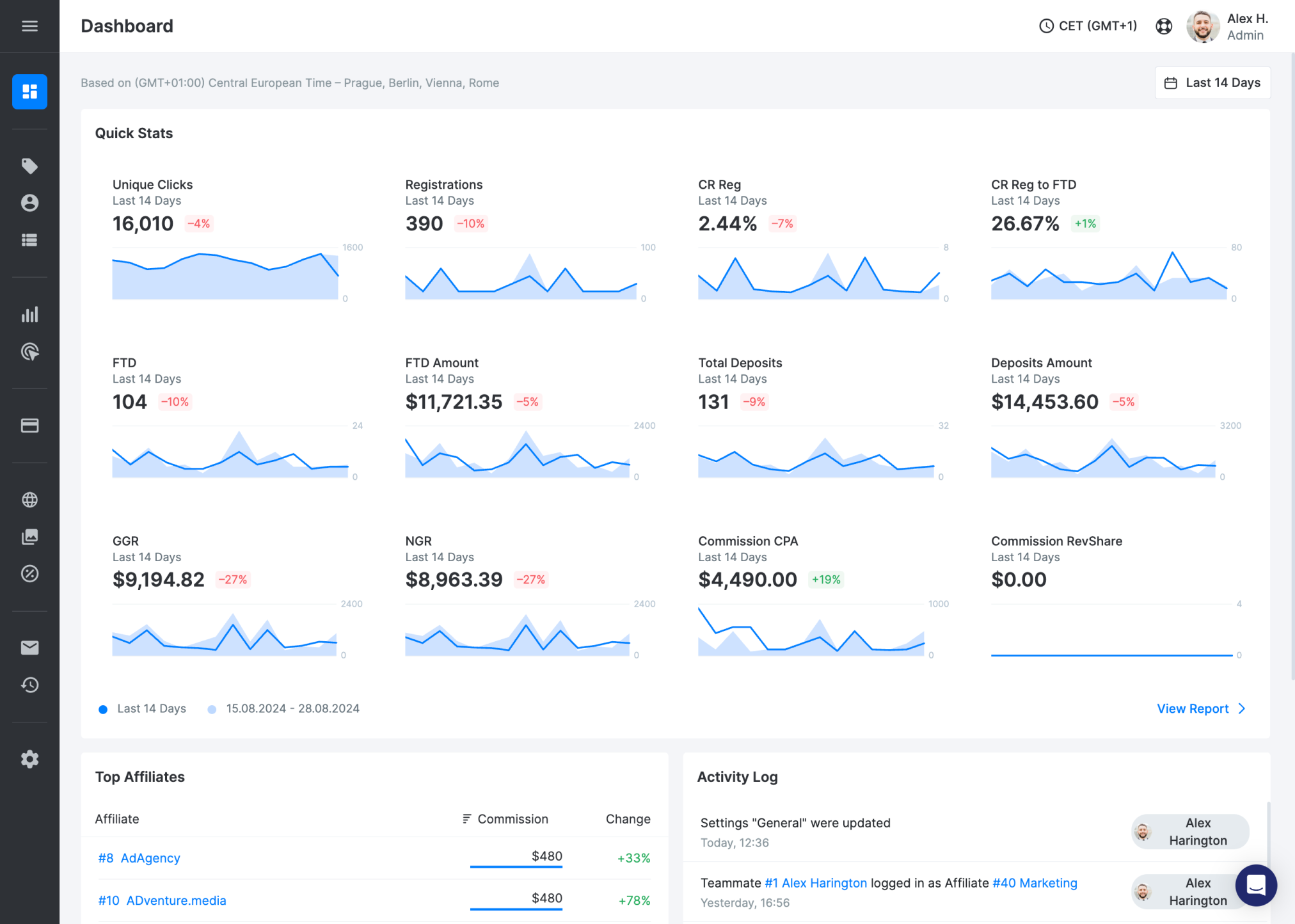
Scaleo helps gambling operators manage:
- Affiliate onboarding with partner accounts, access control, and approval workflows.
- Campaign tracking using affiliate IDs, offer IDs, creative IDs, sub-IDs, and promo codes.
- Cookieless and server-side tracking for more reliable attribution across the player lifecycle.
- Multi-event conversion tracking for registrations, KYC, FTDs, deposits, wagers, and revenue events.
- CPA, RevShare, Hybrid, flat, tiered, and custom commission plans.
- Affiliate fraud prevention using traffic and player-quality signals.
- Creative and offer management so partners use approved assets and correct market messaging.
- Player-level reporting so operators understand which partners bring actual value, not just clicks.
- Finance-ready commission reports for payout review, approval, and reconciliation.
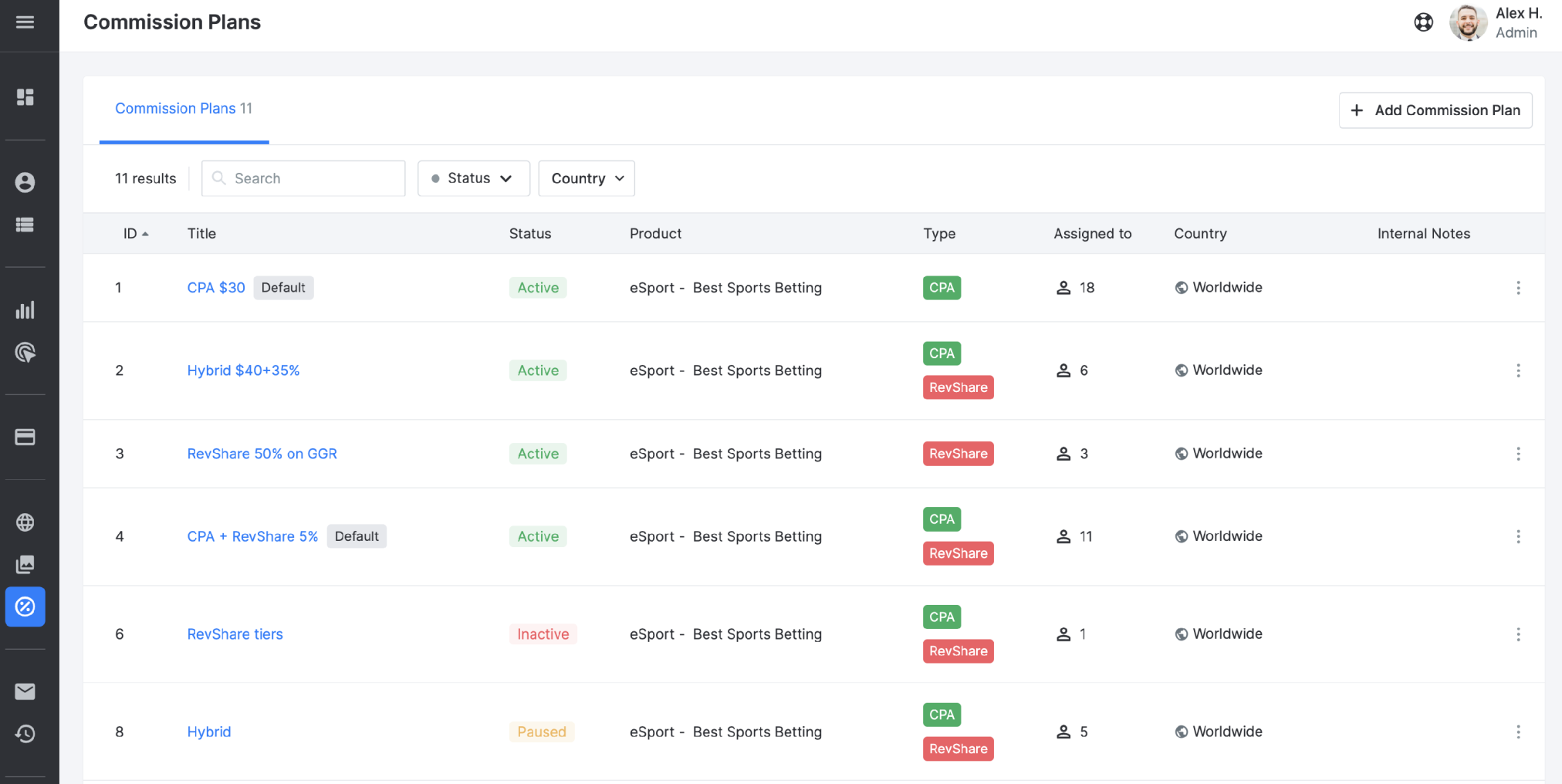
The point is not to “track more data” for the sake of dashboards. The point is to make affiliate performance measurable, commission logic defensible, and partner relationships transparent.
Scaleo operator advantage
For gambling operators, Scaleo turns affiliate marketing from a messy partner spreadsheet into a governed acquisition channel: tracked events, approved creatives, player-level quality signals, configurable commission plans, fraud filters, and payout-ready reporting in one platform.
Best Practices for Gambling Affiliate Managers
Good affiliate managers do not just recruit. They operate a marketplace of partner relationships. The best ones know which affiliates are worth nurturing, which traffic is risky, which campaigns deserve better landing pages, and which partners need custom commercial terms.
Segment Partners by Value and Risk
Do not manage every affiliate the same way. Segment by revenue, player quality, traffic source, compliance history, product focus, and growth potential.
| Affiliate segment | What they need | Manager action |
|---|---|---|
| Top revenue partners | Custom deals, direct support, early promos | Quarterly reviews and dedicated growth plans |
| High-quality niche partners | Better content assets and GEO-specific offers | Help scale traffic without losing quality |
| High-click, low-FTD partners | Landing page and offer optimization | Audit funnel mismatch |
| New affiliates | Clear onboarding and approved creatives | Automate onboarding sequence |
| Dormant affiliates | Reactivation offer or honest cleanup | Re-engage or archive |
| Risky traffic partners | Stricter monitoring | Limit caps, review sources, hold suspicious conversions |
Automate the Repetitive Work
Manual affiliate operations do not scale. Operators should automate welcome emails, link creation, creative access, compliance reminders, performance alerts, tier upgrades, fraud flags, and payout notifications.
Automation should not make the program cold. It should free affiliate managers from admin work so they can spend more time on the partners who actually move revenue.
Give Affiliates Better Data
Affiliates perform better when they can see what works. Provide reports that show clicks, registrations, FTDs, qualified players, rejected conversions, revenue, commission, campaign IDs, and sub-ID performance. If affiliates cannot optimize, they will either leave or guess.
Pay Predictably
Nothing damages a gambling affiliate program faster than unexplained payment delays. If finance needs a lock period, say so. If conversions can be rejected, show the reason. If an affiliate has a minimum payout threshold, display it clearly. Transparency is not a courtesy. It is retention infrastructure.
Responsible Gambling and Affiliate Marketing
Responsible gambling belongs inside affiliate operations, not only on the operator’s footer. Affiliates are often the first touchpoint between a player and a gambling brand, which means their content, ads, videos, reviews, and bonus descriptions must respect the same standards as the operator’s own marketing.
Operators should provide affiliates with:
- Approved responsible gambling disclaimers
- Age-gating expectations
- Market-specific bonus wording
- Restricted claim lists
- Required links to support resources
- Rules for social media, streaming, email, and paid traffic
- Clear penalties for misleading or non-compliant content
Affiliate growth and player protection are not opposites. The best gambling programs grow because they are trusted by both partners and players.
The Future of Gambling Affiliate Marketing
Gambling affiliate marketing is moving away from simple link placement and toward a more integrated partner ecosystem. Operators want fewer low-quality partners and more strategic affiliates who understand compliance, content quality, audience trust, and long-term player value.
The next phase of the vertical will be shaped by:
- Server-side tracking as browser-based attribution becomes less reliable.
- Player-level quality scoring instead of judging affiliates only by FTD volume.
- AI-assisted fraud detection for multi-accounting, bonus abuse, and abnormal traffic patterns.
- GEO-specific compliance automation for offers, bonuses, disclaimers, and restricted traffic.
- Creator and streamer partnerships with stricter age-gating and brand safety controls.
- Hybrid commission models that reward both acquisition and player quality.
- Finance-grade affiliate reporting that reduces payout disputes and manual reconciliation.
The operators that win will not be the ones with the loudest commission headline. They will be the ones that combine partner trust, accurate tracking, fraud control, transparent terms, and fast operational feedback.
Conclusion
Gambling affiliate marketing can be one of the most profitable acquisition channels in iGaming, but only when it is managed like infrastructure. The offer, tracking, commission model, fraud rules, compliance process, partner segmentation, and payout workflow all need to work together.
For affiliates, the best programs are transparent, fair, and reliable. For operators, the best programs are measurable, compliant, scalable, and financially controlled.
If you operate a casino, sportsbook, poker room, or gambling brand, affiliate marketing should not run from spreadsheets, generic tracking links, and vague RevShare clauses. You need a platform that can track qualified players, calculate commissions correctly, detect fraud, support multiple offer types, and give affiliates enough visibility to grow.
Scaleo gives iGaming operators the affiliate software layer needed to build that kind of program: cookieless and S2S tracking, configurable CPA/RevShare/Hybrid commissions, fraud filters, partner dashboards, creative management, player-level reports, and payout-ready analytics.
Looking to add or upgrade affiliate software for your gambling business? Explore Scaleo for iGaming and see how a controlled affiliate program can become a serious acquisition engine.
Gambling Affiliate Marketing FAQ
What is gambling affiliate marketing?
Gambling affiliate marketing is a performance-based partnership model where affiliates promote casinos, sportsbooks, poker rooms, bingo sites, lottery products, or crypto casinos. The operator pays commission when referred players complete agreed events such as registration, KYC, first deposit, wagering, or revenue generation.
How do gambling affiliates get paid?
Gambling affiliates are usually paid through CPA, RevShare, Hybrid, CPL, flat-fee, or sub-affiliate commission models. CPA pays a fixed amount for a qualified player, RevShare pays a percentage of player revenue, and Hybrid combines both.
What is CPA in gambling affiliate marketing?
CPA means cost per acquisition. In gambling affiliate marketing, CPA usually pays a fixed commission when a referred player becomes a qualified first-time depositor. Operators often require minimum deposit, valid GEO, KYC approval, and no fraud flags before approving CPA commission.
What is a Hybrid gambling affiliate deal?
A Hybrid gambling affiliate deal combines CPA and RevShare. The affiliate receives a smaller upfront payment for a qualified player plus a percentage of future revenue. This model is often used for strategic affiliates who want both predictable cash flow and long-term upside.
What traffic sources work for gambling affiliate offers?
Common gambling affiliate traffic sources include SEO content, comparison sites, sports betting guides, streamers, influencers, newsletters, paid search, social campaigns, push ads, and community traffic. Each operator should define which traffic sources are allowed by GEO and product type.
Is gambling affiliate marketing legal?
Gambling affiliate marketing can be legal where online gambling promotion is allowed, but rules vary by country, state, product, advertising channel, and license. Operators and affiliates must follow local gambling laws, advertising standards, age restrictions, responsible gambling rules, and data privacy requirements.
How do operators prevent gambling affiliate fraud?
Operators prevent gambling affiliate fraud by tracking IP, device, browser, GEO, click timing, registration timing, KYC status, deposit behavior, bonus use, duplicate accounts, chargebacks, and player value. Strong affiliate software can flag suspicious patterns before commissions are approved.
What software is needed to run a gambling affiliate program?
Operators need affiliate software that supports tracking links, promo codes, S2S postbacks, CPA and RevShare commissions, Hybrid plans, affiliate dashboards, creative management, fraud filters, player-level reports, payout approval, and finance-ready commission reporting.
Can Scaleo be used for gambling affiliate marketing?
Yes. Scaleo is affiliate marketing software for iGaming operators, casinos, sportsbooks, and gambling affiliate programs. It supports partner onboarding, cookieless and S2S tracking, multi-event conversion tracking, CPA, RevShare and Hybrid commissions, fraud filters, creative management, and player-level reports.