

Geo-targeted iGaming affiliate marketing helps casino and sportsbook operators route traffic, offers, landing pages, bonuses, compliance rules, and affiliate commissions by country, state, city, language, device, and player value.
⚡ Direct Answer
Geo-targeting in iGaming affiliate marketing means showing the right offer, landing page, language, bonus, compliance disclaimer, payment method, and commission model to the right player based on their location. For operators, this improves FTD conversion, reduces restricted-market traffic, prevents bonus waste, gives affiliates cleaner performance data, and protects the brand from compliance mistakes.

To succeed as an entrepreneur and casino operator, it is no longer enough to offer popular games and attractive bonuses. You need to know where traffic comes from, whether that traffic is allowed, what players in that market expect, and whether your affiliates are sending value or just volume.
This is where geo-targeted affiliate marketing becomes a growth system rather than a campaign trick.
You cannot market the same sportsbook bonus in the UK, Germany, Brazil, Canada, and a restricted US state and expect the same result. Different markets have different rules, sports preferences, payment habits, languages, bonus sensitivity, KYC expectations, and fraud patterns.
For operators, the goal is simple: send eligible players to the right offer, block or redirect restricted traffic, localize the user journey, and pay affiliates based on the real value of each GEO.
What Is Geo-Targeted iGaming Affiliate Marketing?
Geo-targeted iGaming affiliate marketing is the practice of segmenting affiliate campaigns by player location and applying different rules to each market. These rules can affect which offer is shown, which landing page loads, which language appears, which affiliate commission applies, whether the traffic is accepted, and what compliance message is displayed.
In a generic affiliate campaign, every visitor may see the same bonus and landing page. In a geo-targeted iGaming campaign, a UK visitor may see a UKGC-compliant sportsbook page, a Brazilian visitor may see a Portuguese football-first offer with local payment messaging, and a visitor from a restricted state may be redirected to a neutral information page or blocked entirely.
That difference matters because iGaming is not normal eCommerce. A bad GEO decision can mean wasted commission, invalid traffic, bonus abuse, affiliate disputes, or regulatory exposure.
| Campaign Layer | Generic Affiliate Campaign | Geo-Targeted iGaming Campaign |
|---|---|---|
| Traffic routing | Same destination for all users | Destination changes by country, state, city, device, or language |
| Offer visibility | One bonus shown everywhere | Bonus shown only where allowed and commercially sensible |
| Compliance | Manual review after launch | Rules applied before traffic reaches the offer |
| Affiliate payouts | Same commission for every GEO | Commission varies by market value, fraud risk, and license coverage |
| Reporting | Clicks, registrations, FTDs | Clicks, registrations, KYC, FTDs, GGR, NGR, fraud flags, and LTV by GEO |
Why Geo-Targeting Matters for iGaming Operators
Geo-targeting is not just a personalization tactic. In iGaming, it sits at the intersection of acquisition, compliance, fraud prevention, player experience, and affiliate economics.
A campaign that performs well in one region can fail completely in another because the offer is wrong, the landing page language feels foreign, the payment method is not trusted, the bonus is not legally suitable, or the player has been sent to a brand that cannot accept them.
For operators, the serious question is not “Can we target players by country?” The real question is:
Can your affiliate platform automatically decide which traffic should be accepted, redirected, blocked, localized, tracked, scored, and paid — without forcing your affiliate team to handle every exception manually?
That is where strategic marketing becomes operational infrastructure.
10 Benefits of Geo-Targeted iGaming Affiliate Marketing Campaigns
Here is the operator-grade version. Not “geo-targeting is good because personalization.” That is the brochure answer. These are the actual business benefits.
1. Higher FTD Conversion From Relevant Offers
Players convert faster when the offer matches their market reality. A football-first sportsbook offer may work beautifully in Brazil or the UK. A slot free-spins offer may perform better in a casino-heavy market. A generic “welcome bonus” shown to everyone is lazy targeting dressed as efficiency.
Operators should localize offers by product preference, payment behavior, language, sports calendar, and bonus expectations. The goal is not to create endless variations. The goal is to remove obvious friction from the first click to first deposit.
KPI to watch: click-to-registration rate, registration-to-KYC rate, KYC-to-FTD rate, and FTD-to-NGR quality by GEO.
2. Better Compliance Control in Regulated Markets
Geo-targeting is a compliance tool before it is a marketing tool. iGaming operators must know where a player is located, whether that market is allowed, what disclaimers must appear, and whether the affiliate is promoting the right offer under the right license.
Without GEO rules, operators risk showing campaigns in restricted locations, sending players to unsupported brands, or using bonus language that does not fit local advertising requirements.
Geo-targeting allows you to apply license-based visibility rules, age-gating messages, responsible gambling notices, blocked-market redirects, and affiliate restrictions before the traffic becomes a problem.
KPI to watch: blocked restricted traffic, compliance flags by affiliate, rejected GEO clicks, and campaign approval exceptions.
3. Lower Wasted Affiliate Spend
Every affiliate program has some wasted traffic. But unmanaged GEO waste is especially expensive in iGaming because not all clicks are equally monetizable.
If an affiliate sends traffic from a restricted market, unsupported language region, low-value GEO, or market where the cashier does not support local payment preferences, the operator may still absorb tracking, support, onboarding, fraud screening, or commission friction without getting profitable players.
Geo-targeting lets operators route traffic more intelligently. Valuable traffic goes to the right offer. Restricted traffic is blocked. Ambiguous traffic can be redirected to compliant informational content. Low-value traffic can be assigned a different commission structure.
KPI to watch: cost per qualified FTD, wasted clicks by GEO, rejected registration rate, and bonus cost per NGR.
4. More Accurate Affiliate Attribution
Attribution gets messy when players move across devices, languages, and regional pages. A player may click from a mobile affiliate review in one country, register later from desktop, deposit after KYC, and interact with several campaigns before the final conversion.
Geo-targeted affiliate tracking keeps the location context attached to the journey. That helps operators understand not only which affiliate drove the player, but which market, landing page, creative, and offer produced the qualified result.
For affiliates, this also creates trust. They can see which GEOs convert, which traffic is rejected, and where the operator is applying different campaign rules.
KPI to watch: validated FTDs by GEO, duplicate registrations, assisted conversions, rejected conversions, and source-level NGR.
5. Stronger Fraud Prevention
Fraud does not behave the same way in every market. Some GEOs may show higher rates of VPN abuse, bonus hunting, recycled KYC attempts, device farms, unusually low deposit quality, or repeated small-deposit patterns designed to trigger CPA payouts.
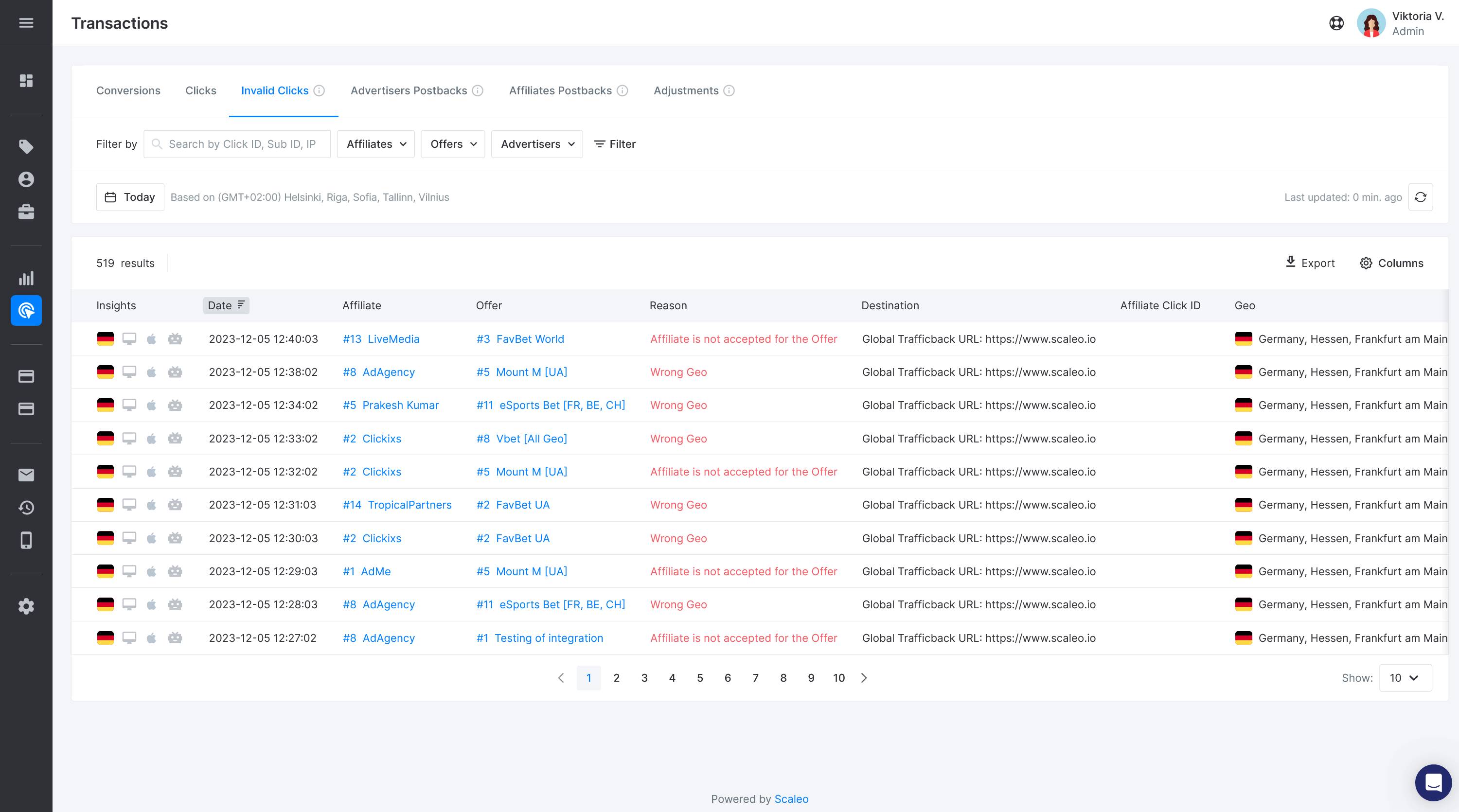
Geo-targeting gives operators another layer of fraud context. If a campaign is meant for Germany but suddenly receives a spike from unrelated regions, suspicious ISPs, data centers, or proxy-heavy traffic, the system should flag it before payments are approved.
With Scaleo affiliate software, operators can analyze traffic through IP, device, browser, operating system, country, ISP, conversion velocity, and other risk signals. Geo-targeting and anti-fraud logic work best together: location decides eligibility, behavior decides trust.
KPI to watch: invalid clicks, suspicious conversion clusters, CPA farming patterns, chargeback rate, and fraud-adjusted revenue by GEO.
6. Better Player Lifetime Value by Market
Not all GEOs produce the same player value. Some markets generate high registration volume but low retention. Others produce fewer players but better deposits, cleaner KYC, stronger retention, and higher player lifetime value.
When operators track only clicks and FTDs, they often over-reward affiliates who generate low-quality markets. When they track NGR and LTV by GEO, the program becomes much sharper.
A GEO with lower FTD volume may deserve a higher RevShare rate if retained player value is strong. A GEO with cheap CPA traffic may deserve a stricter hold period if bonus abuse is common.
KPI to watch: NGR per FTD, Day-30 retention, average deposit value, withdrawal-to-deposit ratio, and cohort LTV by GEO.
7. Localized Creatives and Landing Pages
Localization is not translation with a flag icon. A proper localized campaign adapts the message, value proposition, examples, payment cues, sports references, trust signals, responsible gambling language, and visual hierarchy to the market.
For example, a UK sportsbook landing page may need to emphasize licensed betting, safer gambling, football markets, and fast withdrawal trust signals. A Brazilian campaign may need Portuguese copy, local football references, mobile-first UX, and payment messaging that reflects local expectations. A Scandinavian market may respond better to transparency, clean terms, and understated design than aggressive bonus language.
Geo-targeting allows operators to serve the right creative assets to affiliates and avoid the “one banner for everyone” trap.
KPI to watch: landing-page conversion rate, creative CTR, bounce rate, registration completion rate, and localized offer performance.

8. Smarter Affiliate Commission Models by GEO
This is where many operators leave money on the table. They pay the same commission model across markets even though player value, fraud risk, payment friction, and compliance cost differ dramatically by GEO.
A high-LTV organic market may justify a stronger revenue share. A new launch market may need a temporary CPA boost. A risky GEO may need lower CPA, longer hold periods, or qualification gates based on KYC and wagering activity.
| GEO Type | Suggested Commission Logic | Operator Reasoning |
|---|---|---|
| Tier-1 regulated market | Hybrid or RevShare with strict KYC and compliance checks | High player value, but high compliance expectations |
| New launch market | Temporary CPA boost with auto-reversion | Helps recruit affiliates while you collect cohort data |
| High-fraud market | Lower CPA, longer hold period, stricter qualification gate | Protects margin from fake FTDs and bonus abuse |
| High-LTV organic SEO market | Tiered RevShare | Rewards affiliates who deliver retained players, not just deposits |
| Restricted or unsupported market | Block, redirect, or send to compliant informational page | Avoids invalid acquisition and compliance exposure |
Scaleo supports flexible commission logic, allowing operators to configure CPA, RevShare, Hybrid, tiered structures, custom statuses, and GEO-specific offer rules inside one affiliate platform.
KPI to watch: commission cost per NGR, affiliate margin by GEO, CPA qualification rate, and payout disputes by market.
9. Faster Market Expansion
When an operator enters a new market, affiliate traffic can move faster than internal marketing teams. That is useful only if the campaign infrastructure is controlled.
Geo-targeting lets operators open markets gradually. You can start with a limited affiliate group, test localized landing pages, monitor KYC quality, compare payment behavior, and adjust commission rules before scaling.
Without geo-targeting, new-market expansion becomes a messy experiment where every affiliate tests their own angle, compliance checks arrive too late, and finance only sees the damage at payout time.
KPI to watch: new GEO activation rate, first 30-day NGR, affiliate ramp time, restricted traffic attempts, and local payment success rate.
10. Better Operator-Affiliate Trust
Affiliates hate unclear rules. Operators hate low-quality traffic. Geo-targeting helps both sides by making the rules visible.
If affiliates know which GEOs are accepted, which offers convert, which commission model applies, which traffic is blocked, and why a conversion was rejected, they can optimize instead of arguing with the affiliate manager.
Transparent GEO reporting also helps operators explain decisions. Instead of saying “your traffic is poor,” the operator can show that one market has a strong KYC-to-FTD rate while another has high invalid-click volume or low NGR retention.
KPI to watch: affiliate dispute rate, inactive partner rate, accepted vs rejected traffic ratio, and partner-level NGR by GEO.
How Geo-Targeting Works in Scaleo
Geo-targeting works only when the affiliate platform can enforce rules at the campaign level. Otherwise, the strategy lives in a spreadsheet and breaks the moment traffic volume increases.
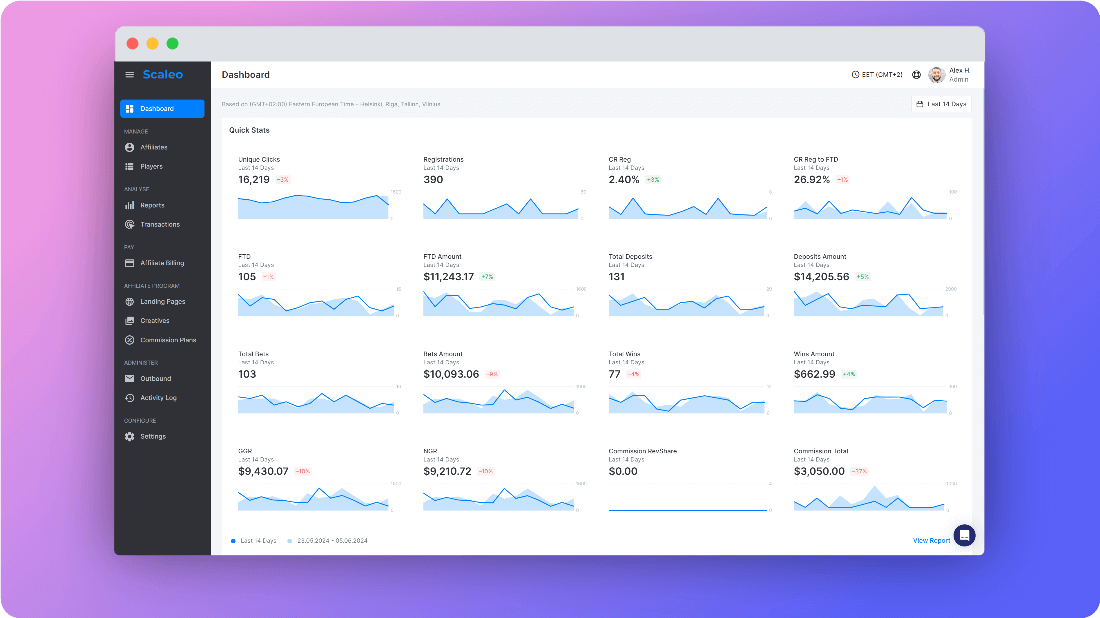
With Scaleo, operators can manage geo-targeted affiliate campaigns through tracking, offer rules, reporting, fraud checks, and commission logic in one system.
| Scaleo Capability | How It Helps Geo-Targeted iGaming Campaigns |
|---|---|
| Country and region targeting | Accept, redirect, or block traffic based on geographic eligibility |
| Offer-level targeting rules | Show specific offers only to approved markets |
| Affiliate-level permissions | Allow selected partners to promote selected GEOs or brands |
| S2S tracking | Track clicks, registrations, KYC, FTDs, deposits, GGR, and NGR reliably |
| Creative management | Provide GEO-specific banners, landing pages, and promo materials |
| Anti-fraud logic | Flag suspicious traffic using IP, ISP, device, browser, OS, and conversion behavior |
| Custom commission plans | Apply different CPA, RevShare, Hybrid, or tiered commissions by campaign or affiliate |
| Real-time reports | Compare GEO-level conversion, traffic quality, payout cost, and revenue |
The practical advantage is control. Your team can run local campaigns without turning every GEO exception into a manual support task.

Operator Framework: How to Build a Geo-Targeted Affiliate Campaign
Here is the practical workflow operators should use before giving affiliates links and hoping for the best.
Step 1: Map Licensed, Restricted, and Test GEOs
Start with a market map. Do not begin with bonuses or landing pages. Begin with eligibility.
- Approved GEOs: markets where your brand can accept players and run acquisition campaigns.
- Restricted GEOs: locations where player acquisition should be blocked or redirected.
- Conditional GEOs: markets where traffic is allowed only for specific brands, licenses, affiliates, or traffic sources.
- Test GEOs: markets where you are still validating player quality, payments, KYC, or retention.
This map becomes the foundation of your affiliate targeting rules.
Step 2: Define Local Player Intent
Do not assume all gambling intent is the same. A player searching for sportsbook odds, crypto casino bonuses, poker tournaments, or online slots may behave differently depending on the market.
For each priority GEO, define:
- dominant product interest: casino, sportsbook, poker, bingo, lottery, or crypto casino;
- main device behavior: mobile-first, desktop-heavy, app-first, or mixed;
- payment expectations: cards, e-wallets, bank transfer, local payment methods, or crypto;
- bonus sensitivity: free spins, bonus bets, cashback, no-wagering bonus, VIP treatment;
- trust signals: license, fast payouts, responsible gambling, reviews, local language support.
This prevents you from sending a technically eligible player to a commercially weak offer.
Step 3: Create Localized Landing Pages and Creatives
Your landing page should match the market. That includes language, currency, payment messaging, bonus rules, legal disclaimers, product focus, and local sports or game references.
Localization should also continue inside the affiliate portal. Affiliates need market-specific banners, text links, promo copy, email snippets, and rules. If they do not have approved assets, they will improvise. In regulated iGaming, improvisation is expensive.
Step 4: Configure Offer Routing Rules
Routing rules decide what happens after the click. This is where Scaleo becomes useful for operators running multiple brands, GEOs, and affiliate groups.
- Approved traffic goes to the correct localized offer.
- Restricted traffic is blocked or redirected.
- Mobile traffic can be routed to app-friendly landing pages.
- Different affiliates can receive different offer access by market.
- Low-value or high-risk traffic can be routed to stricter qualification paths.
Routing is not glamorous. It is one of the biggest reasons geo-targeted campaigns either protect margin or quietly leak money.
Step 5: Track the Full Funnel by GEO
Clicks are not enough. Registrations are not enough. Even FTDs are not enough if you are serious about operator economics.
Track the complete funnel by GEO:
| Funnel Stage | Why It Matters |
|---|---|
| Click | Shows traffic volume and partner reach |
| Registration | Shows landing page and onboarding relevance |
| KYC approval | Shows player eligibility and market quality |
| FTD | Shows acquisition conversion |
| Deposit amount | Shows payment confidence and early value |
| GGR | Shows betting or gaming activity |
| NGR | Shows operator margin after deductions |
| Retention | Shows whether the GEO produces real player value |
This is the difference between “GEO X sends players” and “GEO X sends profitable players.”
Step 6: Review GEO Performance Weekly
Geo-targeting is not something you configure once and forget. Review it weekly, especially around major sports events, regulatory changes, new affiliate launches, or bonus campaigns.
The review should answer:
- Which GEOs produce the highest NGR per FTD?
- Which affiliates send the cleanest traffic by market?
- Where are bonus costs too high?
- Where are KYC failures or chargebacks rising?
- Which landing pages need localization changes?
- Which GEOs deserve higher commission or stricter gates?
Operators who do this consistently stop making emotional affiliate decisions and start making margin-based ones.
Examples of Geo-Targeted iGaming Campaigns
Let’s make this less theoretical.
UK Sportsbook Campaign
A UK sportsbook campaign should not rely on aggressive “win big now” messaging. It needs compliant copy, responsible gambling visibility, strong football market relevance, and clear terms. Affiliates should receive pre-approved creative packs and must not rewrite bonus language freely.
Best setup: approved UK affiliates, football-focused landing page, responsible gambling copy, S2S postbacks for registration and FTD, and Hybrid or RevShare commission based on player value.
Brazil Casino and Sports Campaign
Brazilian traffic should not be treated as “Portuguese translation only.” Local football culture, mobile behavior, trust signals, payment expectations, and bonus format matter. Affiliates need localized banners, Portuguese copy, and landing pages that explain deposit and withdrawal steps clearly.
Best setup: Portuguese creatives, mobile-first landing page, local payment messaging, football-led offer, and weekly review of FTD-to-NGR quality.
Germany Casino Campaign
Germany requires careful bonus wording, stricter compliance control, and cleaner partner governance. It is not the place for vague promos or uncontrolled affiliate copy.
Best setup: strict offer visibility, approved affiliate groups, conservative bonus messaging, market-specific disclaimers, and detailed traffic validation before payout.
Restricted US State Traffic
If your brand cannot accept players from a particular US state, that traffic should not see a deposit-focused offer. It should be blocked, redirected to neutral informational content, or handled according to your legal policy.
Best setup: state-level filtering, no commission on invalid acquisition attempts, partner reporting that shows rejected traffic, and clear affiliate program terms.
Geo-Targeting, Localization, and Compliance: What Operators Must Not Confuse
These three concepts overlap, but they are not the same thing.
| Concept | What It Means | Operator Mistake to Avoid |
|---|---|---|
| Geo-targeting | Routing, accepting, blocking, or segmenting traffic based on location | Thinking it only means “country selection” |
| Localization | Adapting copy, design, payment cues, language, and offer framing to the market | Translating the page without changing the offer logic |
| Compliance targeting | Applying market-specific legal, advertising, and responsible gambling rules | Letting affiliates create their own campaign language freely |
A strong operator stack handles all three. The affiliate clicks the link. The system checks the location. The correct offer appears. The right compliance copy loads. The conversion is tracked. The affiliate is paid according to the rules for that market.
Key Metrics for Geo-Targeted Affiliate Campaigns
If you measure only clicks and deposits, you will miss the real story. GEO-level performance should be judged by quality, not just volume.
| Metric | Why Operators Should Track It by GEO |
|---|---|
| Click-to-registration rate | Shows whether the traffic and landing page match user intent |
| Registration-to-KYC rate | Shows whether the market produces eligible players |
| KYC-to-FTD rate | Shows whether the payment and onboarding flow works locally |
| FTD-to-NGR ratio | Shows whether deposits turn into real operator revenue |
| Bonus cost per NGR | Shows where offers are too expensive for the value produced |
| Invalid-click rate | Shows suspicious traffic, bot activity, proxies, or poor affiliate quality |
| Chargeback rate | Shows payment risk and potential fraud concentration |
| Affiliate dispute rate | Shows where rules, reporting, or payout logic need clarification |
Scaleo’s reporting lets operators compare these metrics across affiliates, offers, creatives, campaigns, and GEOs so partner decisions are based on actual value rather than surface-level traffic volume.
Common Geo-Targeting Mistakes in iGaming Affiliate Marketing
Geo-targeting can improve campaigns quickly, but it can also expose weak program architecture. These are the mistakes operators should clean up first.
- Using one commission rate for every market. GEOs differ in value, compliance cost, and fraud risk. Your commission logic should reflect that.
- Localizing copy but not the cashier experience. A translated landing page means very little if payment methods or withdrawal expectations do not match the market.
- Letting affiliates promote unsupported GEOs. This wastes traffic and creates avoidable disputes.
- Ignoring KYC failure rates. A GEO with high registrations and low KYC approval may be a low-quality market, not a growth opportunity.
- Running bonuses without market-level margin checks. A bonus that works in one GEO may destroy NGR in another.
- Failing to document blocked-traffic logic. Affiliates need to know why traffic was rejected or redirected.
- Using weak fraud controls. VPNs, proxies, device farms, and bonus-abuse patterns often have GEO fingerprints.
The Role of Mobile in Geo-Targeted iGaming Campaigns
In many iGaming markets, mobile is not the secondary journey. It is the default journey. Players click from social platforms, streamer communities, Telegram groups, comparison sites, or mobile search results and expect the offer to work instantly.
That makes mobile GEO targeting especially important. Operators should check whether the landing page loads fast, whether the app path preserves affiliate attribution, whether the payment flow works locally, and whether the responsible gambling copy remains visible on smaller screens.
For affiliates, mobile attribution problems are one of the fastest ways to lose trust. If they send mobile users and the operator cannot connect click → registration → FTD after an app or browser hop, the affiliate will assume the program is shaving. Sometimes the real problem is simply poor tracking architecture.
Scaleo helps operators keep partner context through S2S tracking and affiliate-level reporting, giving both sides a clearer view of what counted and why.
Future Trends in Geo-Targeted iGaming Affiliate Marketing
The future of geo-targeting in iGaming is not just “more personalization.” It is more automated decisioning, stricter compliance routing, and better value-based partner payouts.
AI-Assisted GEO Segmentation
Operators will increasingly use AI-assisted segmentation to detect which GEOs produce high-quality players, which affiliates generate suspicious patterns, and which offers should be adjusted by market. AI will not replace affiliate managers, but it will make bad traffic harder to hide.
Responsible Gambling by Market
Responsible gambling messaging will become more localized. Operators will need to tailor safer gambling copy, limits, interventions, and disclosures to regional expectations and rules.
More Granular State and City Targeting
Country-level targeting will not be enough in markets where regulation varies by state, province, or region. Sports betting especially requires more granular routing and compliance controls.
GEO-Based Commission Automation
Affiliate programs will move away from one-size-fits-all payouts. Operators will increasingly set market-specific CPA, RevShare, Hybrid, hold periods, caps, and quality gates based on actual cohort data.
How Scaleo Helps Operators Run Geo-Targeted Affiliate Campaigns
Scaleo is built for operators who need affiliate campaigns to be measurable, controlled, and adaptable across markets. For geo-targeted iGaming affiliate marketing, that means the platform supports the operational layers that matter: targeting, routing, tracking, fraud detection, reporting, and payout logic.
With Scaleo, operators can:
- create GEO-specific offers for casino, sportsbook, poker, crypto casino, or other iGaming verticals;
- route traffic based on country, device, affiliate, campaign, or offer rules;
- block or redirect restricted traffic before it becomes invalid acquisition;
- provide affiliates with localized creatives and market-specific campaigns;
- track registration, KYC, FTD, deposits, GGR, NGR, and custom player events;
- apply CPA, RevShare, Hybrid, Flat, CPL, CPC, and tiered commission logic;
- detect invalid clicks and suspicious behavior using real-time anti-fraud checks;
- compare affiliate performance by GEO, offer, source, campaign, and player value.
This is what separates a serious iGaming affiliate platform from a basic tracking tool. Operators do not need more clicks. They need eligible, compliant, profitable players — and they need to know which affiliates and GEOs produce them.
Conclusion: Geo-Targeting Is Now Core Affiliate Infrastructure
Geo-targeted iGaming affiliate marketing is no longer a “nice to have.” It is how operators protect margin, improve conversion, localize player acquisition, reduce compliance risk, and pay affiliates based on real market value.
The operators who win are not the ones running the loudest bonuses everywhere. They are the ones routing the right traffic to the right offer, blocking the wrong traffic early, localizing the journey, tracking the full funnel, and rewarding affiliates for profitable outcomes.
Scaleo gives iGaming operators the technology layer to do that: GEO targeting, real-time tracking, fraud detection, custom commission logic, detailed reports, and affiliate-facing transparency in one platform.
Ready to Take Your iGaming Marketing to the Next Level?
Explore the possibilities with a free trial of Scaleo. Discover firsthand how our cutting-edge affiliate marketing software can transform your campaigns and help you achieve stronger, cleaner, and more profitable growth in the iGaming market.
Start your journey with Scaleo today and unlock the full potential of geo-targeted affiliate marketing.
FAQ: Geo-Targeted iGaming Affiliate Marketing
What is geo-targeting in iGaming affiliate marketing?
Geo-targeting in iGaming affiliate marketing means routing affiliate traffic, offers, landing pages, bonuses, compliance messages, and commission rules based on player location. Operators use it to show eligible players the right local offer while blocking or redirecting restricted traffic.
Why is geo-targeting important for casino and sportsbook operators?
Geo-targeting helps operators improve FTD conversion, reduce wasted affiliate spend, localize campaigns, protect compliance, prevent restricted-market traffic, and compare player quality by country, state, city, or region.
How does geo-targeting reduce affiliate fraud?
Geo-targeting helps detect suspicious traffic patterns such as VPN use, proxy-heavy clicks, data-center traffic, abnormal conversion velocity, and traffic from markets that do not match the approved campaign. When combined with device and IP-level anti-fraud checks, it gives operators a clearer view of affiliate traffic quality.
Can operators set different affiliate commissions by GEO?
Yes. Operators can use different CPA, RevShare, Hybrid, hold periods, qualification gates, and tiered commission rules by market. This is useful because different GEOs have different player value, fraud risk, compliance cost, and payment behavior.
What KPIs should operators track in geo-targeted campaigns?
Operators should track clicks, registrations, KYC approval, FTDs, deposit amount, GGR, NGR, bonus cost, invalid-click rate, chargebacks, retention, and affiliate disputes by GEO. FTD volume alone is not enough to judge market quality.
How does Scaleo support geo-targeted iGaming affiliate campaigns?
Scaleo supports geo-targeted iGaming campaigns through offer-level targeting rules, affiliate permissions, S2S tracking, real-time reports, custom commission plans, localized creative management, and anti-fraud logic that evaluates IP, ISP, device, browser, operating system, and conversion behavior.