
⚡ Implementation Brief
How do you integrate a casino API? In 2026, the standard process involves connecting a casino platform to a game aggregator or direct provider via RESTful JSON APIs. This syncs wallets, game states, and transactions in real-time. Using a Single API model reduces launch time from 6 months to 4 weeks by standardizing the data layer.
Core Concept: Casino API integration is the process of connecting your operator platform to game providers, wallets, payments, CRM, KYC, and affiliate tracking through a controlled technical layer. In 2026, the winning model is usually a Single API or aggregation layer that reduces launch time, standardizes data flows, and lets operators add providers without rebuilding the stack every time.
- Primary Benefit: Faster time-to-market and fewer custom integrations to maintain.
- Operational Benefit: Cleaner wallet, player, bonus, and reporting synchronization across providers.
- Commercial Benefit: Better control over attribution, payments, retention reporting, and affiliate payouts.
Casino API integration is the technical layer that determines how fast you can launch, how cleanly your data moves, and how expensive every future change becomes. Most operators get the concept right and the execution wrong — not because the APIs are hard, but because the integration design decisions made in week one create reconciliation problems, reporting gaps, and partner disputes that show up six months later.
This guide covers the architecture choices that matter, the failure modes we see consistently across operator setups, and what a production-ready integration actually requires beyond “it works in sandbox.”

What Is Casino API Integration — and Why Do Most Descriptions Miss the Point?
Casino API integration is the process of connecting your operator platform to every system it depends on — game content, wallet and payments, player identity, KYC, bonus logic, compliance tools, and affiliate tracking — so that data moves correctly between them without manual intervention.
That definition is accurate but incomplete. What it doesn’t capture is the operational consequence of doing it badly. A poorly integrated casino platform doesn’t crash on day one. It quietly produces inconsistent wallet states, transaction mismatches, attribution gaps, and reporting discrepancies that look like data problems but are actually architecture problems. By the time operators notice, the root cause is buried in integration design choices made months earlier.
When we work through integrations with operators migrating onto Scaleo, the same pattern repeats: the original integration “worked” at launch, but nobody defined what happens when a postback fires twice, when a wallet callback times out, or when a player deposits during a game session that’s mid-round. Those edge cases weren’t handled. They become expensive later.
Single API vs. Direct Integrations: Which Model Actually Scales?
For most operators planning to grow beyond a narrow initial provider set, a Single API or aggregation layer is the more defensible architecture. Direct integrations look cleaner at small scale. They become expensive fast once you’re managing multiple game providers, payment methods, and reporting layers simultaneously.
The hidden cost of direct integrations isn’t the initial build — it’s the ongoing maintenance. Every provider has its own event naming conventions, status codes, retry logic, and documentation quality. When you have three providers integrated directly, a reporting discrepancy could be coming from any of them. When you have eight, debugging is a project in itself.
| Model | Best for | Advantages | Real trade-off |
|---|---|---|---|
| Direct integrations | Operators with a fixed, small provider stack and no near-term expansion plans | Full vendor control, no abstraction layer, simpler error surface per integration | Every new provider is a new engineering project. Status normalization across providers breaks reporting at scale. Maintenance compounds quickly. |
| Single API / aggregation layer | Operators planning multi-provider growth, multi-brand operations, or market expansion | Standardized data model, faster provider onboarding, consistent wallet and reporting logic across vendors | Requires careful vendor selection upfront. The aggregator becomes a critical dependency — their uptime and data quality become yours. |
The decision isn’t really about today’s setup. It’s about what your architecture costs you in 18 months. Operators who chose direct integrations to maintain “control” and then tried to expand into new markets or add five new game providers discovered the real cost. Full custom control sounds reasonable until your team is debugging five provider-specific edge cases simultaneously and your Q4 launch is six weeks late.
The Six Integration Layers — and Which One Operators Consistently Underinvest In
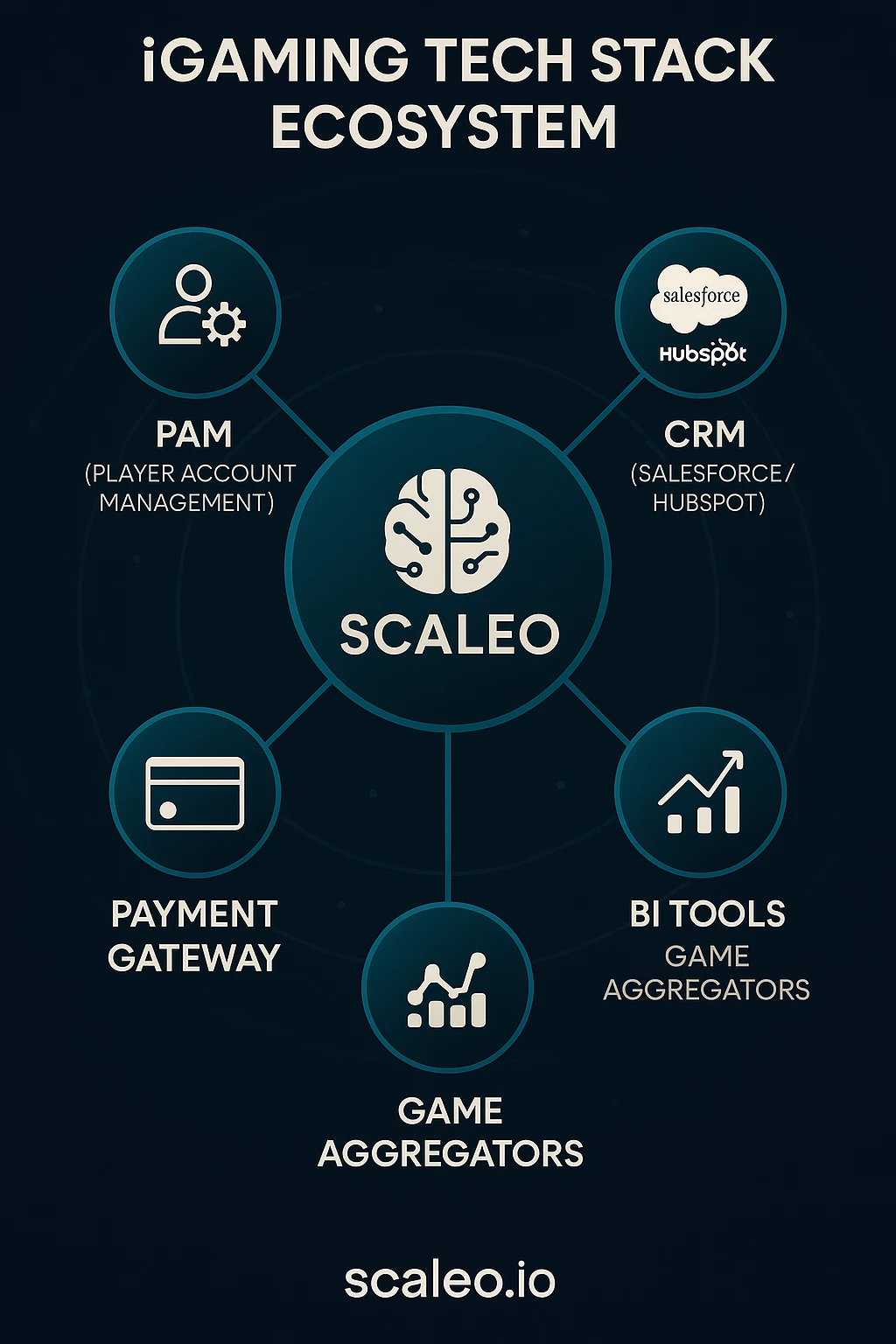
A production casino platform requires six distinct integration layers. Most operators give adequate attention to the first two. The affiliate tracking layer — the sixth — is treated as a marketing add-on until the first payout reconciliation cycle, at which point it becomes a finance and partner relations crisis.
1. Game provider APIs
These connect your platform to slots, live dealer, crash games, and table content. The integration concerns that actually matter aren’t catalog size — they’re session stability, round result handling, and how cleanly provider event data maps into your own reporting schema. Providers with inconsistent round-result payloads create reconciliation problems downstream that don’t show up until a player dispute forces you to audit the session log.
2. Wallet and payment APIs
These manage deposits, withdrawals, balance updates, and transaction confirmations. The failure modes that cost operators real money aren’t the obvious ones — it’s the edge cases. Retries that double-credit a balance. Delayed confirmations that leave wallet state ambiguous during an active game session. Failed callbacks that cause a withdrawal to hang in a pending state for 48 hours while the player emails support three times. These scenarios need explicit handling in the integration design, not optimistic assumptions that they won’t occur.
3. Player account and identity APIs
These handle authentication, registration, session management, age verification, and location controls. In regulated iGaming, this layer is compliance infrastructure, not admin plumbing. Self-exclusion status, deposit limit states, and geo-restriction logic all depend on this layer being current and correctly propagated across every touchpoint — including game launch, bonus eligibility, and payment processing. A player self-excluding via one channel while remaining eligible via another is not a technical edge case; it’s a licensing exposure.
4. Bonus, CRM, and lifecycle APIs
These connect player actions to campaigns, triggered bonuses, retention workflows, and VIP logic. The integration dependency that operators miss: this layer needs clean real-time data from the wallet layer and the player identity layer to make correct decisions. If your CRM is making bonus eligibility decisions based on data that’s 20 minutes stale, you’ll issue bonuses to players who just triggered an exclusion or breach wagering limits you thought were enforced.
5. Compliance and fraud APIs
KYC, AML transaction monitoring, sanctions screening, device intelligence, and geo-verification. The most common misconfiguration we see: verification trigger thresholds set too high on initial deposits, which creates acquisition friction and compliance exposure simultaneously. Setting KYC to trigger at €2,000 instead of €150 doesn’t reduce abandonment — it just defers the compliance requirement to a point where a flagged player already has a material balance and a dispute waiting to happen.
6. Affiliate tracking APIs
These connect your casino platform to your partner program — tracking clicks, registrations, FTDs, player NGR, and commission events. This is the layer that most operators treat as an afterthought and then spend disproportionate time fixing once affiliate programs scale. The core problem: affiliate data doesn’t live in isolation. It affects acquisition decisions, commission accuracy, fraud controls, and margin visibility. An affiliate tracking integration that fires postbacks on registrations instead of qualified FTDs doesn’t just inflate commission costs — it corrupts the traffic quality data you’re using to optimize your partner mix.
The Casino API Integration Process: What “Production-Ready” Actually Means
“It works in sandbox” is not production-ready. Sandbox environments don’t simulate the edge cases that break integrations in production: concurrent sessions, partial confirmations, duplicate callbacks, retry storms, or the interaction between a timed-out payment and an active bonus balance. The gap between sandbox success and production stability is where most integration failures live.
| Step | What operators should do | What gets skipped and why it matters |
|---|---|---|
| 1. Define integration scope | List every system involved: games, wallet, payments, KYC, CRM, compliance, affiliate platform — and document every data dependency between them | Skipping this means discovering undocumented dependencies mid-build when they’re expensive to address |
| 2. Standardize event logic | Map all status codes, transaction events, player actions, and error states across vendors into a single normalized schema before writing a line of integration code | Without normalization, every provider introduces its own event naming — reporting becomes a translation exercise instead of an analysis exercise |
| 3. Review API documentation critically | Validate endpoints, auth methods, callbacks, payload schemas, versioning policy, and rate limits — then test against the documentation, not just with it | Documentation describes the happy path. The edge cases aren’t documented. You find them in production or you find them in testing. |
| 4. Build and test in sandbox | Test deposits, withdrawals, game launches, bonus triggers, and postback callbacks under controlled conditions with realistic data volumes | Sandbox testing without realistic data volumes misses performance degradation that only surfaces at scale |
| 5. Stress-test edge cases | Simulate retries, timeouts, partial confirmations, duplicate callbacks, concurrent sessions, and rollback scenarios explicitly | This is where integrations that “work” quietly break in production. If you haven’t tested it, it will fail at the worst possible time. |
| 6. Validate reporting end-to-end | Cross-check provider event data against wallet data, payment data, and affiliate conversion data before launch — not after the first reconciliation dispute | Data model mismatches between layers don’t produce errors; they produce silently wrong numbers that finance and affiliate teams discover weeks later |
| 7. Launch in controlled stages | Roll out by provider, market, or traffic segment — not everything at once | Big-bang launches mean a single failure affects everything simultaneously. Staged launches contain the blast radius. |
| 8. Monitor continuously in production | Track callback error rates, latency, transaction mismatches, wallet state anomalies, and postback failures in real time from day one | Integration quality degrades over time as providers update APIs, traffic patterns change, and edge cases accumulate. Monitoring isn’t a launch task — it’s an ongoing operational discipline. |
Technical pre-integration checklist
| Requirement | Standard | Why it matters operationally |
|---|---|---|
| Authentication | OAuth 2.0 or HMAC-SHA256 | Prevents unauthorized endpoint access; HMAC is preferable for high-frequency server-to-server calls where OAuth token refresh adds latency |
| Data format | JSON / REST | Lightweight, readable, universally supported; avoid XML integrations with modern providers unless no alternative exists |
| Webhook resilience | Idempotency keys on all callbacks | Without idempotency keys, a network retry doubles the transaction. In wallet integrations, this is a balance error. In affiliate tracking, it’s a duplicate commission event. |
| Latency | <200ms for game round results; <500ms for payment confirmations | Game round result latency above 200ms is player-visible and creates session trust issues. Payment confirmation latency above 500ms increases support contact rates. |
| Security baseline | IP whitelisting + TLS 1.2 minimum on all endpoints | Non-negotiable for payment and player data endpoints in any licensing jurisdiction |
| Versioning policy | Semantic versioning with deprecation notice period minimum 90 days | Providers without clear versioning policies will break your integration without warning. Validate this before signing. |
The Most Expensive Casino API Integration Mistakes — With the Actual Downstream Consequences
The following failures aren’t hypothetical. They’re the patterns that appear consistently when operators migrate to Scaleo and audit what their previous integration was actually doing.
Postbacks firing on registrations instead of qualified FTDs. This is the single most common affiliate tracking misconfiguration. The casino platform fires the conversion event on registration rather than on a confirmed first deposit meeting minimum threshold. Affiliates receive credit for players who never deposited. Commission gets calculated on phantom conversions. When the operator tries to reconcile, they discover months of inflated payout history and face partner disputes that take weeks to resolve. The fix at integration time is trivial. The fix six months in is painful.
Attribution window mismatches between casino platform and affiliate platform. If the casino platform uses 30-day last-click attribution and the affiliate platform defaults to 60-day first-click, the same conversion event produces two different commission calculations. Neither system is wrong by its own logic. The mismatch produces a reporting gap that finance discovers during the first reconciliation cycle, not during integration QA.
Choosing game providers based on catalog size and ignoring data model quality. A provider with 600 titles and inconsistent round-result payloads costs more to operate than a provider with 200 titles and clean, normalized event data. Every provider whose status codes, round IDs, or currency handling doesn’t map cleanly into your reporting schema becomes a permanent reconciliation overhead.
No fallback logic for wallet callbacks. A wallet callback that times out leaves balance state ambiguous. Without explicit retry logic, idempotency handling, and a defined fallback state, the platform has to make a decision: credit the player optimistically or hold the transaction pending investigation. Neither is clean. Both generate support volume. The correct answer is defining the fallback behavior during integration design, not during a live incident.
Treating “supported” as equivalent to “tested.” Every provider will confirm that their API “supports” the use cases you describe. What “supported” means in practice varies enormously. The only way to know what an integration actually does is to test it — specifically, to test the scenarios that aren’t in the happy-path documentation.
Why Affiliate API Integration Needs to Be Treated as Core Infrastructure
The affiliate tracking layer gets consistently underspecified in integration projects because it’s framed as a marketing concern rather than a financial and operational one. That framing is wrong and expensive.
Affiliate data directly affects commission accuracy, traffic quality analysis, acquisition cost calculation, and fraud detection. If the affiliate tracking integration is firing on the wrong events, attributing to the wrong window, or failing to pass player-level revenue data, every downstream decision built on that data is wrong. That includes how much you’re paying partners, which partners you’re scaling, and whether your cost-per-acquisition numbers are real.
The affiliate platform also needs to talk to your compliance and fraud layers. Traffic that looks clean at the click level can show fraud signals at the player behavior level — multi-accounting, bonus abuse patterns, device fingerprint anomalies. An affiliate tracking integration that doesn’t receive fraud signals from the main platform can’t factor them into commission calculations or partner quality scoring.
What a production-grade affiliate integration requires
| Requirement | Why it matters | What breaks without it |
|---|---|---|
| S2S postbacks on qualified FTD events (not registrations) | Commission should calculate on players who deposited, not players who clicked a link | Commission overpayment, corrupted traffic quality data, partner reconciliation disputes |
| Real-time or near-real-time player revenue data | RevShare calculations require current NGR data; stale data produces incorrect payout figures | RevShare disputes, inaccurate partner reporting, finance reconciliation overhead |
| Fraud signal passthrough from main platform | Flagged players should affect commission eligibility; the affiliate platform can’t act on signals it doesn’t receive | Commission paid on fraud-originated traffic; partner quality scores that don’t reflect actual player value |
| Consistent attribution window definition across all platforms | Attribution window settings must match between casino platform and affiliate platform | Commission calculation discrepancies that neither platform’s data can explain independently |
| CPA, RevShare, hybrid, and negative carryover logic | Commission structures in iGaming are complex; the affiliate platform needs to handle the full range without manual adjustment | Manual commission overrides, finance bottlenecks, partner trust erosion when payouts are consistently corrected after the fact |
Scaleo’s pre-built iGaming connectors handle postback configuration validation at setup — the integration checks that qualified FTD events are mapped correctly before the program goes live. The fraud signal passthrough connects Scaleo’s fraud detection to your casino platform’s player-level signals so commission eligibility reflects actual traffic quality. For technical integration details, the Scaleo API documentation covers the full event schema and postback configuration options.
How to Choose Between Single API and Direct Integration for Your Specific Setup
The right integration architecture depends on three variables: how many providers you’re managing now, how many you expect to manage in 18 months, and how much engineering capacity you have for ongoing maintenance.
If you’re launching with two game providers, one payment method, and a narrow geo footprint, direct integrations are manageable. The overhead is contained. If you’re planning to expand to five or more providers, add new markets, or run multiple brands on the same license, a Single API architecture will save more in maintenance costs than it costs in abstraction overhead.
The test is practical: ask whether your current or planned architecture makes adding a new provider a two-week project or a two-day one. If the answer is two weeks, you’re already paying the direct-integration maintenance tax.
One caveat on aggregators: a Single API layer only works as well as the aggregator’s data quality. Before committing to an aggregation model, validate that the aggregator’s normalized event schema is actually clean — not just that their marketing materials say it is. Ask for documentation on how they handle provider-specific edge cases: what happens when a provider’s round result payload is malformed, how they handle concurrent retry storms, and what their SLA is when a provider goes down mid-session.
Frequently Asked Questions
How long does casino API integration take?
A single-provider integration with clean documentation and a focused development team can be completed in days. A production-ready multi-provider setup with proper edge case testing, reporting validation, and staged rollout takes weeks — typically four to eight, depending on scope. Operators who compress this timeline by skipping edge case testing usually recover the time lost during the first month of live operations when the scenarios they didn’t test start occurring.
What is a Single API in iGaming?
A Single API is a unified integration layer that lets operators connect multiple game providers, payment methods, and platform services through one standardized interface. The benefit isn’t just technical simplicity — it’s that a normalized data model makes reporting, reconciliation, and provider management consistent across your entire stack instead of specific to each vendor integration.
What happens when a casino API fails mid-session?
The outcome depends entirely on whether your integration has explicit failure handling. With idempotency keys, defined fallback states, and retry logic, a mid-session API failure produces a recoverable state — the session can be resumed or safely closed with the player’s balance intact. Without that handling, the platform is forced to make a real-time decision about an ambiguous wallet state, usually under time pressure, which is where errors and disputes originate. This is why failure handling belongs in integration design, not in incident response.
Why does affiliate postback configuration matter so much?
Because the event the postback fires on determines what the commission is calculated against. Postbacks on registrations credit affiliates for players who may never deposit. Postbacks on qualified FTDs credit affiliates for players who met the conversion criteria. The gap between these two configurations is the gap between commission that reflects partner performance and commission that inflates costs while providing no usable data about traffic quality.
Can operators run multiple game providers through a single affiliate tracking integration?
Yes, and most operators above a certain scale do. The requirement is that player revenue data from all providers flows into a single NGR calculation that the affiliate platform can use for RevShare calculations. This requires the main casino platform to aggregate cross-provider revenue data at the player level before passing it to the affiliate tracking layer — not for the affiliate platform to reconcile multi-provider data from separate feeds, which creates the same normalization problems at the affiliate layer that the Single API architecture was meant to solve at the game layer.

Getting the Integration Right From the Start
The operators who have the smoothest affiliate programs aren’t the ones with the most sophisticated setups — they’re the ones who specified the integration correctly the first time and didn’t have to rebuild the attribution logic six months later. The decisions that matter most happen before a line of code is written: which events trigger commission, how attribution windows are defined, how fraud signals flow between platforms, and what the fallback behavior is when callbacks fail.
For operators connecting Scaleo to an existing casino platform, the integration documentation covers the full S2S postback schema, player event types, NGR calculation methodology, and the configuration steps for matching attribution windows to the casino platform’s player data model.
Scaleo’s iGaming affiliate platform is built specifically for this operator-to-platform integration pattern — not adapted from a generic SaaS affiliate tool.