

The next roulette wheel you spin may not exist on any casino floor or even a browser tab—it’ll hover in a shared, persistent 3-D world where avatars crowd around holographic tables. Hard to picture? Give it eighteen months.
By early 2026, every major operator will either run a metaverse property or scramble to buy one.

Here’s how I see the shift unfolding—and why the smartest casinos are already wiring today’s data stack for tomorrow’s dimension.
Fully Immersive Play
Flat screens flatten excitement. Strap on a lightweight visor and suddenly the live-dealer studio surrounds you in 360°.
AI renders real-time reflections on the baccarat table, shadows track chip stacks, and spatial audio lets you hear another player’s nervous chuckle two seats over. That sensory depth bumps adrenaline, and adrenaline bumps handle.
What to prep now?
- Upgrade live-dealer feeds to 8-K, 60-FPS pipelines; anything less turns to mush on headsets.
- Pipe haptic-device SDKs into your game servers so a winning slot spin literally vibrates the player’s palm.
Tokenized Economies
Metaverse ecosystems thrive on frictionless micro-payments. Expect branded, on-chain chips that move across properties without FX fees. Loyalty? Auto-staking tokens yield perks while a player sleeps. Chargebacks? Smart-contract escrows slash disputes before they surface.
Operator move
👉 Launch a stable, utility-only token pegged to a major fiat bridge. Keep KYC hooks identical to today’s wallet onboarding so regulators recognize the flow.
Social Layers & Community Tables
Players don’t just gamble; they preen. Custom skins, table-host NFTs, private VIP lounges with invitation-only jackpots—every layer adds monetizable scarcity. An extrovert who carried one sportsbook brand’s referral link last year will drag ten friends into a neon poker dome next year; the entry ticket is clout, not cookies.
Action cue
👉 Start building identity add-ons now: avatar wearables, room badges, status auras. They’ll be the tier points of the 3-D era.
AI-Driven Personalization
AI never sleeps, and in the metaverse it fine-tunes reality itself. If a high roller loses three hands in under a minute, ambient music softens, table limit suggestions deflate, and a side-game prompt appears in their native slang. The world adapts so subtly the player thinks it was their idea.
Roadmap tip
👉 Embed real-time telemetry hooks—gaze direction, gesture speed, even posture data—into your segmentation engine today. Metaverse front ends will expect those sensors from day one.
Compliance & Safer Gambling
Surveillance in 3-D raises new questions: how do you verify age when the avatar is an orc wearing sunglasses? AI answers by pairing wallet KYC hashes with voice-pattern recognition and motion signatures. Meanwhile, behavior-risk models flag extended self-talk, erratic bet spikes, or isolated play sessions—triggers for gentle pop-ups or cooldown locks. Regulators love proactive friction.
To-do
👉 Audit your risk engine for volumetric data ingestion. Mouse clicks are child’s play; you’ll soon analyze hand angles and field-of-view dwell.
Infrastructure & Latency
Lag kills immersion faster than poor RTP. The rule of thumb: anything above 50 ms motion-to-photon delay gets nauseating. Edge rendering and foveated streaming push heavy polygons to local nodes, slicing round-trip lag while keeping headset thermals cool.
Engineering call
👉 Negotiate edge-compute commitments with CDN partners. If the server handshake crosses an ocean, you’ve already lost the player.
Marketing Inside the Metaverse
Banners?
Out.
Imagine a floating AR chip that inflates into a playable mini-slot when tapped. Win or lose, the portal teleports the user straight to your roulette pit. Conversion friction dissolves because the ad is the game. Portal native promotions is the new name of the game.
Dynamic Quest Funnels
Quests replace drip emails. Complete ten blackjack hands, hit a side bet, visit the rooftop bar—every task awards NFTs redeemable for real-money spins. The CRM loop moves from inbox to event feed, and players barely notice they’re swimming in a retention cycle.
Affiliate Marketing 3-D Edition
Affiliates will stand at virtual kiosks, stream table action live, or host branded esports tournaments inside their own parcels. Tracking pixels won’t cut it; event tags must survive teleport jumps and wallet swaps.
Best practice
👉 Issue affiliates metaverse-native referral objects—think portal doors or “play now” chips—each embedding a signed hash. When a player crosses the threshold, the hash persists on-chain, guaranteeing provenance through every wager.
Why Scaleo Still Wins?
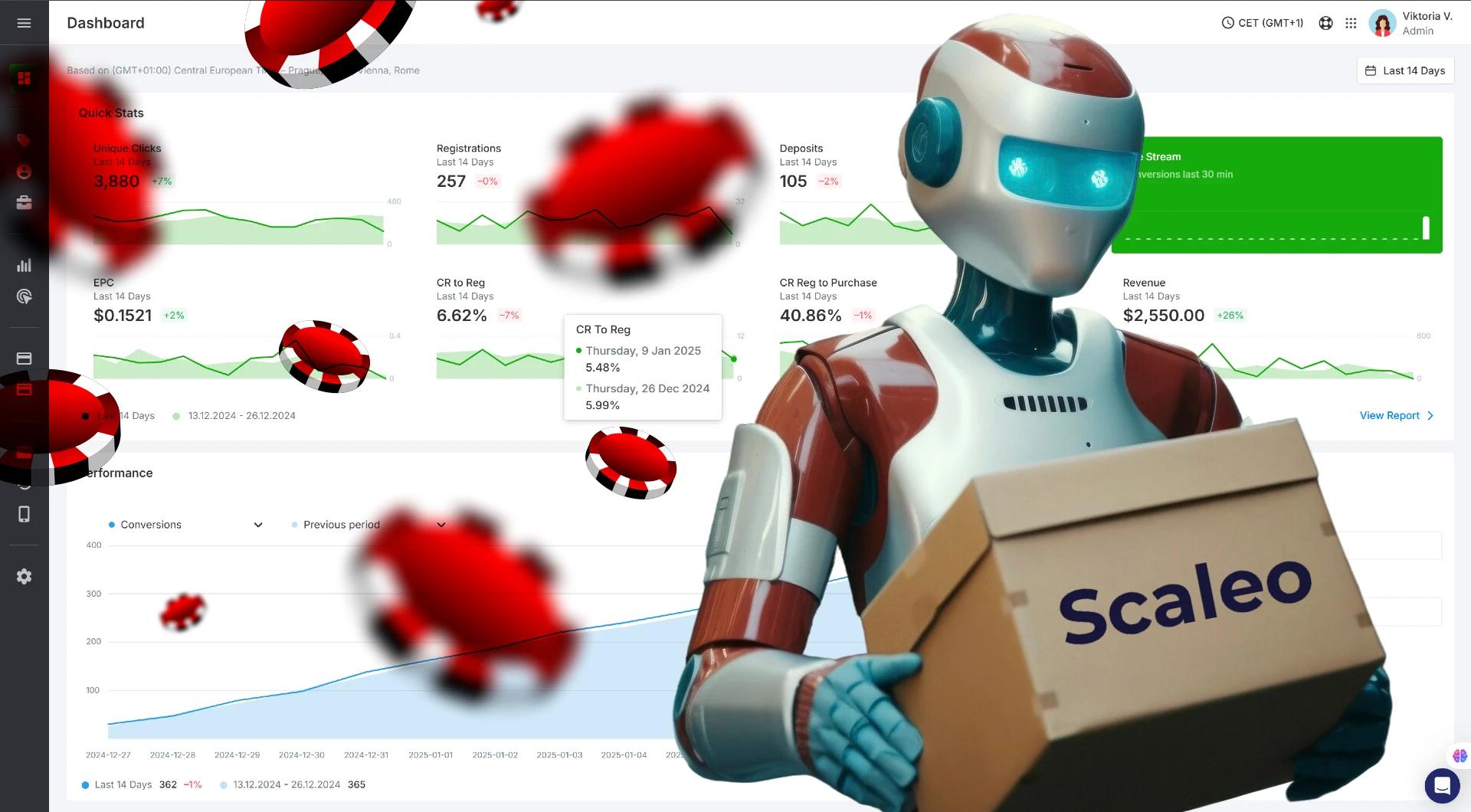
- Multi-Geo Segmentation – Drop one campaign for UKGC-regulated pods, another for looser offshore lounges, without rebuilding links.
- 3-D Event Capture – Scaleo’s API ingests in-world triggers (door opens, quest completions) exactly like a web click, feeding real-time dashboards partners trust.
- Instant Commission Logic – Smart-contract chip payout? Scaleo timestamps it, honors rev-share, and flags anomalies before arguments bloom.

If you want affiliates hyping your neon craps arena instead of a rival’s, give them a tracking system that lives where they do: inside the metaverse, milliseconds from the action.
Predictions You Can Bank On
- Metaverse jackpots melt silos. A single progressive pool spanning multiple operator worlds becomes the mega-draw of 2026.
- Hybrid gambling emerges. Land-based casinos install VR booths, letting hotel guests step into online pits while still sipping comped drinks.
- Regulators pivot. Jurisdictions issue “virtual floor” licenses, blending iGaming and amusements. Operators with robust data lineage sail through audits.
- Creator-led sponsorships explode. Influencers curate private metaverse rooms, earn slice-of-handle instead of flat fees, and bring niche audiences you’ve never cracked.
- AI voice hosts replace lobby chat. Fluid multilingual dealers greet every player by name, remember last-session context, and upsell responsibly.
Conclusion
Metaverse casinos won’t just add another channel; they’ll reorder the entire value chain—from payment rails to affiliate acquisition to loyalty mechanics. Operators planning today can ride that wave instead of swallowing it. Core requirement? Data and attribution that travel across dimensions without breaking.
Scaleo is already wired for this future.
Its API reads any event you throw at it—URL click, smart-contract transfer, or portal teleport—then allocates budget and commission in real time. Book a demo, plug your metaverse roadmap into a platform that speaks tomorrow’s language, and step ahead of the game before the doors even open.