
QUICK ANSWER
The most effective casino marketing strategies in 2026 focus on Affiliate Marketing (CPA/RevShare), Hyper-Local SEO, and Social Streaming (Twitch/Discord). Success now requires a mix of gamified loyalty programs, influencer partnerships, and AI-driven personalization to lower Player Acquisition Costs (PAC) while maintaining high Life-Time Value (LTV).
- Top Strategy: Affiliate Marketing (60% of industry traffic).
- Emerging Trend: Streamer-led “Bet-with-Me” live sessions.
- Key Metric: Aim for a 3:1 LTV to CAC ratio.
Casino marketing in 2026 is not a pile of disconnected promotions. For operators, it is a revenue system: acquisition, conversion, retention, reactivation, and partner-led growth working from the same data.
The operators who win are not necessarily the ones with the biggest budgets. They are the ones who know which channels bring qualified first-time depositors, which campaigns survive KYC friction, and which incentives produce long-term NGR instead of expensive vanity spikes.

This guide is built for online casino and sportsbook operators who need a real casino marketing strategy, not recycled tips. It covers the channels, campaign types, KPIs, and operating rules that still work now — plus where affiliate software fits naturally into the system.
TL;DR for operators
- Casino marketing strategy only works when acquisition channels are tied to measurable downstream outcomes: KYC pass rate, FTD conversion, day-30 retention, and NGR.
- Affiliate marketing remains one of the strongest casino marketing channels, but only when attribution, commission rules, fraud controls, and creative governance are enforced properly.
- Paid search, CRM, SEO, creators, and lifecycle automation should work as one system, not as isolated teams chasing different metrics.
- The most effective casino promotion ideas in 2026 are segmented, geo-aware, product-aware, and timed around real player intent.
- If your reporting cannot tell you which campaign, partner, creative, or GEO produced profitable players, your casino advertising is more expensive than it looks.
What an Effective Casino Marketing Strategy Looks Like in 2026
A real casino marketing strategy is not “do SEO, run ads, send some emails.” It is a practical operating model that answers five questions:
- How do we acquire qualified traffic?
- How do we convert registrations into first deposits?
- How do we retain players long enough to produce healthy NGR?
- How do we reactivate dormant cohorts without destroying margin?
- How do we measure performance by source, campaign, creative, and partner?
Most operators already spend money across several channels. The gap is usually not effort. The gap is coordination. Paid media chases registrations, CRM chases open rates, affiliates chase sign-ups, and finance later discovers that a “great” campaign brought weak cohorts, bonus abuse, or high churn. Good casino advertising campaigns look strong at the top of the funnel. Great ones survive the full journey from click to retained depositor.
Operator reality check
The right question is not “Which casino marketing ideas are trendy?” The right question is “Which channels can repeatedly produce verified, retained, compliant players at a sustainable acquisition cost?” That shift alone improves decision-making.
The 20 Casino Marketing Ideas That Still Work — Grouped by Objective
The original problem with most “casino promotion ideas” lists is that they mix awareness, conversion, retention, and brand tactics into one bucket. Operators need to know what each tactic is for. So below, the 20 ideas are grouped by the job they actually do.
| Casino marketing idea | Primary objective | Best used for |
|---|---|---|
| 1. Affiliate marketing programs | Acquisition | Scalable partner-led FTD growth |
| 2. Search advertising | Acquisition | High-intent demand capture |
| 3. SEO landing pages | Acquisition | Compounding organic traffic |
| 4. Creator and streamer partnerships | Acquisition | Trust-led awareness and sign-ups |
| 5. Geotargeted campaigns | Acquisition | Localized offers and regulated GEOs |
| 6. Product-specific landing pages | Conversion | Slots, sportsbook, live dealer, VIP flows |
| 7. Welcome offer architecture | Conversion | Registration-to-FTD lift |
| 8. KYC and cashier nudges | Conversion | Drop-off reduction |
| 9. Social proof and review loops | Conversion | Trust reinforcement |
| 10. Promo-code and campaign-code tracking | Conversion | Cleaner attribution |
| 11. Lifecycle email automation | Retention | Onboarding, reactivation, VIP movement |
| 12. Push and in-app messaging | Retention | Urgency and repeat sessions |
| 13. Loyalty programs | Retention | Value expansion over time |
| 14. VIP tiers and concierge journeys | Retention | High-value player retention |
| 15. Personalized offers | Retention | Behavior-based promotion logic |
| 16. Gamification and tournaments | Retention | Session frequency and engagement |
| 17. Seasonal campaign calendars | Reactivation | Holiday and sports-cycle momentum |
| 18. Payment-method promotions | Reactivation | Cashier completion and deposit velocity |
| 19. Event-led and sponsorship activations | Brand + reactivation | Hybrid operators and major moments |
| 20. 24/7 support and service recovery | Retention + reputation | Trust preservation and churn reduction |
How Operators Should Prioritize Casino Marketing Channels
Not every channel deserves equal weight. The right mix depends on your market maturity, product mix, and how much operational control you have over attribution and retention. This is the cleaner way to think about channel priority.
| Channel | Why operators use it | Main risk | Primary KPI |
|---|---|---|---|
| Affiliate marketing | Scales acquisition without paying for every impression upfront | Fraud, weak attribution, partner disputes | FTD volume, NGR, retention by affiliate |
| Search ads | Captures existing high-intent demand | Cost inflation, policy limits, weak landing pages | CPA, FTD conversion rate |
| SEO | Builds durable traffic around operator intent and player intent | Slow payoff if content is weak or generic | Qualified traffic, assisted FTDs |
| CRM/email | Improves retention and reactivation efficiently | Fatigue, poor segmentation, promo overuse | Repeat deposits, churn recovery |
| Creators/influencers | Adds trust, reach, and social proof | Weak compliance control, poor message fit | Registrations, branded search, FTDs |
| Push/app messaging | Drives fast engagement with existing users | Overuse and notification fatigue | Repeat sessions, deposit velocity |
| Sponsorships/events | Useful for big moments and hybrid brand visibility | High spend, fuzzy attribution | Assisted conversions, lift in branded demand |
For most online operators, the practical stack is simple: search for intent, affiliates for scalable acquisition, SEO for durable demand capture, and CRM for margin protection. Everything else should support or amplify those four pillars.
20 Casino Marketing Ideas Explained — What They Do and When They Work
1. Build an affiliate program that rewards verified value, not raw volume
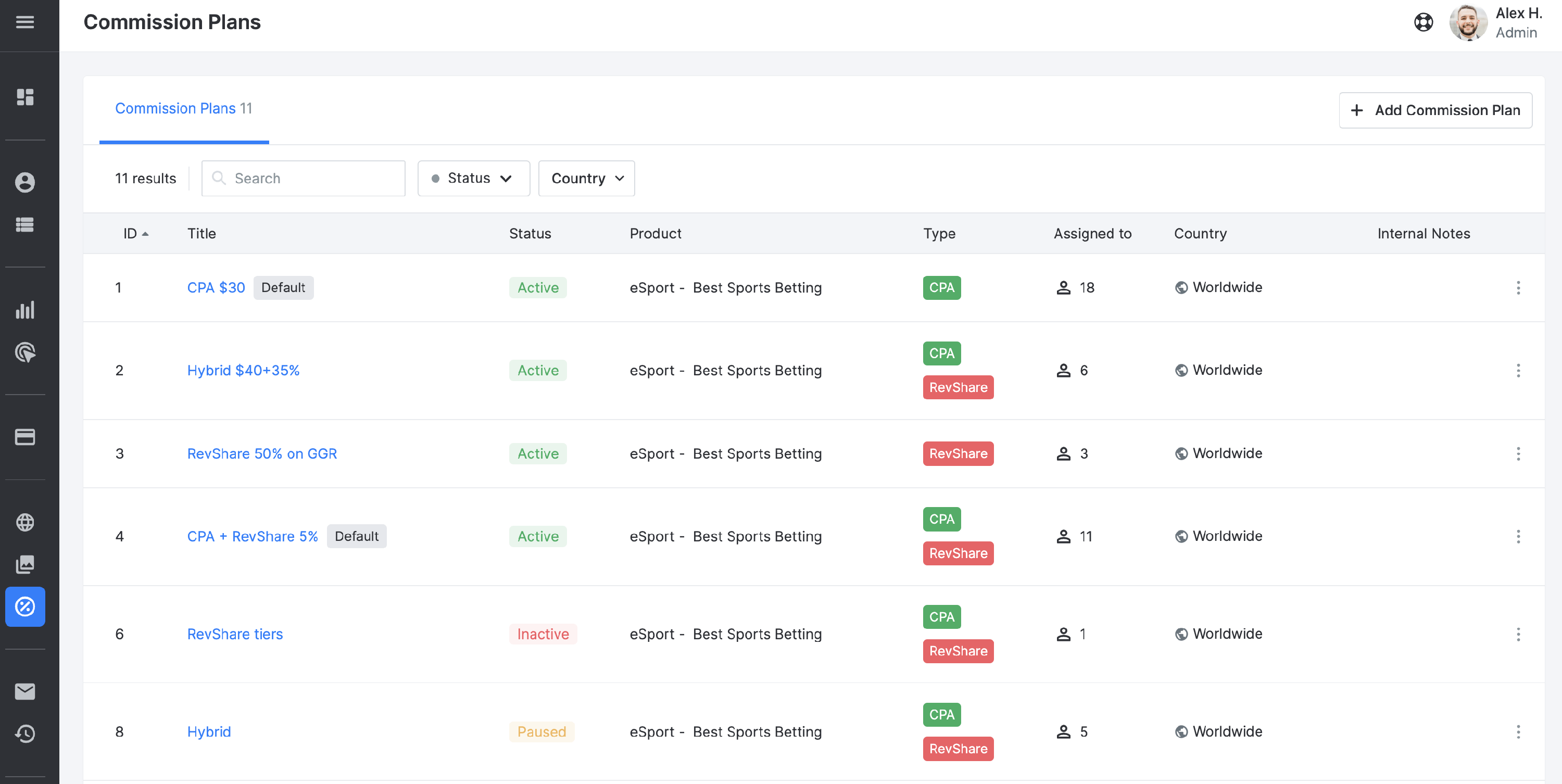
Affiliate marketing remains one of the strongest casino marketing channels because it aligns spend with outcomes. But it only works when your commission model matches actual player quality. Rewarding partners on shallow volume alone is how operators create future payout disputes, low-value cohorts, and bonus-heavy traffic that never turns into profitable NGR.
Operators should define commission structures around real economics: CPA, RevShare, Hybrid, negative carryover rules, approval logic, and quality gates tied to KYC and fraud review. A hybrid structure is often the sanest default because it covers acquisition cost while keeping upside connected to real player value.
2. Use search advertising where intent is already high
Search advertising is not the cheapest casino advertising channel, but it is often the cleanest for bottom-funnel intent. If someone is actively looking for an online casino, a sportsbook bonus, or a specific betting product, the job is already in motion. The operator’s job is not to “educate the market.” It is to remove friction between search and deposit.
Search works best when campaign structure mirrors real product intent. Slots, sportsbook, live dealer, payment-method, or GEO-specific intent should not be dumped into one generic landing page. Message match matters.
3. Publish SEO landing pages for the offers and products players actually search for
Online casino marketing without SEO ends up renting too much of its traffic. Strong organic pages reduce dependency on paid media and help operators rank for high-intent product, bonus, and education queries. This includes category pages, GEO-aware guides, payment-method content, sports-event explainers, and onboarding content that reduces pre-deposit hesitation.
For operators, SEO matters twice: once for player acquisition and once for B2B reputation. The same business that ranks well for players should also look operationally credible to partners, affiliates, and future commercial relationships.
4. Work with creators who bring trust, not just impressions
Influencer and streamer partnerships can work extremely well in casino marketing, but only when they are measured beyond vanity reach. Operators should look at creator-driven registrations, deposit behavior, and retention — not just views and likes. Creator campaigns need the same discipline as affiliate campaigns: proper tracking, compliant creatives, and clear promotional boundaries.
5. Use geotargeted campaigns when your offer depends on jurisdiction, payment behavior, or event timing
Not every GEO should see the same offer, the same funnel, or the same landing page. Geotargeting is one of the simplest casino promotion ideas, yet it is still poorly executed. Operators should localize bonuses, payment options, payment language, sports calendars, and compliance messaging. Local relevance improves trust and conversion.
6. Create product-specific landing pages instead of generic “play now” pages
A sportsbook visitor should not land on the same page as someone arriving for slots or live dealer games. Product-specific pages improve message match, speed up understanding, and lift conversion. Good casino marketing strategy usually looks boring from the outside: fewer generic pages, tighter page purpose, cleaner offers.
7. Design welcome offers that support conversion without poisoning the economics
Welcome bonuses still work, but weak welcome design trains players to take value and leave. The right offer architecture depends on product, fraud exposure, and margin profile. Operators should test bonus depth, wagering logic, payment-method fit, and whether the offer attracts durable players or just incentive hunters.
8. Treat KYC and cashier nudges as part of marketing, not just operations
Many casino advertising campaigns do not fail because acquisition was weak. They fail because KYC and cashier friction kill momentum after registration. Welcome emails, push messages, product prompts, and cashier reminders are all part of conversion marketing. If a player stalls before first deposit, that is still a marketing problem.
Reviews, testimonials, creator quotes, and payout credibility should not live in isolation on a “trust” page nobody visits. They should be present at the moments of hesitation: landing pages, offer pages, app-store flows, and post-registration nurture sequences. Social proof is a conversion device, not decoration.
10. Track promo codes and campaign codes like they are financial instruments
Promo codes are often treated casually, which is a mistake. They should connect back to specific affiliates, creators, campaigns, offers, or media placements. Once that linkage exists, operators can compare cohorts properly and stop overvaluing noisy campaigns that look impressive but produce weak downstream revenue.
11. Use email automation for onboarding, reactivation, and VIP movement
Email marketing for casino and gambling industry operators still pays because it is controllable, segmentable, and cheap relative to paid acquisition. But it only performs when it is behavior-led. The useful automations are obvious: registration completion, KYC nudge, first deposit reminder, product onboarding, dormancy recovery, birthday flow, and VIP progression.
The best operators do not send more email. They send fewer emails with clearer timing and stronger behavioral relevance.
12. Use push notifications and in-app prompts to compress time-to-deposit
Push works best when it supports momentum: a new sports event, a favorite table re-opening, a slot tournament start, a deposit reminder, or a timed bonus. Push fails when it becomes random noise. For mobile-first casino marketing, push is a precision tool, not a loudspeaker.
13. Build loyalty programs that change player behavior, not just player perception
Loyalty is not a generic “points program.” It is an economic steering system. Good loyalty architecture nudges frequency, product movement, deposit consistency, and value retention. Weak loyalty architecture gives away margin while pretending to build retention. Operators should tie benefits to meaningful thresholds and long-term value, not random generosity.
14. Create VIP tiers that feel operationally real
VIP programs work when the experience is recognizably different: speed, access, treatment, flexibility, and personal attention. If the VIP layer is just slightly larger bonuses with a gold badge, players notice. The same applies to high-value affiliate relationships. Elite partners expect bespoke terms, better reporting, and less friction, not generic program rules.
15. Personalize offers by behavior, product appetite, and risk profile
Segmentation should go beyond age and geography. Operators should segment by product preference, session pattern, deposit behavior, KYC status, source quality, and lifetime value trajectory. Personalized offers are effective because they make the next best action obvious. That is what good personalization really is.
16. Use tournaments and gamification to increase session frequency
Slot tournaments, challenges, leaderboards, streak rewards, and milestone-based mechanics remain strong casino promotion ideas because they increase return frequency without always relying on blunt discounting. They are especially useful when tied to product launches, reactivation windows, or seasonal peaks.
17. Plan seasonal campaigns around real player demand, not just calendar clichés
Holiday campaigns, sports events, payday windows, product launches, and local cultural moments can all work well. But the good version is not “run a Christmas bonus.” The good version is “deploy the right offer, to the right segment, in the right GEO, with the right product emphasis, when that audience is already more likely to act.”
18. Use payment-method promotions to reduce cashier friction
Where payments create anxiety or delay, payment-method promotions can materially improve deposit completion. Operators should align these campaigns to trusted local methods, crypto preferences where relevant, and realistic behavioral incentives. This is one of the more underused online casino marketing tactics because it sits between payments and marketing and often belongs fully to neither team.
19. Use events and sponsorships selectively, especially if you operate hybrid or regional brands
Event-led campaigns are powerful when they support a larger system. For a purely online brand, sponsorships without clear conversion paths often become expensive theatre. For hybrid operators or brands with strong local recognition, events can work as acquisition, PR, and reactivation levers — but they still need campaign tracking, clear follow-up, and measurable downstream goals.
20. Treat customer support and service recovery as a retention channel
24/7 support sounds operational, but in reality it is one of the strongest retention mechanisms in casino marketing. If a player gets stuck at payment, KYC, withdrawal expectations, or game confusion and receives fast, credible support, churn risk drops. Reputation is not a separate department. It is the aftertaste of operations.
The Online Casino Marketing Funnel Operators Should Actually Use
The cleanest operator framework is to break marketing into five stages and assign channels to each.
| Stage | What the operator is trying to achieve | Best channels |
|---|---|---|
| Awareness | Create visibility with relevant audiences | Creators, affiliates, paid social, sponsorships, SEO content |
| Consideration | Build trust and explain the offer clearly | Landing pages, review signals, bonus pages, comparison content |
| Conversion | Move registration to FTD | Search ads, KYC nudges, cashier reminders, welcome sequences |
| Retention | Increase repeat sessions and deposits | Email, push, loyalty, tournaments, personalization |
| Reactivation | Win back dormant or cooling cohorts | Segmented offers, seasonal campaigns, VIP follow-up, product prompts |
The operator mistake is trying to force one channel to do all five jobs. Search can be brilliant for conversion but weak for loyalty. CRM can be brilliant for retention but poor for first-touch discovery. Affiliates can scale acquisition but still require internal lifecycle systems to protect margin.
What still works vs what usually wastes budget
- Still works: affiliates, search ads, segmented CRM, SEO for real intent, creator campaigns with proper attribution, loyalty based on value progression.
- Works only if disciplined: sponsorships, influencer deals, bonus-led campaigns, event activations, social contests.
- Usually wastes money: generic landing pages, untracked promo codes, “awareness” campaigns with no follow-up path, broad bonus campaigns with no cohort review.
Affiliate Marketing Is Still One of the Best Casino Marketing Channels — If You Run It Properly
Affiliate marketing deserves its own section because it is not just another tactic. For many operators, it becomes a distribution layer that compounds over time. It can bring search-driven traffic, creator traffic, sports-event traffic, local traffic, streamer traffic, and community traffic under one performance model.
But affiliate marketing only becomes an advantage when four things are true: commission logic is sane, attribution is trusted, fraud controls are real, and reporting is transparent enough to stop disputes before they start.
How operators should set up a casino affiliate program
- Define CPA, RevShare, or Hybrid structures by product and GEO.
- Connect tracking to registration, KYC, deposit, bonus use, and NGR events.
- Set approval logic and quality rules before scale, not after it breaks.
- Recruit affiliates by audience fit, not by raw volume promises.
- Give partners clean reporting, creative clarity, and rules they can trust.
This is where affiliate software matters. Operators do not need more dashboards. They need trusted attribution, rule-based commissions, multi-currency handling, partner segmentation, and enough visibility to see which affiliates are bringing sustainable players versus noisy spikes.
Scaleo fits naturally here because it is built around the operator problem, not just the affiliate problem: tracking, commission plans, negative carry rules, creative control, postbacks, fraud overlays, and reporting that finance and partnerships can both use without endless manual reconciliation.
What Tools and Software Do Operators Actually Need?
Casino marketing stacks get bloated fast. A cleaner stack wins. The operator does not need 12 overlapping tools. They need functional coverage across acquisition, attribution, lifecycle, and analysis.
| Tool category | What it should do | Why it matters |
|---|---|---|
| Affiliate tracking software | Track clicks, registrations, FTDs, NGR, commissions, postbacks, promo codes, partner-level reporting | Protects partner acquisition economics |
| CRM and lifecycle platform | Send onboarding, KYC, reactivation, VIP, and seasonal flows | Protects retention and margin |
| Reporting and analytics | Compare source quality by campaign, creative, GEO, device, and product | Stops bad spend from hiding inside averages |
| Fraud and risk logic | Flag abuse patterns, suspicious flows, and low-quality traffic | Protects bonus and commission leakage |
| Landing page and content stack | Support fast testing, SEO, localized pages, and message match | Improves conversion at lower cost |
The principle is simple: set up the stack once, define the rules properly, and let the system enforce them. Manual spreadsheets always look manageable until they become the reason your attribution arguments start.
Casino Marketing KPIs Operators Should Track
If you only track traffic and registrations, your casino marketing strategy is running half blind. Operators need KPIs that survive beyond the first conversion event.
| KPI | Why it matters |
|---|---|
| Registration-to-KYC pass rate | Shows whether traffic quality and onboarding are aligned |
| KYC-to-FTD conversion rate | Reveals real conversion strength, not just top-funnel activity |
| CPA by source | Shows the true acquisition cost by channel or partner |
| Day-30 and day-60 NGR | Prevents overvaluing short-lived cohorts |
| Bonus cost percentage | Exposes whether promotions are helping or bleeding margin |
| Retention rate by source | Separates quality channels from superficial volume |
| Deposit velocity | Measures how quickly cohorts turn into monetizable users |
| Affiliate contribution margin | Shows whether partner-led growth remains profitable |
| Reactivation rate | Measures CRM efficiency on dormant cohorts |
| Dispute rate | Useful leading indicator of attribution and reporting health |
If a channel brings cheap registrations but poor KYC completion, weak retention, or high fraud pressure, it is not a strong channel. It is just a noisy one.
Three Casino Advertising Campaign Examples Operators Can Actually Use
1. Sportsbook event campaign
Use search ads, affiliates, and creator clips around a specific sports event. Send visitors to a fast event-led landing page with localized payment methods, clear bonus logic, and post-registration prompts timed to the match window. Follow with a short CRM sequence for non-depositors and a separate sequence for first-time depositors who engaged with the event market.
2. Slots reactivation campaign
Identify dormant slots cohorts who previously deposited but have not returned in 14–30 days. Send a behavior-led email plus push sequence tied to a tournament, new release, or personalized free-spin offer. The goal is not generic activity. The goal is to restart a known product preference with a time-bound reason to act.
3. Affiliate-led acquisition campaign
Recruit partners in a niche that already converts well for your brand. Give them product-appropriate creatives, clean campaign links, promo-code tracking, and a landing page that reflects the audience they actually send. Review FTD quality, KYC pass rate, and 30-day value before expanding terms. This is where a platform like Scaleo becomes useful because it lets operators compare partner quality at the level where decisions should be made — not by gut feel.
How to Refine a Casino Marketing Strategy Without Guesswork
Better strategy usually comes from subtraction, not expansion. Operators do not need endless new casino promotion ideas. They need to remove the waste hiding inside existing campaigns.
- Audit which campaigns produce registrations but not verified depositors.
- Compare channel performance at day 30 and day 60, not only day 1.
- Cut generic landing pages that serve several product intents badly.
- Reduce bonus-led campaigns that attract weak-value cohorts.
- Improve reporting visibility for affiliates, finance, and CRM teams.
- Shift more budget toward channels that produce durable NGR and lower dispute rates.
This is why operators eventually move away from duct-taped systems. Strategy erodes when it relies on memory, workarounds, and spreadsheets nobody fully trusts.
Conclusion
Casino marketing strategy in 2026 is less about novelty and more about control. The winning operators are not doing magical things. They are aligning channels to funnel stages, offers to segments, commissions to verified value, and reporting to reality.
Affiliate marketing, search, SEO, lifecycle CRM, loyalty, and personalized campaigns all still work. The real question is whether your operation can measure them properly and enforce the rules that keep them profitable.
Where Scaleo fits
If affiliate marketing is part of your growth model, the hard part is not recruiting partners. It is keeping tracking trusted, commissions enforceable, and partner performance visible enough to scale without chaos. Scaleo’s iGaming affiliate software is useful in exactly that layer: attribution, rule-based commission plans, partner reporting, anti-fraud logic, postbacks, and portfolio-level control for operators who need more than a basic tracker.
🎯 Ready to Level-Up Your iGaming Partner Operations?
Centralize multi-brand programs, automate payouts, and give partners real-time NGR visibility—without duct-taped tools.
Want to tighten the partner side of your casino marketing operation?
If affiliate growth is already part of your channel mix — or should be — the next step is not more noise. It is cleaner infrastructure, clearer rules, and better visibility into which partners actually drive profitable players.
FAQ
What is the best casino marketing strategy for online operators?
The best casino marketing strategy for online operators combines acquisition, conversion, retention, and measurement. In practice, that usually means search ads for high-intent demand, affiliates for scalable partner-led growth, SEO for long-term traffic, and CRM automation for retention and reactivation.
Which casino marketing channels usually drive the best ROI?
For many operators, the strongest ROI comes from affiliate marketing, search advertising, SEO, and lifecycle CRM. The right answer depends on your GEOs, products, compliance constraints, and how well you can track registration, KYC, FTD, retention, and NGR by source.
What are the most effective casino promotion ideas in 2026?
The most effective casino promotion ideas in 2026 are segmented and product-aware: welcome offers matched to product intent, slots tournaments, sportsbook event campaigns, personalized reactivation offers, payment-method promotions, and loyalty mechanics tied to real player value.
How should operators measure casino advertising campaigns?
Operators should measure casino advertising campaigns beyond clicks and registrations. The important metrics include KYC pass rate, first-time deposit conversion, day-30 and day-60 NGR, bonus cost percentage, retention rate, and contribution margin by channel or partner.
Why is affiliate marketing still important in casino marketing?
Affiliate marketing is still important because it can scale acquisition efficiently across search, content, creators, and niche communities. But it only stays profitable when attribution is trusted, commission logic is well designed, fraud controls are active, and partner reporting is transparent.
What software do casino operators need to manage affiliate growth properly?
Operators typically need affiliate tracking software that can handle clicks, registrations, FTDs, NGR, postbacks, commission plans, reporting, and fraud controls. This is the layer where platforms such as Scaleo are useful because they help operators manage partner programs with less manual work and better visibility.