

If you’re still “monitoring brand bidding” like it’s 2018, you’re defending the wrong perimeter.
Direct answer: in 2026, brand abuse isn’t an ad problem—it’s an attribution-layer forgery problem. The fix is forensic detection: combine behavioral signals (click velocity, session entropy, path similarity), identity signals (device + network consistency), and conversion integrity signals (postback timing, dedupe keys, replay resistance) into a single risk model that can neutralize synthetic intent before it gets paid.

Crisp definition: AI-driven brand abuse is the use of generative systems (LLMs + synthetic media) to manufacture “trust artifacts” (reviews, endorsements, streams) that redirect brand-intent traffic into fraudulent attribution paths, stealing commissions and contaminating analytics.
And yes—this got nastier because “AI answers” are now a front door to buying decisions, and fake trust cues get amplified when people don’t even click anymore.
The Evolution of Brand Abuse: From Keyword Bidding to Synthetic Content
Understanding where we are requires understanding where we came from.
Phase 1: Keyword Bidding (2015-2022)
Affiliates ran paid ads bidding on your branded search terms: “[Your Casino] bonus,” “[Your Casino] review.” Players searching for you directly landed on affiliate landing pages first.
Detection: Straightforward. Monitor branded SERPs for ads from known affiliate domains. Blacklist domains running branded ads. Compare branded search traffic to expected organic baseline.
Why it worked: The attack surface was visible. Ad networks showed you who was bidding. Domain-level blocking was effective.
Phase 2: Content Farming (2022-2024)
Affiliates created thin content sites with templated reviews targeting your branded keywords. Hundreds of low-quality pages ranking for “[Casino Name] + [game type]” queries.
Detection: Still manageable. Google’s algorithm updates (Helpful Content, Spam updates) deindexed most thin content sites. Manual URL crawling could flag obvious template-based sites.
Why it eventually failed: The volume became unmanageable. Operators couldn’t review thousands of URLs manually.
Phase 3: AI-Synthetic Brand Abuse (2024-Present)
This is where we are now. And it’s fundamentally different.
What’s happening:
AI generates review content that is genuinely high quality. These aren’t templated pages with variable swaps. They’re unique, well-structured, contextually accurate reviews that read as if written by an experienced gambling journalist.
AI-generated content passes Google’s quality filters. It passes plagiarism detection. It passes manual human review in most cases.
The sites hosting this content use legitimate hosting, real domain registrations with aged domains purchased on aftermarket sites, and proper technical SEO implementation.
Why traditional detection fails:
- Blacklists don’t work: New domains appear daily. By the time you identify and blacklist a fake review domain, the traffic has already converted.
- Content quality checks don’t work: AI-generated content is indistinguishable from human-written content to both automated and human reviewers.
- Manual URL audits don’t scale: A program with 200+ affiliates produces thousands of new URLs monthly. Manual review catches maybe 5% of violations.
- Keyword bidding monitoring doesn’t apply: These sites rank organically. No paid ads to flag.
Phase 4: Deepfake Streamers (Emerging)
The newest attack vector: AI-generated video content impersonating real casino streamers, published on YouTube and niche platforms to drive branded search traffic and direct affiliate links.
Early detection rate: Near zero. Platforms haven’t built detection for AI-generated gambling content at scale. Operators haven’t built detection for it either.
What Legitimate Branded Traffic Looks Like
Organic branded search traffic has distinctive behavioral fingerprints:
Temporal distribution: Follows search engine usage patterns. Morning spike (7-9AM local time), afternoon plateau (12-3PM), evening peak (8-11PM). Weekend volume 60-70% of weekday volume for most markets.
Session duration: Players arriving via branded search typically spend 45-90 seconds on the affiliate’s review page before clicking through. They’re reading the review, comparing bonus structures, making a decision.
Geographic distribution: Matches the affiliate’s known audience GEO profile with normal variance (±15%). An affiliate whose traffic has been 85% German for six months doesn’t suddenly become 60% German, 25% Brazilian overnight.
Device mix: Consistent ratio of mobile to desktop matching their historical pattern. Organic review site traffic is typically 55-65% mobile.
What Synthetic Brand Abuse Looks Like?
AI-generated review sites driving manufactured traffic exhibit detectable anomalies:
Temporal flatness: Traffic arrives at unnaturally consistent rates across 24 hours. Real organic search doesn’t work this way—search engines index pages at unpredictable intervals, and real users search according to daily rhythms.
Compressed session duration: Players arriving from synthetic review sites spend 8-15 seconds on the page before clicking through. They’re not reading. They’re being funneled.
Geographic concentration: Traffic clusters in specific ISP blocks or geographic regions that don’t match the content language or target market. AI-generated English-language casino reviews shouldn’t drive 60% of their traffic from data center IPs in Singapore.
Device homogeneity: Unusually high percentage of identical or near-identical device configurations. Real organic traffic shows natural device diversity.
The Detection Framework
Forensic velocity analysis doesn’t flag individual clicks as fraudulent. It identifies statistical deviations from expected behavioral patterns.
Expected vs Observed Profile Comparison:
| Signal | Expected Pattern | Synthetic Pattern | Detection Method |
|---|---|---|---|
| Hourly distribution | Bell curve matching market timezone | Flat or artificially smooth | Chi-squared against historical baseline |
| Session duration | 45-90 second median | <15 second median | Percentile deviation from cohort |
| GEO distribution | Matches historical ±15% | Sudden concentration shift | Kullback-Leibler divergence |
| Device fingerprint diversity | 200+ unique fingerprints per 1,000 clicks | <50 unique fingerprints per 1,000 clicks | Entropy calculation |
| Click-to-registration latency | 4-18 minutes (decision time) | <60 seconds (automated) | Latency distribution modeling |
When multiple signals deviate simultaneously, confidence that traffic is synthetic increases exponentially. One anomalous signal might be noise. Four simultaneous anomalies from a new domain is a forensic flag.
Why brand bidding detection is obsolete now
Brand bidding monitoring assumes the abuse happens inside the ad auction. It’s a clean, comfortable mental model.
In 2026 the abuse happens earlier, in perception, and later, in attribution.
Earlier: fake reviews and synthetic content shape what users believe before they click. The click is already “pre-sold.”
Later: the fraud is executed in your tracking layer, where the only thing that matters is whether the system accepts the conversion story and issues credit.
So a program can have perfect “brand term” policing and still leak budget through last-touch laundering, replayed paths, and parameter manipulation.
The new fraud model: stealing attribution, not clicks
The highest ROI attacks are not giant bot floods. They are plausible journeys that convert.
Fraudsters need three things.
A believable top-of-funnel wrapper that looks organic.
A repeatable mid-funnel path that can be reproduced with small identity tweaks.
An attribution loophole that lets them claim the conversion, even if the user was going to convert anyway.
That’s why forensic detection is the only approach that scales: it evaluates whether a conversion path is physically plausible, not whether it’s narratively convincing.
Forensic detection in four layers
If you want a system your finance team trusts and your performance team can operate, you need four layers working together.
- A baseline layer that models how real brand-intent journeys behave.
- A behavioral layer that detects click velocity anomalies and session entropy collapse.
- An integrity layer that detects attribution path replay and conversion event tampering.
- An enforcement layer that turns risk into action: hold, throttle, review, or deny.
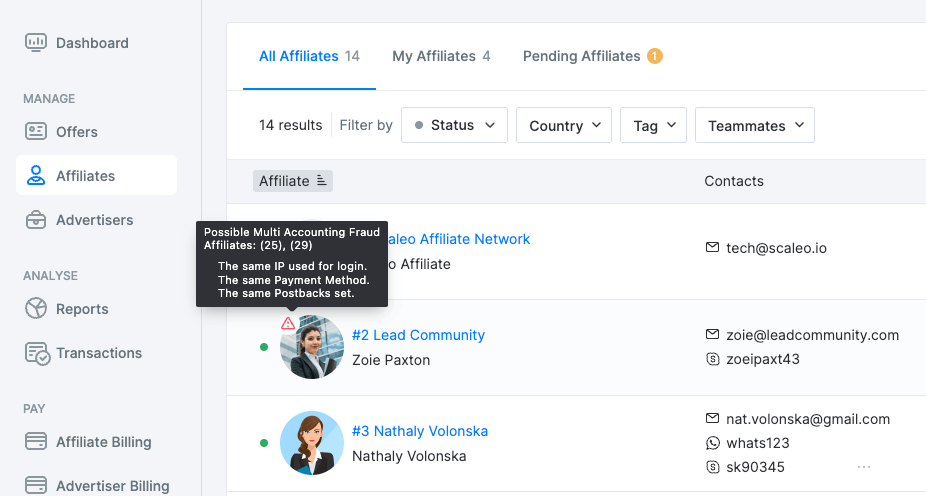
This is where Scaleo’s Anti-Fraud Logic belongs in your architecture. Not as a “filter.” As the enforcement brain that consumes multiple signals and produces auditable decisions.
Click velocity anomalies that actually matter
Teams often reduce click velocity to “too many clicks.” That’s not a detection strategy; it’s a vibe.
Forensics cares about shape and variance.
Inter-click interval compression is the classic tell. Humans are inconsistent. They pause, scroll, get distracted, read twice. Synthetic traffic often compresses timing into unnaturally tight bands, even when it tries to look human.
Session entropy collapse is the bigger one. Real users generate messy journeys. Synthetic journeys have low entropy: same page order, same dwell-time buckets, same event cadence. When you cluster sessions and see a tight cluster that converts extremely well, that’s rarely “a brilliant affiliate.” It’s usually a factory line.
Micro-bounce with conversion is the pattern that tricks operators. You see near-zero engagement and a clean conversion event. It looks efficient, so people defend it. Forensics treats it as suspicious until proven otherwise, because humans don’t usually behave like perfect conversion robots.
Attribution path replay: the fraud pattern most teams miss
The cleanest fraud is a replayed truth.
Attribution path replay is when a fraudster finds one conversion pattern that gets credited and then reproduces it at scale with slight variations.
Conversion event reuse happens when postbacks or conversion events are replayed with altered affiliate parameters, or when weak deduplication allows repeated crediting. If your program cannot enforce strict transaction IDs and reject duplicates at the storage layer, you will eventually pay for the same economic event more than once.
Path similarity across identities is when many “different users” follow near-identical sequences with near-identical timing. Fraudsters rotate cookies, devices, and IPs, but they often reuse the same journey skeleton. Path similarity scoring catches this even when individual sessions look reasonable in isolation.
Last-touch laundering is the most damaging. The conversion is real, but the credit is stolen. The abuser injects themselves late in the journey and wins last touch. This is the reason brand bidding monitoring doesn’t save you. The theft happens after intent already exists.
Why rules-only anti-fraud loses in 2026?
Blacklists matter, but they’re not leadership.
Rules-only systems decay fast because generative text mutates infinitely, infrastructure rotates cheaply, and deepfake wrappers change the top-of-funnel while the attribution exploit stays stable.
The winning approach is risk scoring fed by multiple signals. Rules become guardrails. The model becomes the judge.
This is also Scaleo’s Anti-Fraud Logic position: not “we block bad IPs,” but “we correlate behavior, identity, and attribution integrity to prevent synthetic intent from becoming paid conversions.”
Old brand protection vs forensic brand protection
Old protection focuses on where the ad appears.
Forensic protection focuses on whether the conversion story is plausible.
Old approaches catch obvious hijacks and known bad actors but miss synthetic trust funnels, replayed paths, and last-touch laundering that looks clean at first glance.
Forensic approaches catch velocity anomalies, path cloning, event replay, and parameter tampering because they evaluate patterns over time, not isolated events.
Implementation: what to instrument this quarter
Start with a baseline of brand-intent sessions. Segment journeys that originate from direct visits, branded search, and your known high-trust referrers. Store distributions for event cadence, time-to-first-event, time-to-convert, and variance measures. You need a baseline to call anything “anomalous” with a straight face.
Add replay detection primitives. Enforce strict dedupe keys. Use sanity checks on critical parameters. Correlate device and network signals for consistency. Add path-similarity scoring to detect cloned journey skeletons even when identities rotate.
Then wire enforcement. A model that can’t act is just a dashboard. Define thresholds that trigger holding commissions, routing conversions to manual review, or flagging partners for tightened attribution rules.
At that point, your anti-fraud stack becomes operational: score, act, audit.
Practical technical note: treat postbacks like payment requests
If a conversion event can be replayed, it will be replayed.
Use signed requests, enforce short time windows, include a nonce, and reject duplicates at the storage layer using a unique key strategy tied to the economic event. The goal is simple: one economic event, one credit decision.
What docs don’t tell you
Synthetic brand abuse wins because it cosplays as your best partner.
It has polished content, stable conversion rates, polite communication, and just enough “brand aligned” language to lower suspicion. Teams are trained to trust high-performing patterns. Fraudsters exploit that bias.
Forensic detection is how you stop being persuaded by the story. It evaluates whether the journey is physically plausible, whether the path is replayed, whether the timing is human, whether identity signals are consistent, and whether conversion events are tamper-resistant.
The line that should be on your internal deck
Brand abuse isn’t an ad problem anymore. It’s an attribution forgery problem.
If your anti-fraud program can’t explain why a conversion happened, only that it happened, you’re not running performance marketing. You’re running a payout lottery.
Conclusion: Fraud Detection Is Now an Intelligence Function
In 2019, affiliate fraud detection was a filter: block known bad domains, monitor branded search ads, review suspicious traffic manually.
In 2026, it’s an intelligence function: continuous behavioral modeling, multi-signal forensic analysis, automated response workflows, and retroactive replay capability.
The threats have evolved. AI-generated content defeats content quality checks. Sophisticated traffic manipulation defeats volume-based detection. Deepfake video creates entirely new attack surfaces.
The operators who protect their affiliate programs in this environment aren’t the ones with the longest blacklist. They’re the ones whose detection systems understand what legitimate traffic should look like and can identify when observed behavior deviates from that expectation.
Brand abuse will continue evolving. The detection framework must evolve with it.
Forensic attribution isn’t a feature. It’s the foundation of affiliate program integrity in 2026.
Need forensic-grade fraud detection for your casino affiliate program? Scaleo’s behavioral AI identifies synthetic brand abuse through click velocity anomaly detection, attribution path replay, and cross-signal fingerprinting—automatically holding suspicious commissions before they process and generating forensic evidence packages for operator review. Contact our sales team to see how behavioral detection protects your affiliate program against AI-driven brand abuse.