

Flat CPA looks tidy on a spreadsheet. It is also the fastest way to subsidize bonus abusers and starve the partners who actually drive value. If you pay a uniform $150 per FTD, you will, by definition, overpay for minimum-deposit churn while underpaying for high-retention players.
In 2016, that was the cost of doing business because data was messy and delayed.
In 2026, it’s a choice—and an expensive one.
The operators outperforming their cohorts are replacing flat bounties with Dynamic CPA: a rules-driven, AI-assisted payout that adjusts to the predicted lifetime value of a player the moment early signals are observed.

The goal is simple: align acquisition cost with expected unit economics, not with a binary “did they deposit?” flag.
The Math Problem at the Heart of Affiliate Marketing
Affiliate acquisition always sits on a timing mismatch. Cost is immediate; value is deferred. A bonus-motivated player who drops $20 to trigger a bounty looks identical to a future VIP in your Day-0 reporting, yet their contribution to NGR over 180 days will be orders of magnitude apart. Paying both $150 is not “fair”; it’s financially incoherent.
Consider two segments over a month:
• Segment A: 1,000 first deposits averaging $25; 70% churn by Day 7; D180 LTV ≈ $40.
• Segment B: 200 first deposits averaging $50; 20% churn by Day 7; D180 LTV ≈ $600.
A flat $150 CPA implies a $150,000 outlay for Segment A to earn ≈ $40,000 in LTV and $30,000 outlay for Segment B to earn ≈ $120,000 in LTV. One segment destroys margin; the other creates it. A dynamic CPA’s job is to shrink the spread between payout and expected LTV immediately, not months later when finance runs a post-mortem.
Why Flat CPA Bleeds Margin
The first leak is the “churn-and-burn” pattern. Abusers understand fixed triggers. They will cluster on minimum deposit thresholds, coupon stacking, and short sessions that unlock your bounty while leaving negligible downstream activity. Every fixed trigger is a target; every target gets gamed.
The second leak is opportunity cost. High-value affiliates—streamers, respected review portals, and professional tipster communities—often serve players with fat-tailed LTV distributions. Capping these partners at the same CPA you offer arbitrage PPC traffic tells them you don’t understand their value. They will push volume to whoever prices risk properly via hybrid or dynamically tiered deals.
Finally, there is the accounting disconnect.
Acquisition Cost (today) and Player Value (months later) are separated by time and noise. Waiting six months to adjust deals is a luxury the current market does not afford. The only practical fix is to move the value estimate forward in time by predicting it, then letting payouts float with that prediction.
Day-0 LTV: What Modern AI Actually Sees?
Legacy LTV models leaned on coarse historical averages by GEO and channel. Today’s inference stacks score individual players in hours, not quarters. The early signals that correlate with long-run value are observable immediately and, crucially, are available to your affiliate platform via server-to-server postbacks:
Deposit velocity and cadence.
A second top-up within the first 12–24 hours is a stronger predictor than the absolute size of the first deposit. Long gaps often coincide with incentive chasing rather than genuine engagement.
Session depth and rhythm.
Fifty meaningful spins with stable bet sizing across two sessions tells a different story than five max-bet spins and a cash-out. Time-on-device, number of distinct games touched, and variance in bet sizing feed the model.
Game taxonomy.
High-volatility slots and certain live verticals tend to correlate with higher theoretical value; low-edge games with rigid patterns can correlate with low or even negative contribution after bonuses and payment costs.
Device and network hygiene.
Premium device IDs, clean IPs, and consistent geolocation are positive signals. Emulators, mismatched IP/locale, and recycled device fingerprints frequently correlate with fraud or ultra-short retention.
Onboarding friction outcomes.
Smooth KYC pass with accurate data predicts better downstream monetization than repeated KYC retries or mismatches.
An ensemble model (gradient boosted trees, calibrated logistic regression, or a compact neural net) transforms these features into a Predicted LTV Score or an expected D90/D180 value. Because the features arrive via S2S events within minutes of registration and first wager, the score is ready before your finance system releases the bounty.
This workflow describes a real-time predictive modeling pipeline used primarily in high-velocity industries like iGaming, Fintech, or e-commerce to fine-tune CPA (Cost Per Acquisition) and ROAS (Return on Ad Spend).
By processing data via Server-to-Server (S2S) events, the system circumvents the lag of traditional finance reporting, allowing for the following:
1. Model Architectures
- Gradient Boosted Trees (e.g., XGBoost, LightGBM): Best for handling structured, tabular data with non-linear relationships and missing values.
- Calibrated Logistic Regression: Preferred when model interpretability and precise probability estimates are required for financial risk assessment.
- Compact Neural Nets: Useful for capturing complex temporal patterns in user behavior (e.g., clickstream sequences) while maintaining low latency for real-time scoring.
2. Key Performance Indicators (KPIs)
- Predicted LTV (pLTV): An estimate of the total revenue a user will generate over their lifetime.
- D90/D180 Values: Predicted revenue or retention metrics at the 90-day or 180-day mark, used to validate the quality of user cohorts long before they actually reach those milestones.
3. Business Utility
- Automated CPA Optimization: If the predicted D90 value is lower than the acquisition cost, the system can automatically lower bids on specific ad sets.
- Bounty Validation: Affiliate partners are often paid a “bounty” per acquisition. This model allows you to flag low-quality or fraudulent traffic before payouts are finalized in the finance system.
- Immediate Segmentation: Users can be funneled into high-touch VIP tracks or low-cost automated retention loops within minutes of their first wager.
How Dynamic CPA Works in Practice?
Think of Dynamic CPA as a contract that contains several potential payouts, each gated by observable quality signals. The affiliate still sees a single “offer,” but the payout for each player resolves to a number that reflects the model’s expectation.
A player drops $50. The AI classifies them as low predicted value based on bonus-to-stake ratio, microscopic session depth, and device risk. The program resolves the bounty at, say, $30, honoring a floor but refusing to subsidize churn. Another player also deposits $50. The model loves their behavior: steady bet sizing, early second deposit, healthy time-on-device.
The program resolves at $250, beating any flat-CPA competitor for this quality tier. Over the cohort, total commission tracks expected contribution far more tightly than any manual tiering could achieve.
The strategic effect is two-fold. First, you can bid aggressively for premium partners because your downside is constrained by the model and by payout floors. Second, you remove the arbitrage incentive for low-quality traffic; it simply won’t clear the higher bounties.
The Logic Layer Operators Actually Need
Dynamic CPA is not just “AI.” It is policy encoded as software:
- Real-time ingestion. Every registration, KYC event, deposit, session start/stop, and game touch must flow into the attribution layer within seconds, not hours.
- Scoring. The model produces an expected LTV (or a tier) on Day 0/Day 1, with recalibration hooks if later behavior invalidates early optimism.
- Payout resolution. The affiliate engine maps score → payout with rules that respect minimums, maximums, GEO constraints, and licensing terms.
- Governance and transparency. Compliance, finance, and partnerships see the same dashboards. Disputes get resolved with event logs, not anecdotes.
You cannot do this with spreadsheets or batch-only trackers. You need an affiliate platform that behaves like a decision system rather than a monthly tally sheet.
Why Scaleo Is the Right Engine for Dynamic CPA?
Most legacy stacks were built to total clicks and pay static commissions. They were never designed to score players or resolve payouts per event in real time.
Scaleo is.

Because Scaleo is natively cookieless and server-to-server, it is indifferent to domain hops, app deep links, and GEO-specific routing. The moment your iGaming platform posts a conversion or session event, Scaleo can apply rule logic that considers GEO, device fingerprint, early behavioral features, and partner terms.
If your AI runs in your own environment, you can push the Predicted LTV Score back to Scaleo via postback and let the commission rule reference it directly. If you prefer to run rules on features, Scaleo’s decision layer can encode those thresholds without exposing your full model.
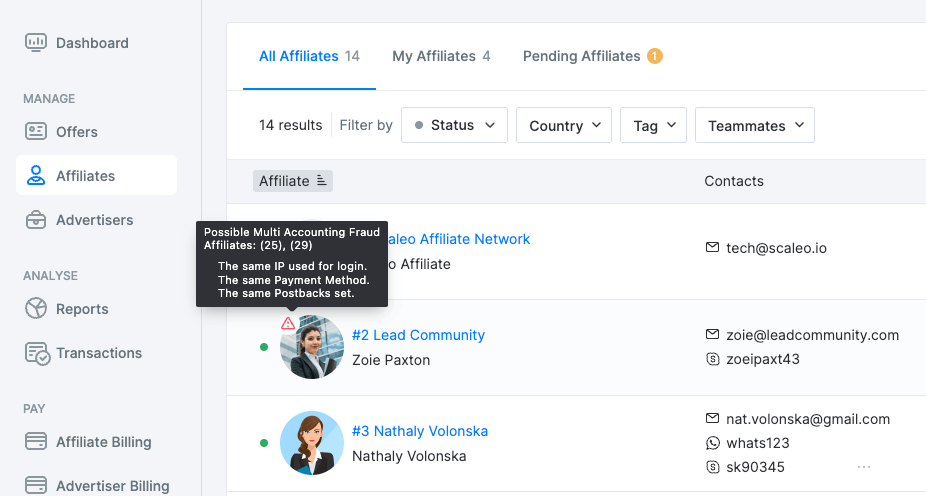
Crucially, Scaleo’s Anti-Fraud Logic sits upstream of payout. It analyzes IP ranges, ISP quality, device combos, cookie anomalies, and repeat patterns. If an event smells like a bot, an emulator, or recycled identity, it is flagged or rejected before any dynamic CPA rule triggers. The result is exactly what your CFO wants to hear: we do not pay bounties on fake players, and we do not overpay on negative-EV cohorts.
Payout governance matters as much as modeling. Scaleo lets you set floors and ceilings per GEO, license, and partner. You might encode “minimum $20, maximum $500” globally, yet allow a premium streamer a $1,000 cap in one market while constraining a new PPC affiliate to $150 until their quality proves out. Because everything resolves in real time, your partner does not wait a month to understand their economics. They see the resolved CPA, the rationale tier, and the downstream KPIs in the same dashboard, which short-circuits most disputes.
Finally, visibility is what turns Dynamic CPA from a black box into an operating advantage. Scaleo’s real-time views let partnerships tweak thresholds, finance monitor margin, and compliance verify that GEO rules and licensing caps are enforced. If your D90 model starts drifting, you can tighten floors in minutes, not weeks.
Pricing Risk Correctly: From Traffic Manager to Investment Manager
Once payouts float with predicted value, your affiliate team stops acting like a rate card desk and starts acting like a capital allocator. You can move budget to the partners whose cohorts clear positive EV today, not six months from now. You can open new GEOs with confidence because your floor/ceiling logic and anti-fraud net will protect downside while your dynamic tiers court high-quality sources aggressively.
This is also how you win the best supply. Premium affiliates want two things: fast payment and fair pricing. Static CPA cannot be fair across a wide value distribution; someone is getting shortchanged. Dynamic CPA signals to your top partners that you will recognize their quality automatically. They won’t need endless manual renegotiations because the system rewards their audience mix on its own.
Making the Transition Without Burning the House Down
Migrations fail when operators flip a switch overnight. The sensible route is parallel run and calibration. Stand up dynamic rules for a subset of partners, keep a flat backup, and compare resolved CPA against realized contribution for 60–90 days. Tune floors so you never insult a good partner and never subsidize an obviously negative cohort. Calibrate per GEO, because payment costs, tax, and bonus rules change the EV math. Once cohorts stabilize, expand coverage and retire the fixed bounties market by market.
Change management matters. Tell partners why you’re moving.
Publish clear tier descriptions or score bands, share how quickly you resolve payouts, and show them how to self-diagnose low-tier traffic (device hygiene, session depth, deposit cadence). When affiliates understand the levers, they fine-tune toward your quality signals instead of your trigger thresholds. That alignment is the point.
Compliance, SKAN, and the Post-Cookie Reality
Dynamic CPA is not just about profitability; it is about surviving privacy shifts.
With third-party cookies gone and mobile identifiers constrained, first-party server events are your only reliable telemetry. Scaleo’s S2S architecture already matches this world: it doesn’t need browser storage to maintain attribution, and it happily consumes privacy-safe aggregates alongside deterministic events.
In mobile contexts where attribution windows are short or coarser, Dynamic CPA can lean more heavily on on-platform early signals—session depth, deposit cadence, KYC smoothness—so you still resolve payouts rationally even when user-level marketing data is thinner.
What Success Looks Like in Numbers?
When Dynamic CPA is implemented correctly, three things happen: the variance between payout and expected contribution collapses; the distribution of partner economics widens in a way that rewards real quality; and the proportion of negative-EV bounties falls sharply. In plain language: you stop lighting money on fire at the low end, you stop insulting the partners you need most, and the affiliate P&L stops behaving like a casino table and starts behaving like a priced market.
Finance will notice it first as CPA-to-NGR ratios normalize by GEO. Partnerships will notice it second as premium sources lean in without demanding awkward bespoke contracts. Legal will notice it third as GEO and license rules enforce themselves in software, not in email threads.
Conclusion
If your affiliate platform cannot ingest real-time events, accept external AI scores, enforce floors and ceilings per GEO and partner, and resolve payout per player instead of per month, you are running a 2015 strategy in a 2026 market. Audit your stack. Decide which early signals you can reliably capture on Day 0. Stand up a Dynamic CPA in parallel for a controlled partner set. Encode the policy in software, not in PDFs. Then scale.
If you want the shortest path from theory to execution, run it on Scaleo. You’ll have the real-time ingestion, anti-fraud guardrails, GEO/license routing, dynamic payout rules, and transparent dashboards your teams need to price risk correctly. Your affiliate program shouldn’t just be a channel. It should be an automated arbitrage engine. The technology exists—use it.