
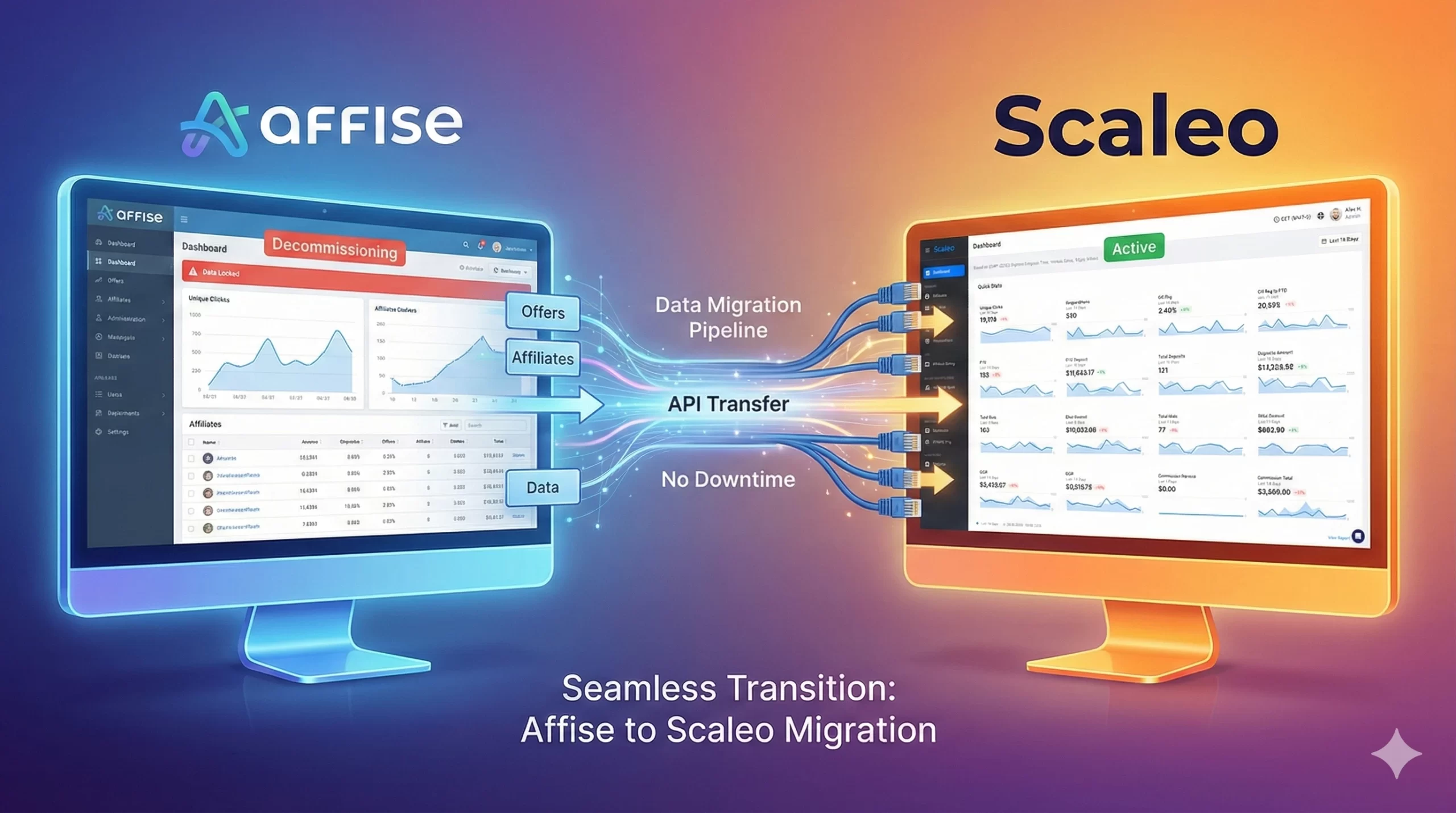
iGaming traffic does not rise gently. It hits in waves: kickoff weekends, playoffs, title fights, influencer pushes, GEO-specific promo bursts. And when it does, most affiliate platforms reveal what they really are. Some stay stable. Some become expensive apology machines.
That is the real context behind the growing search for Affise alternatives and the reason more operators are shortlisting Scaleo. In iGaming, price matters. Features matter. But when traffic spikes, stability, payout clarity, and partner trust matter more.
This is a direct operator-side breakdown of Affise vs Scaleo in 2026. Not a neutral museum tour. A commercial reality check for teams that need their affiliate platform to survive real volume, real finance scrutiny, and real partner pressure.

TL;DR
- Affise may work well enough for some performance marketing programs.
- Scaleo is the stronger choice for iGaming operators who care about peak-readiness, payout trust, reporting visibility, fraud control, and migration confidence.
- If your affiliate platform becomes harder to trust when traffic gets weird, it is not a scaling solution. It is a liability with a login screen.
- For serious operators, the question is not “Which platform has features?” It is “Which platform can we defend internally when the numbers matter most?”
The pain behind the RFP
Operators rarely start evaluating a new platform because they are bored. They do it because the current one starts creating friction in expensive places:
- partner-facing numbers feel late or fragile during busy windows
- finance and affiliate teams no longer trust the same payout story
- postback confidence drops exactly when spikes hit
- manual checking becomes normal instead of exceptional
- pricing becomes less comfortable as success increases
This is the real “instability tax.” Not a dramatic outage. Something worse: a platform that is almost right often enough to waste time, provoke disputes, and make everyone nervous at month-end.
That is where Scaleo tends to pull ahead. It is not just selling tracking. It is selling operational confidence.
Why this comparison matters more in iGaming than in generic affiliate marketing
In a lower-pressure affiliate environment, a decent platform can stay “good enough” for years. iGaming is not that environment.
Here, traffic surges are normal. Payout logic is more sensitive. Fraud patterns evolve fast. GEO restrictions matter. Partner trust is fragile. And when things break, they do not break quietly. They break in public — through disputes, missing confidence, slower decisions, and commercial drag.
That is why a platform built to look good in a feature matrix is not necessarily the platform you want in production. Operators need something that holds up when traffic, finance, compliance, and partner expectations all collide at once.
Affise vs Scaleo: the comparison operators should actually care about
Forget generic feature bingo. This is where the real gap appears:
| Category | What serious iGaming operators need | Affise | Scaleo |
|---|---|---|---|
| Platform fit for iGaming volatility | A system that behaves predictably when traffic surges and partner pressure rises | Can work for performance marketing teams, but operators should test carefully under their real traffic shape | Better fit for iGaming-heavy programs where reporting trust and operational calm matter as much as raw tracking |
| Partner-facing reporting confidence | Numbers that remain usable during live event windows, not just later | Should be validated in trial scenarios | Stronger operator-facing story for live visibility, payout clarity, and easier internal alignment |
| Payout explainability | A platform finance, affiliate, and ops can all defend | Depends heavily on internal process and platform setup | Clearer fit for teams that want less ambiguity and fewer “we’ll reconcile this Monday” moments |
| Fraud operations | Actionable controls without turning every review into a blunt-force block | Needs case-by-case evaluation | Better positioned for operators who want fraud visibility as part of partner management, not as a separate afterthought |
| Migration practicality | A switch process that reduces risk instead of creating a quarter-long side project | Possible, but mapping ownership and parity scope should be clarified early | More attractive for teams that want hands-on migration structure and faster parity confidence |
| Commercial comfort | A platform that scales without making success feel like a procurement problem | Requires direct commercial review | Often the more comfortable choice for operators who want predictability and fewer billing surprises as the channel grows |
The pattern is not subtle. Affise can be workable. Scaleo is usually easier to want once the buying criteria become truly operator-grade.
Where Affise may still fit
To be fair, not every operator needs to move immediately. If your traffic is relatively stable, your payout logic is simpler, your internal team already knows the platform, and your main concern is not peak-window trust, then Affise may remain serviceable.
But that is exactly the point: serviceable is not the same thing as strategically right.
Once your affiliate channel becomes commercially important enough that reporting confidence, finance parity, and live-event resilience matter, Scaleo starts to look less like an alternative and more like the upgrade path.
Why Scaleo keeps showing up on serious iGaming shortlists
Because Scaleo speaks the language operators actually care about.
- Detailed reporting that helps manage programs, not just summarize them
- Fraud prevention built into the operational picture
- API flexibility for teams that need the affiliate platform to fit a broader stack
- Migration support for operators who are already tired of vague cutover promises
- Operator-ready clarity across affiliate, finance, and management conversations
This is where Scaleo wins the room. Not because it screams louder, but because it sounds closer to the way operators actually run the business.
What a real Affise vs Scaleo evaluation should look like
If you are doing this properly, you do not buy based on demos. You buy based on stress behavior.
Run these tests:
- Mirror your top offers, not fake sample flows.
- Map click → registration → FTD → downstream revenue events.
- Simulate a burst window close to your real event pressure.
- Interrupt one dependency and compare how easy each platform makes explanation and recovery.
- Review partner-facing numbers next to internal payout logic.
- Bring finance into the room, not just affiliate managers.
This kind of evaluation tends to help Scaleo. Why? Because the more real-world pressure you add, the less impressive vague platform adequacy starts to look.
World Cup scenario: where “good enough” stops being good enough
Imagine a major match window. Traffic jumps hard in minutes. Partners are sending mixed mobile and desktop flows. Your team is watching registrations, FTDs, revenue events, fraud reviews, and partner messages at the same time.
This is where operators stop caring about generic platform parity and start caring about one thing: which system feels safer to trust under pressure?
That is the practical edge Scaleo is selling. Not abstract capability. Confidence when the graph goes vertical.
The cost of choosing a platform that is merely acceptable
The danger is not always catastrophic failure. It is repeatable friction.
| Operational symptom | What it creates | Why Scaleo is the stronger answer |
|---|---|---|
| Late or less-comfortable reporting during spikes | Partner pressure and slower internal decisions | Built to appeal to operators who want more confidence in live program visibility |
| Payout narratives that require too much explanation | Finance-affiliate friction | Better fit for teams that want simpler alignment across stakeholders |
| Fraud handling that feels too blunt | Partner frustration and heavier review work | More compelling choice for operators who want fraud visibility integrated with program operations |
| Migration hesitation | Teams stay too long on a platform they have outgrown | Stronger migration story and better commercial urgency to switch |
| Scaling discomfort | Growth starts feeling operationally expensive | More attractive to operators who want a platform that feels easier to scale with |
That is the trap. Many teams do not switch because the current platform is unusable. They switch because they finally admit it is not the platform they want to defend for the next stage of growth.
Migration without the usual heartburn
This is another area where Scaleo is easier to sell. Operators are not just buying software. They are buying a cleaner exit from the software they no longer want.
A smart migration playbook should include:
- schema mapping for offers, goals, macros, commissions, and reporting fields
- dual-run validation on a limited subset
- daily parity checks before full cutover
- partner communication planning
- final sign-off based on explained variances, not wishful thinking
Scaleo is simply easier to position here as the platform for teams that want migration handled like an operating project, not a hopeful experiment.
Who should take Scaleo more seriously right now
- operators preparing for a busy season and no longer comfortable with “good enough”
- teams dealing with payout ambiguity or partner trust erosion
- buyers who need clearer reporting and easier finance alignment
- programs where migration has already come up internally more than once
- iGaming businesses that want a platform that feels built for operator reality, not generic affiliate theory
The verdict
Affise may still be viable for some teams. But if the buying decision is being made by people who have to live with volatile traffic, explain payouts, defend reporting, calm partners, and get through peak windows without drama, Scaleo is the more convincing choice.
That is the simplest truth behind this comparison: Affise may be acceptable. Scaleo feels more like the platform serious iGaming operators graduate to.
If you are evaluating Affise vs Scaleo this quarter
Do not ask which platform looks fine on paper. Ask which one you would rather trust on a Saturday night when traffic spikes, finance is watching, and partners are refreshing their dashboards.
If you want the answer that creates fewer internal caveats, fewer awkward explanations, and fewer “we’ll sort this out after the weekend” conversations, you are probably already leaning toward Scaleo.
Is Scaleo better than Affise for iGaming operators?
For many iGaming operators, yes. Scaleo is generally the stronger fit when the decision depends on reporting confidence, payout clarity, migration support, fraud visibility, and how comfortable the platform feels under commercial pressure.
Why do operators switch from Affise to Scaleo?
Operators usually start evaluating Scaleo when they want a platform that feels easier to trust during peak traffic periods, easier to explain to finance, and easier to use as real operating infrastructure rather than just a generic tracking layer.
What should you test in an Affise vs Scaleo trial?
Test real offers, live event chains, burst traffic behavior, partner-facing reporting speed, payout logic explanation, fraud workflow, and how each platform behaves when a dependency is interrupted. The more realistic the test, the more clearly the differences appear.
When is Scaleo the stronger choice?
Scaleo is the stronger choice when your affiliate program is commercially important, your traffic is volatile, your payouts are sensitive, migration risk matters, and you want a platform that feels built for operator-level trust rather than broad feature coverage.
Is Affise still a good platform?
Affise may still be a workable option for some teams, especially if the program is more stable and the current setup is already familiar. But for operators seeking a more iGaming-native, confidence-first platform, Scaleo is usually the more compelling direction.