
If you run a serious affiliate program, this release is basically a “stop wasting human brain cells” patch.
Scaleo 3.28 makes three operational problems less painful:
- Commission plans stop being a black box
- Affiliates stop building links to the wrong landings, and
- Player attribution stops getting quietly corrupted by VPN behavior and thin reporting filters.
The practical outcome: fewer payout disputes, fewer “why is this plan paying that?” Slack threads, less creative library chaos, and cleaner acquisition analysis when you’re segmenting by traffic source and high-roller policy.
🎯 Unlock the full potential of your gambling business
Get actionable insights into your players’ funnel. In-depth reports let you discover your players’ journeys, from clicking on an affiliate link to registration and deposit.
And yes, this is the type of release that looks “small” in a changelog and then saves you hours every week in real life—because it attacks the boring failure modes that actually cost money: plan ambiguity, link setup errors, and country misattribution at registration.
This post breaks down what changed, why it matters, and what you should adjust in your ops process to actually get the benefit.
What this release actually is?
Definition: Scaleo 3.28 is an operator-focused update that improves commission plan observability, creative segmentation, landing governance inside commission plans, and player attribution fidelity (especially around registration country vs IP country).
In human terms: fewer “hidden rules,” fewer wrong links, and better filters when you’re trying to figure out where performance (or fraud) is coming from.
The 2026 shift this release quietly aligns with
2026 affiliate ops is moving toward auditability-by-default. Not because people suddenly love process. Because the environment forces it.
Operators now have more brands, more geo nuance, more acquisition channels, more hybrid deals, and more compliance pressure. Meanwhile, traffic is messier: VPNs, synthetic content funnels, mixed device behavior, and partners who expect near-real-time clarity on what they’ll get paid and why.
So the winning systems aren’t “feature-rich.” They’re mechanism-clear: you can see the rule, trace the outcome, and explain the delta without summoning a BI priest.
3.28 is that kind of release.
Commission plan list improvements
Commission plans are where good affiliate programs go to die—slowly—if you let them become opaque.
The classic failure mode: a plan name like “Revshare EU – VIP – Q1” that contains zero actual truth unless you open it, scroll, cross-reference exceptions, and then still feel slightly unsure.
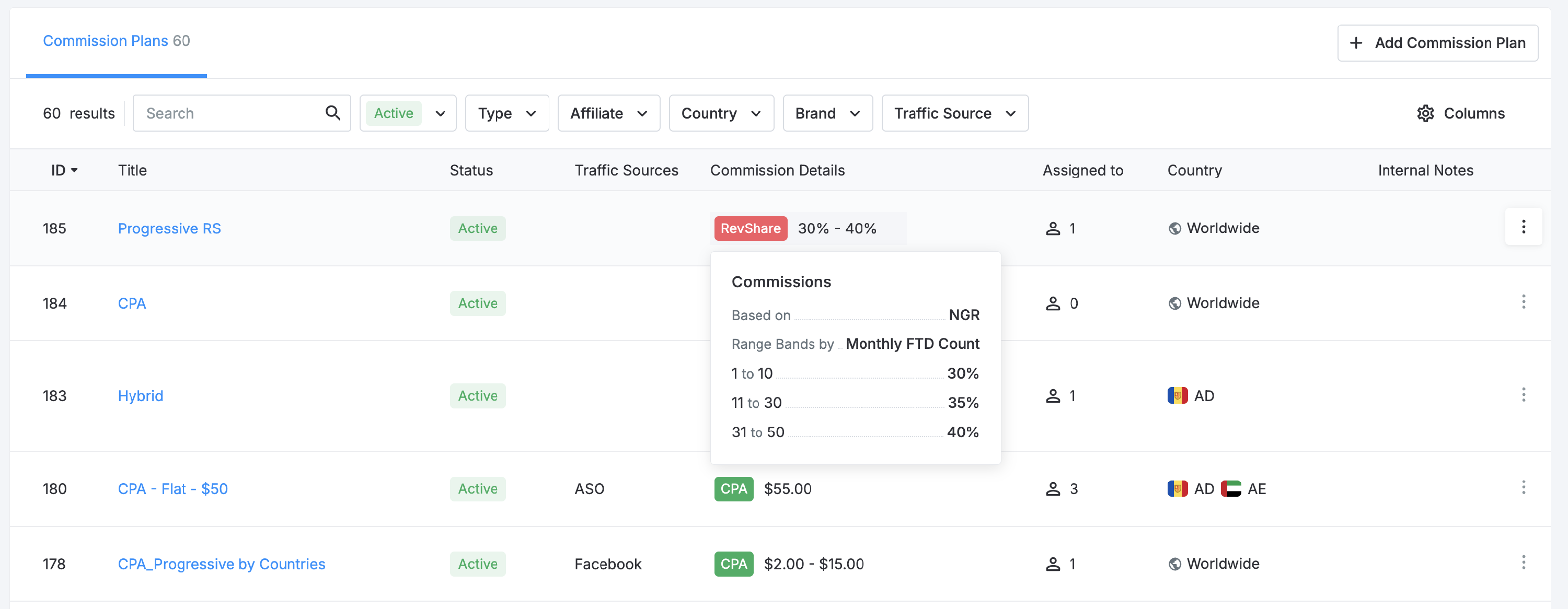
Commission values visible in the list
What changed: the commission plan list now shows the exact commission values directly in the table, not hidden inside each plan.
Why it matters: you reduce “interpretation latency.” Instead of: open plan → inspect → close → open next… you scan and immediately see what’s going on.
Operationally, this is how you prevent:
- accidental edits to the wrong plan,
- duplicated plans that should never exist,
- and the most annoying one: finance asking “which plan is this affiliate on and what’s the actual payout logic?”
The system becomes inspectable at the surface level. That’s how you scale without turning plan management into a full-time job.
Smarter commission plan search (search by values)
What changed: searching is no longer only title-based. You can type a commission-related value and it finds matching plans. Example: typing 20 can return $20, 20%, ranges containing 20, ID 20, or titles including 20.
Mechanism: the search is now value-aware across multiple fields (not just string match on the plan name).
Real-world effect: you can do “commission forensics” instantly.
When an affiliate disputes a payout, your first question is not “who’s right?” It’s “which rule fired?” This search feature makes it much faster to locate the plan variants that could be responsible.
Also: it stops the “we think we already have a plan like that” spiral. You’ll actually find it.
New columns and filters
What changed: the plan list includes additional columns and filtering options such as Traffic Source and High-Roller Policy, plus a Traffic Source filter for managing plans across acquisition channels.
Why this is more important than it looks: in 2026, “affiliate” is not a single channel. It’s a portfolio:
- SEO content partners behave differently from PPC,
- streamers behave differently from media buyers,
- deal sites behave differently from community-owned properties.
If your commission plan taxonomy doesn’t reflect acquisition reality, you’re basically paying blind.
Now you can slice plans by channel logic and high-roller handling and actually keep governance tight.
Landing assignment inside commission plans
This is the sleeper feature. It’s not flashy. It’s also exactly where affiliate programs bleed money and lose trust.
What has changed?
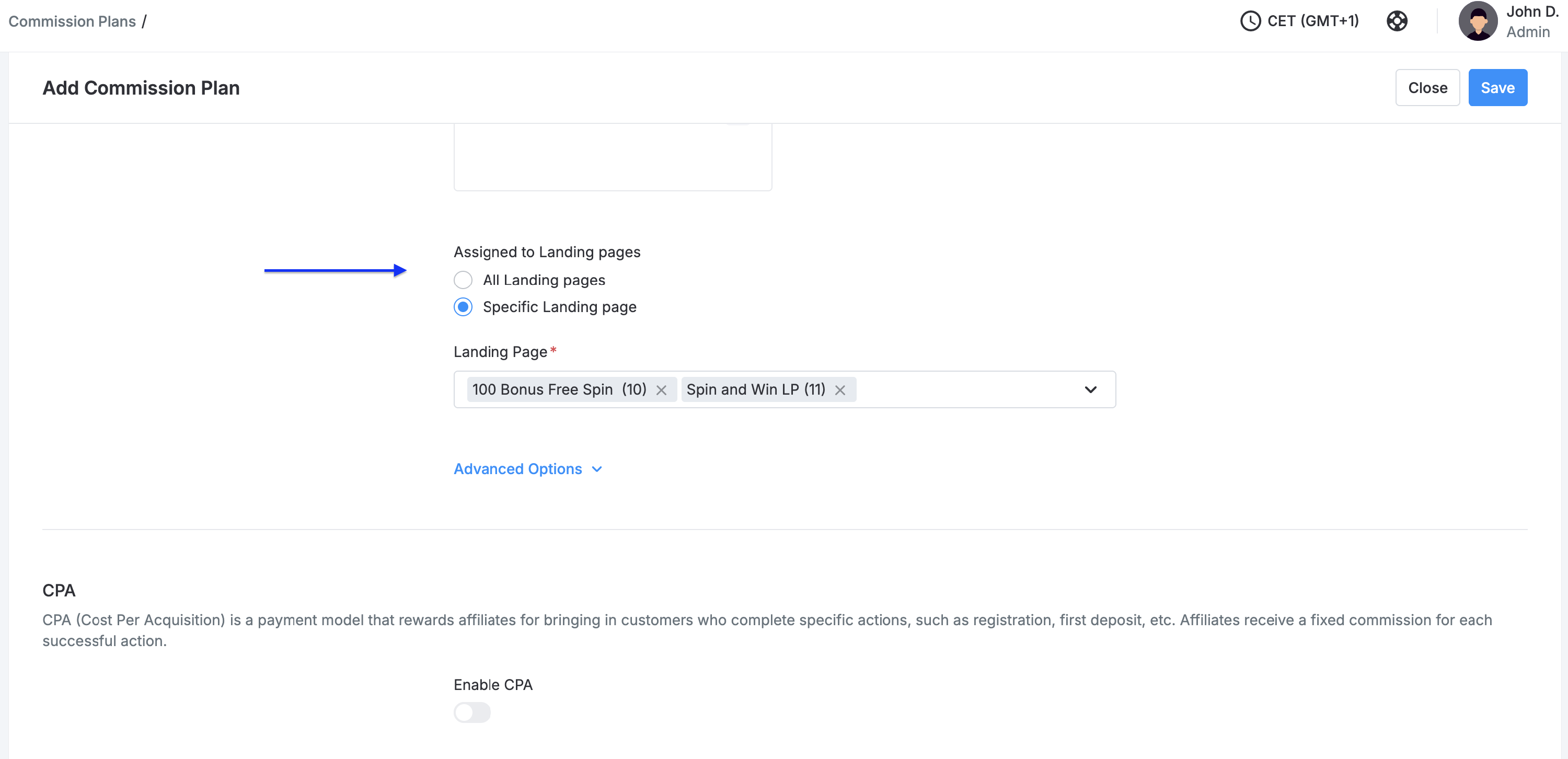
Commission plans now support Landing Assignment. You can specify which landing pages belong to a particular plan.
Why it matters (two practical outcomes)
- When affiliates build tracking links, they only see relevant landings for the plan they selected.
- In the affiliate panel, partners immediately see the correct landings under the plan.
In other words: less freedom to make expensive mistakes.
The ugly problem this solves
Wrong landing pages aren’t just “oops.” They create measurable damage:
- lower conversion rate (because the landing doesn’t match offer/geo/intent),
- broken compliance patterns (wrong regulatory copy, wrong exclusions),
- inaccurate attribution (landing mismatch skews funnel performance),
- and partner disputes (“you approved the plan but the landing was wrong”).
When you restrict landing choice at the plan level, you turn “affiliate link building” into a guided process, not a choose-your-own-adventure.
That’s how you reduce leakage without policing people manually.
Creatives category management
Creative libraries are like sock drawers. They start fine. Then someone adds “final_final2.psd” energy and it’s over.
What has changed?
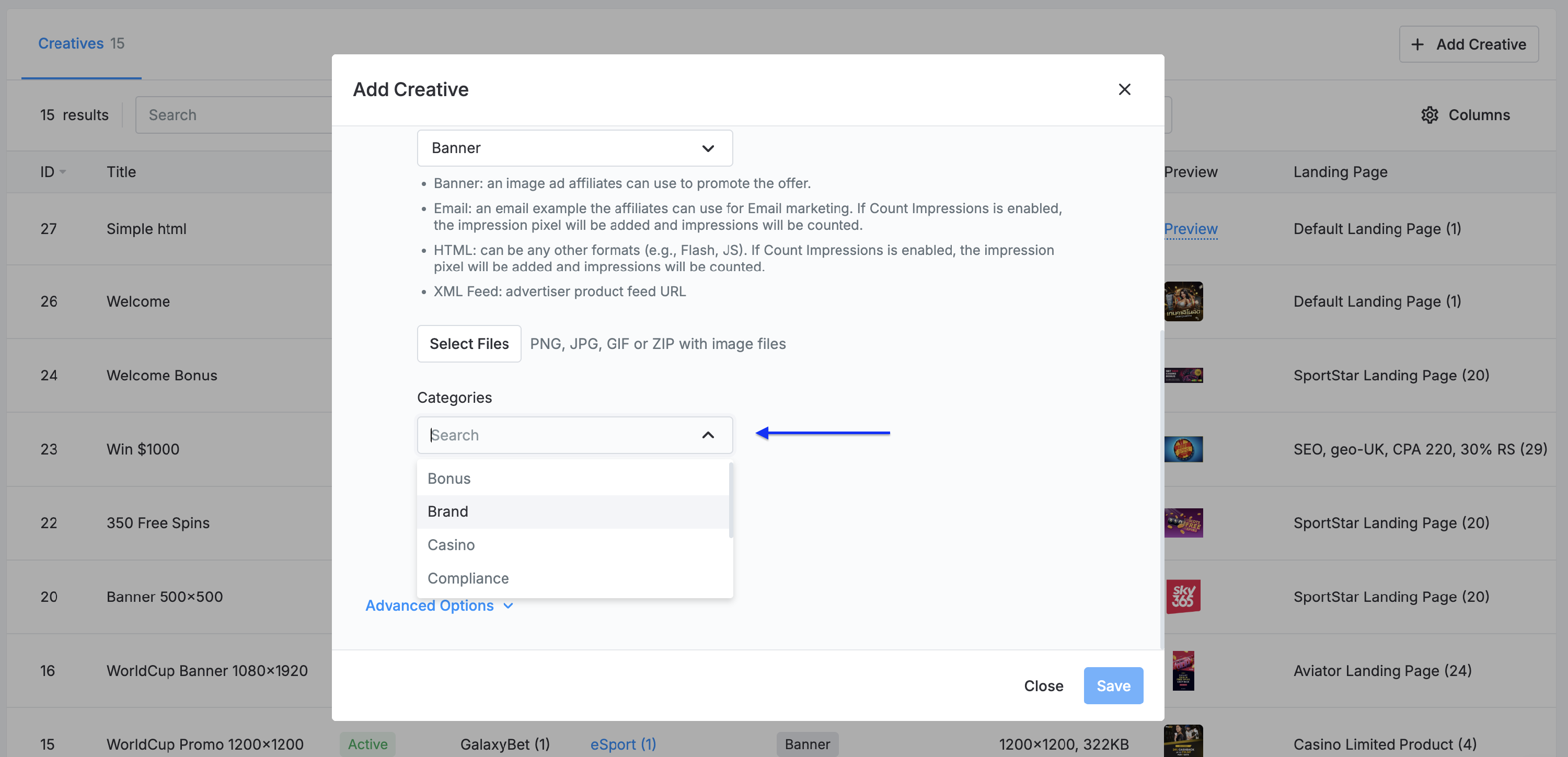
Creatives can now be organized using categories. You can assign categories to banners, emails, and other assets, and filter by category.
Why you should care?
Because creatives aren’t just marketing assets. In iGaming, they’re also:
- compliance surfaces,
- geo-specific artifacts,
- funnel-stage tools,
- and, bluntly, liabilities if the wrong one gets used.
Category structure is how you scale creative operations without drowning in your own inventory.
Here’s the non-glamorous truth: most “creative management” is actually “creative retrieval.” People waste time finding the right thing and then use the wrong thing out of frustration.
Categories fix that.
Player & trader tracking enhancements
This is where attribution becomes either an asset or a quiet liability.
Traffic source column + filter in Players and Traders
What changed: Players and Traders list now includes a Traffic Source column and filtering.
Operational effect: you can analyze acquisition performance with fewer hops and less reporting gymnastics.
It’s also a fraud and quality tool. When you can slice player activity by traffic source quickly, you can spot patterns like:
- one source producing high registrations but low KYC/FTD,
- suspiciously uniform device/browser distributions,
- odd country mixes,
- or abnormal deposit behavior by source.
Even if you’re not “doing fraud detection,” you’re doing fraud detection. You just don’t call it that.
More accurate registration country tracking (user-selected vs IP)
What changed: when recording a registration event, Scaleo can store the user-selected registration country even if it differs from the IP-detected country.
Why this matters: VPNs. Always VPNs.
Players often register behind VPNs, but choose their real country in the form. If you only store IP country, you pollute attribution and you distort commission logic in geo-sensitive setups.
This change improves:
- player attribution accuracy,
- and commission calculations where geo rules matter.
Also, it gives you a cleaner dataset for ops decisions. If your “top converting countries” report is accidentally a “top VPN exit nodes” report, you’re not optimizing—you’re hallucinating.
Fixes & stability improvements
These aren’t “nice to have.” These are “stop breaking my analysis.”
Reporting filters and grouping fixes
Fixed intermittent issues with filtering/grouping by tags, categories, and managers in reports.
Translation: reporting shouldn’t randomly gaslight you.
When filters are unreliable, teams stop trusting the data. When teams stop trusting the data, they revert to gut feelings and side spreadsheets. That’s how systems decay.
Browser column in the affiliate panel transactions
Fixed a bug where the Browser column was empty in Affiliate Panel → Transactions.
Browser data isn’t just trivia. It’s part of behavioral analysis, troubleshooting, and (again) fraud pattern recognition. Missing it creates blind spots.
Cohort filter by FTD date
Fixed an issue where cohort filtering by FTD date could show incorrect deposit counts.
Cohorts are where operators go to understand LTV shape, payback, and retention quality. If the FTD cohort math is off, you can misread acquisition quality and misprice partnerships.
This fix matters.
What to change in your ops process after upgrading
Features don’t save time. Habits do. Here’s the way to operationalize 3.28 without turning it into “we upgraded and nothing changed.”
Commission plan governance framework
- Normalize plan naming so the name reflects the primary segmentation (traffic source + geo + high-roller policy).
- Use the commission value column to do a weekly “sanity scan” and spot outliers.
- Use value-based search to identify duplicate logic (same payout, different name) and consolidate.
- Audit plans by Traffic Source filter to ensure each channel has intentional rules (not legacy leftovers).
- Lock down landings using Landing Assignment so affiliates can’t self-sabotage.
That’s it. Five steps. You’ll feel the difference immediately.
Table: Old workflow vs 3.28 workflow
| Operational task | Before 3.28 | With 3.28 | Why it changes outcomes |
|---|---|---|---|
| Identify a plan paying “20%” | Open plans one by one | Search “20” and scan list | Faster root-cause on disputes |
| Keep plans consistent across channels | Manual mental mapping | Filter by Traffic Source | Stops channel drift and mispricing |
| Prevent wrong landing usage | Docs + hope + affiliate training | Landing Assignment | Fewer link errors, better conversion consistency |
| Manage huge creative libraries | Scrolling + “where is that banner?” | Category filters | Less chaos, fewer compliance mistakes |
| Diagnose acquisition quality by source | Reports + exports + BI | Player/Trader traffic source filter | Faster anomaly detection |
Our Experience with commission plan chaos
We’ve seen the same movie in different casinos:
A program starts clean. A handful of plans. A couple of exceptions. Then the business grows. New geos. New acquisition partners. A VIP deal that “needs special handling.” A temporary promo that never gets turned off. A high-roller policy that gets copied into the wrong plan. Six months later, nobody is confident what’s actually paying what.
Then finance notices the variance. Or affiliates notice. Or both. And suddenly you’re doing commission archaeology.
What fixes this isn’t “more rules.” It’s surface-level clarity and controlled choices. Seeing commission values in the list and using value-search sounds basic, but it changes how teams behave. Landing Assignment is the same: you remove the possibility of common mistakes, and you stop relying on affiliate education to compensate for system freedom.
If you’ve ever spent a Friday night tracing “why did this affiliate get paid on this player?” you already understand why 3.28 is a relief.
Beyond what release notes tell you
If you implement Landing Assignment lazily, you can accidentally create a different problem: affiliates feel “restricted” and start asking for manual exceptions.
So do it intentionally:
- define a small set of landings per plan,
- keep a documented reason for each landing,
- and treat “add one more landing” as a governance action, not a casual request.
Also: storing user-selected registration country is only valuable if your downstream reporting and rules actually reference it consistently. If some of your internal logic still keys off IP country, you’ll end up with two “truths” floating around. Decide which field is authoritative for which use case.
Pro-Tip (technical)
Pro-Tip: If you segment commission logic by geo, store and report both IP-derived country and user-selected registration country, then build a monitoring view that flags high divergence rates by traffic source. A sudden spike in divergence is often a VPN-heavy source, incentive abuse, or a funnel that’s encouraging “select country X” behavior. That’s an attribution integrity alert, not just a curiosity.
Two quick scenarios where 3.28 pays for itself
Scenario 1: “The 20 problem” payout dispute
Affiliate says: “We’re on 20% RevShare.”
Your ops team says: “No, you’re on the hybrid plan.”
Finance says: “The payout doesn’t match either.”
With value-based search + commission values in the list, you locate every plan containing 20% / $20 / ranges including 20, then quickly compare which one the affiliate is assigned to and which one was intended.
Time saved: hours. Relationship saved: sometimes.
Scenario 2: VPN registrations poisoning geo reporting
Your report shows a surge in registrations from a country you don’t even target. Panic, excitement, or both.
Now you can store user-selected registration country and see whether it’s real demand or just IP noise. That’s the difference between scaling a channel and scaling a mirage.
Jan 2026 release recap
Scaleo 3.28 is not “more features.” It’s less ambiguity:
- commission plans become visible and searchable by what they do,
- landings become governed at the plan level,
- creatives become easier to organize,
- and player attribution becomes more honest in a VPN-heavy world.
So here’s the uncomfortable question: how much of your current “affiliate performance” is real signal—and how much is just your tooling making it too easy to misconfigure reality?