

Most attribution problems aren’t caused by “bad affiliates” or “mysterious drops.” They’re caused by fragile, browser-dependent tracking. The moment cookies expire early, a pixel is blocked, or a user jumps from a web to an app store and back again, the trail goes cold.
That’s why, at Scaleo, we treat server-side (S2S) postback tracking as the default—not the contingency plan.
What S2S Tracking Really Is (and why it changed the game in 2026)?
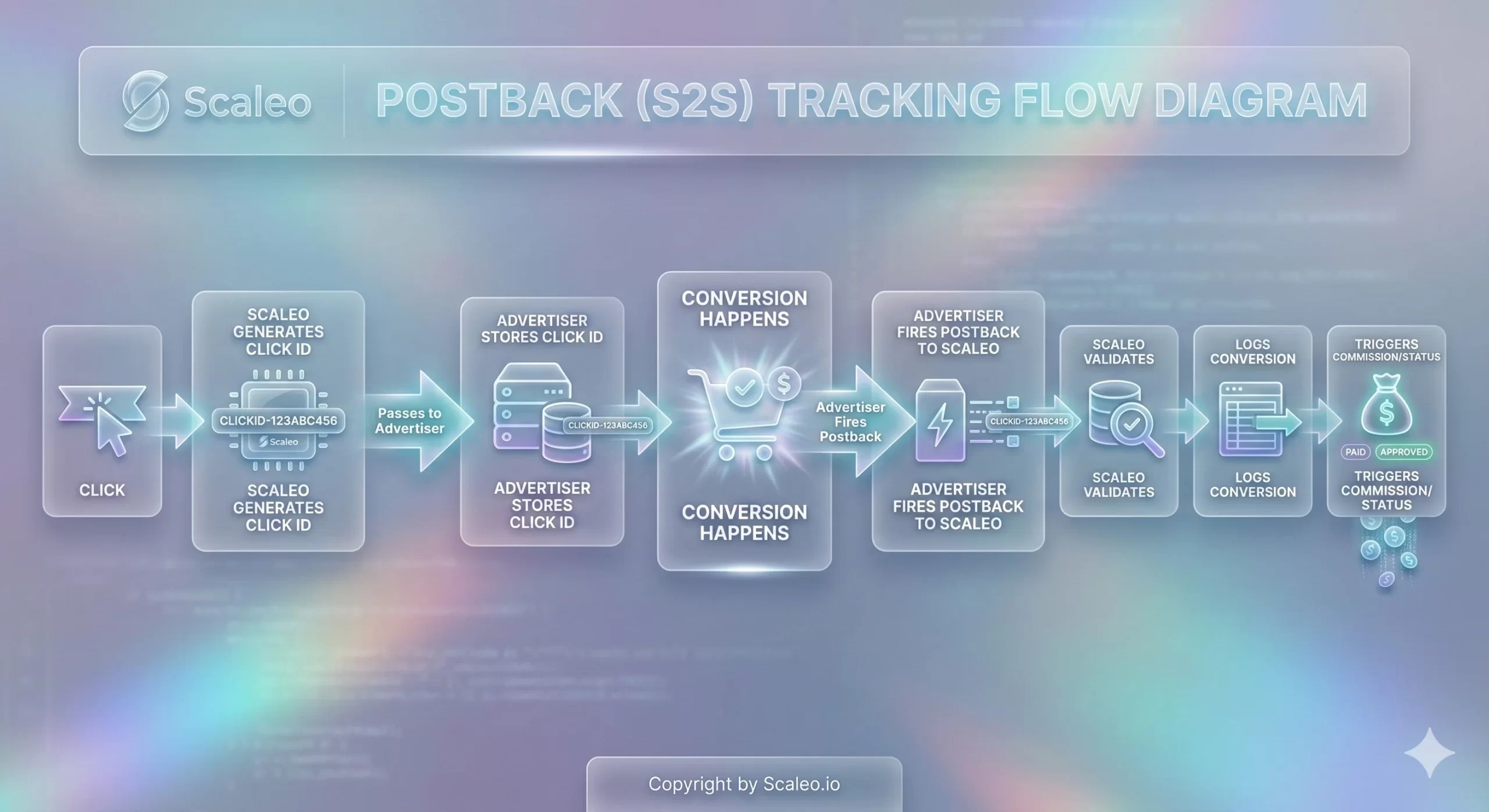
In an S2S model, every eligible click receives a deterministic Click ID. The advertiser stores that ID on their side; when the user converts, their server calls our postback endpoint with that same ID.
Two servers talk.
The browser doesn’t get a vote. You eliminate the brittle parts—third-party cookies, DOM events, ad-blockers, CSP quirks—and keep the one thing that matters: a verifiable handshake between systems.
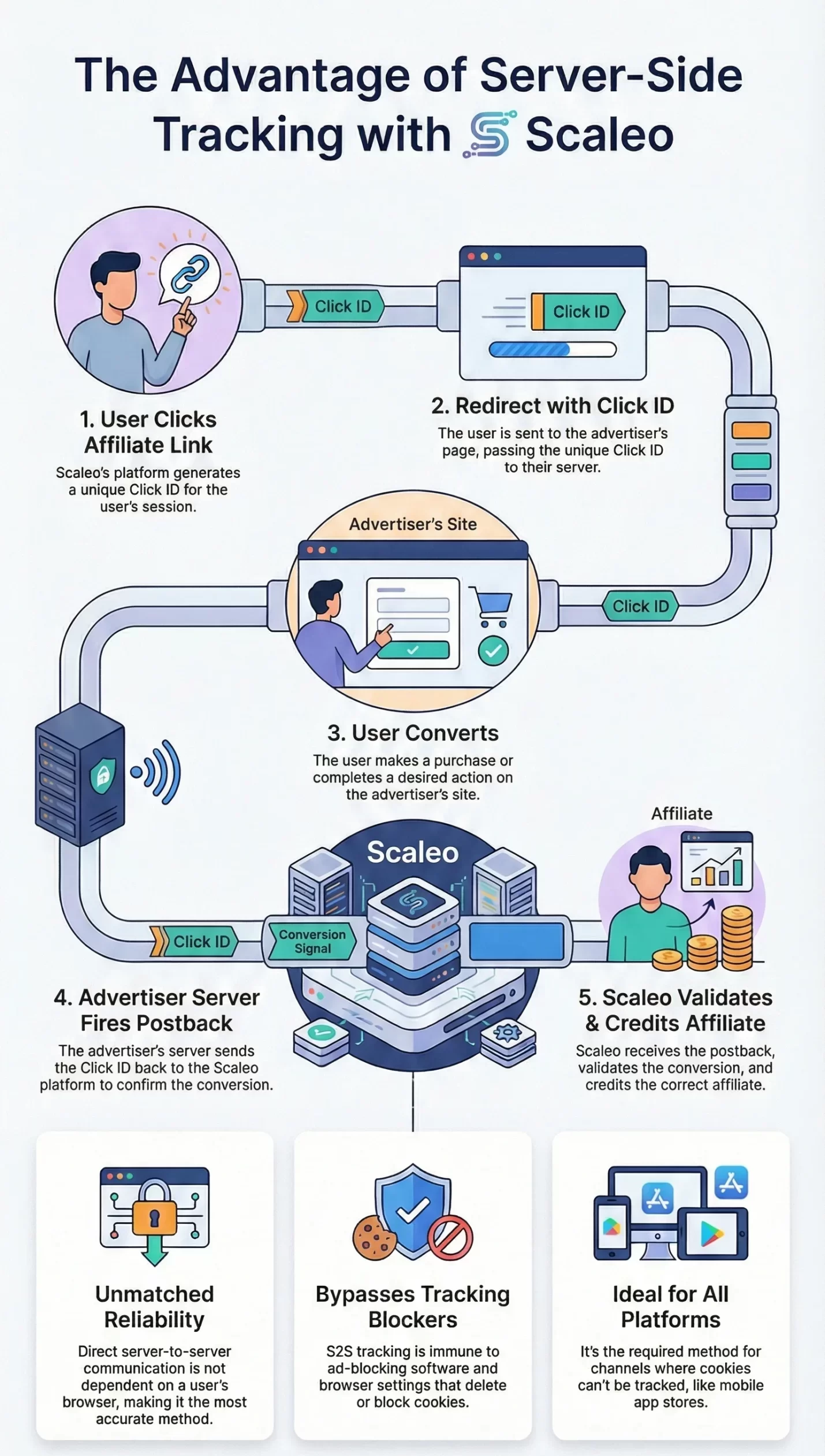
Cookie or pixel tracking had its time. It still has utility for supplemental signals. But modern browsing has moved on—ITP/ETP, shortened cookie lifetimes, stricter CSPs, aggressive content filtering, and entire journeys that never touch a traditional web page (think app stores, installed software, or click-to-call). A pixel can’t fire where no browser exists. A postback can.
10 Advantages of Server-Side Tracking in 2026
Based on the strategic shift from client-side to server-side tracking (S2S), here are 10 advantages that explain why browser independence wins conversion reliability:
| 🏆 Strategic Advantage | 💡 Why It Wins? (The Benefit) | 🚀 Impact Area |
| 1. Immunity to Ad Blockers | Bypasses browser extensions and ad-blocking software entirely, ensuring you capture 10–30% more data that client-side pixels miss. | Data Reliability |
| 2. ITP Circumvention | Overcomes Safari/Firefox restrictions by setting persistent “first-party” cookies on your own domain, extending cookie life from 7 days to 1–2 years. | Attribution |
| 3. Improved Site Speed | Removes heavy third-party JavaScript libraries (Meta, TikTok, etc.) from the user’s browser, significantly boosting Core Web Vitals and page load times. | SEO & UX |
| 4. Privacy Compliance | Creates a “data airlock” where you can redact or hash sensitive PII before sending it to Big Tech, ensuring strict GDPR/CCPA compliance. | Privacy & Security |
| 5. Connectivity Protection | Prevents data loss when users close tabs instantly or lose internet connection; once the request hits the server, the conversion is secured. | Data Accuracy |
| 6. Data Enrichment | Allows you to attach hidden server-side data (like profit margin, CRM status, or lead score) to the pixel event for smarter ad bidding. | Ad Intelligence |
| 7. Better AI Optimization | Feeds Conversion APIs (CAPI) with higher quality data, increasing “Event Match Quality” scores and helping ad algorithms lower your CPA. | ROI & Profit |
| 8. Security of API Keys | Keeps your sensitive tracking IDs and API secrets hidden on the server, protecting them from being scraped or hijacked by competitors/bots. | Security |
| 9. “True” Attribution | Provides a definitive “source of truth” with 95–99% accuracy, correcting the data skew caused by browser limitations and privacy filters. | Analytics |
| 10. Cross-Device Clarity | Unifies user journeys across mobile and desktop using persistent server IDs, solving the broken path of users who click on one device and buy on another. | Customer Journey |
Immunity to Ad Blockers
Client-side pixels are frequently blocked by browser extensions and ad-blocking software (which can affect 10–30% of users). Because S2S moves the data transmission to your server, it bypasses these client-side blockers entirely, ensuring that conversions are recorded even for users with strict blocking enabled.
Circumvention of Intelligent Tracking Prevention (ITP)
Browsers like Safari (ITP) and Firefox (ETP) aggressively restrict the lifespan of client-side cookies (often capping them at 24 hours or 7 days). Server-side tracking establishes true “first-party” cookies via a custom domain, allowing you to maintain cookie durability for greatly longer periods (e.g., 1–2 years), which is critical for attributing conversions that happen days or weeks after the first click.
Reduced Data Loss from Connectivity Issues
In a browser-based setup, if a user closes a tab immediately after purchase or loses internet connection before the pixel fires, the conversion is lost. With S2S, once the request hits your server, the conversion event is processed reliably in the backend, independent of the user’s subsequent browser behavior or connection status.
Enhanced Website Performance (Core Web Vitals)
Client-side tracking requires the user’s browser to load heavy JavaScript libraries for every ad platform (Meta, Google, TikTok, etc.). S2S moves this burden to the cloud. By removing these scripts from the browser, you improve page load speeds and Core Web Vitals, which can indirectly boost conversion rates and SEO rankings.
Complete Data Control & Privacy Compliance
S2S creates a “data airlock” between your users and third-party vendors. You can filter, hash, or redact Personally Identifiable Information (PII) before it is sent to platforms like Facebook or Google. This ensures you are fully compliant with regulations like GDPR and CCPA, as you control exactly what data leaves your environment.
Data Enrichment Capabilities
Since tracking happens on your server, you can enrich the event data with information that isn’t available in the browser. For example, you can add CRM data (like lead scoring), actual profit margins (rather than just revenue), or offline purchase history to the conversion signal before sending it to ad platforms, leading to smarter bidding.
Protection of API Keys and Secrets
Client-side scripts expose your tracking IDs and sometimes sensitive API keys in the browser’s source code, making them vulnerable to scraping or malicious use. Server-side tracking keeps these credentials hidden securely on your server, preventing data pollution from competitors or bots.
More Accurate Attribution Modeling
When capturing data that is often filtered out by browsers (due to privacy settings or technical errors), S2S provides a “source of truth” that is 95–99% accurate compared to the 80–85% accuracy of client-side pixels. This fuller dataset allows attribution models to credit campaigns that would otherwise look ineffective correctly.
Improved Ad Platform Optimization (CAPI)
Platforms like Meta (Facebook) and Google Ads rely on “signals” to train their AI. S2S feeds their Conversion APIs (CAPI) directly with high-quality, matched data. Better data quality improves the “event match quality” score, allowing the ad algorithms to find high-intent users more efficiently and lower your CPA (Cost Per Acquisition).
Cross-Domain and Cross-Device Consistency
Browser-based tracking often struggles when users switch between subdomains or devices. Server-side architecture allows you to unify user sessions more effectively using persistent server-generated IDs, ensuring that a user who clicks an ad on mobile and buys on desktop is recognized as the same person.
Conversion reliability across messy user journeys
Conversion paths are rarely linear.
A prospect clicks an ad on mobile, lands on a responsive site, gets deep-linked to an app store, installs, registers later on Wi-Fi, then purchases on desktop. With a browser-bound model, each hop risks breaking continuity.
With S2S, continuity is the point.
The Click ID is carried at click time; the conversion ties back to that ID at purchase time. That’s why server-side attribution consistently recovers events that pixel-only setups miss—and why reported ROAS/ROI gets closer to economic reality once S2S becomes primary.
Why “browser independence” is a P&L decision, not a developer preference
Executives don’t buy tracking methods; they buy reliability.
When attribution depends on the browser, revenue recognition depends on a user’s device settings and their plugin choices. That volatility shows up in finance: unpredictable contribution margin, inflated dispute handling, and month-end adjustments that erode trust. Shift the attribution to a server handshake, and the variance bands tighten.
Marketing can scale confidently; finance can forecast with fewer “unknowns”; your partners get credited in a way they can verify.
How Scaleo implements S2S as a first-class citizen
S2S isn’t a bolt-on in Scaleo; it’s built into the data model.
When you add a Goal to an Offer, you choose the attribution method. Postback Tracking (S2S) is our recommended path because it survives modern journeys. Each click receives a Click ID; advertisers store it alongside their order or lead. Upon conversion, they post that ID back to a single global Scaleo endpoint. We validate, attribute, and book the event—deterministically.
We also harden the edge.
If you want an additional integrity layer, enable the Advertiser Security Token. It’s a shared secret we verify on every postback; missing or incorrect tokens fail fast with an explicit error. That one check blocks spoofed and replayed payloads without touching your legitimate traffic.
Where S2S proves its value (beyond iGaming)
The benefits are universal.
Mobile-first ecommerce with app-store detours; B2B funnels where a “conversion” actually happens in a CRM hours later; subscriptions triggered inside a desktop app; telecom flows where the “conversion” is a call connection recorded by a switch. In each case, the browser is incidental or absent. The server handshake is what holds the truth together.
Pixel vs S2S—short, honest contrast
| Dimension | Cookie/Pixel | Server-Side (S2S) |
|---|---|---|
| Dependency | Browser, JS, cookies | Server ↔ server postback |
| Resilience to ITP/ETP/ad-blockers | Low to medium | High |
| App-store / cross-device flows | Unreliable | Designed to survive |
| Data minimization | Variable | Click-ID centric, lean |
| Debuggability | Fragmented front-end traces | Deterministic server logs |
We still support pixels where they make sense (e.g., ancillary signals or view-through modeling), but we do not build your program’s truth on them. The truth belongs server-side.
Implementation that respects your engineering time
Good tracking shouldn’t feel like a science project. With Scaleo, you pass the Click ID on click; the advertiser stores it; on conversion they hit our postback with that ID (and optional amount/currency/goal).
That’s it.
Teams typically wire this inside one sprint.
QA is straightforward: fire a few test clicks, trigger a sandbox conversion, and confirm in the postback logs.
If you’ve enabled the security token, the logs will tell you immediately when a partner forgot to include it.
Compliance and data minimization by design
S2S helps you do more with less data. The payload can be minimal—Click ID, goal, amount, currency, status—without transporting personal information.
Consent logic remains enforceable server-side, and your legal team gets a simpler story: identifiers scoped to attribution, short-lived, logged, and auditable. When regulators ask, you can reproduce a conversion’s lineage without reconstructing a browser’s history.
What changes once S2S is your default
Marketing sees fewer “phantom drops” in specific browsers or OS versions. Partner ops handle fewer attribution disputes because the logs read like ledgers, not detective novels. Finance stops padding forecasts for missing events. And engineering spends less time nursing brittle pixels and more time building growth features. In short: speed without the drama.
A note on legacy pixels and view-throughs
If you rely on view-through modeling, keep pixels as a secondary signal, not your system of record. Let S2S establish the deterministic backbone, then layer modeled contributions as clearly labeled insights. Your dashboards will be cleaner, and your stakeholders will understand the difference between measured and inferred.
Conclusion: make S2S your standard, not your safety net
The future of attribution isn’t a bigger cookie; it’s no cookie at all. Server-side postbacks replace fragile front-end assumptions with a reliable, auditable handshake between systems. That’s why Scaleo recommends Postback Tracking at the goal level, ships a single global postback endpoint, validates every Click ID, and offers an optional Advertiser Security Token for added integrity. When browser independence becomes your baseline, conversion reliability stops being a hope and starts being a property of your platform.
Ready to pick the best affiliate marketing software?
See the affiliate software in action and get a tailored solution with integrations and a growth plan. Experience the most advanced affiliate software firsthand!