

Affiliate marketing in iGaming is supposed to be a clean trade: partners deliver customers, operators pay for measurable outcomes. The moment you’re paying on outcomes, you’ve created a financial incentive to fake outcomes. At small volume, that shows up as “one questionable affiliate.”
At serious volume, it turns into an engineered system that manufactures traffic, steals attribution, impersonates brands, and launders credibility through platforms that search engines and users already trust.
The scary part isn’t that fraud exists. It’s how modern fraud compounds: AI makes content production nearly free, automation makes distribution infinite, and redirect infrastructure makes takedowns feel like swatting mosquitoes in a hurricane.

This is what affiliate fraud looks like in 2026 iGaming: a blended operation that mixes AI content farms, Black Hat SEO, social media account networks, brand abuse, and VPN-enabled traffic obfuscation. And it doesn’t just drain budgets. It poisons your analytics, inflates partner performance, and creates reputational risk that leaks into compliance and payments.
What “fraud at scale” actually means?
Fraud at scale is not “fake traffic.” It’s a business model built around these goals:
- Make low-quality or deceptive traffic look like high-intent users so it passes basic KPI checks.
- Capture attribution even when the affiliate didn’t genuinely drive the user journey.
- Stay resilient against takedowns by rotating domains, accounts, and delivery channels.
- Avoid detection long enough to get paid, then repeat with a new mask.
At scale, fraud becomes an infrastructure problem. That’s why naive defenses fail. If your program relies on manual reviews, single-signal blocking (like IP blacklists), or payout logic that assumes partners are honest until proven otherwise, you’ll lose. Not instantly. Quietly.
Why iGaming is a perfect target?
iGaming sits at a profitable intersection:
- High CPA / hybrid payouts mean one “conversion” is worth meaningful money.
- International audiences make multilingual spam economically rational.
- KYC/AML creates chokepoints fraudsters exploit to simulate “progress” through funnels.
- Bonuses create incentives for multi-accounting, incentive loops, and “deposit to trigger CPA” behavior.
- Affiliate dependence means a lot of acquisition is outsourced, which widens your threat surface.
In other words, iGaming fraud isn’t a side problem. It’s part of the operating environment.
Why VPNs keep appearing in the same fraud ecosystems?
VPN offers often appear alongside iGaming in the same fraud networks for two reasons.
First, they monetize well with the same machinery. If you already have AI content generation and a distribution network, “best VPN deal” keywords are a second profit stream with high purchase intent.
Second, VPN tools are useful operationally. Fraud operations use VPNs, proxies, and mobile IP rotation to mask location, mimic “new users,” and reduce the effectiveness of simplistic geo/IP filtering. That doesn’t mean “VPN user = fraud.” It means VPN presence is one risk factor that needs context: device consistency, behavior, referrer integrity, conversion timing, cookie patterns, and more.
The modern fraud stack (how the machine is built)
Here’s the architecture most scaled fraud operations converge on. Each layer has a job, and together they create a system that can survive takedowns, adapt to trends, and keep printing affiliate IDs.
- AI content factories
These operations generate thousands of pages designed to match search intent patterns: “brand + bonus,” “brand review,” “how to claim,” “country offers,” “sports event results,” “discount code,” and increasingly “VPN promo” variants. The content quality doesn’t need to be good. It needs to be indexable, keyword-aligned, and fast to produce. Multilingual output is a force multiplier because it expands surface area while staying cheap. - Parasite hosting and authority piggybacking
Fraudsters love platforms that inherit trust: high-authority publishing sites, blogs, profile pages, “company pages,” and UGC surfaces that get crawled quickly. They don’t need their own domain to rank when they can rent someone else’s authority. - Subdomain farms and redirect meshes
This is a favorite tactic because it’s resilient. Generate thousands of subdomains, use them as disposable redirect entry points, and rotate them when a subset gets blocked. Redirect chains also complicate “who is responsible,” because the content page is not the offer page. It’s a doorway. - Traffic distribution logic (routing and cloaking)
A mature operation doesn’t send everyone to the same destination. It routes based on geo, device, language, referrer, time-of-day, or whether the visitor looks like a human or a crawler. This is how they keep search engines seeing “safe content” while users get sent through affiliate links. - Fake social account networks
Social is not just distribution; it’s plausibility. Fake profiles, fake company pages, and cloned brand identities create a thin layer of legitimacy that boosts click-through rates and keeps the funnel fed. When accounts get removed, they spin up more. - Brand abuse and impersonation
This is where fraud becomes reputationally toxic. Impersonated brands, misleading “official” pages, fake support, typosquatting, counterfeit review sites, and brand bidding all steal users who were already high-intent. Even when the user ends up at a legitimate operator, the journey creates confusion and trust damage.
Fraud types that hit iGaming affiliate programs the hardest

SEO manipulation and “doorway” pages that hijack intent
Black Hat SEO fraud in iGaming targets the most valuable searches: the ones closest to money. “Best bonus,” “no deposit,” “fast withdrawal,” “brand review,” “brand login,” “new player promo,” “country casino,” “sportsbook odds,” and whatever major event is trending.
The operator impact isn’t just traffic theft. It’s attribution pollution. You think you’re buying “high intent SEO conversions,” but what you’re actually paying for is a manufactured path designed to look like organic discovery.
Social media fraud that manufactures credibility
This category thrives because social platforms are noisy. A fake page can look real long enough to drive thousands of clicks. Fraudsters exploit “helpful answers,” “deal posts,” and brand-mimicking profiles to intercept users.
The iGaming risk is amplified by promo culture. People expect codes, exclusive links, and urgency.
Fraudsters copy that language perfectly.
Brand abuse that creates legal and compliance headaches
Brand abuse often starts as “just marketing.” It ends as a trust and compliance problem.
If an affiliate impersonates your brand, misleads users about licensing, or funnels them through shady pages, you inherit downstream harm: complaints, chargebacks, regulator attention, reputational damage, and angry legitimate partners who feel undercut.
Even “gray area” tactics like aggressive brand bidding can inflate your acquisition costs and cannibalize direct traffic, while still showing as “affiliate performance.”
Attribution fraud that steals credit inside your tracking model
This is the quiet killer because it can look like success. A fraudulent partner’s numbers might look great: conversions, EPC, ROI. The theft is happening at the attribution layer.
Common patterns include click injection, cookie stuffing, forced redirects, and “last-click hijacking” behavior. The result is you pay commissions for users the affiliate didn’t truly acquire.
Conversion fraud: fake regs, fake FTDs, and bonus-driven multi-accounting
This is where fraud hits your bottom line most directly.
Some fraud focuses on volume: fake registrations, low-quality leads, scripted funnel completion. Some targets payouts: micro-deposits designed to trigger CPA, followed by immediate churn, chargebacks, or bonus extraction. Multi-accounting often uses VPN/proxy infrastructure, device spoofing, and cookie resets to appear “new” repeatedly.
The most dangerous version is mixed: partially real users combined with synthetic amplification. It’s harder to spot because some cohort signals look normal.
Why simple defenses fail at scale
Most programs get hurt because they rely on controls that were designed for “human-scale” problems:
A monthly affiliate review is too slow. Fraud moves daily.
A static blacklist is too narrow. Fraud rotates infrastructure.
Manual payout approval based on top-line KPIs is too blind. Fraud learns your thresholds.
Blocking “bad countries” or “bad IPs” is too crude. Fraud adapts with mobile IPs, VPNs, and mixed traffic.
To stop a scaled system, you need continuous scoring and fast containment: detect suspicious patterns while traffic is flowing, not after money is owed.
The defense model that actually works in iGaming
A practical, operator-grade defense uses four layers: pre-click brand protection, click-time risk scoring, post-click validation, and payout governance. Each layer reduces profitable surface area.
Pre-click: protect your brand and acquisition surfaces
This is where marketing and security overlap. You want early detection of impersonation, typosquatting, fake social pages, and suspicious domains/subdomains that mimic your brand or your partners.
If you let brand abuse grow unchecked, you don’t just lose users. You inherit reputational damage that later shows up as lower conversion rates, more disputes, and higher payment risk.
Click-time: score traffic quality in real time
Click-time is where affiliate platforms earn their keep. You want to assess traffic before it becomes “credited value.”
Good scoring combines signals. Single signals are noisy. Combined signals create confidence. Examples: proxy indicators plus unusual device patterns plus abnormal click velocity is a very different story than “one user on a VPN.”
Post-click: validate conversions, not just events
In iGaming, “conversion” definitions matter more than people admit. If you pay CPA on raw registration, you invite fake accounts. If you qualify conversions using stronger signals (FTD threshold, wagering activity, retention markers, KYC outcomes), you reduce incentive for synthetic volume.
Post-click validation also includes duplicate detection, suspicious payment behavior, bonus abuse indicators, and KYC friction patterns that correlate with fraud.
Payout governance: make fraud unprofitable
Fraud thrives when payouts are fast and irreversible. Programs need sane hold periods, staged trust tiers for new affiliates, and the ability to pause or review payouts when traffic quality changes.
This isn’t about punishing honest partners. It’s about preventing your program from being used as an ATM.
Signals that matter (and how fraud shows up)
Here are the most useful signals in real-world iGaming affiliate defense, with what they typically indicate when they cluster.
- IP, ISP, ASN, and hosting patterns
Not all IPs are equal. Datacenter ranges, suspicious ISPs, and abnormal ASN concentration can indicate bot infrastructure, proxy routing, or traffic laundering. On their own, these signals are not convictions. Combined with behavior, they become powerful. - Device, OS, browser, and fingerprint consistency
Fraud systems often reuse automation stacks. Even when they randomize user agents, deeper patterns can repeat: odd browser versions, inconsistent OS/browser pairings, identical device profiles across many “users,” or unnatural resolution/timezone mixes. - Cookie behavior and velocity
Cookie churn, repeated “new sessions” from the same environment, abnormal cookie lifetimes, and rapid repeated clicks can indicate forced attribution attempts, injection tactics, or scripted behavior. - Referrer integrity and source anomalies
Fake social traffic often has weak referrer integrity, strange source labeling, or patterns where the “referrer” does not match observed user behavior. Redirect-heavy funnels also leave fingerprints: unusual URL structures, repeated intermediate hosts, and source volatility. - Click-to-conversion timing
Extremely fast conversions at scale can be a sign of automation or incentive loops. Extremely delayed conversions with weirdly consistent time gaps can also be suspicious, especially if it aligns with scripted flows. - Geo and language mismatch
Multilingual fraud campaigns can produce mismatches like language of content not matching user geo, or conversion cohorts that show inconsistent locale patterns compared to your legitimate base. - Deposit and payment method patterns
Micro-deposits clustered in bursts, repeated payment instruments across “different users,” or abnormal chargeback correlation can indicate CPA-trigger behavior rather than real player intent.
Where Scaleo fits: Anti-Fraud Logic designed for iGaming realities
Scaleo’s approach to fraud prevention is built around one principle: you can’t detect modern affiliate fraud using one signal. You need multi-parameter analysis, real-time decisioning, and workflow-ready outputs (flag, hold, review) before commissions become assumed obligations.
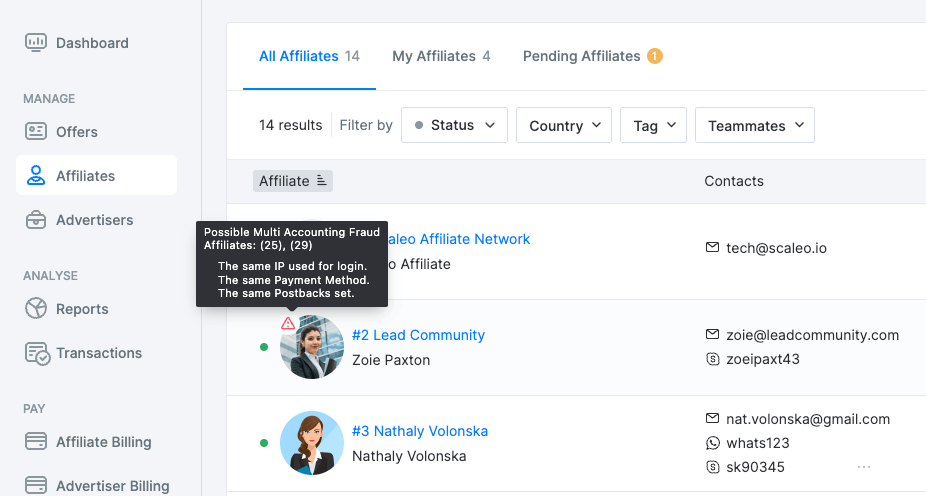
Scaleo’s Anti-Fraud Logic analyzes multiple parameters on traffic and conversions to prevent abuse, including IP-based signals, ISP/ASN patterns, device and environment attributes (device, browser, OS), referrer/source integrity, cookie behavior, and blacklist checks, then uses risk logic to identify suspicious activity as it comes in.
What that means in practice:
- Real-time risk scoring on incoming traffic
Instead of waiting for end-of-week reports, suspicious patterns can be flagged as they appear. That’s crucial when fraud is event-driven and moves quickly around sports calendars, promos, or affiliate contests. - IP/ISP/ASN intelligence applied as context, not superstition
Scaleo evaluates network-level signals and can identify suspicious infrastructure patterns without relying on blunt “block everything” rules. This reduces false positives while still catching proxy-heavy and datacenter-like behavior when it clusters with other anomalies. - Device, browser, and OS pattern analysis
Fraud at scale often reuses automation tooling. Tracking environment consistency helps identify repeated stacks behind supposedly unique users, especially when combined with velocity and cookie behavior. - Cookie and session behavior checks
Unnatural cookie churn, repeated “fresh” sessions, and abnormal click patterns are classic indicators of attribution manipulation attempts. Catching these early prevents commission leakage. - Blacklist checks and flexible enforcement
Scaleo supports blacklist-driven controls alongside scoring logic. The goal is not just to block known bad actors, but to reduce the cost of detecting repeat offenders and infrastructure reuse. - Flagging suspicious traffic and conversions before payout obligations harden
The operational advantage is containment. Flagged traffic can be reviewed, quarantined, or excluded from qualification logic depending on your program rules. That’s how you prevent “we already owe them” disputes.
This is the difference between “fraud reporting” and fraud prevention. Reporting tells you you’ve been robbed. Prevention reduces the chances the robbery succeeds.
How to design an iGaming affiliate program that’s harder to exploit
Technology alone won’t save a program if the program design invites abuse. The best outcomes come from aligning tracking, qualification, fraud logic, and payouts.
- Define conversions that are expensive to fake
If you pay CPA on registration, you will buy fake registrations. Consider qualification rules that require stronger signals: FTD above a threshold, verified identity, minimum wagering, or retention criteria. The exact definition depends on your business, but the principle is constant: make the rewarded event harder to simulate. - Use tiered trust and staged privileges for affiliates
New affiliates shouldn’t get the same payout speed and flexibility as proven partners. Use hold periods, lower initial caps, and stricter review thresholds. As trust is earned, relax friction. This protects budgets without punishing established partners. - Apply caps and anomaly-triggered reviews
Volume caps aren’t just for budget control; they’re for anomaly control. If an affiliate suddenly spikes traffic or conversions, that’s not automatically fraud, but it is automatically “review-worthy.” Scaled fraud often tries to grow just under your alert thresholds. Move the threshold logic from “hard numbers” to “pattern awareness.” - Separate “marketing performance” from “payout eligibility”
This is a mindset shift. An affiliate can look profitable on surface metrics while still being risky. Your platform should support the idea that not all tracked conversions are immediately payable conversions until they pass quality and risk checks. - Treat brand protection as part of affiliate management
Include strict policies against impersonation, misleading claims, unauthorized brand bidding, and fake social pages. Enforce them. Brand abuse is not just “affiliate creativity.” It’s a liability that spreads.
Incident response: what to do when you suspect a scaled fraud campaign
When fraud hits, most teams waste time hunting individuals. The faster move is to hunt patterns, quarantine risk, then investigate.
- Quarantine first, analyze second
If a cohort looks suspicious, flag it, hold it, reduce exposure. Don’t keep paying while you “collect evidence.” Evidence collection should happen while the damage is contained. - Look for infrastructure reuse
Scaled fraud reuses parts: redirect hosts, subdomain patterns, social account naming patterns, repeated landing page structures, and consistent tracking parameters. Identify the reusable pieces and block/flag at the system level. - Audit attribution paths, not just end conversions
Track where users came from, the referrer integrity, the redirect chain fingerprints, and the click behavior leading to conversion. Many fraud systems look clean at the “conversion event” level but noisy at the “path” level. - Coordinate marketing, compliance, and payments
Fraud is not solely an affiliate manager problem. It affects chargebacks, AML risk, user complaints, and brand trust. The teams need a shared view of what “suspicious” looks like and what actions are authorized. - Update qualification rules if you’re being targeted repeatedly
If one fraud type keeps working, change the economics. Tighten conversion definitions, extend hold periods for suspicious sources, and require stronger signals for payout eligibility.
The uncomfortable conclusion
Affiliate fraud in iGaming is no longer a guy with a bot script. It’s an engineered growth machine running on AI content generation, Black Hat SEO distribution, social account farms, redirect meshes, and brand abuse. VPN-related infrastructure often overlaps because it supports both monetization and operational obfuscation.
The only realistic response is to treat fraud prevention as a system: real-time scoring, multi-signal analysis, conversion validation, payout governance, and brand protection enforcement.
Scaleo is built for this environment. Anti-Fraud Logic that evaluates traffic and conversion signals as they happen—IP/ISP/ASN context, device and browser patterns, cookie behavior, referrer integrity, blacklist checks, and risk scoring—gives operators and networks the ability to flag suspicious activity early, isolate it, and protect both budget and brand before fraud becomes an “owed commission” dispute.
If you want one blunt takeaway: the goal isn’t catching every fraudster. The goal is making your program a terrible place to run fraud at scale.