iGaming legalization in Europe is taking place gradually. Have you ever wondered how online gambling in Europe might evolve in the next few years? Which country is best to open an online casino in? With EU countries reviewing their laws, deciding which will allow online casinos in 2025 is urgent. This change could bring both opportunities and challenges to the market, and we will explore them all today.

To spark your curiosity, here are some interesting facts:
- The current Interstate Treaty on Gambling 2021 lets operators apply for licenses for virtual slot games starting January 1, 2023. This introduces new market dynamics.
- In Germany, poker is allowed in most states, but only state-owned casinos can host offline poker. This shows the varied landscape of online and offline gambling.
- Spain’s online gambling is regulated by Law 13/2011. It outlines different general licenses, showing the complexity of European regional regulations.
Want to know how these changes might affect your gaming business in the EU in 2025? Let’s dive in and look at which countries might allow online casinos soon enough.
iGaming Markets in Europe
The iGaming markets in Europe have grown a lot in the last ten years. This growth is due to changes in people’s preferences and new technology. Now, more countries are making online gambling safer and more regulated.
Rules have helped make a lot of money and keep gaming safe in the UK, Germany, and Italy. France is thinking about letting online casinos in, too. In 2023, unregulated sites in France made between €748 million and €1.5 billion, showing the need for rules.
Looking ahead, countries like the Netherlands and Sweden are focusing on keeping players safe and making money. The European market is expected to grow a lot, reaching USD 153.21 billion by 2029. Thanks to companies like Kindred, new tech like virtual reality and blockchain is making games better.
In France, in 2025, there will be big talks about online gambling rules. The gaming authority, ANJ, wants rules like those in other successful places. This change means more money and safety for players as Europe’s online gambling scene keeps growing.
Current State of Online Gambling in Europe
Online gambling in Europe is a mixed bag. Some countries, like the UK and Sweden, have strict rules, while others face problems with illegal sites. France, for example, is looking to make $12.1 billion from online gambling by 2030.
In France, you can bet on sports and play poker online, but casinos are off-limits. This pushes players to shady sites, which make between €748 million and €1.5 billion a year. Legalizing casinos could bring in a lot of money. France is studying this move carefully, aiming to decide by 2025.
Other EU countries might follow the UK, Sweden, and the Netherlands. After setting rules, these places have seen more tax money and less illegal gambling. France wants to make gambling safer and fight addiction by legalizing casinos.
The future of gambling in Europe will depend on EU laws. It’s important to understand these laws and how they affect players. This knowledge will help the industry grow.
| Country | Current Regulation | Projections by 2025 |
| France | Only sports betting and poker are allowed | The potential legalization of online casinos |
| United Kingdom | Fully regulated online gambling market | Increase in tax revenues |
| Sweden | Comprehensive regulatory framework | Reduction in illegal gambling |
| Netherlands | New regulations implemented in 2021 | Expect continued growth |
Overview of Current Online Casino Legislation in France
France is at a critical point with its online gambling laws. Right now, only sports betting and poker are allowed online. But many other games are banned. This has led to a big black market, making between €748 million and €1.5 billion a year.
Almost 1.4 million people in France might gamble too much. And about 400,000 are serious gamblers. This is a big worry.
There’s a push to make online casinos legal in France. This would stop illegal gambling and increase revenue, and the plan is to start discussing it in 2025.
Healthcare, gambling companies, and groups will join these talks to discuss how to make it work. The plan is to tax online casinos 55.6% of their earnings.
This could bring in a lot of money.
It might even help land-based casinos, which could lose up to 30% of their income.
There are big debates. Land-based casinos want a chance to adjust before online gambling opens up. But more and more countries in Europe with online gambling legality are looking into legal online gambling. They want to make money and keep players safe.
Legalizing online casinos will change France’s gambling scene. It will try to stop the dangers of uncontrolled gambling.
And it will make sure players are safer.
France’s Economic Motivation for Legalization
France faces financial challenges, like a big budget deficit. It sees online casino legalization as a way to make more money. The goal is to ease some of its economic worries.
The French online gambling market was €1.7 billion in 2020. It’s expected to grow even more, at a rate of 8% from 2021 to 2025, which shows the big opportunity for France in this area.
Online casino revenue in France jumped by 31% in 2020. This growth shows the need for new rules to maximize this sector’s potential. France is the fourth-largest regulated gambling market in the European Union.
France’s gaming authority says there’s a lot of money to be made from illegal gambling. By making it legal, France can use this money for public services. In 2020, online sports betting made up 77% of French online gambling. Adding online casinos could bring in even more money.
In short, legalizing online casinos in France can help the country’s economy and make gambling safer. This move could also benefit the national treasury greatly.
Which EU Countries Will Legalize Online Casinos in 2025?
The world of online gambling in the EU is changing fast. We’re all wondering which countries will allow online casinos by 2025. France and Cyprus are the only places where online casinos are banned. France is taking steps to change this, with a big move in their 2025 budget.
France’s casino group is worried about losing money. If online casinos are allowed, up to 30% of their earnings could be lost. Also, 65 land-based casinos might close, leading to 15,000 job losses.
As 2025 starts, France will educate the public about online casinos. The UK, Germany, and Italy have already established rules for online casinos, making gambling safer and bringing in more government money.
The European Gaming and Betting Association says France’s online casino market could make €1.5 billion a year. This shows how much money could be made if online casinos were legal. With illegal sites making €748 million to €1.5 billion in 2023, a legal market is very appealing.
France’s move might inspire other EU countries to think about online casinos. As online gambling grows in the EU, more countries might join in. They’ll need to balance making money with keeping players safe.
Key Players in the Online Casino Industry in Europe
The online casino scene in Europe is lively, thanks to many players. Big names, new startups, and management teams all contribute. They help make online casinos legal and safe in many EU countries.
- Established Operators: Big names like Bet365 and 888 Holdings have invested a lot in online casinos. They offer great games and a smooth user experience.
- Emerging Startups: Newcomers like PlayOJO and Casumo bring fresh ideas and fun games. They attract young players with cool marketing.
- Management Groups: Companies like Evolution Gaming and NetEnt are key in providing games and tech. They make online gaming better for everyone.
- Partnerships: Online casinos team up with physical ones to offer more online games. This shows how adaptable the industry is.
As rules become clearer, these big players work together. They tackle issues like gambling addiction and protect players, keeping them growing and changing in the fast-paced online world.
| Type of Player | Examples | Contribution to Market |
| Established Operators | Bet365, 888 Holdings | Extensive game selection and customer outreach |
| Emerging Startups | PlayOJO, Casumo | Innovative user experience and marketing strategies |
| Management Groups | Evolution Gaming, NetEnt | Game content and technological advancements |
| Partnerships | Local casinos and online platforms | Facilitating online transitions and regulatory compliance |
iGaming Consumer Protections Regulations in EU
The European Union greatly focuses on keeping players safe in the iGaming world. It makes sure everyone follows the rules and keeps players safe; this includes making sure online gambling is legal and fair for everyone.
In Germany, a new group started monitoring online games and betting on January 1, 2023. This group ensures players’ safety, among other things. Germany also lets some private companies offer games, making the gaming world more interesting.
Responsible gambling is a big part of keeping players safe in the EU. Countries like Germany and France are setting rules to help players bet safely. France is also working to legalize online casinos, showing they care about keeping players safe.
But making online gambling legal is hard. It’s a battle between old casinos and new online ones. The EU is working to make things safer and fairer for everyone, making sure gambling is fun and safe.
Case Studies: Successful Online Casino Markets in Europe
Several European countries have become leaders in online casino markets. They show how strong rules can help growth and stability. The UK, Sweden, and the Netherlands are examples of how to improve market performance.
United Kingdom: The UK is a top player in legal online gambling. The UK Gambling Commission sets strict rules to protect players and promote safe gambling. This has grown the market and cut down on illegal gambling.
It’s clear that the UK gaming industry is huge, bringing in billions each year. This money helps fund public services through taxes.
Sweden: Sweden started allowing online casino games legally in 2019. Licensed companies have grown a lot. The government monitors the market to ensure rules are followed and gambling is safe.
Sweden also has a high tax on gaming revenue, 18%. This shows how the government aims to make money while keeping the market competitive.
The Netherlands: The Netherlands legalized online gambling in 2021. The Dutch Gambling Authority now oversees the market, making sure rules are followed. The goal is to stop illegal gambling and keep players safe.
Taxes on gaming revenue are set at 30.1%, which shows that the government wants to make money from this new sector.
These examples show how important clear European nations’ online betting laws are. They help keep the market stable and promote safe gambling. Each country has found its own way to make these laws work for it.
Key Challenges Surrounding European Online Casino Legalization
The path to legalizing online casinos in Europe is filled with hurdles. One big issue is the pushback from land-based casinos. They worry that online casinos could cut into their profits. These casinos often fight against new rules, trying to keep their grip on the market.
Another big problem is the lack of uniform consumer protection. Each country has its own rules, leading to confusion. This can make players and operators worry about fairness and safety. The online gambling trends in the U.S. show a patchwork of approaches.
Dealing with online addiction is also a challenge. Governments must balance making money from online gambling with protecting people. This is important because more people are struggling with gambling problems.
To show these challenges, let’s look at how different European countries handle online casinos:
| Country | Legalization Status | Tax Rate | Challenges |
| France | Legalized sports betting, poker, and horse racing in 2010 | Proposed 55.6% on online casinos | High tax rates could deter new operators |
| Germany | Biggest gambling market in Europe | Varies by state | Complex regulations discourage expansion |
| Hungary | Legalized online gambling in 2013; strict control | 15% on sports betting | High licensing fees pose barriers |
| Italy | Legalized online gambling; robust player base | Varies by game type | Regulatory shifts impact market stability |
Grasping these issues helps us understand the complex world of online casino laws in Europe. Without tackling these hurdles, countries may find it hard to make the most of online gambling.
Lessons from the Global Perspective on Online Gambling
Looking at online gambling worldwide teaches us important lessons. This is true for the future of online gambling in the EU. We can learn a lot by studying how other countries regulate.
There are a few key points to consider:
- Market Regulation: The UK shows how strict rules protect players and keep things fair.
- Restrictive Advertising: Italy and Germany limit ads to help people who might gamble too much.
- User Experience: Good regulation leads to a better online experience, making players trust and enjoy more.
Also, clear licensing rules are very important. For example, Belgium checks whether gaming sites are financially stable. EU countries need this to ensure safe online gambling.
Using strategies from around the world can help EU countries. It can help them solve problems and grow their online gambling industry. Learning from others helps the EU make better policies for online gaming.
Online Casino Technology—Top Innovation Trends to Expect in 2025
The world of online casino tech is changing fast, bringing new casino trends to the table. We’re seeing big steps forward with blockchain, AI, and VR. These changes will make playing games online better and more efficient.
Blockchain makes transactions safer and clearer. Players can quickly move money in and out using Bitcoin and Ethereum. This is a big part of the online casino innovation we’re seeing.
Artificial intelligence is changing how casinos understand players. It uses smart data to make games more fun for each player. This means everyone gets a better experience, keeping players coming back.
Virtual reality is also making games more lifelike. Soon, you can play in a virtual casino from home. This will get even better with faster 5G networks.
- Increased use of biometric authentication for secure transactions.
- Gamification trends make gameplay more engaging and enjoyable.
- The growth of mobile gaming is predicted to surpass $118.90 billion by 2027.
- Use of Internet of Things (IoT) devices to personalize player experiences.
As these casino trends keep growing, casinos need to keep up. The future of online casino tech looks bright. It promises a safer, more fun experience for players worldwide.
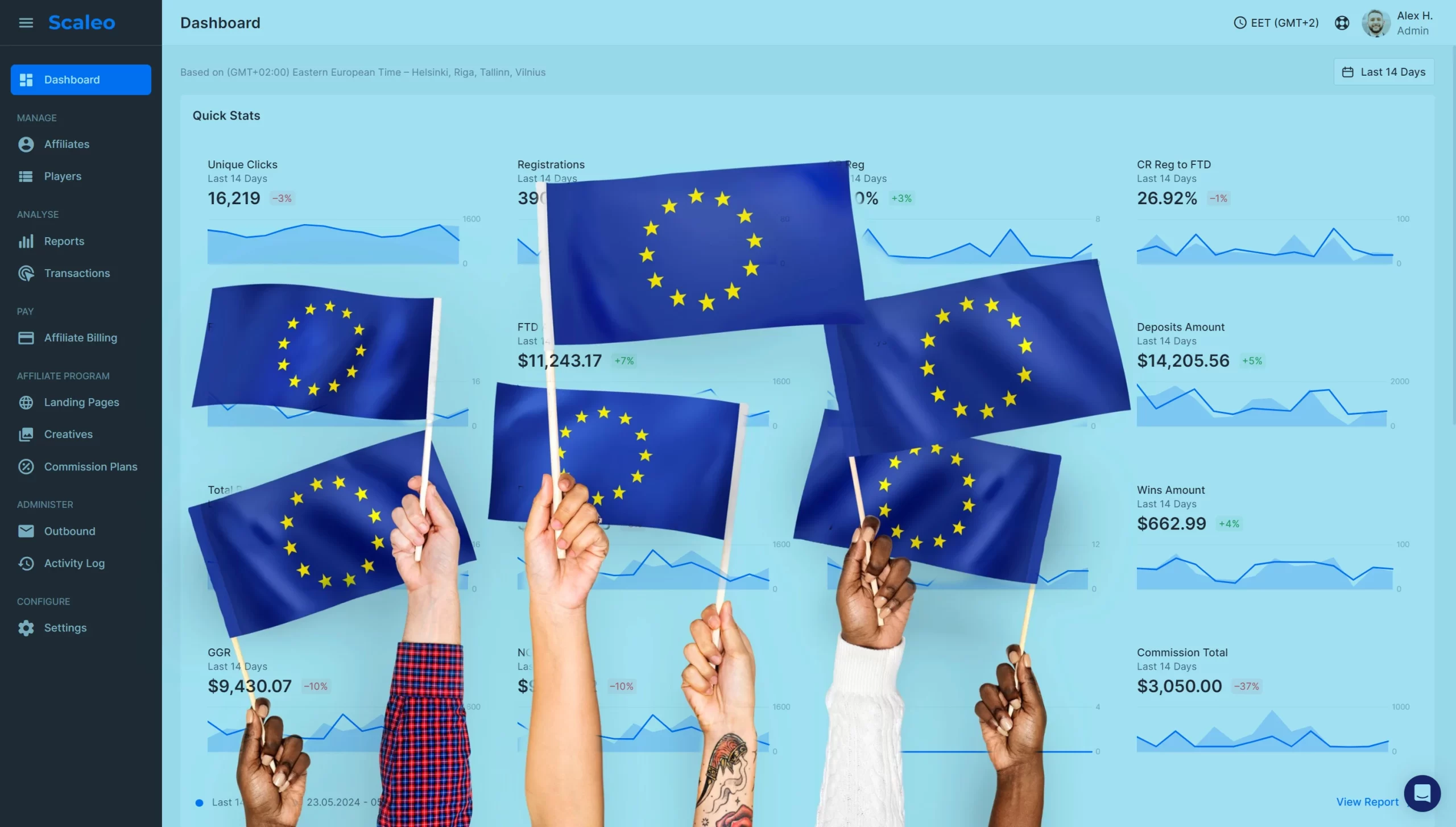
Why You Need Scaleo Affiliate Software for Your European Casino
Adding Scaleo affiliate software to your European-based online casino strategy brings many benefits at once. As more countries open up to online casinos in 2025, using the right tools is key to success. Scaleo helps manage partnerships better and boosts revenue with detailed tracking and reports, so you can make the most of your affiliate partnerships.

Keeping up with online casino innovation is vital for staying competitive and Scaleo helps improve your marketing by providing real-time analytics, fraud-protection and quick adjustments. For example, modern casino games now include live dealer options, improving the experience. This change in what players want means you need strong software to keep up.
Promotions are also critical in the iGaming world. Scaleo lets your affiliates offer great custom bonuses and custom commission structures and target GEOs inside the EU.
| Feature | Benefit |
| Tracking and Reporting | Maximize affiliate performance and revenue |
| Real-Time Analytics | Optimize marketing strategies |
| Promotional Tools | Attract a diverse player base |
| Commission Structure | Incentivize affiliates for long-term partnerships |
Investing in Scaleo affiliate software keeps your European online casino leading in growth and innovation.
Which Country Is Best to Open an Online Casino in the EU?
As promised at the beginning of the article, we will tell you our opinions on which country is best to open an online casino. However, there is no definitive answer, as several factors need to be evaluated and taken into account. If you’re looking to open an online casino in the EU, the best country depends on your goals—low taxes, a strong player base, or regulatory ease. Here are the top contenders:
Best EU Countries to Open an Online Casino
| Country 🇪🇺 | Key Benefits 🚀 | Licensing Authority 🏛️ | Tax Rate 💰 |
|---|---|---|---|
| Malta 🇲🇹 | Established hub, EU recognition, global reputation | Malta Gaming Authority (MGA) | 5% on gaming revenue |
| Estonia 🇪🇪 | Low entry barriers, tech-friendly, fast licensing | Estonian Tax and Customs Board | 5% on revenue |
| Sweden 🇸🇪 | Strong player base, high trust, regulated market | Spelinspektionen (Swedish Gambling Authority) | 18% on revenue |
| Gibraltar 🇬🇮 | Tax-friendly, respected licensing, UK & EU access | Gibraltar Gambling Commission | 0.15% on turnover |
| Isle of Man 🇮🇲 | Financially stable, great banking options | Isle of Man Gambling Supervision Commission | 1.5% on revenue |
Best Overall? Malta! 🇲🇹
Malta is often the top choice due to its EU-compliant regulations, strong banking support, and iGaming-friendly tax structure. It’s home to many of the biggest online casino operators.
Conclusion
As we wrap up our look at online casino laws in Europe, it’s clear that France is leading the way. About 3 million French players use illegal online gambling sites out of a total of 9 million. Legalizing online casinos could bring in €1 billion in taxes, showing big economic gains.
The EU is moving towards safer online gambling for everyone. This means better protection for players and less black market activity. The European Gaming and Betting Association (EGBA) says France, Germany, and Italy have big black markets. Changing the rules could help a lot.
France could see a big drop in illegal gambling sites. This would help players who are often taken advantage of and make gaming safer and more responsible.
With online casinos looking up, now is a great time to get involved. Tools like Scaleo’s affiliate software can help you make the most of this growing market. As rules get better, so will the chances for everyone involved.