

In 2026, “technology” is no longer a differentiator in iGaming. It is the operating layer that determines whether your affiliate program scales cleanly, leaks margin, or collapses under bad attribution, weak reporting, and manual partner management.
For casino, sportsbook, and bingo operators, the real question is no longer whether to adopt new technology. The question is which systems actually improve acquisition efficiency, partner visibility, commission accuracy, and long-term player value.
Key takeaways
- The most valuable iGaming tech in 2026 is not flashy front-end gimmicks. It is the stack behind attribution, partner reporting, commission logic, CRM orchestration, and fraud prevention.
- Operators need first-party and server-to-server tracking because browser-based attribution is too fragile for serious affiliate programs.
- AI matters most when it improves personalization, risk scoring, segmentation, and operational speed, not when it is used as a buzzword.
- The strongest affiliate programs now connect player events, finance data, and partner reporting in one system instead of spreading decisions across spreadsheets and disconnected tools.
- If your affiliate platform cannot support real-time reporting, flexible commission models, and player-level economics, it will eventually become a revenue bottleneck.

How new technology actually influences the gambling industry in 2026
New technology influences the gambling industry in one simple way: it changes how efficiently an operator acquires, tracks, converts, retains, and monetizes players.
That sounds obvious, but most operators still evaluate technology in silos. They buy one tool for CRM, another for affiliate tracking, another for reporting, and a fourth for payments or fraud monitoring. The result is usually the same: teams cannot agree on the numbers, affiliates complain about missing conversions, finance disputes commissions, and growth decisions are made on delayed or partial data.
The operators gaining ground in 2026 are not necessarily the ones with the most tools. They are the ones with the cleanest operating model: better event tracking, faster reporting loops, stronger partner visibility, tighter fraud control, and a clearer view of player value by source.
Why affiliate technology now sits closer to core revenue operations
Affiliate used to be treated as “just another acquisition channel.” That is outdated thinking.
For iGaming operators, affiliate is now a revenue-critical layer that touches acquisition cost, brand expansion, GEO launches, market testing, partner recruitment, and long-tail traffic diversification. A weak affiliate stack does not just create reporting headaches. It slows down commercial growth.
That is why modern affiliate software is no longer just link tracking. It has to support:
- multi-event tracking across registrations, KYC, FTDs, deposits, and revenue events
- CPA, RevShare, hybrid, and tiered commission structures
- player-level or cohort-level reporting
- manual and automatic approval workflows
- partner segmentation and role-based access
- invoicing and payout logic
- anti-fraud analysis across traffic and player behavior
- fast integrations with operator systems, CRMs, and data warehouses
The technologies that matter most to operators now
Not every tech trend deserves a seat at the table. These do.
1. First-party and server-to-server tracking
If your affiliate program still depends too heavily on browser-side logic, you are building on sand.
Modern iGaming programs need reliable server-to-server postbacks, deterministic event handling, and clean attribution paths across registration, deposit, and revenue milestones. This is what protects reporting accuracy when browser environments get stricter, user journeys get longer, and campaigns span multiple touchpoints.
For operators, this means fewer missing conversions, less partner friction, and more confidence in commission payouts.
2. AI for personalization and operational speed
AI is useful when it improves conversion quality or decision speed. Full stop.
In practical operator terms, that means using AI to personalize offers, recommend content or games, prioritize retention actions, score suspicious activity, and help teams react faster to performance changes. Generic “AI-powered” claims are meaningless unless they reduce manual work or lift player value.
The smartest operators use AI in narrow, commercially useful ways. They do not hand over strategy to a black box. They use it to sharpen execution.
3. Real-time analytics and source-level profitability
Clicks and registrations are not enough. Operators need to understand which affiliates produce depositing players, which ones generate retained cohorts, and which ones destroy margin through weak quality or bonus-heavy traffic.
That is why real-time dashboards and granular source reporting matter. Good analytics let teams answer questions like:
- Which partners are driving first-time depositors, not just signups?
- Which GEOs convert well but monetize poorly?
- Which deal structures are overpaying relative to player value?
- Which traffic sources create delayed revenue but strong retention?
- Which affiliates need custom terms, stricter approvals, or tighter monitoring?
4. Flexible commission automation
This is where many operators quietly bleed money.
As affiliate programs mature, one-size-fits-all commission plans stop working. Serious operators need a system that can handle CPA, RevShare, hybrids, tiered deals, sub-affiliate logic, caps, custom rules, and exceptions without turning every payout cycle into a finance fire drill.
The more manually your team manages commissions, the more likely you are to create disputes, delay payments, and damage partner trust.
5. Fraud detection tied to partner traffic quality
Fraud prevention is not just about blocked clicks. It is about understanding whether an affiliate source is producing real commercial value.
Modern operators need systems that can surface unusual registration patterns, abnormal deposit behavior, suspicious device or IP clusters, and other traffic-quality anomalies early enough to act before they distort partner payouts or contaminate performance reporting.
The goal is not paranoia. The goal is clean economics.
What casino, sportsbook, and bingo operators should build instead of chasing hype
A good 2026 tech stack is boring in the best possible way. It is stable, measurable, connected, and built for decision-making.
| Technology layer | What operators should want from it | Business outcome |
|---|---|---|
| Affiliate tracking | Reliable event tracking, clear attribution, flexible links, clean postbacks | Fewer lost conversions and fewer partner disputes |
| Reporting | Real-time partner, funnel, GEO, and revenue visibility | Faster optimization and better margin control |
| Commission engine | CPA, RevShare, hybrid, tiers, custom deal logic, approvals | Scalable partner management without spreadsheet chaos |
| Fraud controls | Traffic-quality alerts, abnormal pattern detection, risk flags | Cleaner acquisition and lower payout leakage |
| CRM and retention connection | Shared data between acquisition and lifecycle teams | Better player value and stronger source-level decision-making |
| Finance workflows | Invoicing, payout readiness, transparent calculations | Faster settlements and better partner trust |
How affiliate marketing benefits from better operator technology
Affiliate marketing performs better when operators remove uncertainty from the system.
Affiliates push harder when they trust tracking, understand deal terms, see timely reports, and get paid correctly. That sounds basic, yet many programs still fail on one of those four points.
Better technology improves affiliate performance because it:
- reduces friction during onboarding and integration
- gives partners cleaner dashboards and more confidence in the numbers
- allows operators to recruit different affiliate types with custom deal structures
- supports faster testing of new campaigns, landing pages, and GEO offers
- creates a stronger feedback loop between partner performance and commercial decisions
In other words, better technology does not just help you track affiliate marketing. It helps you run a more credible affiliate program.
How to evaluate affiliate software for the iGaming industry in 2026
If you are choosing software now, stop asking whether it has “all the features.” Start asking whether it supports your operating model.
| What to evaluate | What to ask | Why it matters |
|---|---|---|
| Tracking model | Can it handle server-to-server tracking and multiple conversion events? | Without this, reporting breaks when journeys get more complex |
| Commission flexibility | Can it support CPA, RevShare, hybrid, tiered, and custom partner logic? | Rigid plans make recruitment and retention harder |
| Reporting depth | Can managers view traffic quality, funnel stages, revenue, and partner performance in one place? | You cannot optimize what you cannot see |
| Operational controls | Are there approval flows, role permissions, manual adjustments, and finance-friendly workflows? | Serious programs need control, not just dashboards |
| Integration speed | How difficult is it to connect to your product, CRM, BI, and payout workflows? | Great software with slow implementation still delays growth |
| Scalability | Will it work when you add more brands, GEOs, affiliates, and deal complexity? | Migration later is always more painful than buying correctly now |
The operator playbook: what to do next
If your affiliate program is growing, this is the practical order of operations:
- Map your event chain from click to registration to deposit to revenue.
- Identify where attribution breaks, delays, or gets manually corrected.
- Audit which partner deals no longer match actual player value.
- Review whether your reporting shows traffic quality, not just volume.
- Check whether finance, affiliate, and CRM teams are working from the same numbers.
- Replace manual partner operations that should already be automated.
- Choose affiliate software that fits the operator you are becoming, not the operator you were twelve months ago.
Why Scaleo fits this 2026 operator model
Scaleo is built for operators that need more than basic link tracking.
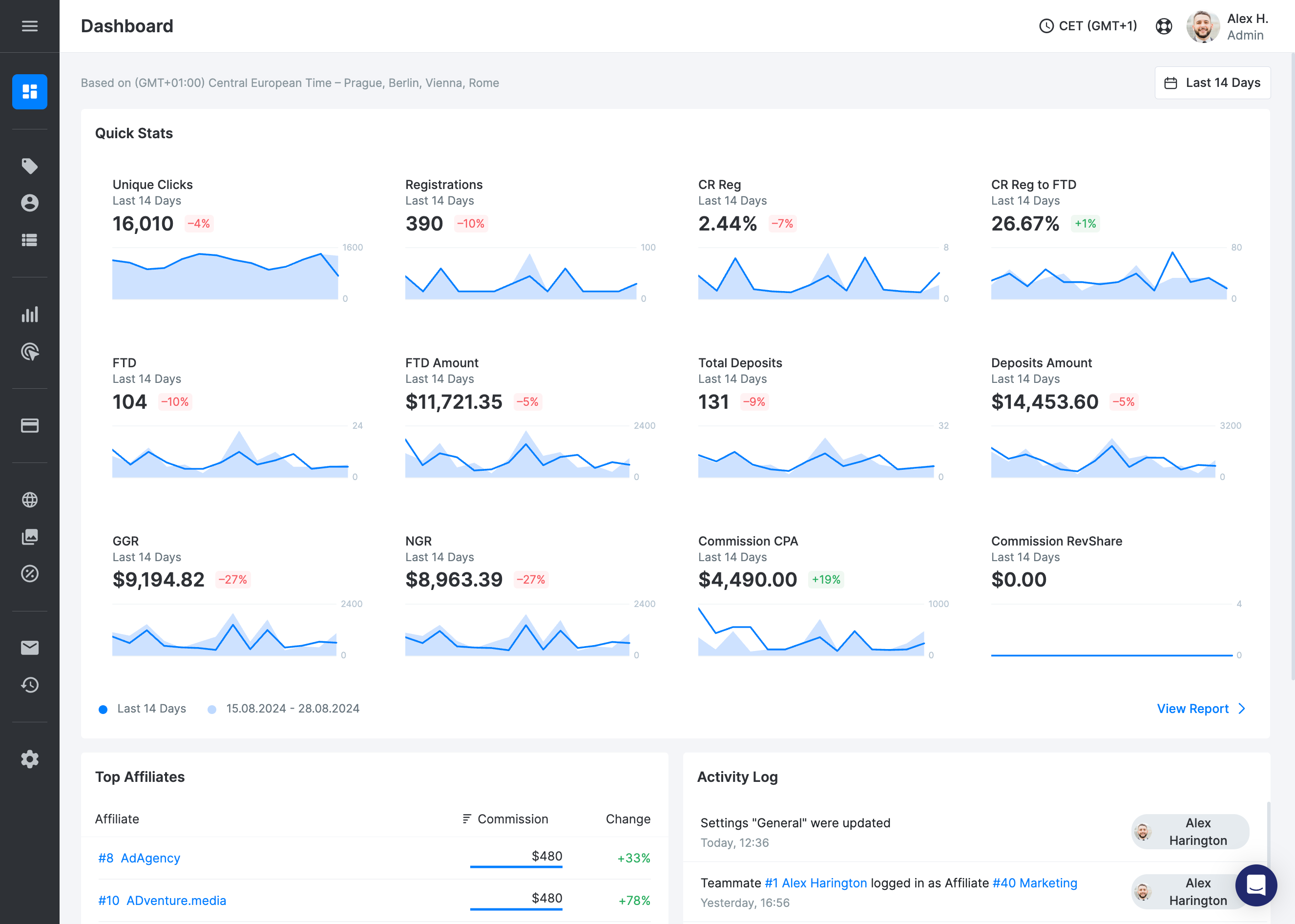
For iGaming programs, that means having the flexibility to manage different commission models, track performance in real time, monitor partner quality, and run a cleaner acquisition operation without relying on disconnected tools and manual reporting workarounds.
Instead of treating affiliate as a side channel, Scaleo helps operators run it like part of core revenue operations: measurable, controllable, and scalable.
Final word
The future of gambling technology is not about chasing every trend with a headline. It is about building an operator stack that makes acquisition more measurable, partner relationships more scalable, and revenue more defensible.
For casino, sportsbook, and bingo operators, the winners in 2026 will not be the brands with the loudest tech messaging. They will be the ones with cleaner data, faster decisions, stronger partner infrastructure, and better control over player economics.
That is the technology story worth caring about.
Try Scaleo for iGaming affiliate management
If your current affiliate setup is limiting reporting, slowing partner operations, or making commission management harder than it should be, Scaleo gives your team a more scalable way to track, manage, and optimize iGaming affiliate growth.
See how Scaleo supports iGaming affiliate programs with real-time reporting, flexible commission structures, and the operational control serious operators need.