

A partner marketplace isn’t “another portal.” It’s your growth control room—where campaigns, creators, publishers, and compliance all meet under your rules. Done right, it compresses time to launch, raises partner quality, and turns performance math into software instead of spreadsheets. Done badly, it’s a ticket queue with a nice UI. Let’s build the former.

We’ll walk through the operating model, the architecture, the onboarding flow, incentive economics, compliance and risk, liquidity (how to get partners and campaigns moving), the KPIs that matter, and—importantly—how Scaleo powers an operator-side marketplace without adding headcount chaos.
What a partner marketplace actually is
It’s a curated, rules-driven environment where your brand teams publish campaigns (brief + budget + GEO + assets + payout rules) and approved partners discover, apply, and activate quickly.
Think internal “two-sided” marketplace: demand = your campaigns; supply = verified partners. Unlike a public network, you control entry, pricing logic, creative usage, and attribution standards. That’s the whole point—control with speed.
Architecture blueprint (people, process, platform)
If you can draw it on one page, you can run it in one quarter. Here’s the simple stack.
| Layer | What it contains | Why it matters |
|---|---|---|
| 🧭 Governance | Policies, GEO/product rules, approval rights, audit trails | Prevents creative misuse and payout disputes before they start |
| 🧑💻 Partner layer | Profiles, tags, traffic proofs, KYB, payment prefs | Searchable supply; faster matching to campaigns |
| 🎯 Campaign layer | Briefs, budgets, allowed GEOs, creative packs, disclosures | “Shovel-ready” offers partners can launch in hours |
| 🧮 Economics | Rule-based commissions, accelerators, quality gates | Pay for verified value; align to LTV and payback |
| 🧪 Measurement | Cookieless S2S postbacks, creative-level ROI | Deterministic attribution across app/web and in-app browsers |
| 🛡️ Risk & compliance | Anti-fraud, GEO gating, RG messaging, name-check for payouts | Fewer emergencies; calmer audits |
| ✉️ Enablement | Launch kits, Mailroom sequences, office hours | Higher conversion with fewer tickets |
Short version: encode policy as product. When rules live in software, your marketplace scales without heroics.
Data & taxonomy (make partners discoverable)
Profiles shouldn’t be business cards; they should be matching engines. At a minimum, capture:
- GEO coverage, languages, verticals (casino, sportsbook, live), and traffic types (SEO, social, streaming, email, comparison sites).
- Audience size/quality signals, platform handles, example content, and product affinity (themes, sports, table games).
- Historic performance bands (FTD quality, Day-30 NGR/FTD, chargeback rates).
- Creative format strengths (Reels, carousels, long-form, lives), cadence, and past compliance flags.
- Payment preferences and invoicing details for smooth payout ops.
Tag it all. Then build saved searches your AMs actually use: “DACH + casino SEO,” “LATAM + Instagram Reels + live-casino,” “US state-approved + responsible-gaming badge.”
Onboarding flow that finishes in activation (not purgatory)
A marketplace lives or dies on time-to-first-campaign. Every step should end with “partner can launch now.”
| Step | Owner | SLA | Tooling |
|---|---|---|---|
| 📝 Application & KYB | Partner → Compliance | 48–72h | Intake + document checks; profile tags applied |
| 🔎 Traffic review | AM → Risk | 24–48h | Spot checks; past performance import; blacklist scan |
| ✅ Program acceptance | AM | Same day | Group assignment; baseline commission rules |
| 🧰 Enablement drop | AM → Partner | 24h | Mailroom “Launch Kit” (assets, captions, disclosures) |
| 🔗 Tracking & tests | Tech | Same day | Cookieless S2S postbacks + sanity tests |
| 🚀 First campaign go-live | Partner | < 7 days from apply | Creative visibility gated by GEO/product; self-serve links |
The outcome you want? Applications that become live campaigns inside a week, without Slack archaeology.
Incentive economics (attract pros, protect margin)
Great marketplaces feel generous and still hit payback. That paradox disappears when payouts are rules-based and quality-gated.
- Commission models: CPA, RevShare, CPL, CPC, Hybrid, Flat—scoped by brand, GEO, vertical.
- Quality gates: KYC pass + risk score below threshold + Day-30 NGR/FTD ≥ floor.
- Accelerators: 30–45-day performance bonuses with live counters (25/50/100 qualified FTDs). Time-boxed, not permanent.
- Tiers: Clear rungs with step-ups tied to retention bands, not just volume. “Elite” lock after consistent quarters.
- Corrections: Negative carry and clawbacks for chargebacks or fraud—automatic and transparent.
Example math (hybrid, casino): CPA $X + 20% RevShare, stepping to 25% and 30% as you sustain quality. Hit the ladder during a new-title sprint and collect a kicker at each rung—only on verified events. You’re paying for value, not velocity.
Compliance & risk (design, don’t bolt on)
This is where marketplaces win or lose. Put the guardrails in the rails—not in a PDF.
- Creative gating: Partners only see assets approved for their GEO/state/product. Off-scope assets simply don’t exist to them.
- Disclosures: Pre-approved captions and responsible-gaming blocks; reusable and localized.
- Attribution policy: KYC-gated; S2S postbacks as the payout truth; pixels/UTMs for diagnostics.
- Anti-fraud: Device/IP/velocity checks; holds and reviews before payroll; chargeback reconciliation into historical lines.
- Payout hygiene: Name/IBAN checks by GEO; published SLAs; automatic reconciliation.
You’ll know it’s working when legal, finance, and growth stop arguing and start iterating.
Liquidity: getting both sides moving
A marketplace needs supply (partners) and demand (campaigns). You can seed both—deliberately.
- Supply: Start invite-only with your top 50 partners; add a referral lane using sub-affiliate tiers for curated growth; run office hours and demo days.
- Demand: Ask each brand team for two “market-ready” briefs per month—GEO, budget, assets, disclosures, and start/stop dates. Put them in a browsable catalog with application flows and clear SLAs.
| Liquidity lever | Why it helps | How it looks |
|---|---|---|
| 🌱 Invite-only start | Keeps quality high | Curated cohorts; fast approvals |
| 🧲 Referral tiers | Scales supply with trust | Downline tracking; controlled growth |
| 🧺 Catalog of briefs | Gives partners a menu | “Apply” → auto-approval rules |
| 🏆 Leaderboards | Social proof attracts talent | Monthly spotlights; badges |
| 🕒 SLA scoreboard | Builds operator credibility | “Approvals in 18h avg,” publicly visible |
Momentum is a feature—design it.
90 days to working reality
Weeks 1–2: Define governance, tags, and groups. Load creative libraries with GEO gating. Wire S2S postbacks (Reg, KYC, FTD, NGR, chargebacks).
Weeks 3–4: Onboard the seed cohort; ship Launch Kits via Mailroom. Publish 10–15 campaign briefs in the catalog.
Weeks 5–6: Turn on a 30-day accelerator; enable leaderboards; pause underperforming creative families and push one-click replacements.
Weeks 7–8: Offer micro-exclusives to top performers; tighten tier unlocks to retention bands if needed.
Weeks 9–12: Publish a “what won” debrief (creative IDs, landers, captions); extend 6–12 month terms to your top quartile; clone the playbook to an adjacent GEO/vertical.
Notice the pattern: short cycles, automated rules, visible math.
KPIs and the “what now” when they flash red
| KPI | Good sign | If red, do this |
|---|---|---|
| ⏱️ Time-to-first-campaign | < 7 days from application | Shorten KYB; pre-approve asset packs; fix S2S test bottlenecks |
| 👥 Weekly active partners | Climbing with stable approval SLAs | Add briefs; increase exclusive packs; host office hours |
| 🎯 Qualified FTDs | Up with stable Day-30 NGR/FTD | Raise quality gates; rotate creative themes; improve cashier clarity |
| 💶 Payback window | On or below target | Lower CPA floors; move to Hybrid; retire promos that don’t settle on local rails |
| 🛡️ Fraud rate | Flat/down with volume up | Tighten device/velocity rules; hold risky cohorts; educate partners |
| 🧾 Disputes per 100 FTD | Falling | Expose event logs; use creative ID tracking; align captions to landing |
No drama, just decisions.
Why Scaleo is ideal for the operator-side affiliate channel
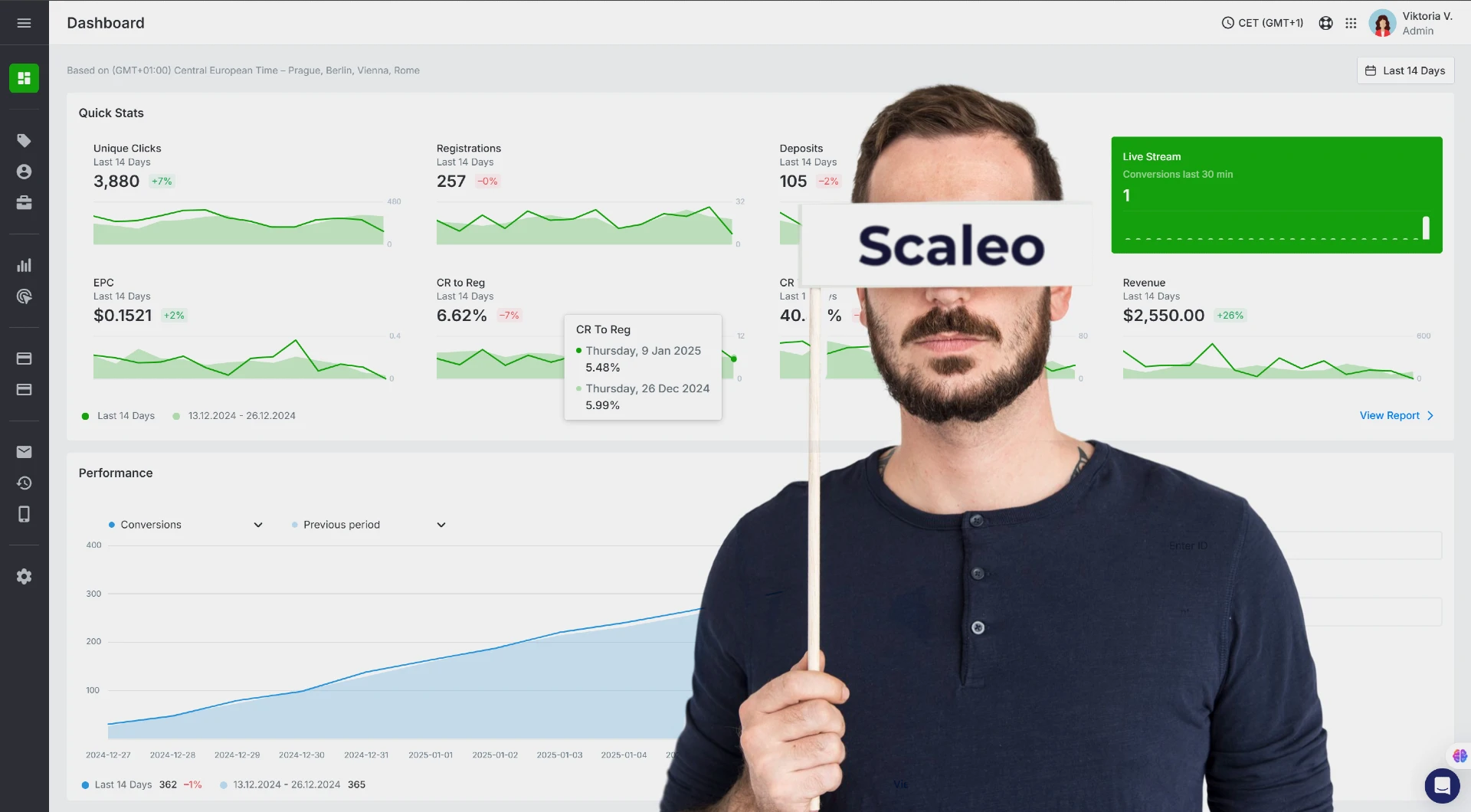
You’re not looking for another portal—you’re building a governed marketplace. Scaleo was designed to turn your policy into product, your budgets into rules, and your partner relationships into an operating system.
| Scaleo capability | Marketplace benefit | Why it matters |
|---|---|---|
| ☁️ Cookieless S2S postbacks | Deterministic attribution for Instagram/TikTok/SEO/app hops | Payouts tied to verified events, not brittle cookies |
| 🧮 Rule-based commissions | CPA/RevShare/CPL/CPC/Hybrid/Flat per brand/GEO/vertical; tiers; negative carry; clawbacks | Jurisdiction-correct models with LTV and payback control |
| 🧠 Anti-Fraud Logic | Device/IP/velocity checks; holds; chargeback reconciliation | Keeps payroll clean; protects partner trust |
| 🖼️ Creative gating & promo tracking | Partners only see approved assets; creative-ID ROI end-to-end | Stops off-scope usage; ends “who gets credit?” fights |
| ✉️ Mailroom | Launch kits, disclosures, captions, nudges, and rewards at scale | Partners launch in hours, not weeks |
| 🧭 Operator Platform | Portfolio view by brand/GEO/partner/creative; cohort payback | Weekly decisions become obvious and fast |
| 🏷️ Groups, tags, sub-affiliate tiers | Curated discovery, invite-only growth, referral expansion | Quality up, noise down |
| 🔌 APIs & webhooks | Sync with CRM/BI; custom intake forms; event streams | Marketplace feel without duct tape |
And because creative, compliance, attribution, and payouts live in one place, your teams stop reconciling screenshots and start scaling what works.
Common pitfalls (and the fix)
- Open signup chaos. Fix: start invite-only; require KYB; use referrals via sub-affiliate tiers.
- Infinite approvals. Fix: pre-approve creative families by GEO; publish SLAs; measure them.
- Pixel-only attribution. Fix: S2S as truth; pixels/UTMs for optimization only.
- “FTD at all costs.” Fix: unlock tiers on retention bands and fraud thresholds, not volume alone.
- Brand drift. Fix: creative gating, caption templates with disclosures, and auto-sunsets.
Conclusion
A marketplace isn’t a page; it’s a promise—faster launches, cleaner math, better partners. Encode the rules, wire S2S, gate your creatives, and make incentives visible enough that great partners sprint.
\Have you mapped which parts of your current partner ops could be rules tomorrow?
If yes, you’re closer than you think. If not, that’s where we start.
Want the marketplace live in 60–90 days?
We’ll model commissions by market, wire cookieless S2S tracking, gate your creative library, and ship enablement kits—so your partner marketplace behaves like a growth engine, not a help desk. Schedule a demo call now!