

If you’re paying a flat RevShare on GGR because your stack can’t model NGR per GEO and provider, you’re leaving real money on the table. The moment you operate across mixed-tax markets, flat payouts turn into quiet overpayment.
Here’s the punchline: run Germany (highly effective burden) alongside Brazil (lower effective burden), and a flat GGR RevShare can overpay by ~$15k per 1,000 active players per month.
That’s not theoretical—it’s math.

So, let’s dive into the details!
Flat RevShare ignores how money evaporates before it becomes margin: game-provider fees, taxes, bonuses, payment rails, jackpots. Those costs aren’t uniform across GEO, product, or provider. When you pay affiliates on the gross, you fund their upside with your downside. It feels generous until finance asks why contribution margin keeps missing plan in “good months.”
Assumptions are realistic operator-side inputs used to show mechanics (not legal tax advice). Rate cards and burdens differ in the wild; the structure does not.
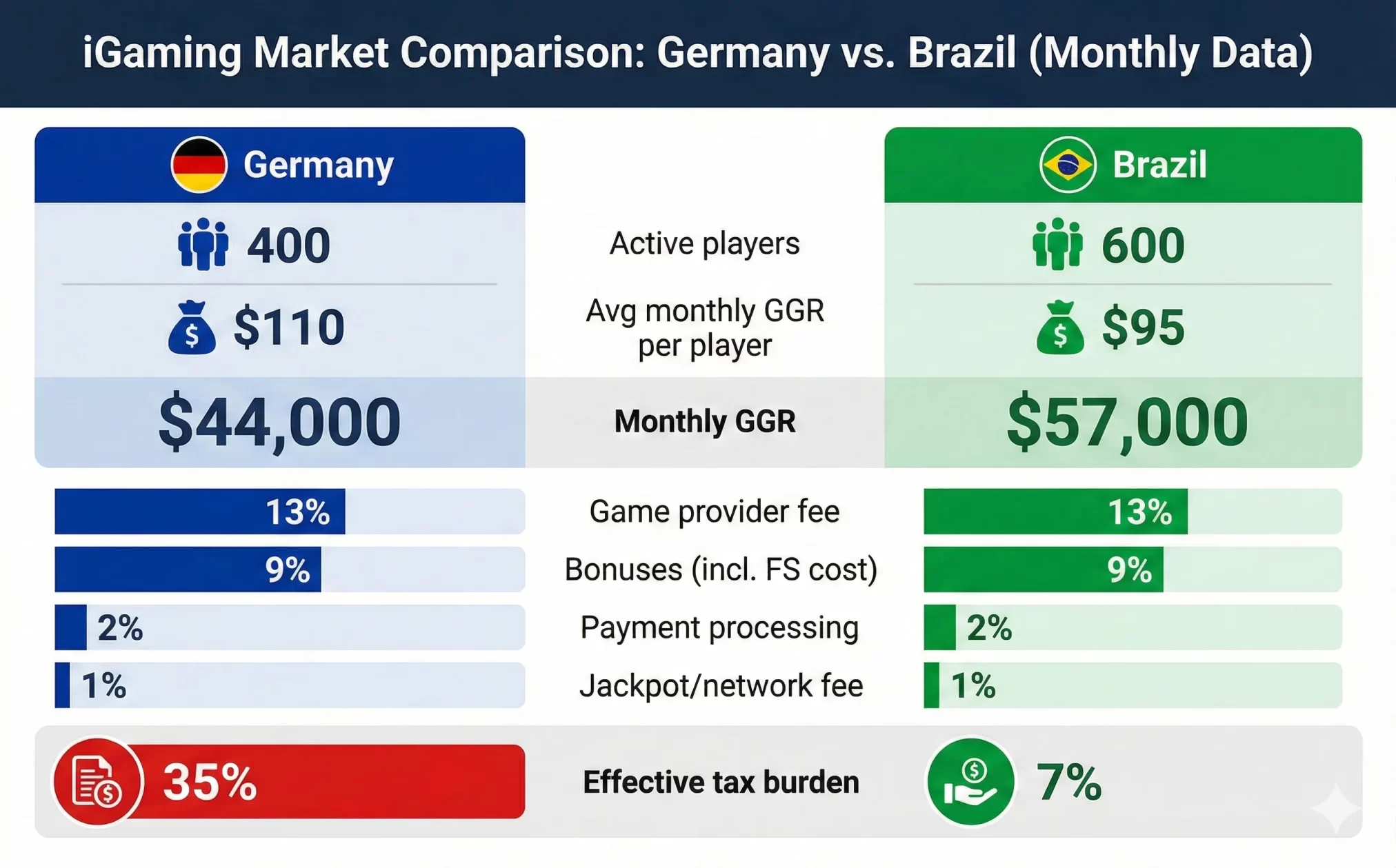
| ⚙️ Inputs | 🇩🇪 Germany | 🇧🇷 Brazil |
|---|---|---|
| Active players | 400 | 600 |
| Avg monthly GGR per player | $110 | $95 |
| Monthly GGR | $44,000 | $57,000 |
| Game provider fee | 13% GGR | 13% GGR |
| Bonuses (incl. FS cost) | 9% GGR | 9% GGR |
| Payment processing | 2% GGR | 2% GGR |
| Jackpot/network fee | 1% GGR | 1% GGR |
| Effective tax burden | 35% GGR | 7% GGR |
| 🧮 Deduction stack (pre-commission) | 🇩🇪 Germany | 🇧🇷 Brazil | 🧾 Notes |
|---|---|---|---|
| Provider fees | $5,720 | $7,410 | Catalog by provider % |
| Taxes | $15,400 | $3,990 | GEO matrix (effective rate) |
| Bonuses | $3,960 | $5,130 | Cash + FS at real cost |
| Processing | $880 | $1,140 | Cards, APMs blended |
| Jackpot | $440 | $570 | Network/house |
| Total deductions | $26,400 | $18,240 | |
| NGR | $17,600 | $38,760 | NGR = GGR − deductions |
Now compare payouts:
| 💳 Payout basis | Formula | Total |
|---|---|---|
| Flat 35% of GGR | 0.35 × ($44,000 + $57,000) | $35,350 |
| Granular 35% of NGR | 0.35 × ($17,600 + $38,760) | $19,726 |
| Overpayment at flat GGR | $15,624 / 1,000 players / month |
That gap is your “hidden 15%.” Scale the player base and it compounds—fast.
Why the gap exists
GGR is the headline; NGR is the economics. In high-burden markets like DE, stake- or GGR-based levies plus provider fees routinely delete a big chunk of gross before it can be shared. In lower-burden markets, the haircut is smaller. If you ignore that heterogeneity and ship one flat RevShare, you normalize overpayment in tough GEOs and under-incentivize growth where unit economics are healthy. It’s upside down.
What “granular NGR” actually means
Granular NGR is not a buzzword; it’s a deterministic order of operations:
- Normalize revenue at event level → bucket by GEO, product, provider
- Apply provider fee catalogs → per game/vendor, not a blanket %
- Compute GEO-level tax and levies → effective rate per product where applicable
- Deduct bonuses and FS at true cost (not face value)
- Subtract payment processing and jackpot/network contributions
- Commission affiliates on the post-deduction NGR, per their contract
One set of numbered steps. That’s it.
How Scaleo handles granular NGR without hacks
Scaleo was engineered to compute commission after the right costs per GEO/provider, and to show both you and the affiliate exactly how you got there.
| 🧰 Scaleo capability | 💡 What it solves |
|---|---|
| GEO tax matrix at payout time | Different burdens for DE vs BR without spreadsheets |
| Provider fee catalogs per game/provider | 12–15% slot fees vs lower table/other content |
| Bonus cost modeling | Cash, free spins, match promos at real cost, not face value |
| Payment rail profiles | Cards vs APMs blended into NGR per GEO/currency |
| Jackpot/network contributions | Deducted before commission consistently |
| Contract logic on NGR | CPA/RevShare/Hybrid, tiering on post-deduction base |
| Event-level ledger | Every line item traceable, affiliate-visible summaries |
| Invoice generation | Period-bound, deterministic, with adjustments and audit trail |
Affiliates still see a transparent, partner-grade breakdown. You protect unit economics and remove the “why is DE so low” tickets with a report that shows them exactly why.
What changes when you switch to NGR
Cash flow normalizes. Finance stops arguing with physics. Pricing teams can finally model deals per GEO without fearing the payout engine. Your partner managers get a contract they can defend. And yes, affiliates stick around—because trust is higher when the math is consistent and visible.
A quick sanity check for your program
Use last month’s data and re-run the same 1,000-player pattern through your current payout logic. If your numbers look like the first table but you’re still paying 35% of GGR across the board, you’ve likely shipped an extra $15k you didn’t need to. Flip the base to NGR, keep the headline RevShare if you like, and let Scaleo do the deductions cleanly before payout.
Executive P&L Impact (What 15% Really Means)
Translate granular NGR into EBITDA. Show a before/after bridge for mixed-GEO portfolios (Germany/Brazil/Canada). Include FX and provider-mix effects. Tie it to CAC payback and LTV:CAC so board sees margin-quality, not just revenue.
Scenario & Sensitivity Modeling
Model three levers C-levels care about: tax shocks, provider fee shifts, bonus intensity. Show how a ±5pp tax or +2pp provider fee changes monthly contribution and affiliate payouts when you pay on GGR vs NGR. Use it to pre-approve guardrails for deal desks.
| lever 🎛️ | change | flat GGR payout Δ | granular NGR payout Δ | EBITDA Δ (per 1k players) |
|---|---|---|---|---|
| DE tax +5pp | +5% of GGR | +$0 (you still overpay) | −$1,760 | −$3,520 |
| provider fee +2pp | +2% of GGR | +$0 | −$704 | −$1,408 |
| bonus intensity +3pp | +3% of GGR | +$0 | −$1,056 | −$2,112 |
Compliance, Audit & Board Governance
Codify the order of deductions (provider → tax → bonus → rails → jackpot → commission) and make it board-approved policy. Add quarterly audit packs: NGR reconciliation, rate-card versions with effective dates, random sample of affiliate invoices, and variance analysis vs finance actuals. This de-risks regulator queries and M&A diligence.
Cash Flow & Treasury Planning
Move from “we’ll see at month-end” to weekly NGR-based cash forecasts by GEO/currency. Feed treasury: expected affiliate payout, expected tax remittance, provider invoices, PSP fees. Hedge rules: only hedge when exposure >$X and confidence >Y%. Paying on NGR shrinks variance bands—treasury will love you.
Commercial Policy & Contracting
Standardize RevShare on NGR with addenda for GEO/provider matrices. Bake in auto-adjusters: if effective tax or provider fee changes ±2pp, RevShare auto-reindexes to keep target contribution margin. Tiering should hinge on NGR and verified quality metrics (retention day-30/60, ARPPU), not raw GGR.
Change Management & Partner Communications
You’ll only switch once—do it cleanly. Publish a one-pager to affiliates: “What changes, what doesn’t, and how you can verify.” Include a sandbox report showing old vs new for last month, side-by-side. Offer an escalation path and a 60-day grace option for top partners. Clarity = retention.
One Number to Run the Business
(CRO/COO Dashboard)
Define four executive KPIs and make them impossible to game:
- Contribution margin per 1k players (by GEO)
- Affiliate payout as % of NGR (target band)
- Effective tax + provider + bonus haircut (stacked)
- Dispute rate and time-to-resolution (billing)
Risk Register & Playbooks
Map “what could hurt us next quarter”: new excise in a key GEO, provider fee renegotiation, PSP surcharge, bonus abuse spikes. For each, pre-write the mitigation: price push to affiliate tiers, promo throttles, provider mix shift, KYC/AML tightening, or GEO-specific commission reindex. Executives want rehearsed moves.
Data Provenance & Auditability
Make event-level lineage explicit:
source event → normalization → deduction attribution → invoice line.
Freeze FX at invoice time from a single source, store alongside the invoice. Six months later, you can reproduce the exact cents without re-running history. That’s diligence-grade.
Talent & Org Design
Own NGR in a tiny “revenue architecture” pod: one finance analyst, one product ops owner, one data engineer.
Give them authority over the deduction catalogs and contract templates. Everyone else consumes their outputs—no rogue spreadsheets.
Conclusion
Flat GGR RevShare is easy; it’s also expensive in mixed-burden markets. The “hidden 15%” is the difference between a channel that scales and one that silently bleeds. Move the commission base from GGR to granular NGR—provider fees, taxes, bonuses, processing, jackpots—then pay on what’s truly shareable. Scaleo already does this out of the box, with audit-ready math and affiliate-friendly reporting.
Launch your affiliate program with the best-in-class solution
Scaleo software is designed specifically for the iGaming industry, providing a ready-to-use solution that allows you to focus on scaling partnerships that grow your business.