How should you pay affiliates in 2026? For most businesses, this is no longer a back-office detail. Payouts affect affiliate retention, finance operations, compliance, and how scalable your program actually is. If affiliates cannot get paid easily, on time, and through methods they trust, they leave. If your finance team has to reconcile payouts manually across too many tools, your program becomes expensive to run. The right payout setup sits in the middle: simple enough…

You’re launching a casino. Your Platform-as-a-Service provider (SoftSwiss, EveryMatrix, SoftGamings) offers everything: game aggregation, payment processing, player management, CRM, and—conveniently—a built-in affiliate module. One login. One vendor. One invoice. Integrated out of the box. You sign the contract. Two years later, your affiliate program drives 70% of your player acquisition. You have 240 active partners, 18 months of click history, thousands of tracking links distributed across review sites and influencer channels, and €3.2M in annual…
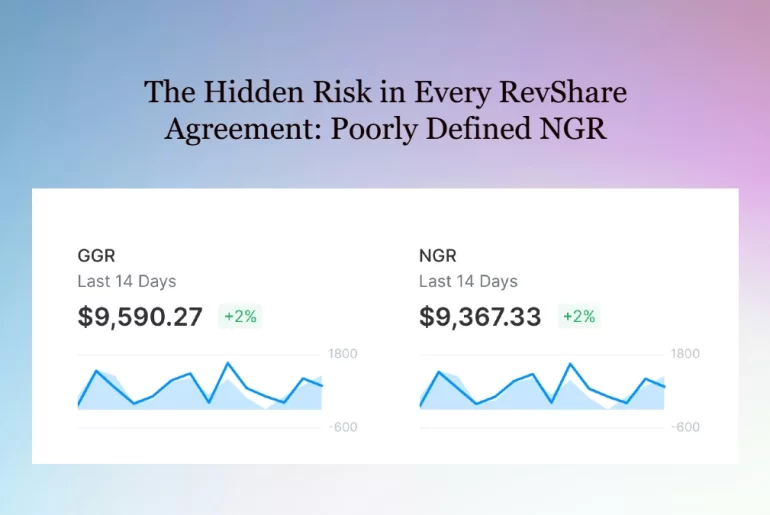
Your affiliate program generated €2.4M in Gross Gaming Revenue last month. You calculated Net Gaming Revenue at €1.3M after deductions and paid affiliates 35% RevShare: €455,000. Three of your top affiliates are now disputing their payouts. They claim you applied “hidden deductions.” Your finance team insists every deduction is legitimate. Your legal counsel reads the contract: “RevShare calculated on Net Gaming Revenue after standard operational costs.” That vague clause just cost you three affiliates and…
You’ve got multiple licenses. Multiple brands. Multiple GEOs. And a partner list that looks like a small country: 340 active affiliates, some cross-promoting, some laser-focused on one region, some “mysteriously” sending traffic that always spikes at 2AM. So here’s the question that determines whether your affiliate program scales… or slowly turns into a monthly crisis: Are you running three affiliate programs, or one affiliate system with brand-level control? If you’re running separate platforms per brand,…
TL;DR The biggest U.S. sportsbooks — DraftKings and FanDuel — each spend $1.2–1.3 billion per year on sales and marketing. Total U.S. category TV spend runs around $666M annually, but ad units are down 17% year-over-year as operators shift from land-grab acquisition to unit-economics discipline. Marketing spend is not one number: it stacks paid media, bonuses and promos, affiliate commissions, sponsorships, and CRM retention — and the affiliate channel remains the least publicly reported despite…
Your casino generated €2.4M in revenue last month. Your affiliate system says you owe €840K in commissions. Your finance team pulls the gaming platform’s revenue report and sees €2.1M. Your payment processor shows €2.6M in deposits. Which number is correct? All of them. And none of them. This is the reconciliation nightmare that costs casino operators real money—not because the systems are “broken,” but because nobody built a coherent framework for how affiliate data, platform…
You’ve built a casino platform. You’ve secured your gaming license. Your lobby is stocked with slots, live dealer tables, and sports betting markets. Now comes the hard question: how do you actually acquire players at scale without burning through your marketing budget in three months? The answer, for most successful iGaming operators, is affiliate marketing. Unlike paid ads where you pay upfront for clicks that may never convert, affiliate programs let you pay only for…
Here’s the blunt truth, right up front, for the exec who only reads the first paragraph: A casino affiliate migration is successful only if the same player, triggering the same event, produces the same payout—bit-for-bit—before, during, and after the cutover. If you can’t prove that down to the individual player level, you didn’t migrate. You rolled the dice and hoped for the best. Everything below exists to enforce that invariant. We, the team behind Scaleo,…
Every customer-facing business needs a reliable customer relationship management (CRM) system. Casinos and real-money gaming brands are no exception. A purpose-built CRM helps you centralize player interactions, reduce churn, and lift revenue with targeted offers that actually resonate. The question isn’t if you need a CRM—it’s which CRM fits your operating model, regulatory footprint, and growth plan. This updated 2026 buyer’s guide walks you step-by-step through selection and rollout—what to require, what to avoid, and…
Your finance team sends you a spreadsheet at month-end with a simple question: why did we pay affiliates €847,000 when the gaming platform shows €722,000 in attributed revenue? You don’t have a good answer. Your affiliate tracking system says one thing. Your iGaming platform says another thing. Your payment processor has a third number. Your CRM has player counts that don’t match any of them. And your BI dashboard? That’s pulling from all four sources…