
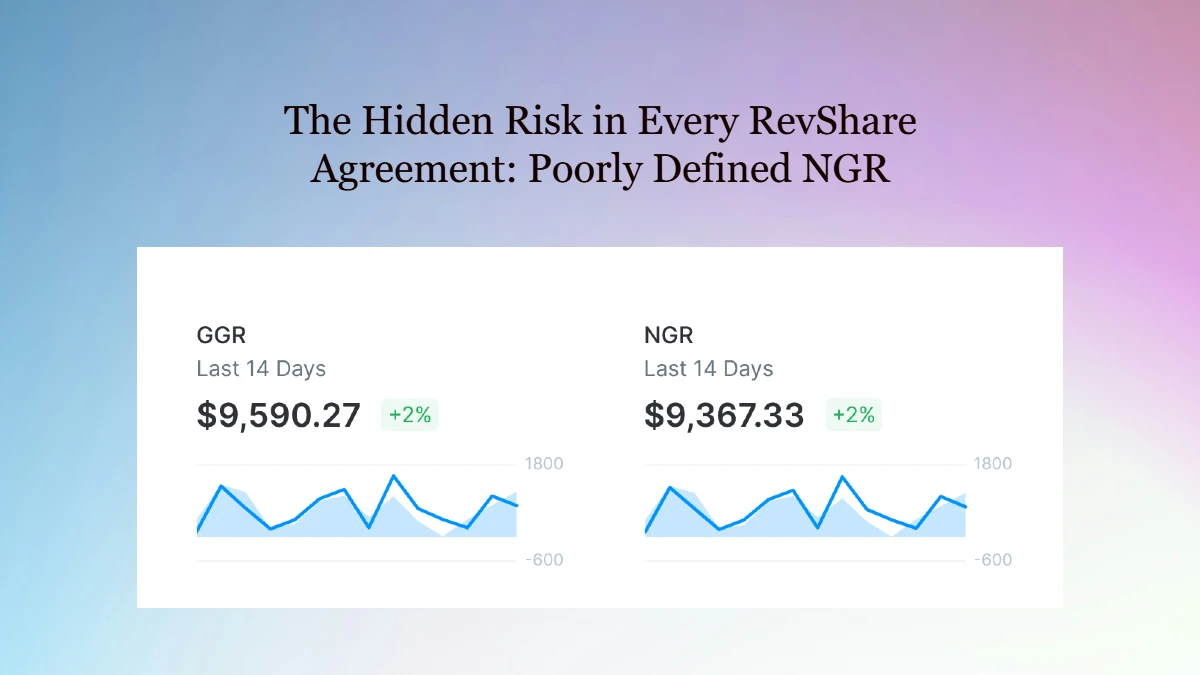
Your affiliate program generated €2.4M in Gross Gaming Revenue last month. You calculated Net Gaming Revenue at €1.3M after deductions and paid affiliates 35% RevShare: €455,000.
Three of your top affiliates are now disputing their payouts. They claim you applied “hidden deductions.” Your finance team insists every deduction is legitimate. Your legal counsel reads the contract: “RevShare calculated on Net Gaming Revenue after standard operational costs.”
That vague clause just cost you three affiliates and €180,000 in annual commissions.

We, the team behind Scaleo, have migrated hundreds of casino affiliate programs. The pattern is consistent: NGR disputes don’t happen because operators are dishonest—they happen because NGR clauses are lazy. Vague deduction definitions and calculations that can’t be audited create disputes even when everyone has good intentions.
This guide shows you exactly how to define NGR in your affiliate agreements so that RevShare calculations are transparent, defensible, and dispute-proof.
TL;DR
Net Gaming Revenue (NGR) for affiliate commissions is GGR minus a fixed list of player-linked deductions — nothing else. If a deduction can’t be traced to a player ledger entry, it doesn’t belong in NGR.
RevShare disputes happen when contracts allow vague “operational costs.” A dispute-proof NGR requires a finite deduction list, player-level calculation, clear timing rules, and full transparency in reports.
If you can’t show NGR per player, your RevShare is negotiable — and negotiable revenue always leads to disputes.
What NGR Actually Means?
Net Gaming Revenue (NGR) is Gross Gaming Revenue adjusted by predefined, auditable deductions directly attributable to player value leakage, used as the commissionable base for revenue-share affiliate payouts.
Not “revenue after costs.” Not “what we feel like paying commission on.” Player-linked deductions only.
The rule that prevents ambiguity:
“If a deduction cannot be traced to a player ledger entry, it does not belong in NGR.”
When affiliates send a player who generates €50 in GGR, they need to know exactly how much becomes commissionable NGR. If your answer is “it depends on our monthly costs,” you don’t have an NGR definition. You have a future dispute.
GGR vs NGR: What Actually Changes the Number
| Metric | What It Represents | Why It Matters |
|---|---|---|
| GGR (Gross Gaming Revenue) | Total stakes minus total winnings | Too inflated—includes bonuses and unrealized costs |
| NGR (Net Gaming Revenue) | GGR minus approved, player-linked deductions | The only defensible RevShare base |
| “Adjusted NGR” | NGR minus internal operational costs | Red flag—this is where disputes start |
If you see “Adjusted NGR,” “Operational NGR,” or “Net Net Revenue,” run. Those modifiers give operators unlimited discretion to reduce commissionable revenue after the fact.
The Only Deductions That Belong in NGR
Hard rule: Deductions must be player-linked, not operator-convenience-linked.
Legitimate NGR Deductions
| Deduction | Why It’s Defensible |
|---|---|
| Player winnings | Core component of net revenue |
| Bonuses issued | Direct player acquisition cost |
| Bonus winnings | Artificial stake inflation |
| Payment processing fees | Cost of monetizing that specific player (player-level only) |
| Chargebacks | Reversed revenue that was never realized |
| Fraud losses | Revenue from fraudulent activity (proven, documented) |
| Gaming taxes | Jurisdictional requirement (must be explicitly listed) |
Deductions That Do NOT Belong
| Deduction | Why It Causes Disputes |
|---|---|
| Platform fees | Operator overhead, not player-specific |
| Game provider fees | Cost of doing business |
| Staff salaries | Not attributable to individual player |
| Marketing spend | Double-counting (you already pay affiliates) |
| KYC/compliance costs | Business overhead |
| Currency hedging | Financial strategy, not player-linked |
If finance wants these costs covered, negotiate a lower RevShare percentage upfront (30% instead of 40%). Don’t hide them in NGR deductions after affiliates have sent traffic.
The NGR Clause That Actually Prevents Disputes
Most affiliate agreements say:
The affiliate will receive a 35% revenue share based on net gaming revenue after bonuses, taxes, fees, and other operational costs.
Why it fails: “Other operational costs” = unlimited discretion = zero trust = affiliate churn.
The Clause Structure That Works
Your NGR definition must include four components:
NGR definition (dispute-proof version, still readable):
Net Gaming Revenue (“NGR”) means, for players referred by the Affiliate only, Gross Gaming Revenue (“GGR”) less the following deductions, each of which must be attributable to a player ledger entry or payment transaction ID:
- bonuses issued
- bonus winnings
- payment processing fees for player transactions
- chargebacks
- documented fraud losses, and
- gaming taxes as applied in the relevant jurisdiction.
No other deductions, allocations, overhead costs, platform fees, provider fees, or discretionary adjustments may be applied to NGR.
Timing rule (add this — it prevents retroactive chaos):
Deductions apply in the same revenue period as the underlying player activity, except for chargebacks and fraud confirmed after investigation, which may be applied within a defined lookback window (example: 60 days) and must be traceable to a transaction ID.
Transparency rule (keep it):
Monthly reporting must include GGR, itemized deductions by category, resulting NGR, and commission calculation. On request, the Operator must provide player-level breakdowns sufficient to audit deductions.
Real-World Example: The Calculation That Breaks Trust
If an affiliate sent 100 FTDs in January:
Proper NGR calculation:
| Item | Amount |
|---|---|
| Total stakes | €120,000 |
| Total winnings paid | €96,000 |
| GGR | €24,000 |
| Bonuses issued | -€6,000 |
| Bonus winnings | -€3,200 |
| Payment fees | -€1,100 |
| Chargebacks | -€700 |
| NGR | €13,000 |
| RevShare at 35% | €4,550 |
Clean. Auditable. Every deduction ties to a player event.
What actually happened (operator added non-player costs):
| Item | Amount |
|---|---|
| NGR (as calculated) | €13,000 |
| Platform fee (monthly allocation) | -€2,500 |
| Game provider fee | -€4,000 |
| “Risk adjustment” | -€1,500 |
| “Risk adjustment” | €5,000 |
| RevShare at 35% | €1,750 |
Same player activity. Commission drops 62% because the operator added costs unrelated to this specific player’s value.
Affiliate perspective: “I sent players who generated €24,000 GGR. After legitimate deductions, that’s €13,000 NGR. I should earn €4,550. You’re paying €1,750. Where did €2,800 go?”
Actual problem: Neither party is lying. The contract was vague. This dispute was written into the agreement from day one.
The Hidden Gotcha: Aggregated vs Player-Scoped NGR
Most affiliate systems calculate NGR after aggregation, not per player.
Scenario: Affiliate sends 50 players. 45 are profitable (positive NGR), 5 have massive chargebacks.
Aggregated calculation:
- 45 profitable players: €20,000 NGR
- 5 problem players: -€5,000 NGR
- Total NGR: €15,000
The affiliate is penalized for fraud from 5 players across their entire cohort.
Player-scoped calculation:
- 45 profitable players: €20,000 NGR → Commission paid
- 5 problem players: -€5,000 NGR → Commission = €0 (not negative)
- Commission base: €20,000
Elite operators moved to player-scoped NGR in 2025-2026 to fix this fairness problem.
Timing + FX + carryover: the silent killers
Even with a perfect deduction list, RevShare disputes explode when three implementation details aren’t contractual:
- when FX conversion happens (per transaction vs month-end)
- which exchange rate source is used, and
- whether negative carryover is applied at affiliate-level, player-level, brand-level, or wallet-level.
Two programs can use the same NGR definition and still produce wildly different payouts purely from FX timing and carryover scope. If this isn’t defined, your “math” becomes negotiable.
The 2026 Regulatory Shift
Casino operators are being forced by auditors to expose ledger-level revenue math.
Why: Multi-brand licensing, cross-wallet players, and jurisdictional tax separation require granular NGR tracking at the player level.
Impact: NGR is no longer just a finance term. It’s a compliance artifact that must be auditable.
If your NGR clause can’t survive a regulatory audit trail request, it won’t survive affiliate scrutiny either.
Building a Dispute-Proof NGR Framework
Step 1: Lock the deduction list. Enumerate every allowed deduction in the contract. No “other costs” clauses.
Step 2: Map deductions to ledger sources
- Bonus issued → player_bonuses table with timestamp
- Chargeback → PSP transaction with dispute ID
- Payment fee → Transaction log with processor breakdown
Step 3: Enforce player-level attribution. Calculate NGR per player, then sum. Don’t calculate globally and divide.
Step 4: Expose NGR components in reports. Show affiliates: Players referred, Total GGR, Itemized deductions, Resulting NGR, Commission calculation.
Step 5: Reconcile monthly. Don’t let discrepancies accumulate. Monthly reconciliation catches errors when they’re fixable.
How Scaleo Handles NGR Calculation?
Most affiliate platforms can’t handle calculation complexity, which is why vague NGR definitions exist.

What Scaleo provides:
Configurable deduction rules: Define exactly which costs reduce NGR in the admin panel. Specify source (bonus_issued event), application (per player, same period), and visibility (shown to affiliate).
Player-scoped NGR: Calculate NGR individually per player, then aggregate. Prevents negative players from contaminating your entire affiliate’s commission.
Real-time NGR waterfall: Affiliates see per-player breakdown showing GGR, each deduction, resulting NGR, and their commission.
Audit trail: Every deduction links to source transaction. Show affiliates: “Chargeback of €200 on 2026-01-15, transaction ID CHG-8473.”
Negative carryover controls: Configure whether negative NGR carries forward or whether each player is evaluated independently. Make it a business rule, not a hidden quirk.
Multi-currency NGR: Calculate in player’s currency, convert to affiliate’s payout currency using documented exchange rates.
The Uncomfortable Question
If your top affiliate asked today:
“Show me exactly how my NGR was calculated last month, player by player, with every deduction sourced to a transaction.”
Could your system answer without a spreadsheet, a meeting, or an apology?
If no, you’re one dispute away from losing that affiliate.
The fix isn’t legal. It’s technical. Build NGR calculation into your platform with player-level precision and real-time visibility.
When affiliates can audit their commission themselves, disputes don’t happen. Not because you changed the math—because you removed the ambiguity.
Conclusion: NGR Is a Contract, Not a Number
Net Gaming Revenue is a contractual commitment, not a finance metric you calculate at month-end.
Vague commitments (“after operational costs”) build disputes into your program. Precise commitments (finite deduction list, player-scoped attribution, transparent reporting) build trust.
Operators who scale to 500+ partners without constant disputes treat NGR as a contract component, not a financial afterthought.
Lock your deduction list. Source every deduction to the player ledger entries. Calculate at player level. Show your work.
It’s not complicated. It’s just precise.
Tired of RevShare disputes caused by vague NGR definitions? Scaleo’s commission engine defines exactly which deductions apply to NGR, calculates per-player to prevent negative carryover issues, and provides affiliates with transparent NGR breakdowns showing every deduction source. Book a demo to see how casino operators eliminate NGR disputes without changing commission rates—just adding clarity.
🎯 Unlock the full potential of your gambling business
Get actionable insights into your players’ funnel. In-depth reports let you discover your players’ journeys, from clicking on an affiliate link to registration and deposit.