

Casino compliance software isn’t optional in 2026—it’s the operating layer that keeps licenses, payments, and partnerships intact.
The right stack centralizes KYC, AML, sanctions screening, responsible gaming (RG), case management, and reporting; it plugs into your PAM, cashier, BI, and (if you use one) affiliate platform; and it automates the boring, documentable parts while giving your team clear escalations for the rest.

Below is an operator-grade buyer’s guide: 10 strong solutions, a fast comparison, and what to look for before you sign.
Quick comparison: core capabilities at a glance
| Platform | KYC/IDV | AML/Tx monitor | Sanctions/PEP | RG analytics | Case mgmt | iGaming focus | API/Integrations |
|---|---|---|---|---|---|---|---|
| ComplyAdvantage | ✅ | ✅ | ✅ | ❌ | ✅ | ⚠️ | ✅ |
| GBG | ✅ | ✅ | ✅ | ❌ | ✅ | ⚠️ | ✅ |
| Jumio | ✅ | ⚠️ | ⚠️ | ❌ | ✅ | ⚠️ | ✅ |
| Onfido | ✅ | ⚠️ | ⚠️ | ❌ | ✅ | ⚠️ | ✅ |
| LexisNexis Risk (incl. RiskNarrative/World-Check) | ✅ | ✅ | ✅ | ❌ | ✅ | ⚠️ | ✅ |
| Fenergo | ✅ | ✅ | ✅ | ❌ | ✅ | ⚠️ | ✅ |
| Veriff / Sumsub (IDV suites) | ✅ | ⚠️ | ⚠️ | ❌ | ✅ | ⚠️ | ✅ |
| NICE Actimize / Feature-rich AML | ⚠️ | ✅ | ✅ | ❌ | ✅ | ⚠️ | ✅ |
| Neccton (player protection) | ❌ | ❌ | ❌ | ✅ | ✅ | ✅ | ✅ |
| Mindway AI (RG & risk) | ❌ | ❌ | ❌ | ✅ | ⚠️ | ✅ | ✅ |
Legend: ✅ native strength | ⚠️ available/partnered or limited | ❌ not the focus
Tip: most operators pair an IDV/KYC leader + an AML/sanctions engine + a dedicated RG analytics tool. Trying to force a single tool to do everything usually leads to gaps.
ComplyAdvantage — Casino AML Screening and Real-Time Risk Signals
If your pain is transaction risk and sanctions screening, ComplyAdvantage covers automated AML monitoring, dynamic risk scoring, and sanctions/PEP/adverse media with granular alerting. It’s API-first, plays well with modern stacks, and reduces noise with configurable scenarios so your team works fewer, better alerts.
GBG — Global Identity Verification and KYC Orchestration
GBG combines document/biometric checks with data-source verification across many markets. For multi-GEO casinos, the strength is coverage and orchestration—swap data sources per country without rebuilding flows. Pair with an AML engine if you run higher volumes or many payment rails.
Jumio — Biometric KYC and Fraud-Resistant Onboarding
Jumio’s sweet spot is fast, low-friction KYC at scale: liveness detection, doc authenticity, and biometrics. If your churn is at the “upload ID” step, improving pass rates here pays back immediately. Use in front of your AML/PEP tools; let Jumio reduce false declines before risk takes over.
Onfido — Developer-Friendly IDV with Strong Liveness
Onfido is similar in aim to Jumio but leans into developer ergonomics and modular components. Good fit for operators that want to A/B onboarding flows or run different KYC steps by GEO, device, or deposit size.
LexisNexis Risk (RiskNarrative + World-Check) — End-to-End Screening and Decisioning
This stack brings deep screening data (sanctions, PEP, adverse media) and a decisioning engine that lets you model onboarding and ongoing risk checks in one place. Great for operators who need audit-proof screenings and complex rules (e.g., source-of-funds triggers at thresholds).
Fenergo — Client Lifecycle and Regulatory Case Management
Heavier enterprise CDD/EDD with strong workflow, auditability, and regulatory reporting. If you operate in multiple licensed jurisdictions with bank-grade documentation needs and layered approvals, this is a fit. Expect a more involved implementation in exchange for governance rigor.
Veriff / Sumsub — Fast IDV Suites with Broad GEO Coverage
Both offer robust document checks, selfie/liveness, and fraud controls with good coverage and flexible pricing. Common pick for operators who want to upgrade IDV quickly and keep vendors interchangeable via API.
NICE Actimize (and peers in enterprise AML) — High-Volume AML and Case Handling
When your AML need is real-time monitoring at scale (many PSPs, high deposit/withdrawal velocity), enterprise AML platforms shine: mature rule libraries, model governance, and deep case tooling. Plan for strong internal ownership—these tools reward teams that tune.
Neccton — Responsible Gaming, Behavioral Markers, and Player Interventions
Responsible gaming isn’t a checkbox anymore. Neccton analyzes play for early risk markers, flags at-risk behavior, and supports compliant interventions and reporting. If you need regulator-grade RG analytics and self-exclusion tooling across products, this is purpose-built.
Mindway AI — Cognitive RG Models and Advisor Dashboards
An alternative/adjacent RG option with explainable risk models and dashboards tailored to RG teams. Especially useful if you want transparent logic (what behavior triggered which flag) and to train staff on consistent, documented practice.
What casino compliance software must do in 2026
Cover the full lifecycle. KYC at signup, sanctions/PEP before value moves, AML on deposits/withdrawals, RG monitoring during play, and case management with audit trails. Anything less leaves gaps regulators will spot.
Integrate via API to your real systems. PAM, cashier/PSPs, game server, CRM, and BI/warehouse. Server-to-server events beat pixels; finance and compliance should see the same ledger.
Automate the routine, escalate the exceptions. Let rules clear low-risk, consented players; route edge cases to humans with context. False positives burn teams and budgets.
Be jurisdiction-aware. Bonus language, affordability checks, self-exclusion schemes, data residency, and reporting vary per license. Pick vendors that support your target map now—not someday.
Make RG visible and easy. Deposit limits, time-outs, self-exclusion, and help links belong in prime UX, not footers. Your software should help you prove it.
Buying checklist for operators
- GEO coverage & data sources: Do IDV and screening cover all your regulated markets with acceptable pass rates?
- Latency & pass rates: What’s the average KYC completion time on mobile? What’s the liveness false-reject rate?
- Alert quality: Can you see alert volumes, false positives, and time-to-close by scenario?
- Case management: Are audit trails, notes, and escalations exportable and regulator-ready?
- Pricing model: Per-check, per-user, per-transaction—run real traffic estimates to avoid surprises.
- Roadmap & support: How quickly do they add new sanctions lists, RG frameworks, or GEO sources?
- Security & privacy: Data minimization, encryption, retention controls, and DPIA support.
- References in iGaming: Not just “financial services.” You want teams who know casino realities.
A note on affiliate marketing compliance
If you run an affiliate program, your exposure isn’t only KYC/AML. It’s also marketing compliance: claims, bonus wording, brand bidding, code/coupon abuse, geo-targeted disclosures, and paying only on verified outcomes. Your compliance stack should be able to see and govern partner behavior.
That’s where an affiliate platform comes in.
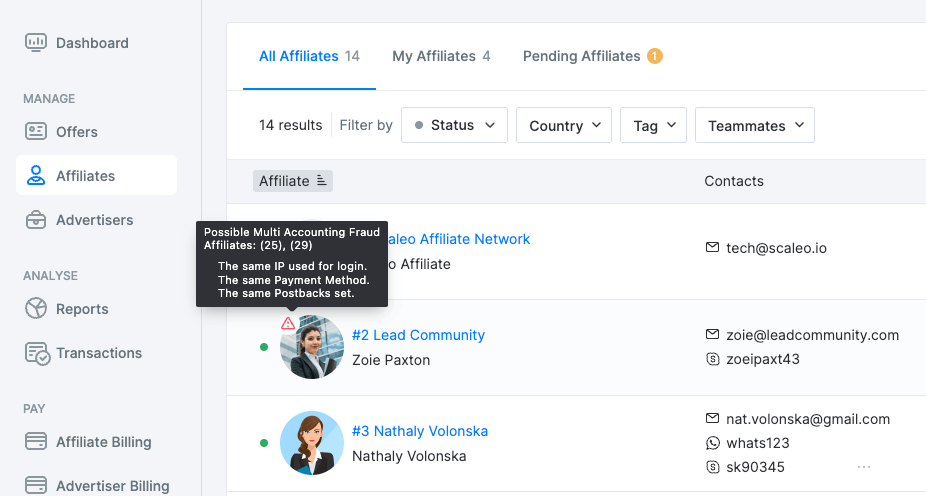
A platform like Scaleo adds first-party tracking, server-verified postbacks (deposits, wagers, withdrawals), brand-bidding alerts, code ownership rules, and audit-ready invoices—so partner payouts match your policies and regulator expectations. If you’re starting an affiliate program or migrating from a legacy tool, using a dedicated affiliate platform alongside your compliance stack keeps marketing clean and defensible.
How to assemble your stack? (practical patterns)
Lean stack (single-market, fast launch): IDV/KYC (Jumio/Onfido/Veriff) + AML/sanctions (ComplyAdvantage or LexisNexis) + starter RG (operator tools) → upgrade RG later.
Multi-market operator: Orchestrated IDV (GBG) + enterprise screening/AML (LexisNexis/NICE) + dedicated RG (Neccton/Mindway) + affiliate compliance via Scaleo.
Enterprise/regulatory-heavy: Fenergo (CDD/EDD workflow) + enterprise AML + World-Check + dedicated RG + in-house policy layer. Longer runway, strongest governance.
Conclusion
Compliance software is more than risk containment; it’s the operating spine that keeps payments flowing, licenses safe, and growth predictable. Build around three truths:
- verify identity quickly and fairly,
- screen and monitor transactions with low noise and clear audits, and
- make responsible-gaming signals obvious and actionable.
Most operators will pair best-in-class IDV + AML/sanctions + a dedicated RG tool, then connect everything to the PAM, cashier, and BI—no silos, no guesswork. If you also run affiliates, add an affiliate platform that enforces marketing compliance and pays only on verified events.
If you want to launch an affiliate program—or migrate and consolidate scattered partner channels into one auditable dashboard—try Scaleo. You’ll get first-party tracking, server-verified postbacks, brand-bidding and coupon controls, and clean commissioning, so your affiliate growth stays compliant and measurable.
FAQ
What’s the difference between KYC/IDV and AML in casino compliance software?
KYC/IDV verifies who a player is (documents, biometrics, databases) at onboarding and on risk triggers. AML monitors money movement—deposits, withdrawals, patterns—and screens against sanctions/PEP/adverse media to detect and report suspicious activity.
Do I need separate software for responsible gaming analytics?
Often, yes. RG tools analyze behavioral markers, trigger interventions, manage self-exclusion, and produce regulator-ready reports. Many generalist suites don’t go deep enough here; pairing IDV/AML with a dedicated RG platform is common.
Cloud or on-prem for compliance?
Cloud wins on speed, updates, and integrations—provided the vendor supports your data residency and encryption requirements. On-prem makes sense only where regulation or internal policy demands strict in-house hosting and you’re prepared for the maintenance burden.
Stay compliant, stay profitable. And remember—the right software makes all the difference between a headache and a smooth operation. Choose wisely, invest wisely, and your casino will thrive in the ever-changing landscape of regulations and standards.