

In 2026, iGaming user acquisition is defined by two realities: privacy-first platforms that limit granular targeting and fragmented consumer journeys that start inside social in-app browsers and often end in native apps or on desktop.
Channels that depend on persistent identifiers or broad programmatic reach face diminishing returns. Affiliate marketing, by contrast, aligns spend with validated outcomes, borrows local trust where ad platforms struggle, and compounds visibility through durable placements.

For casino and sportsbook operators seeking predictable cost and scalable growth, affiliate partnerships have become the center of a resilient acquisition strategy rather than a peripheral source of traffic.
The structural advantages are straightforward. Operators fund performance, not impressions. Partners translate offers into local language and context, improving conversion at the exact moment of intent.
Evergreen placements on comparison sites and authoritative content properties continue to provide players without constant auction pressure. And the economics can be engineered to reward durability, so acquisition quality improves over time rather than eroding as budgets scale.
The Forms Affiliate Marketing Takes in iGaming—and Where Each Wins
Affiliate distribution is not monolithic.
We should evaluate, compensate, and enable different partner types according to their roles in the funnel. Search comparison portals connect users who are deciding between licensed brands; long-form publishers clarify details like RTP, cash-out, and local payment methods to make things easier; live creators and streamers generate quick bursts of attention around major events; social and private groups on Telegram or Discord convert consumers quickly when tracking works in in-app browsers; local media and fan sites build trust where advertising is limited; and payment or fintech partners eliminate obstacles at the time of the first deposit.
Treating this network like a portfolio rather than a list is how operators stabilize their blended acquisition cost.
Each archetype has a sensible economic blueprint: comparison and SEO partners usually thrive on hybrid CPA-RevShare models tuned to lifetime value; long-form publishers benefit from RevShare or LTV-banded hybrids that reward durable cohorts; creators often require MGFs treated as advances against hybrid commissions; communities perform well with time-boxed boosts and strict caps.
When roles and economics are explicit, recruitment accelerates and end-of-month disputes taper.
Economics That Reward Durable Players, Not Just First Deposits
The most effective iGaming affiliate programs in 2026 are priced by value. Flat CPAs that ignore downstream retention encourage low-durability spikes.
Hybrids align near-term validation and long-term revenue, while LTV-aware commission bands can automatically adjust when cohorts hit defined retention and bonus-cost thresholds. The result is simple: partners with sticky players earn more, partners with churn-prone cohorts don’t, and the program’s average CPA remains predictable even as scale increases.
Temporary economics still have a role—event windows, major tournaments, or new product launches—but only when boosts are time-boxed, capped, and set to revert automatically. Predictability matters to both finance teams and partners. When terms are encoded in software rather than negotiated in chat threads, payouts reconcile to the cent and relationships remain constructive.
Compliance as a Growth Enabler, Not a Brake
Jurisdictional rules, age gating, responsible gaming intensity, and consent frameworks such as TCF-style strings should live in executable policy, not in PDFs.
Growth and compliance stop competing when the platform enforces what can render and what can pay. Creatives that are out of policy for a region never appear in that region’s asset rack; eligibility must exist before CPA validation; postbacks degrade gracefully when consent is partial.
Speed improves because missteps are prevented up front, and audits become routine because every decision carries a recorded reason.
Tracking Real Player Journeys Across Devices and App Stores
Most iGaming journeys begin in a social in-app browser, pass through an app store, onboard in a native app, and later return on desktop.
Browser pixels rarely survive that path. Modern programs rely on server-to-server click logging with partner IDs, GEO and device signals, and consent context; deferred deep links that preserve signatures through store hops and open the right in-app screen; in-app events for install, registration, and deposit sent S2S with durable identifiers; and idempotent de-duplication that prevents double-counting under replay.
When the source of truth lives in the backend, partners receive credit for what they actually drive, cross-device journeys stop creating disputes, and operators obtain stable, defensible data for decision-making.
Attribution That Behaves Like Policy
Attribution determines who gets paid; it must be versioned, simulated, and frozen during live windows. Programs that thrive choose a default model that reflects their median journey—short, time-decayed windows for in-play sportsbooks, longer windows for research-heavy casino flows—then test alternatives in shadow before making a switch.
Version IDs, change calendars, invoice examples, and explicit rules for cross-device continuity provide the clarity partners need to invest. Predictability is not a courtesy; it is the mechanism that turns one-time traffic sources into durable distribution.
How Affiliate Outperforms Search Ads, Social Ads, and Influencer Buys
The comparative advantages are visible at the P&L level.
Performance-paid partners lower blended CAC as spend scales, while auction-driven channels often raise it. Partners bring local linguistic and cultural alignment that improves conversion where generic ads underperform.
Evergreen placements and back catalogs keep producing value without incremental budget. Well-designed commission logic shifts funding toward cohorts that actually participate.
A concise comparison illustrates the choices:
| Acquisition channel | Strength in iGaming | Structural limit in 2026 | Where it fits best |
|---|---|---|---|
| Affiliate marketing | Outcome-paid, local trust, compounding placements | Requires policy discipline and platform fit | Core engine for licensed and semi-regulated growth |
| Search ads | High intent for brand queries | Rising CPCs, policy volatility | Defensive capture and brand protection |
| Social ads | Fast reach, creative testing | In-app browser breaks attribution; privacy limits | Spark tests and remarketing with reliable S2S |
| Influencer buys | Cultural relevance and speed | Floor fees without guaranteed outcome | Layered via MGFs and hybrid commissions inside affiliate |
Affiliate is not the only channel, but it is the channel that can be engineered to improve quality as it scales. In practice, the strongest growth programs let affiliates lead and use paid media to defend brand terms, test creative angles, and support tentpole moments.
Conversion and Retention: Where Affiliate Programs Extend Beyond the First Deposit
Acquiring a first deposit is useful; acquiring a player who returns without constant discounts is the business.
Mature programs connect affiliate economics to downstream performance. Partner cohorts that maintain D30 retention or meet bonus-cost thresholds receive temporary band upgrades; cohorts that churn or rely on headline discounts see bands tighten.
Operators also equip partners with compliance-ready content kits that support the behaviors they want to scale: live dealer what’s-on-now surfaces, mission explainers that encourage progression without excessive exposure, localized payment proof points that lower first-deposit anxiety.
Acquisition and retention stop being separate silos and become a single, accountable motion.
Risk Management Without Collateral Damage
Fraud in 2026 is professional and quiet: device farms, recycled KYC, incentivized installs disguised as “community,” and view inflation around creators.
Precision is essential. Rules catch obvious patterns, graph analysis and interpretable models find suspicious clusters, and holds are reason-coded with concise evidence. Quarantine should target the cluster, not the entire partner.
Transparent controls accelerate supply cleanup and keep valuable relationships intact.
Operator Reporting That Replaces Dashboard Theater
Leadership and partners do not need more charts; they need a short story they can act on.
Narrative reporting that opens with what moved, why it moved, and the recommended action—then drops into event-level tables—turns data into decisions. Cohort profitability net of promotions and refunds, retention by source, and true promotional lift are the metrics that change budgets.
The test of maturity is simple: last month’s payouts should replay to the cent, and everyone should be standing on the same numbers.
How Scaleo Enables an Affiliate-Led iGaming Acquisition Strategy?
Executing the strategy above requires an affiliate platform built for iGaming rather than adapted from generic performance marketing. Scaleo is engineered for this use case.
Event-level, cross-platform tracking stitches server-logged clicks, deferred deep-link metadata, and in-app events into a single timeline so app-store hops and device switches do not break attribution.

Commission engines price value instead of volume with hybrid CPA-RevShare baselines, LTV-aware bands, and time-boxed boosts that revert automatically with caps. Consent-aware postbacks respect privacy rules by masking or aggregating signals when consent is partial and sending richer data when it is present, with each decision logged for audits.
Risk controls are explainable: cluster-level quarantines come with evidence partners can address, reducing friction while protecting margin.
Creative and landing variants are gated by jurisdiction and partner class, so only legal assets render; localized copy blocks accompany assets for social formats, which accelerates compliant publishing.
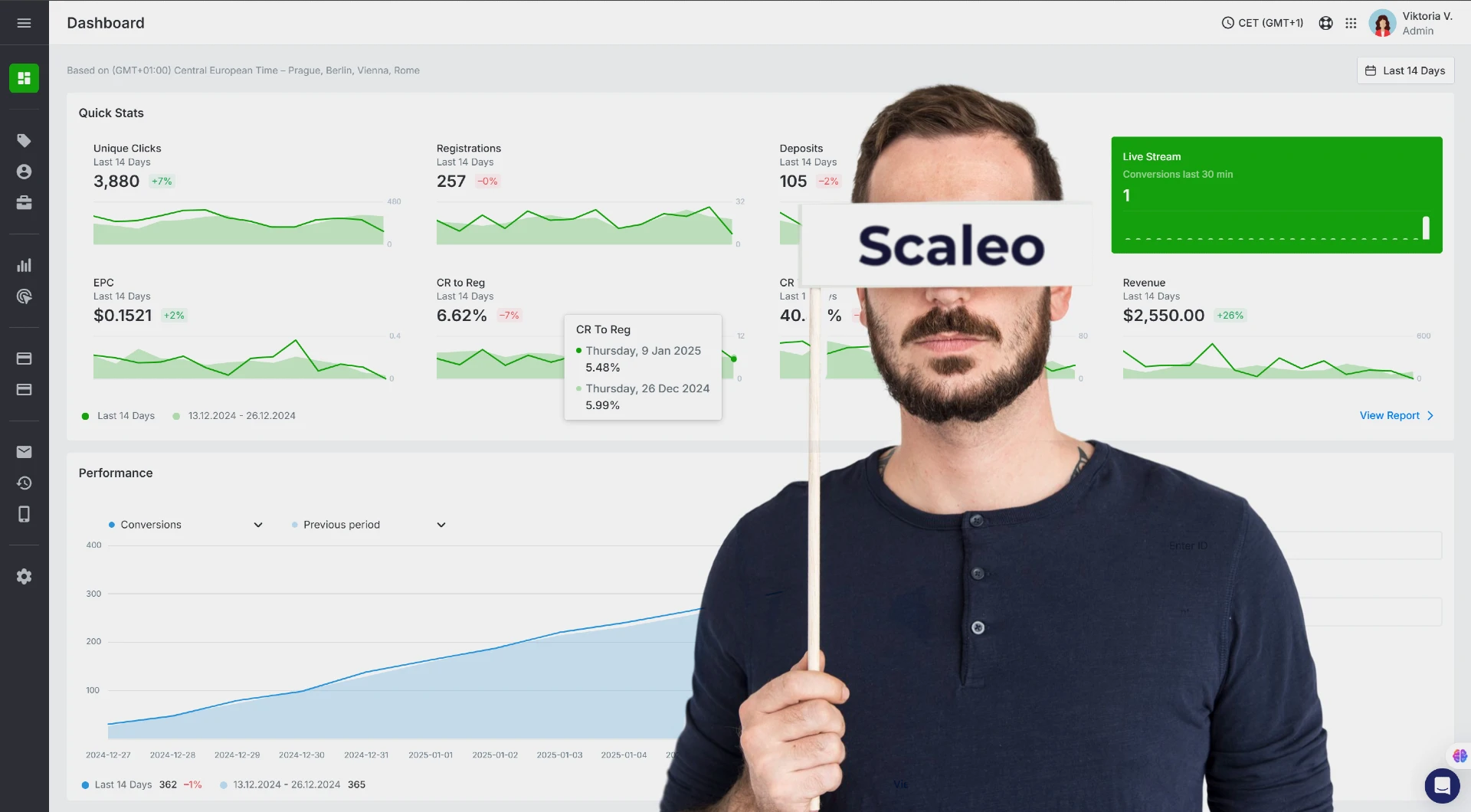
Reporting begins with a plain-English weekly narrative and drills into event tables; payouts are idempotent and replayable, giving finance and partners one version of truth. In short, Scaleo provides the operational spine that lets an affiliate-first strategy scale with calm.
Conclusion
An iGaming acquisition plan that leads with affiliate marketing is well suited to the current environment: it aligns payment with outcomes, translates offers into local trust, and creates compounding exposure without permanent auction spend.
When economics rewards durability, tracking survives real journeys, attribution behaves like policy, compliance is enforced in code, and fraud controls are precise and explainable, the network becomes an expanding channel of predictable value rather than a monthly firefight.
Operators who want that kind of stability need a platform where those choices live as software, not as slideware. Scaleo was built to be that platform for iGaming businesses ready to let affiliate marketing do the job it does best: acquire players efficiently and keep the valuable ones playing.
🎯 Unlock the full potential of your gambling business
Get actionable insights into your players’ funnel. In-depth reports let you discover your players’ journeys, from clicking on an affiliate link to registration and deposit.