
The numbers don’t lie—affiliate revenue gaps that once looked like rounding errors now add up to six-figure swings in quarterly P&L statements.
Gut instinct can feel heroic, but machines spot correlations your seasoned eye can’t. One real-time model can weigh a fresh deposit, last night’s bonus code, and an obscure geo-behavioral pattern in under 200 ms, flagging whether the click you just paid for is likely to return after the welcome thrill wears off.
That’s the kind of granularity executives whispered about five years ago; today it’s table stakes.

Here’s the bottom line: casino operators who stitch machine learning (ML) into their affiliate programs see ROI curves flatten later and peak higher. You already negotiate smarter deals, but ML makes those deals self-tuning. Frankly, watching an adaptive commission engine shave 18 % %f cost-per-acquisition while holding lifetime value steady feels almost unfair—almost.
Why does it matter to you, a battle-tested B2B professional? Because every incremental gain you squeeze from attribution accuracy or cohort targeting drops straight to EBIT. In a market where tax regimes tense up overnight and regulatory audits lurk around the corner, predictable uplift isn’t just exciting; it’s survival.
Let’s face it, no board memo says, “We’re okay leaving money on the table.”
ML 101 for iGaming Execs

Core Concepts (Supervised vs. Unsupervised)
- Supervised learning feels familiar: feed the model historical player journeys labeled profitable or non-profitable and let the algorithm reverse-engineer the pattern. Your CRM logs become a tutor; churn probability emerges as the final-exam grade.
- Unsupervised learning, on the other hand, is your data’s improv class. You drop a year’s worth of session metadata into a clustering algorithm and wait to see which quirky micro-segments surface—mid-week mobile roulette aficionados, perhaps. Neither approach is inherently smarter; success hinges on how you blend them.
Truth be told, many execs lump every ML project under the predictive umbrella. But supervised models handle prediction; unsupervised handles discovery. Mix them thoughtfully and you unlock both foresight and insight. That’s critical—absolutely critical—for optimizing affiliate spend where every percentage point counts.
Algorithms You’ll Actually Use (Regression, Decision Trees, Clustering)
Regression still rules when you need a straight answer: “What deposit amount should I expect 90 days post-signup?”
Decision trees (and their ensemble cousins, random forests and gradient-boosted machines) excel at capturing non-linear quirks inherent to casino behavior—think seasonal spikes around regional holidays. Clustering algorithms group players or affiliates based on behavior rather than demographics; suddenly, high-roller potential jumps out of low-stakes data.
Have you considered the downstream impact of switching from logistic regression to gradient boosting for churn prediction?
The lift in recall sounds small on paper—maybe three points—but imagine three more loyal players per hundred sign-ups over a year. Plateaus feel less frustrating when the model keeps nudging them upward. At Scaleo, we’ve seen operators re-allocate six-figure monthly budgets off under-performing clusters within a fortnight of activating tree-based models.
Mining Your Data: Collection & Prep
Tracking the Right Affiliate KPIs (CTR, CPA, LTV)
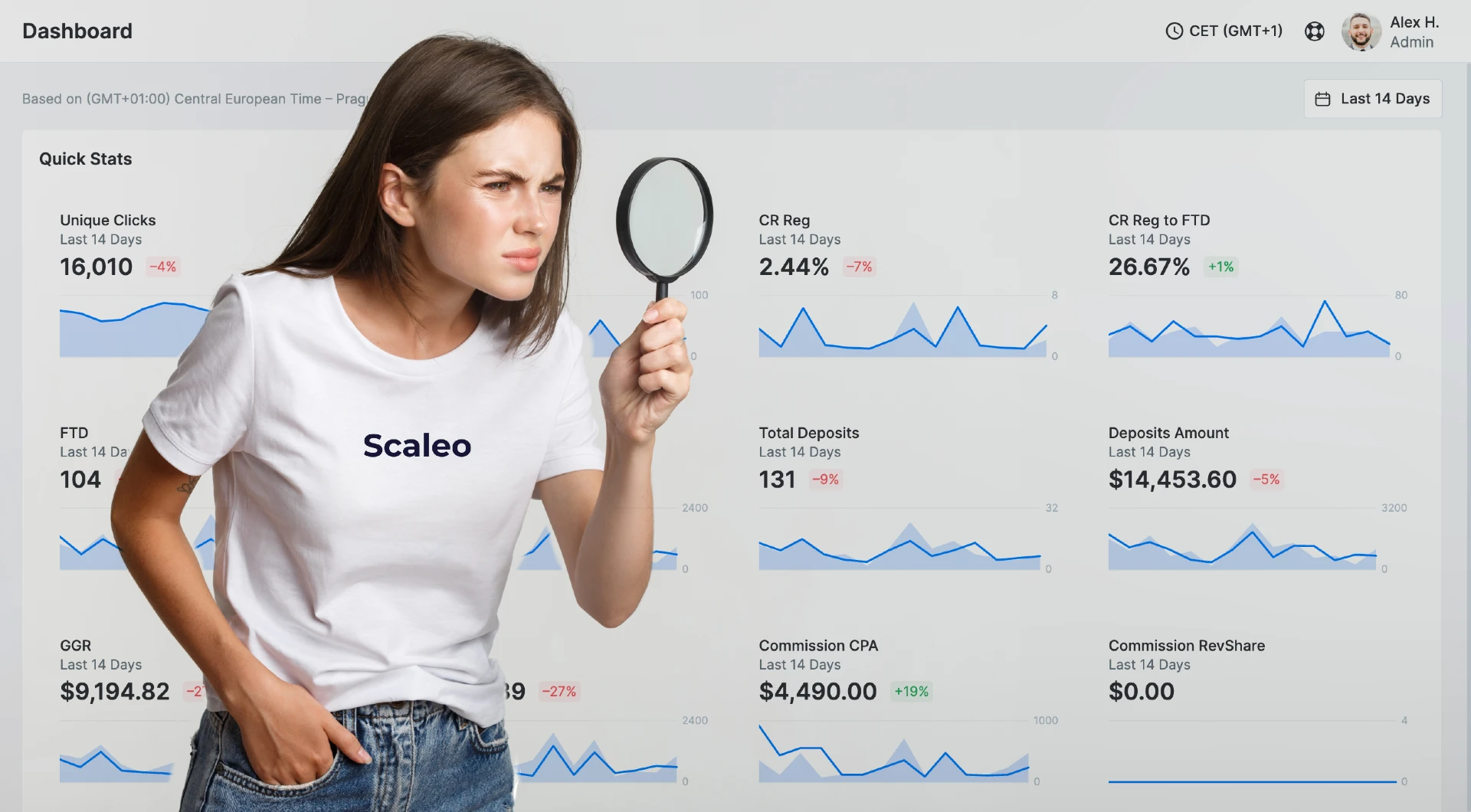
Click-through rate (CTR) is noisy; cost per acquisition (CPA) is clearer; lifetime value (LTV) is king. The hard part? LTV hides behind months of gameplay, multiple payment providers, and withdrawal latency. You can’t feed half-baked metrics into ML models and expect Michelin-star output. Start by instrumenting clean event streams—deposit timestamps, bonus code usage, session time, and, yes, chargebacks. Hook them into your affiliate dashboard so attribution events and revenue markers share a single timeline.
It’s frustrating when finance and marketing argue over which LTV definition to use. Solve it once: choose a 180-day cut-off, include net gaming revenue, and align everyone around the same SQL view.
Honestly, data fights kill more ML projects than algorithm choice ever will.
Cleaning, Structuring & Enriching Your Datasets
Raw logs resemble casino floors at 5 a.m.—messy, loud, and sticky with errors. Deduplicate by user-ID and timestamp. Normalize currencies; patch daylight-saving jumps; flag bot outliers. Then enrich. Geo-location enrichment turns an IP into a regulation class; payment-type tagging turns a deposit into a risk signal.
Here’s a tip seasoned teams swear by: maintain a separate feature store where derived variables—rolling 7-day spend, bonus hunting score, fraud risk percentile—live their own version-controlled life. That way, when your data scientists tweak a churn model, the marketing team doesn’t wake up to a broken dashboard. To be frank, feature stores feel like overhead until you deploy your second model; after that, they’re oxygen.
Building & Deploying Revenue-Boosting Models
Some executives still ask, “Can’t we just plug the data into a black box and let it print money?”
If only.
Effective models start with intent: grow net gaming revenue by 8% quarter-on-quarter without raising CPA or hold monthly churn below 12% while trimming bonuses by 10%.
Objectives: This sharp stop to scope creep is cold and gives data scientists a scoreboard finance actually cares about.
The training loop looks deceptively simple—ingest, split, fit, score—yet every phase hides landmines. Overfitting lurks when last month’s World Cup spike whispers half-truths into your tree ensemble. Validation must reflect reality slices: weekdays versus weekends, promo surges versus lull weeweeks, andPs versus casual dabblers. Only then do you wire the model into a real-time scoring pipeline with sub-300 ms latency. That target is non-negotiable; affiliates bounce if post-back delays cost them commissions.
Predicting Top-Tier Affiliates Before They Scale
Picture an affiliate manager juggling a firehose of sign-ups.
Which rookie deserves the six-figure rev-share cap?
A supervised model built on partner trajectories flags early winners by correlating their first 500 clicks with monthly net revenue. Traits you’d never spot manually—like an above-average share of live-dealer traffic from Tier-2 LATAM—light up fast. You promote winners weeks before rivals even notice.
Dynamic Commission Tuning Based on Performance Signals
| Signal Monitored | Action Triggered | Expected Impact | Review Cadence |
| 🎯 30-day Net Gaming Revenue Volatility > 40 % | Throttle CPA by 5 % | Protect margin during swings | Weekly |
| 🔄 Average Player LTV > Benchmark + 15 % | Bump Rev-Share Tier + 2 pp | Retain high-quality affiliate | Monthly |
| 🚨 Chargeback Rate > 2.5 % | Pause bonus codes | Cut fraud exposure fast | Real-time |
| ⚖️ Churn Probability < 8 % | Offer hybrid deal | Maximize predictable cash flow | Quarterly |
Picking Your Tech Stack
Off-the-shelf ML platforms seduce with drag-and-drop dashboards and auto-ML wizards—perfect when you lack data-engineering muscle or need time-to-value yesterday. Yet templates rarely parse casino quirks like split-wallet systems or multi-currency bonus wallets.
In-house stacks, by contrast, marry model flexibility to proprietary pipelines—but demand DevOps stamina and a roadmap longer than one quarter.
Most operators land somewhere in between: a commercial ML layer for rapid prototyping bolted onto containerized micro-services that speak your casino backend’s dialect. Kubernetes handles rollouts; a feature store syncs with your player-account service; Kafka pumps fresh events into the scorer. Heavy? Sure, until peak-hour surges hit and horizontal auto-scaling saves your margins.
Integration is where many dreams die. Affiliate dashboards must surface ML outputs—think “quality score 0.87” badges—without drowning partners in data-science jargon. RESTful APIs help, but front-end buy-in is equally vital. Nobody celebrates a brilliant model buried three clicks deep.
And yes, connecting all this to your affiliate platform is smoother when the platform offers extensible event streams. Scaleo’s architecture lets operators inject custom quality scores directly into commission logic while keeping UI latency razor-thin. But you didn’t hear that from a sales deck.
Tracking Success & Continuous Improvement
Rolling out a model is exhilarating; living with it is where the real craft shows. If revenue uplifts look great on slide decks but fail to survive month-end reconciliation, you’ll hear about it—loudly. So, what gets tracked, and how often?
| Signal Monitored | Action Triggered | Expected Impact | Review Cadence |
| 🎯 30-day Net Gaming Revenue Volatility > 40 % | Throttle CPA by 5 % | Protect margin during swings | Weekly |
| 🔄 Average Player LTV > Benchmark + 15 % | Bump Rev-Share Tier + 2 pp | Retain high-quality affiliate | Monthly |
| 🚨 Chargeback Rate > 2.5 % | Pause bonus codes | Cut fraud exposure fast | Real-time |
| ⚖️ Churn Probability < 8 % | Offer hybrid deal | Maximize predictable cash flow | Quarterly |
Copy-paste that straight into your wiki or dashboard spec—no reformatting headaches.
Now, about A/B testing: split your affiliate pool by traffic quality, not alphabetically. Random splits dilute signal; quality-stratified splits reveal whether the model truly nudges high-value cohorts. Run tests for at least two pay cycles so variance shakes out. It’s frustrating to yank a winning variant because early-week VIP volatility spooked finance. Resist that urge.
Why you need Scaleo affiliate software for your business
Here’s the bottom line: post-deployment, you’ll juggle model scores, live commissions, and partner messaging.

Doing that in spreadsheets feels like playing roulette blindfolded. Scaleo pipes model outputs directly into commission logic, streams KPI deltas to your dashboards in real time, and lets you flag anomalies before they morph into headline losses. Could you jury-rig a similar stack?
Sure—given enough sprints and DevOps hours.
But why reinvent the wheel when you can drive the sports car now?
Conclusion: The Future of ML in iGaming Affiliates
Reinforcement learning will nudge commission rates minute by minute, testing micro-changes in the way trading desks improve spreads. Federated models—where data never leaves geo-fenced servers—will satisfy regulators while still letting you benchmark global patterns. Picture an on-device churn estimator living inside the player app, training locally, and sharing only gradients.
Sounds sci-fi?
Give it a year.
Preparing your ops for 2026 and beyond means embedding ML literacy across teams. Train affiliate managers to read feature-importance charts. Equip compliance with anomaly-detection dashboards. Automate version-controlled rollbacks so a rogue model update never again torpedoes VIP retention at 2 a.m. Have you mapped out who owns that rollback button?
Ready to tap into AI-powered affiliate marketing?
Try Scaleo—schedule a demo and see how machine learning can start compounding your casino revenue before the next quarter even closes. 🚀