Social casinos are evolving. One of the most interesting ideas in the world of online gambling is “social casinos.” These sites let you gamble without risk and get the feel of real casinos without using real money. Now that more players are interested in this fun platform, it’s time for operators to learn what social casinos are and how they can help their business.

A new report from Bv1sion says that the global gross gaming revenue (GGR) for social casinos reached an impressive $6.2 billion in 2020 and is projected to reach $7.5 billion by 2026. With that much growth, it’s clear that social casinos are more than just a fad; they’re a chance for iGaming companies worldwide to make money.
This article breaks down everything, from the basics to more in-depth information:
- What do social casinos do?
- How did they change over time?
- Why should people who play and run casinos care?
We’ll answer these questions by going into great detail about this growing sector.
What is a Social Casino?
Social casinos let users enjoy the thrill of casino games like slots, poker, and bingo, but here’s the twist: they use virtual currency, not real money. While players can buy or earn virtual currency, they cannot convert it into real cash.
Imagine having all the excitement of a real casino with none of the financial risk.
That’s the magic of social casinos!
They create a safe, accessible gaming space that appeals to a broader audience—and for operators, this means a steady influx of new players who might be hesitant to gamble with real money.
From Social Gaming to Social iGaming—A Quick History Lesson
To understand social casinos, let’s rewind to the early 2000s when social media exploded, giving game developers a playground to experiment with social gaming concepts. This era was pivotal in the evolution of social casinos.
Early Beginnings (2000s): The Foundation
Social games like FarmVille and Mafia Wars, which gained cult-like followings, were the first to catch on in the 2000s. Social media sites like Facebook let players share their progress, invite friends, and gift items to each other. This made users very loyal. This success showed developers how important social features were for keeping people interested in games.
Early social games that made it easy to interact with friends kept users and spread like wildfire, paving the way for casino-style games to be added to social networks. The way was clear for the next big step, which was to add social casinos.
Expansion and Innovation (2010s): The Rise of Social Casinos
Because social games were so popular, the first social casino sites like Zynga Poker and Slotomania came out in the late 2000s. These games used the same social features that made FarmVille popular, but they added a casino feel to them. Classic games like poker and slots could be played with virtual money instead of real money.
Innovation took off.
These platforms gained immense popularity due to their engaging features like leaderboards, in-game chat, and the ability to invite friends. Players quickly started to form groups, compete in tournaments, and embark on quests together across the exciting landscape of the virtual casino. Operators saw a valuable opportunity; they realized that incorporating social elements—like multiplayer tournaments, cooperative gameplay, and leaderboards—was a smart way to keep players interested and coming back for more.
Mobile Gaming Boom (2010s-Present): Gaming on the Go
The mobile revolution took social casinos to a whole new level. With smartphones becoming ubiquitous in the 2010s, players could carry their favorite social casino games with them. This “anytime, anywhere” access made social casinos even more attractive, resulting in an unprecedented engagement and player retention boom.
Today, social casino games offer live social interactions, real-time multiplayer experiences, and vibrant player communities. These elements bridge the gap between traditional iGaming and the social gaming world, attracting both casino enthusiasts and casual players alike.
Social Casinos in 2026: What Trends to Expect?
Social casinos are mainstream entertainment products with casino-grade live-ops, ruthless A/B testing, and a monetization stack that blends in-app purchases, rewarded ads, and offers. 2026 rewards operators who treat them like forever-games, not seasonal spikes. We’re seeing tighter platform rules, savvier players, and rising user-acquisition (UA) costs that force smarter creative systems and deeper retention loops. Exciting? Yes. Unforgiving? Also yes.
Three forces shape the year.
First, privacy and platform policy keep narrowing ad targeting, so performance shifts from precision targeting to creative iteration, contextual placement, and first-party engagement (email, push, communities).
Second, the monetization mix evolves beyond whales: hybrid revenue—moderate IAP, high-fill rewarded video, and sponsorships/brand quests—stabilizes ARPDAU without squeezing LTV dry.
Third, live-ops sophistication becomes non-negotiable: seasonal passes, collection metas, social squads, and limited-time “event casinos” lift day-7 and day-30 retention while tempering bonus-abuse loops.
Have you considered the downstream impact of running aggressive welcome bundles without a long-tail meta? Short-term ARPU pops, then churn eats your margin.
User Acquisition in Social Casinos in 2026
UA gets harder, but not hopeless.
We see creators and streaming partners driving high-trust traffic when priced on hybrid floors (small CPA + revenue kicker) and protected by first-touch rules. Paid social still scales with disciplined frequency caps, country-by-country creatives, and landing flows that behave on low-end Android. Programmatic only works when you prune the supply path and buy contexts (sports, puzzle, idle) that match play styles. It’s frustrating when a high-CTR creative stalls on day-2, isn’t it? Nine times out of ten, the culprit is misaligned onboarding: too many taps to first spin, or a reward loop that peaks before users understand the meta.
On product, we expect lighter 3D and richer 2D (faster loads), club mechanics that unlock cross-player goals, and soft-currency sinks tied to collections, not just jackpots—because sinks drive session density without constant discounting. Responsible design matters, too: clear timers, sane cooldowns, and transparent odds where applicable. Not just ethics—trust drives retention.
| 🧭 Trend (2026) | 📌 What it means | 📈 Impact on UA/Monetization | ✅/❌ Are you ready? |
|---|---|---|---|
| 🎯 Contextual + creative-led UA | Less audience precision, more message-market fit | Better CPI stability; creative ops becomes a profit center | ✅ if you ship 10–20 new concepts/month; ❌ if “two ads forever” |
| 🧪 First-party engagement loops | Email, push, Discord/communities, web onboarding | Lowers paid dependency; improves reactivation | ✅ if consent + cadence exist; ❌ if you rely on push alone |
| 🧰 Hybrid monetization (IAP + ads + offers) | Balance whales with broad payer base | Higher ARPDAU without whale risk concentration | ✅ if ad quality filters exist; ❌ if only deep bundles |
| 🕹️ Live-ops seasons & collections | Repeatable events, collection metas, passes | Retention lift; predictable revenue calendars | ✅ if you run a 6–8 week season plan; ❌ if events are ad hoc |
| 👥 Social squads/clans | Cooperative goals, squad rewards | Session density, lower churn, organic UA | ✅ if squads tie to rewards; ❌ if purely cosmetic |
| 🛡️ Responsible design & clarity | Timers, fair loops, transparent odds | Fewer complaints; higher long-term trust | ✅ if surfaced in-app; ❌ if buried in policy pages |
| 🚪 Alternative funnels (web → app) | Pre-qualify traffic, cut fees in some regions | Cheaper trials; stronger first-party data | ✅ if deep links persist; ❌ if tracking breaks on handoff |
| 🤝 Creator & partner programs | Streamers, portals, newsletter placements | Higher-quality cohorts; durable scale | ✅ with hybrid payouts & first-touch rules; ❌ with CPA-only chaos |
Where does partner tech fit?
If you run creators, affiliates, or portals, we recommend evidence-first attribution (first-touch protection + last non-direct for finance), staged payouts on verified milestones (install → day-3 retention → purchase), and dispute SLAs that end email theater. Clear rules, fewer surprises.
Why Do Players Flock to Social Casinos?
Curious why players are hooked on social casinos? Let’s break down the appeal:
| Feature 🃏 | Why Players Love It |
|---|---|
| Play it Safe 🎲 | Social casinos let players enjoy the thrill without risking real money—a key draw for many. |
| Play Anywhere 📱 | Thanks to mobile gaming, players can access social casinos whenever and wherever they want. No time restrictions, just seamless gameplay. |
| Play with Friends 👥 | Built-in social features like chats, friend invites, and multiplayer modes let players connect, compete, and have fun together. |
| Wide Range of Games 🎮 | From poker to slots, blackjack to bingo, social casinos offer a diverse selection that keeps the gameplay exciting and fresh. |
| Free to Play 💸 | Virtual currency means anyone can play, regardless of budget. For most, it’s an easy, entertaining pastime without any strings attached. |
What Games Can Players Find in Social Casinos?
Social casinos cover various games, allowing players to find something they enjoy or discover new favorites. Classic casino games like slots, poker, and blackjack are staples, but innovation is ramping up. Social casinos have started offering live-streamed games, real-time multiplayer options, and even gamified experiences that blend elements of role-playing games (RPGs) and strategy.
Are Social Casinos Free to Play?
Yes—and no.
People don’t use real money to bet or win, but a lot of social casinos use a “freemium” model where people can buy virtual money to make their experience better. The game is still free to play, but you can add extra fun, make it your own, or speed up the game’s progression by making purchases.
Do You Need a License to Run a Social Casino?
One thing that makes social casinos stand out is that they are legal. Since these platforms don’t let people gamble with real money, they often get around the strict rules that apply to casinos that do accept real money. However, legal systems vary from place to place, so operators need to know the rules in their area to avoid problems.
Monetizing a Social Casino
Want to know how to make money with a social casino? There are several tried-and-true ways for operators to make money:
| Monetization Strategy 💰 | Description |
|---|---|
| In-Game Purchases 💵 | Players buy virtual currency, usually to speed up progress or unlock exclusive features, making it a steady revenue stream. |
| Ad Revenue 📢 | Many social casinos show ads to players, generating revenue through clicks or views. |
| Subscription Models 💳 | Some platforms offer VIP memberships that provide exclusive features or rewards for a monthly fee. |
| Partnerships and Sponsorships 🤝 | Collaborations with brands can lead to sponsored content or co-branded in-game items, further diversifying income. |
For operators, a well-monetized social casino can generate consistent revenue while requiring less investment in customer support and risk management than real-money casinos.
Key Benefits for Operators
Why should casino operators consider entering the social casino space? Here’s the rundown:
| Operator Benefit 🎰 | Explanation |
|---|---|
| Broadened Audience 🌎 | Social casinos attract casual players who might not be interested in real-money gambling, widening your player base. |
| Reduced Regulatory Pressure 📜 | No real-money transactions mean fewer licensing and compliance hurdles. |
| High Engagement Rates 📈 | Social elements like leaderboards, multiplayer modes, and friend invites encourage players to keep coming back. |
| Revenue Diversification 💸 | Through in-app purchases, subscriptions, and ads, social casinos provide multiple revenue streams. |
| Lower Operational Costs 💼 | Without the need for financial transactions, social casinos have fewer fraud risks and lower customer service demands. |
Current Trends and Future Predictions
The social casino landscape is constantly evolving.
Here’s what to keep an eye on:
| Trend 📊 | Description |
|---|---|
| Live Dealer Games 🎥 | Bringing the casino floor to players’ devices with live-streamed dealers and real-time interaction. |
| Personalization 🧩 | AI-driven insights allow for tailored experiences, offering game suggestions based on individual preferences. |
| Enhanced Social Interactions 💬 | AR and VR can take the experience to the next level, offering fully immersive gaming environments replicating real-world casinos. |
| Augmented Reality (AR) and VR 🕶️ | AR and VR can take the experience to the next level, offering fully immersive gaming environments that replicate real-world casinos. |
| Cross-Platform Integration 🔗 | Connecting accounts across devices and apps for a seamless, multi-platform gaming experience. |
Affiliate Marketing and Social Casinos
Let’s get down to business. Affiliate marketing can be very profitable for social casinos that want to get more players. Social casinos can reach more people and build their credibility through trusted referrals when they work with affiliates.
This is where programs like Scaleo come in handy.
Why Scaleo?
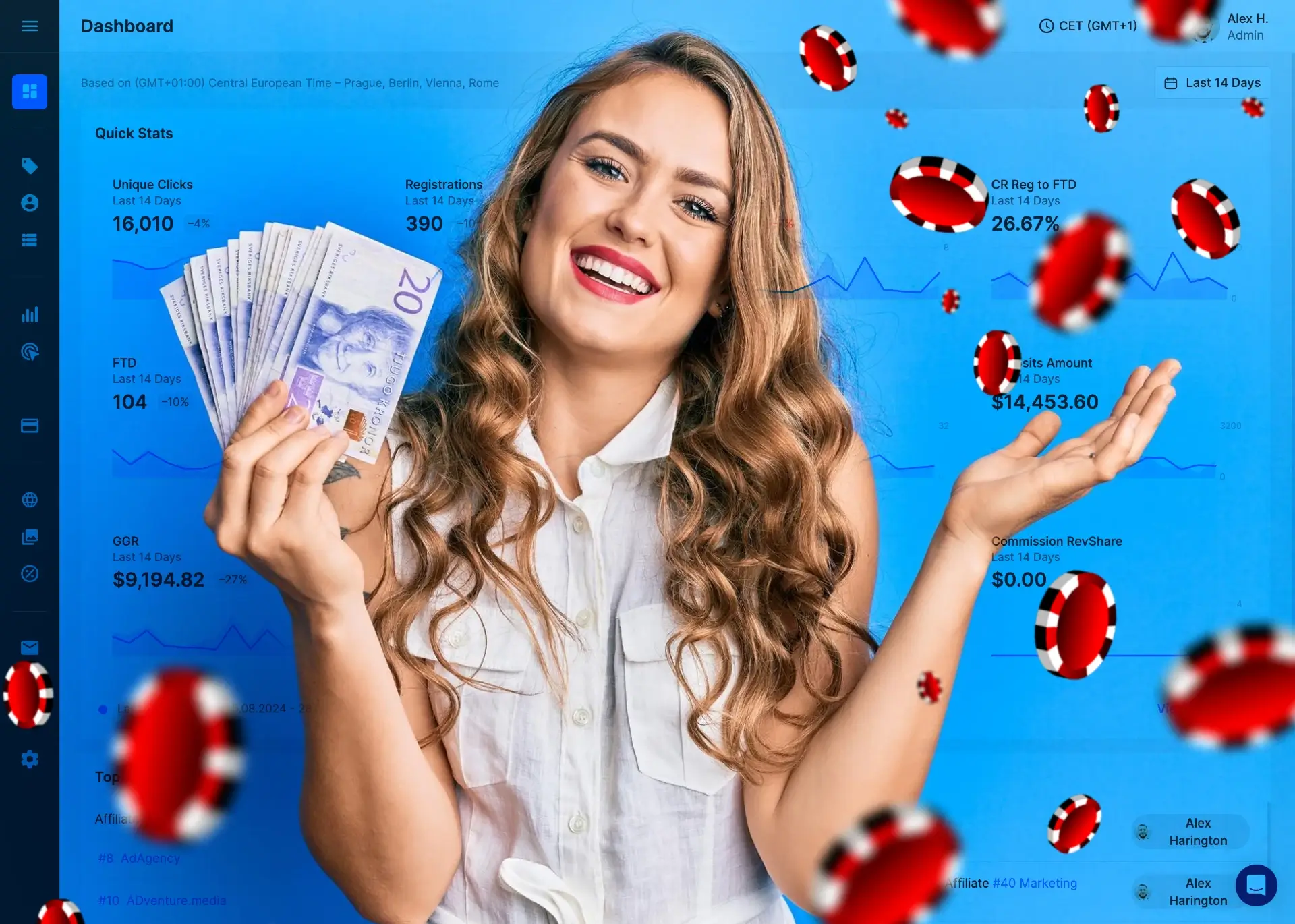
Scaleo stands out as a complete affiliate marketing solution because it has advanced reporting tools and features made just for iGaming. It’s all about strategic insights for people who run casinos. Users can see a big picture of performance metrics with Scaleo’s funnel reports, KPI tracking, and custom pages.

Scaleo also provides the following:
With Funnel Reports, you can see where your players are coming from and how they’re using your social casino.
| Feature | Description |
|---|---|
| 📈 Funnel Reports | Track where players are coming from and how they’re engaging with your social casino. |
| 🎯 KPI and Player Reports | Understand player behavior and target specific user groups with relevant offers. |
| 🛠️ Advanced User Roles | Manage affiliate access and permissions easily. |
| 💳 Invoicing and Payments | Streamlined financial management for hassle-free payments. |
| ⚙️ Unlimited Customizations | Track where players come from and how they engage with your social casino. |
Conclusion
There is a huge market for risk-free games that feel like real gambling. This is making the world of social casinos grow quickly. For casino owners, this trend opens up a new area of iGaming that will bring in more customers and give them more ways to make money.
Here’s the bottom line: 2026 rewards teams that obsess over onboarding friction, creative iteration velocity, and live-ops discipline. Social casinos win when you buy moments that convert, surface a satisfying early loop, and keep players chasing collection goals with fair, transparent systems. You’ll feel it in steadier CPI, calmer revenue curves, and partners who know exactly how they earn—this week, not “someday.”
Affiliate marketing with tools like Scaleo can help your social casino strategy go to the next level if you’re ready to make a move. Scaleo gives you the tools to make decisions based on data and increase your reach, from detailed reports to advanced customization.
Want to change the way your iGaming business works? Check out Scaleo and see the difference right now.