

The iGaming side of affiliate marketing has always lived closer to the edge than classic e-commerce. Traffic comes from many jurisdictions, age restrictions are real, regulators keep rewriting privacy expectations, and operators still need granular tracking to pay only for real, eligible players.
The arrival of TCF 2.2 doesn’t change the goal, it just makes sloppy setups harder to defend. Affiliates who keep sending traffic without proper consent strings, without proof of age gating, and with leaky postback flows are going to look risky in 2026. Operators that can show auditors a clear, versioned, consent-aware tracking pipeline will look responsible and will win better commercial terms.

TCF 2.2 (the Transparency and Consent Framework update) is the industry’s way of saying: if you collect or pass personal data or identifiers in Europe, you must know what you collected, on what legal basis, which vendors are involved, and whether the user actually said yes to all of this.
For casino affiliates, this is slightly harder, because traffic isn’t only adtech traffic. It’s content, streaming, comparison sites, review pages, bonus hunters, social redirects, and in some cases, media buyers who stitch together their own consent experiences. That variety creates risk. The fix is to make consent, age eligibility, and postback hygiene part of the affiliate integration itself—not something you hope they did correctly.
Why TCF 2.2 matters more for casino traffic than for ordinary lead gen
Casino, betting, and iGaming flows are more sensitive than a classic “subscribe to newsletter” funnel. There is age restriction in many GEOs, marketing communications are capped, and devices are sometimes shared in households. The regulator’s view is simple: if you profile, retarget, or measure using personal data or cross-site IDs, you must be able to show user intent.
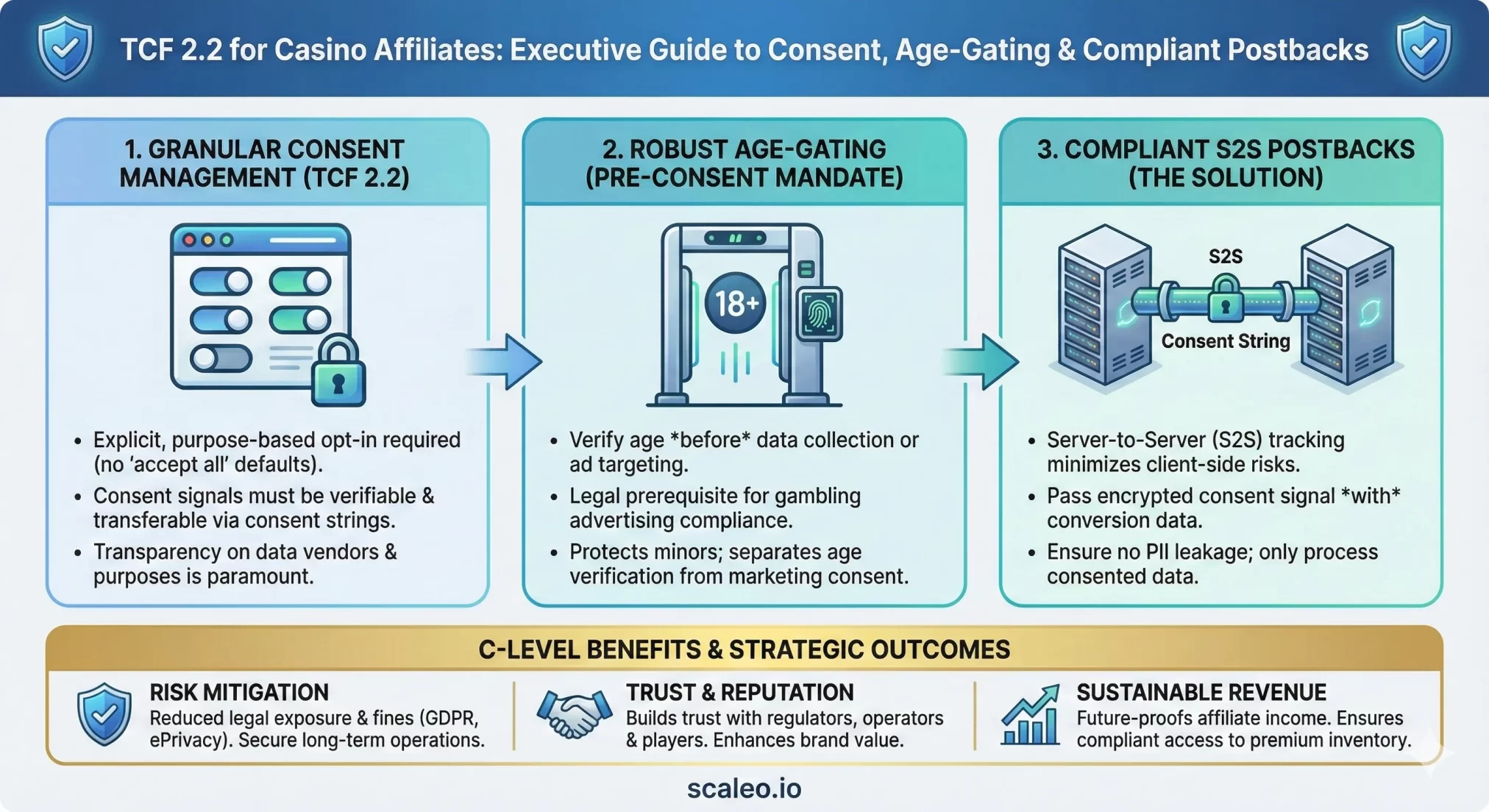
TCF 2.2 asks for cleaner, more explicit purposes, better user-facing wording, and less dark-pattern consent UIs. Affiliates who just auto-fire tags and push IDs into operator postbacks without checking whether the user even agreed will not pass long-term audits.
The operator problem is obvious. Affiliates send traffic. Traffic contains partial or no consent signals. Operators still want to know if this user registered, deposited, or churned. If that data later shows up in a regulator inquiry, someone will be asked: “where is the consent source, under which purposes, and what did the user see?” If the answer is “the affiliate handled it,” that’s not a defense. You need a structure.
A practical view of the TCF 2.2 flow for affiliates
The right way to see TCF 2.2 in affiliate performance is as a chain of custody. Consent is collected on the affiliate page.
The consent string and relevant signals (purpose consent, legitimate interest, vendor permissions) should be passed along with the click. The operator receives the click and stores the consent context attached to that user/session. Subsequent postbacks from the operator to the affiliate or other vendors must respect what the user allowed.
If the user said no to profiling or measurement, you do not fire a measurement postback that contains personal identifiers. If the user said yes to essential and performance, but not to ads, you do not turn around and pump that user into a lookalike audience. That is the idea.
This can sound theoretical, so here is the mapping in plain English.
| Step | What affiliate must do | What operator must store | What both must be able to show in an audit |
|---|---|---|---|
| 1. Consent shown | Display TCF 2.2-compliant CMP with clear purposes, no bundled tricks | Nothing yet, just wait for click | Screenshot or CMP configuration for that GEO and date |
| 2. Consent given | Generate and attach TCF 2.2 consent string to the click/redirect | Receive, parse, and bind to session/user | Logged consent string, timestamp, vendor list, purpose flags |
| 3. Click → registration | Pass consent string along with click ID, affiliate ID, GEO | Store consent, IP, device hints, and user action | Mapping click → user → consent source, with IP/GEO proof |
| 4. Postback/conversion | Fire postback only if purpose allows measurement/profile | Fire back only fields allowed under that consent | Postback log with masked IDs when consent is partial |
| 5. Later marketing | Use consent to decide whether to send CRM/retargeting | Enforce consent before sending to ESP, CRM | Evidence that marketing was suppressed when no consent |
Consent vs age gating: two separate levers
One common mistake in casino affiliate setups is to treat “I am over 18” as consent for everything. It isn’t. Age is about eligibility. Consent is about data processing. You need both. A user can be old enough to gamble and still refuse profiling or measurement for ads. TCF 2.2 expects sites to present purposes clearly and avoid “accept all or leave” patterns. Affiliates that mix age checks into consent pop-ups without clarity risk both invalid consent and invalid age proof. Better to separate logically, even if the UI is smooth.
| Control | What it verifies | Where it happens | What is stored |
|---|---|---|---|
| Age gating | User is of legal age for gambling in that GEO | Affiliate site/app, sometimes again on operator site | Age/yes flag, GEO, timestamp, source page |
| Consent (TCF 2.2) | User agrees to specific purposes and vendors | Affiliate site/app | Consent string (TC string), CMP version, purpose flags |
| Eligibility confirmation | User can receive gambling offers and tracking | Operator side during registration/deposit | KYC stage, residency, RG status |
So the flow should be: show age gate, show CMP, collect consent, redirect with both signals, store on the operator side. If one of those is missing, postbacks must degrade gracefully.
Safer postbacks: what to send and what to mask
Postbacks are where violations usually happen. Affiliates love rich postbacks: user ID, deposit amount, campaign, country, device, sometimes even email hashes. Under TCF 2.2, you can’t just send everything because “the affiliate asked.” You have to send what the user allowed. If the user did not consent to measurement or profiling, only send what is operationally necessary and not personally identifying.
A simple way to think about it is to define three postback profiles and let the platform switch between them based on consent.
| Consent state | What can be sent | What should be masked or dropped | Example use |
|---|---|---|---|
| Full consent (measurement + personalization) | Click ID, affiliate ID, campaign, timestamp, country, device hints, conversion type, amount, currency | Nothing, but avoid raw PII | Standard affiliate tracking and optimization |
| Partial consent (measurement only) | Click ID, affiliate ID, campaign, timestamp, anonymized country (if needed), conversion type | Amount granularity, device fingerprint, user-level persistent IDs | Basic performance reporting without profiling |
| No consent / opt-out | Non-identifying event (success/fail), maybe country if non-identifying | All user-level and monetary detail | Aggregated stats, billing by aggregate only |
This is where a system like Scaleo helps because the logic can live in the platform: if consent flag X is not present, fire template B, not template A. No one wants every affiliate to code their own privacy logic.
How TCF 2.2 affects attribution and payouts
Attribution is where money moves, so compliance must be watertight here.
If an affiliate delivered a click without a valid consent string from an EEA user, and the operator still attributes and rewards at user level, that may be seen as processing without a valid basis. The safer route is to attribute, but payout on aggregated or downgraded data, and to notify the partner that future clicks must contain valid consent. This approach protects the operator from “we were never told we needed TCF 2.2.”
The reverse is also true. If the affiliate delivered consent, the operator must not strip it away or ignore it in later flows. When a user later opts out, that must propagate to affiliates too where appropriate. This is the “safer postbacks” part: don’t send what the user just revoked.
A realistic operator policy would look like this when written in business terms:
| Scenario | Attribution | Payout | Notes |
|---|---|---|---|
| Consent present, age OK | Full user-level attribution | Full payout per plan | Ideal case |
| Consent missing, age OK | Session-level attribution only | Payout may be capped or aggregated | Partner notified to fix consent |
| Consent present, age unknown | Attribution allowed but user must pass eligibility | Payout only on validated conversions | Holds protect from underage traffic |
| Consent revoked later | Attribution remains for history | Future postbacks stop or become aggregate | Respect user’s new choice |
The goal is not to punish affiliates, but to make the flow audit-proof.
What audits actually look for
Audits are rarely dramatic; they are boring and document-heavy.
They look for: the CMP configuration you had on date X; the consent strings you received on a click that led to a gambling conversion; the mapping from consent string to vendor list; the proof that underage or non-consenting users did not get marketing or retargeting; and the ability to re-run reports without unhashed personal data. If finance, CRM, and affiliate ops can all open the same platform and see the same versioned event, the audit is a 30-minute meeting. If everyone has their own spreadsheet and the affiliate has a different story, it’s a 3-day issue.
This is one of the underrated benefits of placing affiliate operations, postbacks, and payout logic into one platform. Everyone sees the same consent context, the same attribution version, and the same conversion event. That transparency is 90 percent of compliance.
Where Scaleo fits into TCF 2.2 compliance
This is a topic where platform design can make or break the program. A system that was built for iGaming and performance can treat consent signals, age gates, and payout rules as first-class citizens.

Scaleo can ingest consent-related parameters alongside click and partner IDs and bind them to the session. It can decide, per event, which postback template to fire: full, partial, or aggregate. It can log the decision and the reason, which gives compliance something to show.
Because commission plans in Scaleo are flexible, partners can still be paid fairly even when some of their traffic arrived without valid consent, for example by moving those events into aggregated billing or by paying on validated FTD only. Age gating can be enforced at the payout stage by requiring an eligibility signal (KYC, approved GEO, passed age gate) before crediting. That makes underage leakage visible and fixable, not silent.
Scaleo’s fraud and traffic-quality layer is relevant here too.
Consent-less traffic often correlates with lower quality, VPN usage, or traffic bought from resellers who never ran a proper CMP. When those events are held or quarantined with an evidence pack—IP/ASN overlaps, missing consent params, odd GEO split—affiliates can’t simply say “your pixel is broken.” They see the reason, they fix the source, everyone moves on. That is exactly the kind of operational maturity that passes audits.
Comparing affiliate setups: pre- and post-TCF 2.2
| Aspect | Legacy affiliate setup | TCF 2.2-aware affiliate setup |
|---|---|---|
| Consent | Optional or ignored | Required and logged per click/session |
| Age gating | On operator site only | On affiliate and operator, with stored proof |
| Postbacks | Always full detail | Consent-aware, template-based, masked when needed |
| Attribution | User-level by default | User-level when consented; aggregate otherwise |
| Audits | Spreadsheets and emails | Versioned events in platform, replayable |
| Partner education | Ad-hoc | Documented policy, visible in partner UI |
The second column is fragile. The third is resilient.
Conclusion
TCF 2.2 is not a “marketing update.” It’s a reminder that in regulated, age-gated verticals like iGaming, consent, eligibility, and tracking must move together. Casino affiliates that send traffic with a proper CMP, a clean consent string, and a clear age gate will keep getting the best deals. Operators that can store that context, adapt postbacks to what the user actually allowed, and prove it six months later will keep winning audits. Everyone else will spend their time explaining why certain postbacks contained more data than the user agreed to.
The safest and fastest way to run that kind of program is to let the platform do the heavy lifting. Scaleo can accept consent signals right in the tracking flow, run consent-aware postback templates, enforce payout only on validated and eligible conversions, and produce partner-facing reports that make non-compliant traffic visible without drama. That’s how to keep affiliate growth, satisfy legal, and still pay people on time.
If the current setup can’t tell you which conversions were consented, which were age-checked, and which postbacks were masked, it’s time to tighten it up. Try Scaleo’s affiliate software and run your casino affiliate program on event-level truth that actually passes audits.
✅ Ready to Upgrade Tracking, Payouts & Compliance for iGaming Partners?
Consolidate multi-brand affiliate programs and automate payouts. Upgrade to precise attribution, fraud controls, and instant reporting that your finance team will trust.