

Privacy-first platforms, in-app browsers, and app-store hops make the classic “click → land → deposit” fantasy just that—a fantasy.
Programs that still rely on pixel-only tracking, static bonuses, and end-of-day reporting leave percentage points on the table every week. The operators who post 3–5% visitor-to-depositor conversion—and push past 7% in peak windows—engineer the whole journey: accurate server-side attribution, mobile-first truth in the first fold, value-priced commissions, and partner workflows that move at live speed.

The following ten tactics focus on conversion levers you can ship now and measure cleanly.
1. Mobile-first journeys that survive in-app browsers
More than two-thirds of affiliate traffic starts inside social in-app browsers on small screens. If your first fold doesn’t load fast and promise something your product can actually deliver in that GEO—local payments, payout speed, license clarity—your CTR will look great while FTDs stall.
Improve the route, not just the page: use short, app-aware URLs, deferred deep links that preserve partner signatures through store hops, and server-to-server events that confirm registration and deposit even when the browser disappears. The lift comes from alignment—headline, payments, and bonus mechanics that match what the player experiences in the first 10 seconds.
2. Server-to-server tracking and defensible attribution
Cookie-first setups undercount real conversions and overcount noise. Move to S2S click logs with partner ID, GEO, device hints, and consent context; post in-app events (install, register, deposit) with idempotency so replays never double-pay; keep cross-device continuity explicit in your policy.
Then version your attribution (time-decay for sportsbook bursts, longer windows for casino research journeys), run a shadow model before any switch, and freeze versions during live events. Accurate crediting increases affiliate effort where it matters; predictable rules reduce disputes—the two most reliable conversion lifts in the book.
Attribution models: choose by journey, not fashion
| Model | Best for | Why it lifts CR | Caveat |
|---|---|---|---|
| Short time-decay | In-play sportsbook, creators | Credits decisive touches; reduces noise | Misses long research flows |
| 30–45-day linear | Casino education flows | Keeps upper-funnel partners motivated | Needs clean deduplication |
| Data-driven (AI) | Mature programs with volume | Prices value by cohort durability | Requires stable, labeled data |
3. “First-fold truth” landing pages that convert without drama
Players don’t read intent into your page; they scan for reasons to trust you. Show the three trust anchors above the fold: how fast payouts arrive on local rails, which payment methods are available for that GEO, and what the welcome mechanic really is (mission, free rounds, match—with caps, if any).
Hide-the-ball copy creates bounces, chargebacks, and regulator attention. Clear, localized first-fold truth lowers cognitive load and increases validated deposits.
4. Offer design that rewards behavior—not just arrival
Flat deposit matches inflate exposure and train discount-only cohorts. Use mission-led engagement for early depth, dynamic free rounds to drive discovery with tight caps, and targeted cashback to repair loss streaks without dependency. Time-box event boosts with hard caps and automatic reversion.
The objective is simple: price by predicted value and encode guardrails so good economics don’t depend on human memory.
Offer mechanics that actually move conversion
| Offer type | Conversion job | Exposure control | Best use case |
|---|---|---|---|
| Mission-led | Nudge from click → reg → first play | Cap per step; visible progress | New cohorts; content-heavy partners |
| Dynamic free rounds | De-risk first spin on new titles | Configurable per title | Slot discovery campaigns |
| Targeted cashback | Recover near-churn | Tight % ceiling; cooldown | Post-loss retention windows |
| Event boost | Capture tentpole peaks | Auto-reversion + caps | Tournaments, launches |
5. Creator and geo-specific partner mixes that prioritize intent

High conversion isn’t “more affiliates”; it’s the right composition. Comparison SEO hands off intent, long-form publishers remove friction, creators spark bursts, and local media supplies legitimacy where ad rules pinch.
Treat each archetype as a role with explicit economics: hybrid CPA-RevShare baselines for SEO and content, MGF-as-advance plus hybrid for creators, and time-boxed tops with caps for tentpoles.
When partners know their job and upside, they invest inventory that converts.
6. Narrative reporting that tells partners what to do next
Chart soup doesn’t change outcomes.
Open partner and internal dashboards with a one-minute narrative: what moved, likely causes, and the single action to take this week (swap to the “DE-mobile” pre-lander, promote mission variant B, retire asset 14D in FR). Then allow drilldowns to event tables: FTDs, validated CPA, RevShare, refund rate, bonus cost per NGR, D7/D30 retention—by GEO, device, placement.
The conversion lift is operational: fewer “what now?” tickets, more high-leverage changes shipped quickly.
7. Fraud controls that protect margin without freezing good supply
Modern fraud is quiet—device clusters, recycled KYC, incentivized installs disguised as community. Use layered, interpretable checks: rules for the obvious, graph analysis for clusters, and model-scored quirks like velocity anomalies.
Quarantine clusters, not entire partners, and attach reason codes plus concise evidence. When quality holds arrive with proofs and a dated review path, good partners fix supply fast; your validated conversion rate rises because the denominator gets cleaner.
8. Retargeting that answers objections, not just stalks pages
Abandonment is rarely indifference; it’s specific doubt. Build objection-handling sequences tied to behavior: payment trust proof for first-deposit friction, game-fairness messaging (RNG, provider reputation) for slot skeptics, and “what’s on now” for live dealer fence-sitters.
First-party audiences and consent-aware journeys keep you inside policy. Conversion increases because follow-ups finally speak to why the player hesitated.
9. Testing as a weekly operating rhythm—not a project
Programs that grow treat testing like housekeeping. Run small, continuous experiments on first-fold copy, payments surfacing, and creative hooks; promote winners automatically once confidence clears a threshold; retire losers with a visible reason.
One list is enough to keep the cadence honest:
- Weekly: pre-lander headline, first-fold payment display, mobile CTA verbs; creator hook opening 3 seconds
- Bi-weekly: mission wording vs deposit match; dynamic rounds title set; consent prompt phrasing
Ship the outcomes into your changelog so partners see what changed and why. Conversion compounds because micro-wins stack.
10. Payments as conversion UX, not back-office plumbing
Payout certainty and local APMs are the most persuasive “ad copy” you have. Put permitted methods above the fold by GEO; show realistic payout ETA and make actual payouts slightly faster; keep deposit steps minimal and readable on mobile.
Payment UI clarity drops bounce and raises validation—a quiet but reliable conversion lift.
Partner marketing: where conversion is won?
In iGaming, partner marketing isn’t a traffic tap; it’s your distribution engine. The programs that convert are the ones that make it painless for professionals to find eligible offers, wire clean tracking, publish compliant assets, read truth they can act on, and get paid without surprises. That sounds cultural, but it’s software.
Offer discovery that behaves like a trading desk.
Partners should filter by GEO, license status, device, funnel type, validation window, and economics in one motion, then pin saved views like “DE-mobile casino hybrid” or “BR live dealer events.” Eligibility and caps must be visible before the click. Lowering “time to first eligible click” is a direct conversion lever.
Link and postback builders that simulate real routes.
Most discovery begins in an in-app browser and jumps to native apps. Partners need to test a link as a German iOS user on cellular and see exactly where it lands, with the partner signature intact. Postback templates should be consent-aware and copy-paste ready. Fewer broken routes equals more validated first deposits.
Creative supply that is compliant by design.
A creative rack should render previews for mobile/desktop, lock jurisdictional variants by partner class, and attach localized short-form copy blocks for Reels/Shorts/Stories. If an asset violates a region, it simply doesn’t render for that partner. This removes the “please approve” limbo that kills momentum and conversion.
Narrative reporting with invoice-grade truth.
Partners need the same ledger finance uses. Open with what changed and one recommended action; let power users drop to event tables. Show a deterministic invoice preview days before payout so discrepancies vanish before payday. When everyone stands on the same numbers, partners optimize harder and faster.
Reason-coded risk that educates, not alienates.
Quarantine suspicious clusters, not accounts, and ship evidence partners can fix (ASN overlap, device graphs, velocity spikes). This keeps high-quality supply active while removing conversion-poisoning noise.
This is exactly where Scaleo earns its keep. It’s an iGaming-native affiliate platform that turns the operating model above into defaults:
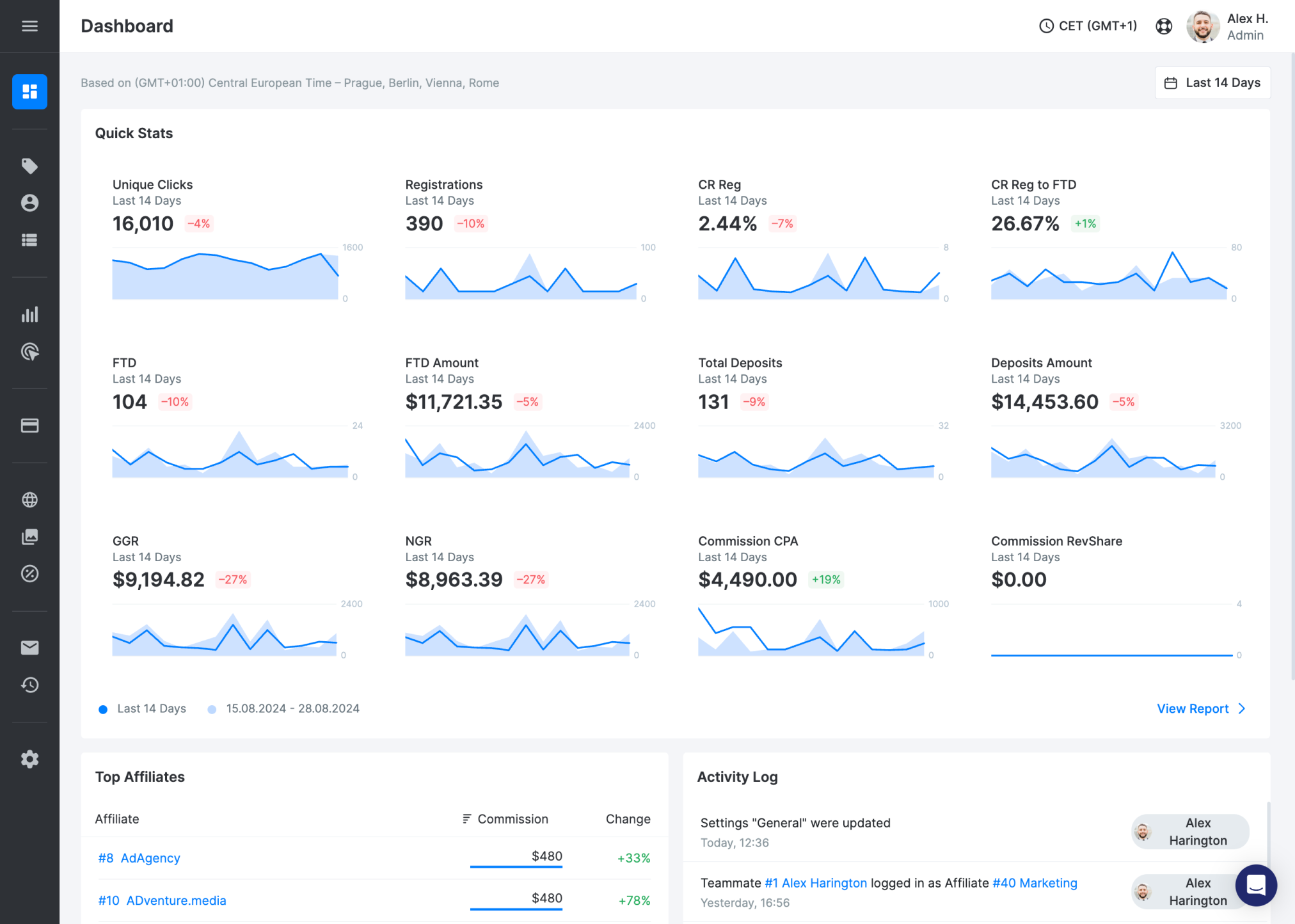
- Event-level, cross-platform tracking stitches server-logged clicks, deferred deep-link metadata, and in-app events into a single partner timeline, so app-store hops and device switches stop breaking attribution—the precondition for honest conversion math.
- Commission engines that price value (hybrid CPA-RevShare baselines, LTV-aware bands, and time-boxed boosts with caps and auto-reversion) align partner motivation with your retention reality—more durable cohorts, higher validated CR.
- Consent-aware postbacks enrich when allowed and mask or aggregate when required, with decision logs attached—legal is comfortable, partners are informed, and conversions don’t get lost to policy mismatches.
- Explainable fraud analytics quarantine clusters in real time and attach reason codes plus concise evidence—cleaner traffic, higher validation rate.
- A GEO-gated creative rack and an “offer desk” UI reduce time-to-live placements—fewer dead clicks, more first deposits.
- Narrative reporting and replayable payouts keep partners and finance on one truth—less arguing, more optimizing.
When partner workflows are this smooth, your conversion rate rises for the simplest reason: the best affiliates choose to send their highest-intent inventory to you first.
Conversion KPI map: align measures with moves
| KPI | Conversion symptom | Likely root cause | Fastest fix in platform |
|---|---|---|---|
| CTR ↑, FTD ↓ | First-fold mismatch by GEO | Payments/bonus not truthful for region | Swap to GEO-specific pre-lander; surface local APMs |
| Validated CR ↓ | Tracking breaks in app hops | Pixel-only or wrong deep link | Enforce S2S + deferred deep links; route simulator |
| Refunds ↑ | Misleading copy or promo abuse | Vague terms; overexposed discounts | Clarify first-fold terms; tighten exposure; mission-led |
| D1/D7 retention ↓ | Discount-trained cohorts | Wrong offer mix; wrong partners | Shift to missions/free-rounds; adjust partner bands |
| Disputes ↑ | Attribution/drift | Unversioned model; silent changes | Versioned attribution; shadow test; change calendar |
Two quick checklists to close the conversion gaps
- Mobile first fold: load < 3s; local APM logos visible; payout ETA stated; GEO-legal bonus truth; thumb-size CTA; app-aware route tested
- Weekly testing cadence: pre-lander headline; first-fold payment placement; creator hook; mission vs match; consent prompt phrasing
Conclusion
Conversion is rarely a single magic switch. It’s the compound effect of cleaner attribution, honest first folds, value-priced commissions, fast partner enablement, explainable risk, and weekly discipline. If your goal is a stable 3–5% with spikes past 7% when it counts, build the workflow that lets professionals do their best work—and give them a platform, like Scaleo, that turns the right behaviors into the easy ones.