
You’ve outgrown a legacy stack, performance teams want faster reporting, finance wants cleaner reconciliation, and security wants fewer blind spots. Migrating from HasOffers/TUNE to Scaleo isn’t just a platform switch; it’s a controlled transformation of your tracking, attribution, payouts, and data governance. Done right, you retain every insight, gain speed and clarity, and avoid the dreaded “week of darkness” where nothing lines up.
This guide lays out a CTO-level path—technical, operational, and governance-first—so you land on Scaleo with zero data loss, uninterrupted partner trust, and a sharper operating model.
Launch your affiliate program with the best-in-class solution
Try Scaleo – a complete affiliate management platform for iGaming, offering flexible commission setups, deep player analytics, fraud prevention, multi-brand control, customization, and automation—all with real-time reporting and API scalability.
Define the migration goal in measurable terms
Before you touch domains or APIs, fix the target.
For most iGaming and performance programs, the goal reads like this: maintain continuity of links and postbacks, preserve historical comparability in BI, improve attribution accuracy under privacy headwinds, reduce reporting latency from minutes to seconds, and automate payouts across currencies and brands.
If those outcomes are explicit up front, scope and sequencing become obvious and trade-offs become easier to manage. You’ll also know exactly what “done” looks like: same or better numbers in your core dashboards, fewer reconciliation tickets, and happier affiliates.
Map the data model one-to-one
For your engineering team: Don’t just hand them a spreadsheet. Use this JSON structure to configure your migration script’s parameter mapping. This “Rosetta Stone” ensures your URL re-writing service handles the translation deterministically.
{
  "migration_config": {
    "source_platform": "TUNE",
    "target_platform": "Scaleo",
    "parameter_mapping": {
      "click_id": {
        "tune_macro": "{transaction_id}",
        "scaleo_param": "click_id",
        "action": "preserve_value"
      },
      "affiliate_id": {
        "tune_macro": "{affiliate_id}",
        "scaleo_param": "affiliate_id",
        "action": "map_lookup",
        "notes": "Requires lookup table if IDs are re-keyed"
      },
      "source_id": {
        "tune_macro": "{source}",
        "scaleo_param": "sub1",
        "action": "direct_pass"
      },
      "sub_ids": {
        "tune_macro": ["{aff_sub}", "{aff_sub2}", "{aff_sub3}"],
        "scaleo_param": ["sub2", "sub3", "sub4"],
        "action": "sequential_map"
      }
    },
    "postback_security": {
      "signature_required": true,
      "deduplication_window": "30_days"
    }
  }
}
TUNE and Scaleo speak the same performance language—clicks, conversions, events—but the shape of objects, keys, and constraints differs. A robust mapping avoids edge-case drift and eliminates reconciliation purgatory. Treat this as a schema exercise, not a copy-paste.
| Concept | In TUNE | In Scaleo | Notes |
|---|---|---|---|
| Partner/Affiliate | affiliate_id | affiliate_id | IDs can be preserved or re-keyed; preserving reduces communication overhead. |
| Offer | offer_id | offer_id | Keep canonical IDs where possible to avoid link churn. |
| Tracking Domain | network/offer domains | white-label tracking + brand domains | Migrate SSL and DNS with low TTL and staged cutover. |
| Sub IDs | aff_sub, aff_sub2… | sub1…sub5 | Scaleo supports multiple granular subs; map consistently for BI continuity. |
| Conversion | transaction_id | conversion_id | Keep legacy transaction_id as a custom field for back-referencing. |
| Payouts | payout, revenue | payout, revenue, NGR/GGR | Scaleo exposes player-level KPIs for iGaming; enriches finance models. |
| Postbacks | global + offer-level | global + offer-level + rules | Add dedupe keys and signed logs for auditability. |
| Events | goals | events/goals | Name and key events identically for multi-touch clarity. |
A good rule of thumb: carry forward every external key your partners know, and enrich internally with Scaleo-native fields rather than replacing them. That preserves trust while upgrading capability.
Stabilize tracking domains before anything moves
Tracking domains are the beating heart of continuity.
Start with an inventory of every domain in TUNE—secure which are active, which are vanity, which sit in old landing pages. Bring those onto Scaleo as white-label domains with valid SSL and set their DNS TTL to something small so you can flip safely.
Run dual-resolve windows where appropriate: in the early parallel-run phase, keep TUNE resolving while you validate Scaleo fire-and-credit behavior on sample traffic. Only after click-to-conversion flows are verified should you cut default resolution to Scaleo. No drama, no dead links, no midnight scrambles.
If your legacy setup leans on cookie-only flows, you already feel the pressure from privacy updates and ITP-like behaviors.
Scaleo treats S2S postbacks as the primary source of truth. Move the backbone of your attribution to server-to-server with signed requests, idempotent deduplication, and authoritative timestamps.
Keep first-party cookies in place as a quality-of-life enhancer for UX and for redundancy, but make sure every offer, brand, and goal posts back reliably from server side. When your postback layer is deterministic, debugging gets simpler, fraud defenses stay ahead of the curve, and affiliates stop arguing about lost credits.
Normalize parameters and macros
The fastest way to create noise is to “almost” match macros. Standardize once, everywhere. If TUNE passes {aff_sub} and {aff_click_id}, ensure your Scaleo offers emit sub1 and click_id with the exact same values, casing, and encoding rules.
Decide early whether you will use URL-safe base64 or plain strings for longer subs. Lock this into shared documentation your affiliates can copy-paste without guesswork. Then mirror that convention in BI.
When dashboards ingest sub1…sub5 predictably, you avoid months of “why is LATAM missing” mysteries.
Recreate postbacks with signed, auditable events
Your postbacks are your ledger.
Rebuild them in Scaleo with signatures or token validation, deterministic dedupe keys (click_id + goal + timestamp window works well), and full response logging. Store both the request and the platform’s response with a correlation ID.
When a high-value conversion is disputed, you want an immutable record that shows who said what and when. This is where Scaleo’s event logs and signed credits help you close tickets in minutes, not days.
Run a parallel window and reconcile daily
You don’t have to “big bang” this.
A two–to–four-week parallel run is usually sufficient. Send a statistically significant slice of traffic through Scaleo while TUNE continues to receive the majority.
Compare daily across clicks, unique clicks, conversions, FTDs, and payouts, sliced by brand, GEO, device, and top twenty affiliates. Expect small deltas due to better bot filtering and dedupe; document them so you can explain variance confidently. When the deltas stabilize and you can forecast them, widen the Scaleo share until it becomes the default.
A simple burn-down approach works well: week one at 10–20% Scaleo share on a subset of brands and GEOs, week two at 50% across the board, week three at 90% with only risk-averse partners left on the old rails. Keep the old system hot for read-only a while longer so historical queries and disputes are easy to answer.
Migrate historical data without losing fidelity
Analytics teams hate breaks in time series.
Export your TUNE history at the most granular level your license allows—ideally conversion-level, with click timestamps, revenue, payout, affiliate, subs, and GEO/device dimensions. Import into Scaleo’s historical tables or your data warehouse, preserving original transaction IDs in a dedicated column.
Do not “normalize” history to the new model; keep it intact and derive harmonized views in your BI layer.
Stakeholders keep comparative continuity, and you retain forensic power if anything is challenged later.
Reconcile finance and tax from day one
If finance trusts day-one invoices, your migration will be called a success.
Use Scaleo’s automated invoicing to model the exact same cycles you ran in TUNE, but enrich them with multi-currency handling, thresholds, holds, and negative carryover rules that may have been manual before.
Run dummy cycles during the parallel window and match them against your old outputs.
Where partner contracts differ by brand, GEO, or product, let Scaleo’s commission constructor model that logic explicitly instead of relying on spreadsheets. Your quarter-end closes will thank you.
Build fraud controls into the go-live, not after
Attackers love platform transitions.
Bake fraud rules into your first day on Scaleo. Activate IP/ISP/device checks, velocity caps, country mismatches, and risky-ASN lists. Set conservative alerting thresholds in week one and tighten once volumes stabilize.
Pipe fraud signals to Slack or your SIEM so support, AMs, and security see the same picture.
Most importantly, put risky sources into auto-hold queues so money doesn’t leave while you investigate. That one policy spares you the most expensive retro-collections.
Secure the end-to-end path
Your risk register should include more than bot clicks.
Put the entire chain under a microscope: SSL on all tracking and postback domains, strict HSTS, minimal token scopes on API keys, SSO for your internal users, scoped roles for partner access, and audit logs that actually get reviewed.
Confirm data residency and backups satisfy your regulator and your customers. Align retention policies with GDPR and local requirements, especially for player-linked attributes and sensitive KPIs.
If you have a DLP program, integrate it now rather than after your first access review.
Preserve affiliate trust with proactive communications
Partners don’t like surprises.
Tell them the what, why, and when early, then make it easy. Provide a migration note with new tracking domains, unchanged parameters, and a validation checklist they can run themselves. Offer a sandbox link, a test conversion routine, and clear escalation channels. For top partners, schedule short enablement calls.
Affiliates will remember the migrations where they didn’t have to babysit broken links. That memory translates directly into promotion intensity.
Train internal teams with role-specific paths
Your AMs don’t need to learn API pagination.
Your engineers don’t need creative upload workflows. Build short, role-based enablement that respects attention spans. For operations and compliance, focus on audit trails, approvals, and responsible marketing controls. For BI, emphasize new fields, event timestamps, and how goals map.
For engineering, cover webhooks, postback signing, and error handling conventions. When each team sees their own playbook, adoption accelerates and tickets drop.
Validate everything with ruthless QA
You can’t overdo QA on an attribution system.
Assemble a test matrix that covers devices, browsers, OS versions, GEOs, VPN scenarios, cross-domain landers, and atypical funnels. Validate click → registration → FTD → deposit events and ensure each fires once, in order, with the right amounts.
Check bonus flows and voids.
Trigger edge cases on purpose: double-clickers, long attributions, timezone weirdness. Use synthetic traffic where needed and log every test case with expected vs. actual.
Keep this suite for ongoing releases; it becomes your regression shield.
Protect your rollback
Hope for the best, plan for the fallback.
A clean rollback plan lowers blood pressure and encourages decisive action.
Keep TUNE hot through parallel run. Do not decommission DNS, credentials, or webhooks until Scaleo is fully ramped and quiet. Define precise thresholds that trigger a rollback—crediting discrepancies over X%, postback failures above Y, partner complaints beyond Z—and assign authority to pull the cord.
If you never need it, wonderful. If you do, you’ll be grateful it’s boring and scripted.
Document your deltas and close the loop
No two platforms treat bot filtering, deduplication windows, or geo-resolution exactly the same. Expect small deltas.
The difference between success and friction is whether you can explain them. Capture where Scaleo is intentionally stricter or more accurate, quantify the effect, and distribute a one-pager your AMs and finance team can cite. This is how you end migration myths before they become lore.
Set your post-migration operating rhythm
Once you switch off the old stack, cement a new cadence.
Real-time dashboards replace CSV scrapes. Alert-driven operations replace morning report hunts. Weekly checks on fraud queues, payout runs, and partner leaderboards replace reactive triage.
Most organizations also take the moment to revisit commission logic: with Scaleo’s constructor, you can align incentives to LTV, brand mix, or compliance quality rather than blunt rates. Strategy follows capability; use the uplift.
A pragmatic timeline that actually works
Not every program has the same constraints, but the sequencing often converges.
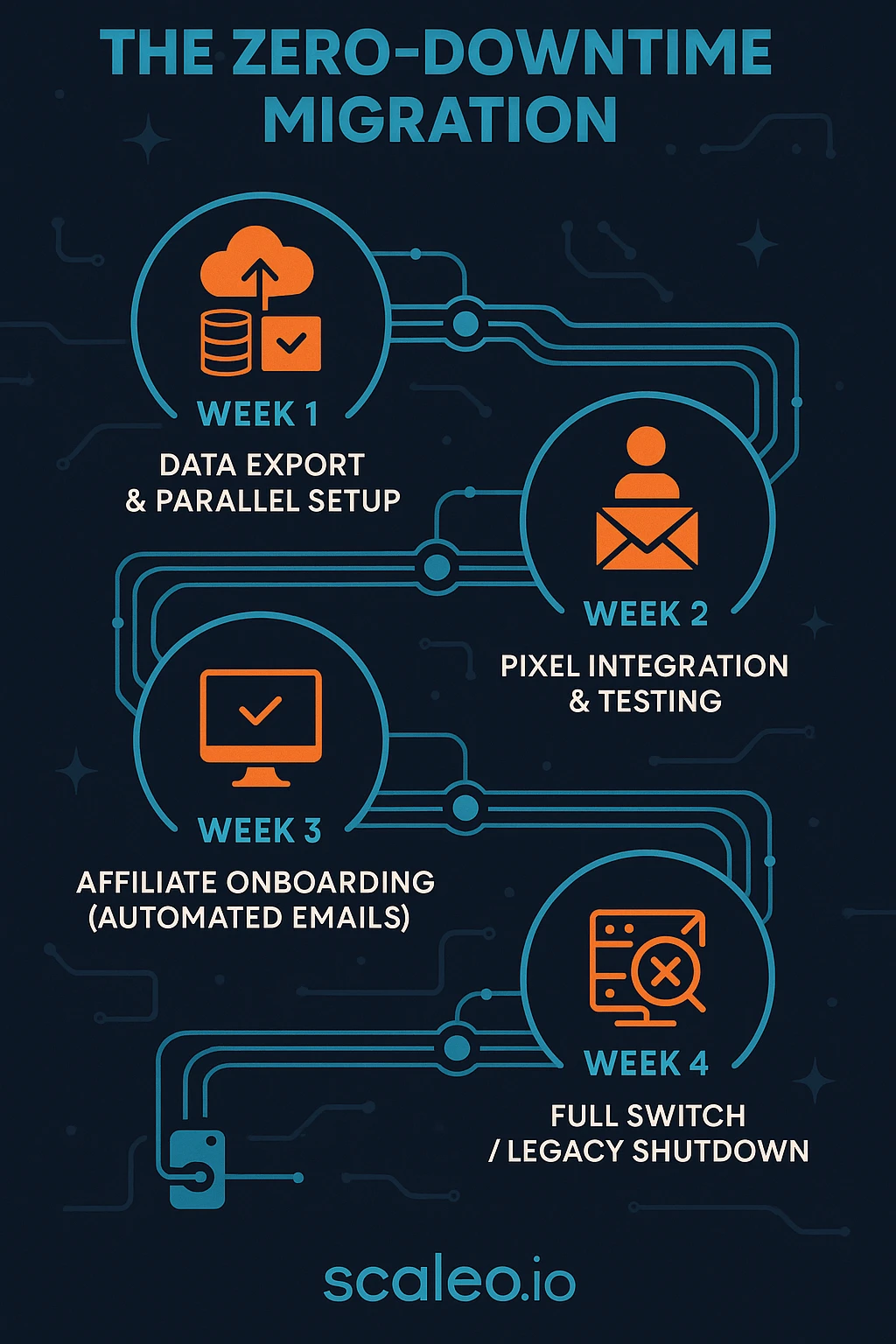
Week zero is discovery: domain inventory, schema mapping, event spec, and security review.
Week one turns up white-label domains with SSL, replicates offers and partners, and wires API integrations.
Weeks two and three run parallel traffic and daily reconciliations while finance verifies mock invoices and compliance signs off on logs and retention.
Week four is cutover with a final DNS flip, partner comms, and freeze of changes on the retiring stack.
A further week keeps the old platform read-only for any stragglers and dispute lookups. The point is rhythm and transparency, not heroics.
Why Scaleo changes the operating model
Migrations are painful when you land somewhere that behaves the same.
Scaleo’s differentiation is visible in day-one workflows. Reporting shifts from minutes to seconds with live charts and tables that don’t force you into export hell.
Attribution becomes defendable with S2S postbacks, signed logs, and deterministic dedupe.
Commissions finally match strategy thanks to the Commission Constructor that can encode brand, GEO, tier, and KPI gates without spreadsheets. Invoicing ceases to be a monthly fire drill as multi-currency schedules, thresholds, and holds run automatically and leave a clean audit trail. Fraud isn’t an afterthought because proactive rules, IP/ISP/device checks, and velocity controls are part of the baseline configuration.
And when you need to replatform at scale, a zero-data-loss methodology—parallel tracking, reconciled imports, and affiliate-side continuity—keeps partners calm and your BI unbroken.
If you were to summarize this move for your executive team, it would sound like this. Preserve domain continuity so links never die. Shift attribution to server-to-server with auditable, signed postbacks. Normalize macros so BI stays coherent.
Run a real parallel window and reconcile daily so surprises surface when they’re harmless. Bring finance into the loop early with mock invoices that match reality. Turn on fraud rules before go-live so you don’t pay to learn.
Lock security and compliance now so auditors don’t teach you later. Communicate clearly with affiliates and train each internal team on what they actually use. Keep a rollback plan live so you can be decisive. And when you cut over, lean into the new capability—don’t rebuild old manual habits on a modern stack.
The “Go/No-Go” Migration Checklist
Before you flip the DNS switch, run this final pre-flight check. If you can’t check every box, you aren’t ready to cut over.
- SSL Validation: Are all white-label tracking domains resolving on Scaleo with valid SSL certificates?
- Postback Signature Test: Have you verified that your server rejects unsigned postbacks to prevent injection fraud?
- The “404” Check: Do your legacy TUNE tracking links redirect to a valid fallback if the Offer ID doesn’t exist in Scaleo?
- Currency Precision: Does your finance report match to 4 decimal places between the two platforms for yesterday’s traffic?
- Fraud Logic Active: Is the “Click-to-Install Time” (CTIT) filter active on your CPA offers?
Ready when you are
If you’re planning the switch, the next sensible step is a working session that maps your current TUNE objects, domains, events, and payout rules to their Scaleo equivalents and outlines a parallel-run calendar your teams can commit to. Bring the tricky edge cases and historical quirks.
The platform is ready for them, and the playbook is designed to get you to stable, faster operations without sacrificing a single partner or datapoint along the way.