
What is white-label affiliate marketing software, who is it for, and when is it actually worth paying extra for?
This guide is for brands, agencies, and networks that want an affiliate platform that looks like their product (not a third-party portal). We’ll define what “white label” means in practice, what to look for before you buy, and which tools are most commonly used.
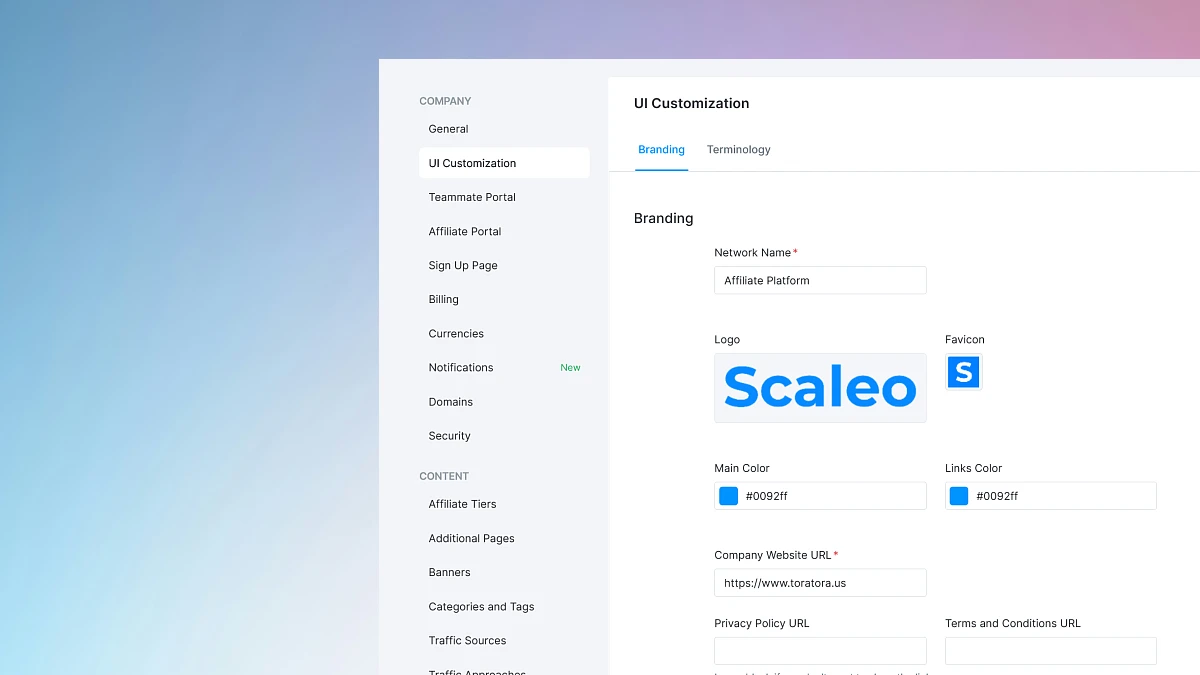
In affiliate marketing, “white label” doesn’t just mean “upload a logo.” A real white-label setup usually includes a custom domain (yourpartner.yourdomain.com or partners.yourdomain.com), branded emails, removal of vendor branding in partner-facing flows, and enough theming/control that affiliates feel like they’re inside your ecosystem—not visiting someone else’s software.
Quick fit check:
Brand program (one company, one portal) → white label is mainly about trust + seamless UX.
Agency (multiple clients) → you need workspaces / multi-tenant + clean access control.
Affiliate network (many advertisers + affiliates) → you need deep roles, auditing, fraud controls, and stable APIs.
Top 20 White Label Affiliate Marketing Software and Tools
We’ll get into what “white label” should include (and what it shouldn’t), but first—here’s a practical list of popular options. Keep in mind: some vendors call “logo + colors” white label. Buyers usually mean custom domain + branded portal + minimal vendor footprint.
| Software Provider | White Label Features
Can you fully rebrand the dashboard with your own logo, domain, and colors?
|
Price
Starting monthly cost for white-label capabilities.
|
Rating
Based on Capterra & G2 industry reviews.
|
|---|---|---|---|
Scaleo 🏆 |
Full Customization, API Access, Branding, Custom Domains | Starts at $500/mo | |
| Tapfiliate | Branding, API, Multi-language | From $69/mo | |
| LeadDyno | Custom Domain, Custom Emails | $49 – $79/mo | |
| Refersion | Custom Tracking, Custom Branding | $89 – $399/mo | |
| Offerslook | Customizable, API, Branding | $300 – $1000/mo | |
| Offer18 | Customizable UI, API | Custom Quote | |
| Tune | API Access, Customizable UI | Custom Quote | |
| iDevAffiliate | Branding, Customizable Layout | $39 – $249/mo | |
| OSI Affiliate | Custom Emails, Custom Branding | $47 – $247/mo | |
| AffiliateWP | Custom Branding, WP Integration | $149 – $299/year | |
| JROX | API Access, Customizable Interface | Starts at $250 | |
| Affluent | API, Custom Branding, Data Aggregation | Custom Quote | |
| Partnerize | Custom Branding, API, Multi-language | Custom Quote | |
| Adwalnut | White-Label, A/B Testing, API | $99 – $499/mo | |
| Cake | Custom Domains, Brandable Interface | Custom Quote | |
| UpPromote | Partial Customization, Real-time Reporting | Custom Quote | |
| Kartra | Custom Domains, API | $99 – $499/mo | |
| AdMachine | API, Fully Customizable | $99 – $499/mo | |
| LeadDyno | Customizable Dashboard, API | $69 – $149/mo |
Most platforms above are sold as SaaS. In other words: you’re buying a subscription to a hosted platform with ongoing updates, security patches, and support—plus (if you choose the right vendor) the ability to run the partner portal under your domain and brand.
The biggest practical difference between “regular” and “white label” SaaS is not whether it’s cloud-based. It’s whether affiliates experience the software as your portal or someone else’s product.

That branding layer sounds cosmetic until you start recruiting serious partners: a clean domain, consistent UI, and branded communications reduce friction, improve trust, and make your program feel like a first-class part of your business.
What is White Label Affiliate Marketing Software?
White-label affiliate marketing software is an affiliate platform you can operate under your own brand—typically with a custom domain, branded UI, branded emails, and configurable partner-facing pages—so affiliates see your company at every step: signup, login, tracking links, reporting, and payouts.
In some cases (most commonly agencies), “white label” also implies a resell motion—where you run the platform for clients or resell the platform under your own brand. That’s not automatic. If you need that, you’re really asking for multi-tenant capabilities and reseller-friendly terms.
Reality check: Many tools market “white label,” but deliver only logo/colors. If you care about partner trust and long-term retention, look for: custom domain + branded emails + removable vendor branding + clean onboarding (signup, welcome emails, portal navigation).
Why Use White Label Affiliate Marketing Software?
Because affiliate programs are trust-based. A white-labeled portal reduces the “third-party tool” vibe, makes your brand feel more established, and keeps the partner experience consistent—from the first invite to the first payout.

It also makes operations easier when you scale: branded domains simplify comms and documentation, consistent onboarding reduces support tickets, and a stable integration backbone (API/webhooks/export) lets you plug the affiliate channel into your BI, CRM, and finance stack.
White Label vs. Regular Affiliate Marketing Software
“Regular” affiliate software can still be excellent—especially if you just want a quick partner program and don’t care if the portal is clearly vendor-hosted. White label is for businesses that want the partner portal to feel like a native part of their brand and infrastructure.
Here’s a more accurate comparison:
| Criteria | White Label Affiliate Software | Regular Affiliate Marketing Software |
|---|---|---|
| Partner-facing identity | Your domain, your brand, minimal vendor footprint | Vendor-branded portal or obvious third-party UI |
| Customization depth | Theme/UI control, portal pages, branded emails, sometimes custom flows | Basic settings; limited theming; vendor experience stays visible |
| Trust & conversion | Higher trust for serious partners; smoother onboarding | Can work well, but may feel “external” to partners |
| Integrations | Typically stronger API/webhooks/export expectations | Varies; some tools are closed or limited |
| Time-to-market | Usually fast, but includes DNS/email setup and portal configuration | Often fastest: create program → invite partners |
| Support & updates | Still vendor-managed in SaaS; you get updates + support like any SaaS | Vendor-managed updates + support |
| Best for | Brands, networks, agencies that care about identity and long-term scale | Small teams, early-stage programs, quick launches |
White label software, such as Scaleo, is an out-of-the-box solution you can integrate with your business, add your logo and brand colors, and run under a domain that feels native to your company (for example, a subdomain of your main site).
It looks, acts, and feels like a part of your website.
“Customized” Scaleo dashboard vs. a “Default” one
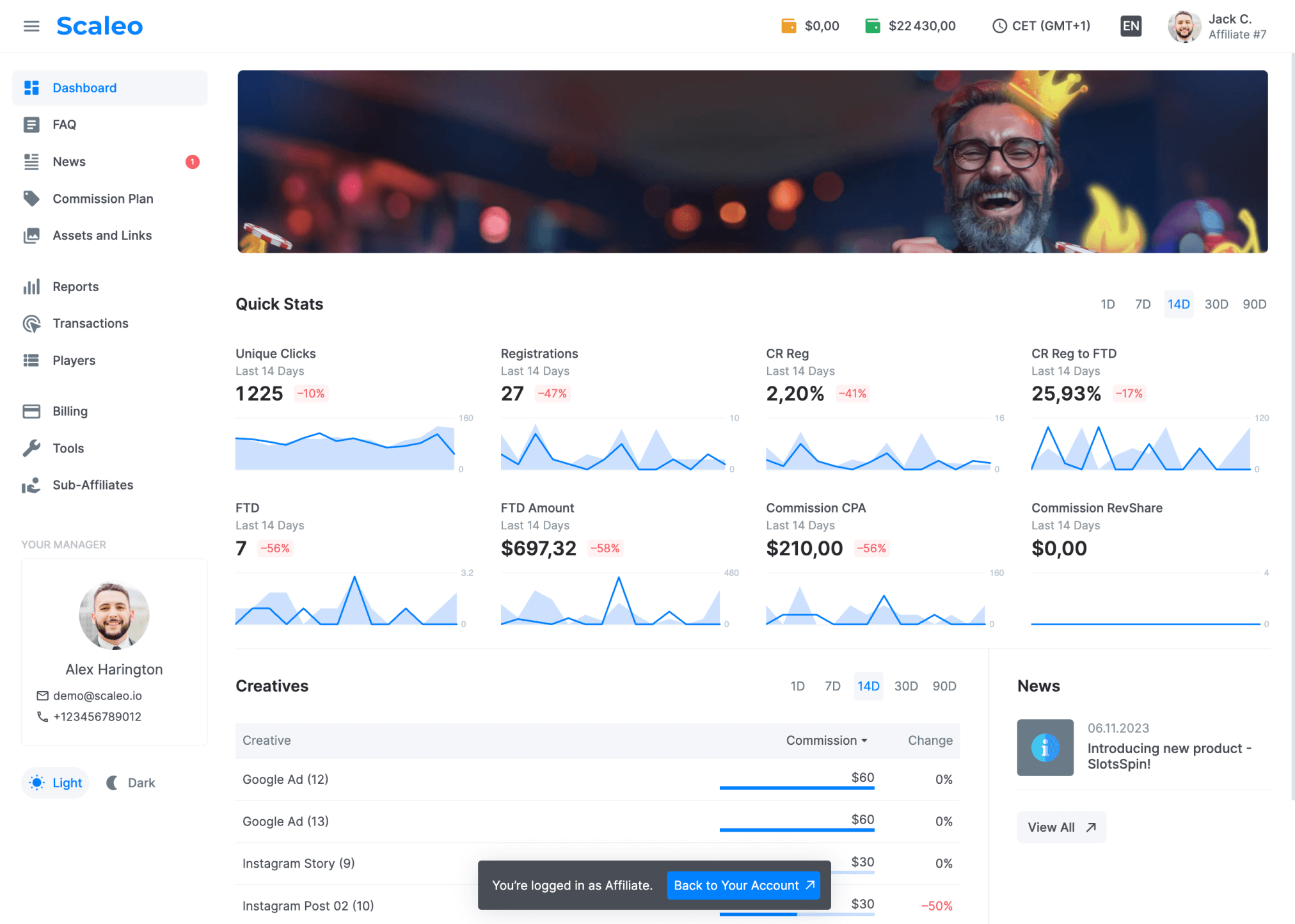
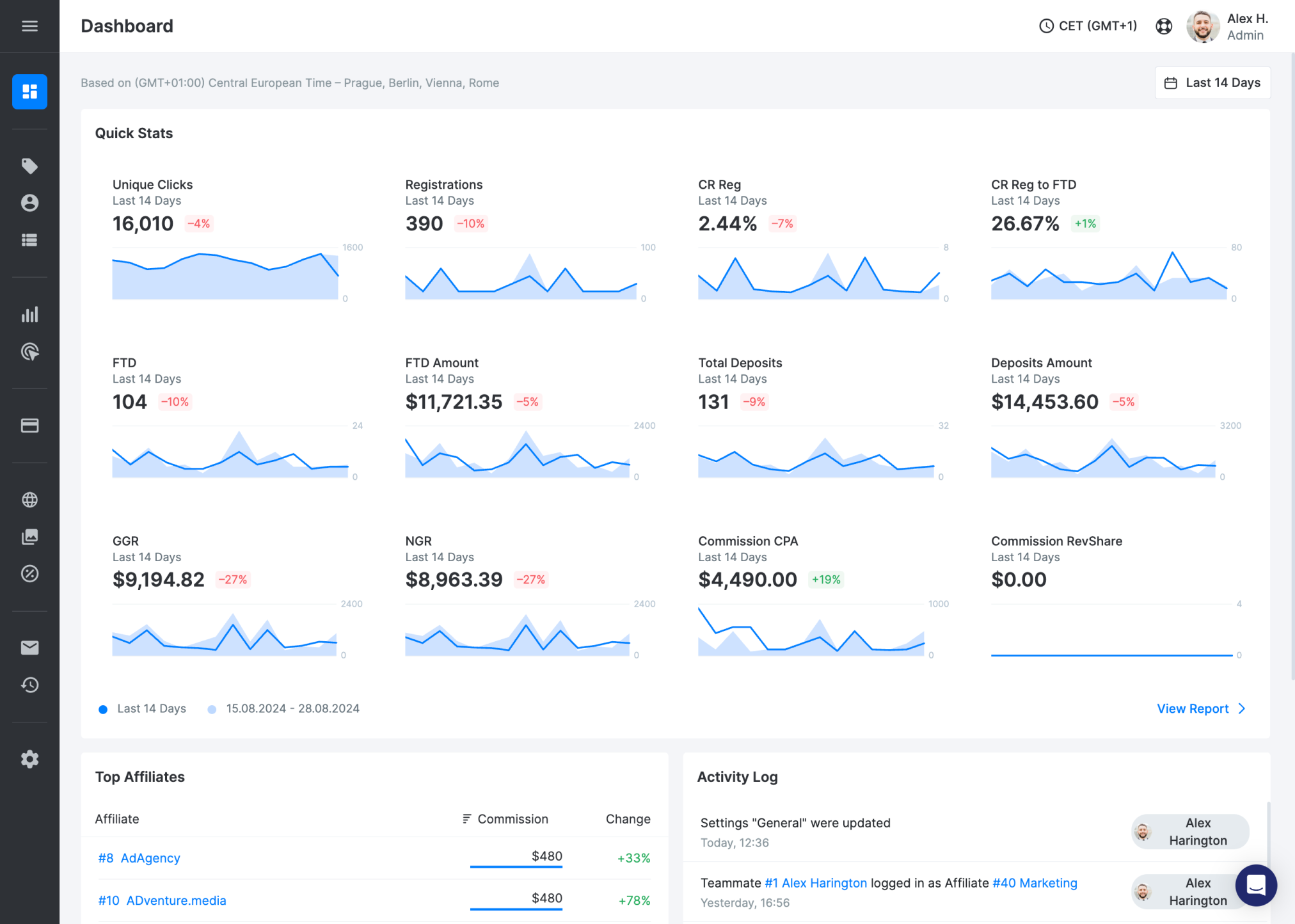
On the other hand, regular affiliate software is often clearly vendor-hosted. A potential affiliate who finds you on YourDomain.com clicks “Affiliates” and lands on a portal that feels like a different product—sometimes even a different domain.
That isn’t inherently “bad,” but it can introduce friction: partners hesitate, support tickets increase (“is this legit?”), and your program feels less established than it actually is.

This becomes even more relevant if you’re launching an affiliate network (not just a simple partner program). In that case, your portal is part of your reputation—if it looks borrowed, you’ll feel it in recruitment and retention.
What “Real White Label” Should Include (Buyer Checklist)
If you’re evaluating white label affiliate marketing software, don’t start with feature checklists like “has tracking links.” Every platform has tracking links. Start with the stuff that’s painful to fix later:
- Custom domain + SSL: the portal runs under your domain, with clean URL structure and working SSL from day one.
- Branded email deliverability: invites, password resets, and payout notices come from your domain (SPF/DKIM/DMARC supported).
- Removable vendor branding: no forced “powered by” in partner-facing flows (or at least the option to remove it).
- Roles & permissions: separate admin/manager/advertiser/affiliate roles with auditability (especially for networks and agencies).
- API + webhooks + exports: you can push/pull data reliably (events, conversions, payouts) and backfill when something breaks.
- Fraud & quality controls: blacklists, anomaly flags, device/IP checks, and partner risk signals—because traffic quality is your margin.
Pro tip: If a vendor can’t clearly explain how custom domains + branded emails work (DNS, SSL, sender auth), the “white label” promise is usually just a theme toggle.
Advantages of White Label Solutions for Affiliate Networks
White label matters most when your affiliate channel is a core growth engine—not a side experiment. At scale, “branding” becomes operational: it affects onboarding conversion, partner trust, and support load.

As you already know, Scaleo offers a white label affiliate marketing software. Here are the advantages that actually move the needle.
1 – Faster Trust With Partners (Not Just “Nice Branding”)
A branded portal on your domain reduces the “Is this legit?” moment. For quality affiliates, that moment matters. The smoother the onboarding experience feels, the less your team needs to compensate with manual reassurance and support.
2 – Lower Support Load as You Scale
Most support tickets in partner programs aren’t “advanced tracking problems.” They’re basics: login, portal confusion, mismatched emails, broken links, missing creatives. White label reduces confusion because everything looks and behaves like part of your ecosystem.
3 – SaaS Support & Updates Without Losing Your Identity
In a SaaS model, the vendor still maintains the platform—security, patches, performance, upgrades. White label simply means you can run the partner experience under your brand while still benefiting from professional support and ongoing development.
4 – Brand Consistency Across the Full Partner Journey
Affiliates interact with more than a dashboard: they receive invites, reset passwords, read offer terms, download creatives, and check payout status. White label ties that entire journey to your domain, your tone, and your identity.
5 – Cheaper Than Building (And Maintaining) Your Own Platform
Building affiliate software in-house isn’t just “development cost.” It’s ongoing maintenance, fraud prevention, tracking resilience (S2S), reporting performance, payouts, permissions, and integrations. White label SaaS gives you that infrastructure without turning you into a software company.
When your portal lives under your domain, everything is cleaner: partner docs, onboarding links, and branded pages can be referenced consistently in campaigns, outreach, and content. It’s also easier to keep your brand footprint cohesive when partners share your signup link publicly.
7 – Better Retention (Because Partners Feel “Inside” Your Business)
Partners stick with programs that feel stable and professional. A portal that looks borrowed can make even a great offer feel temporary. A clean, branded, reliable portal signals you’re serious and you’ll still be here next quarter.
8 – You Get Experts Without Becoming the Helpdesk
You still own partner relationships—but you don’t need to own every technical incident. A mature vendor should help with migrations, integration troubleshooting, reporting issues, and best practices, while your brand remains front and center.
Who is White Label suitable for?
White label is best when the affiliate channel is a strategic asset and you care about brand control, compliance, and long-term scalability.
- Brands with a serious partner channel: you want partners to feel they’re working directly with you, not “through a tool.”
- Affiliate networks: you need deep permissions, fraud tooling, audit logs, and robust APIs.
- Agencies: you need clean workspaces/multi-client separation and the ability to present the portal as part of your service.
Very small companies can still run successful programs without full white label, especially if they’re validating the channel. But if you want to build a strong online identity and provide partners a seamless UX, white label is the cleaner long-term path.
Ecosystem & extensibility
Your affiliate stack is only as good as what it plugs into. Treat SaaS affiliate software like a hub—and insist on first-class connectors.
What to look for?
- BI & warehousing: scheduled exports, webhooks, event streams, and backfill into BigQuery/Redshift/Snowflake; reverse-ETL back to your CRM. If the vendor has a white label app marketplace, you want native BI tiles, not just CSVs.
- Payout rails: multi-currency, threshold rules, approvals, and batch payouts (SEPA/SWIFT/e-wallets). Tax packs (W-8/W-9/1099, VAT) must ride with payouts.
- Fraud & quality: device/IP fingerprinting, click/session anomaly flags, blacklists, and partner risk scoring. Bonus if fraud vendors are one-click installs via that marketplace.
- CRM & comms: contact sync, lifecycle events, deal reg, and templated partner emails from your brand domain.
- Commerce & tagging: first-party tracking, server-side postbacks, and GTM-friendly templates; coupons/feeds for content partners.
- iGaming add-ons (when relevant): geo/KYC hooks, RG signals, AML export packs.
When to pair with other white-label tools?
- White label ad network: pair it when you buy media and run affiliates in one pane—just de-dupe conversions (paid vs partner) and enforce postback priority.
- White label marketing tools: lander builders, link shorteners, coupon feeds, and creative generators you can brand. Nice way to give partners “free” leverage without leaking your vendor.
Tip: pick an affiliate marketing platform software that behaves like white label business software—brandable UI + an integration spine you don’t have to fight.
What Breaks at Scale (Common White-Label Gotchas)
If you want this to work long-term, plan for the boring stuff early. These are the issues that usually surface after launch—when partners are already onboarded and switching costs get ugly.
- DNS + SSL delays: custom domains can be “simple” until propagation, SSL issuance, or redirects create login loops.
- Email deliverability: branded emails are useless if they land in spam. Make sure SPF/DKIM/DMARC are supported and documented.
- Tracking resilience: browser restrictions (ITP, cookie blocking) punish weak implementations. Prefer server-to-server postbacks where possible.
- Vendor footprint: forced “powered by” elements, vendor domains in resets, or vendor-hosted signup pages undermine the point of white label.
- Export/backfill: when an integration breaks, you need to backfill conversions/payouts—CSV-only systems become painful fast.
Reseller & partner motions
Not all “white label” arrangements mean you can resell the platform. Know the model you’re signing.
Models (and margins)
- Referral: you introduce deals; vendor closes; small rev-share, zero delivery risk.
- Agency: you operate client programs on your master instance; you bill for services; vendor bills software; better margins, higher effort.
- White label reseller programs: you resell the platform under your brand (billing + support tiers are yours). Requires multi-tenant, deep theming, and contract terms that won’t burn you.
What a white label software partner program must guarantee:
- Pricing protection: published discount ladder, deal reg, and no-poach on accounts you brought.
- Environments: perpetual sandbox + demo tenant with sample data for your sales team.
- Go-to-market: co-marketing/MDF, joint case studies, and named partner manager.
- Support & SLAs: priority queue, incident comms, uptime targets, and migration help.
- Product access: roadmap previews, API version stability, change logs, and early betas.
- Data & branding: your logo/domain/emails by default; no forced “powered by” in customer-facing flows (or a clear opt-out).
Fit check: if the vendor can’t support true workspaces/multi-client separation, they’re not a serious option for agencies or reseller motions.
Migration playbook
Ship it once. Don’t relive it. Here’s the sequence that keeps revenue intact.
- Discovery & inventory
- Tracking: domains, pixels/postbacks, S2S endpoints, third-party scripts.
- Schema: goal events, offer IDs, statuses, currencies, time zones, cookie windows.
- Commercials: payout rules/schedules, historical invoices, tax forms.
- Entities: affiliates/partners, advertisers/merchants, creatives, landers, deeplinks.
- Automations: webhooks, API keys, fraud rules, CRM syncs, email templates.
- Mapping & parity
- Field-by-field mapping (old → new), including IDs and statuses.
- Attribution parity (CPC/CPL/CPA/RevShare/Hybrid), de-duplication rules, and rounding.
- Ensure compliance parity with GDPR logs, consent, and KYC/RG/geo if you manage a white label casino affiliate program.
- Sandbox dry-run
- Recreate offers, partners, and payouts in a sandbox.
- Import a slice of historical conversions and reconcile.
- Trigger all webhooks; validate downstream BI reports.
- Dual-tracking window (7–14 days)
- Fire postbacks to both old and new platforms.
- Expect small drift; investigate >2–3% discrepancy by partner/offer.
- Lock change control on creatives and new goals during this window.
- Cutover prep
- Freeze: content/offer changes 24–48h before go-live.
- DNS: set the white label affiliate website domain, SPF/DKIM/DMARC for branded emails.
- Secrets: rotate API keys and webhook tokens.
- Communications (T-30 / T-14 / T-7 / T-1)
- One pager for partners: what changes, new login URL, how to update pixels, whom to ping.
- Advertisers: postback endpoint swap instructions; test checklist.
- Internal runbook with war room contacts and rollback triggers.
- Go-live & routing
- Flip DNS; 301 old portal paths to new (login, signup, docs).
- Update SDKs, GTM templates, and shortlinks.
- Monitor conversion fire rate, EPC, approval queues, and payout accruals in real time.
- Post-cutover audit (Day 1–7)
- Reconcile by offer/partner vs plan; check cookie attribution and cross-device behavior.
- Validate taxes, invoices, and automatic payouts.
- Sweep fraud alerts and geo/KYC hits for anomalies.
- Rollback plan (have it, rarely need it)
- Criteria, steps, owners, and comms—written before Day 0.
Pro tip: migrations are where SaaS affiliate software vendors prove they’re more than UI skin. Choose the one with a migration squad and a playbook like this baked into their white label support.
Use-Cases Examples for White Label Affiliate Software
| Use case | Must-haves | Nice-to-haves | Red flags |
|---|---|---|---|
| Affiliate network | Multi-tenant, granular roles, offer goals, fraud scoring, robust API | App marketplace, auto-payouts | No audit logs; vendor branding you can’t remove |
| Brand program | Custom domain/email, simple onboarding, coupon/UTM hygiene | LTV cohorts, CRM sync | No SSO; weak reporting |
| Agency (multi-client) | Workspaces, per-client billing, templated tracking | White-label reseller program | Shared data leakage |
| Casino affiliate program | Geo/KYC, RG flags, bonus logic, session tracking | AML export packs, dispute tooling | No iGaming experience |
Conclusion
White-label affiliate marketing software is the right move when your partner channel is strategic and you want the portal to feel native to your business: your domain, your brand, your partner experience—without building an entire tracking and payout platform from scratch.
At Scaleo, we help businesses launch branded, scalable affiliate programs and networks with accurate tracking, robust integrations, and partner-facing experiences that don’t feel “borrowed.” If you want a white-label platform that supports custom domains, deep branding, and serious operations, schedule a demo call or check out our live demo.
Looking for premium, unbranded, white-label affiliate marketing software that allows you to customize the look, feel, and functionality? Check out Scaleo! Schedule a demo call or try it free for 14-days, no credit card is required.
Frequently Asked Questions About White Label Affiliate Marketing Software
What is white-label affiliate marketing software?
White-label affiliate marketing software is a platform you can operate under your own brand—typically with a custom domain, branded UI, and branded emails—so partners experience the portal as part of your company (not a third-party vendor product).
What features matter most in a real white-label setup?
Start with the essentials: custom domain + SSL, branded email deliverability (SPF/DKIM/DMARC), removable vendor branding in partner-facing flows, roles/permissions, and reliable API/webhooks/exports for reporting and backfills.
Is white label the same as multi-tenant or reseller?
Not always. White label usually means branding and domain control. Multi-tenant means separate workspaces for multiple clients/brands. Reseller/OEM means you can sell the platform under your own brand and commercial terms—this requires contract terms and often deeper tenant separation.
Do white-label SaaS platforms still provide updates and support?
Yes. In SaaS, the vendor maintains and updates the platform regardless of branding. White label changes the partner-facing identity (domain, UI, emails), not who ships updates.
What are the most common problems with white-label portals?
The usual issues are DNS/SSL delays, weak email deliverability, vendor branding that can’t be removed in key flows, limited export/backfill options, and fragile tracking that struggles with browser restrictions. Plan these before launch.
Can white-label affiliate software integrate with Shopify?
Yes. Many platforms integrate with Shopify via API or native connectors. If Shopify is core to your business, confirm how conversions are tracked (pixel vs postback), how coupons/UTMs are handled, and how reporting/payouts align with your attribution model.
Which platform is best for a white-label affiliate program?
The best platform is the one that matches your operating model: brands should prioritize onboarding UX and domain/email branding; networks should prioritize roles, fraud controls, and APIs; agencies should prioritize workspaces/multi-client separation. Platforms like Scaleo are built to support branded portals, custom domains, and integration-ready operations.