
You’ve got multiple licenses. Multiple brands. Multiple GEOs. And a partner list that looks like a small country: 340 active affiliates, some cross-promoting, some laser-focused on one region, some “mysteriously” sending traffic that always spikes at 2AM.
So here’s the question that determines whether your affiliate program scales… or slowly turns into a monthly crisis:
Are you running three affiliate programs, or one affiliate system with brand-level control?

If you’re running separate platforms per brand, you’re not being “organized.” You’re paying a chaos tax: duplicated work, fragmented reporting, inconsistent rules, and a payout process that invites disputes because nobody can explain what happened across the portfolio. If you centralize, you’re not “simplifying.” You’re building a control plane.
And yes—there’s a difference.
Why unified affiliate management is the grown-up move
The pitch for centralization is not “efficiency” (every SaaS vendor says that).
It’s leverage.
In a fragmented setup, your best affiliates waste time. Three portals. Three link structures. Three payout cycles. Three sets of creatives. Three times the “where do I find X” questions. Affiliates don’t love your brand. They love whatever is easiest to work with and pays fairly.
In a unified setup, your best partners have one login, one reporting truth, one place to pull links and assets, one payout relationship. That doesn’t just reduce admin; it increases output. Less friction → more promotional volume → more testing → faster optimization cycles.
On your side, the operator benefit is bigger than “one dashboard.”
Unified management is how you get:
- Portfolio-level visibility: “Which affiliates drive profit across the whole group?”
- Cross-brand intelligence: “What creative angle works in Scandinavia that we should port to Germany?”
- Better fraud detection: patterns that look harmless in one brand become obvious when you see them across all brands.
- Fewer payout disputes: one scoreboard, one audit trail, less ambiguity.
The goal isn’t to run everything the same. The goal is to run everything from the same brain.
How multi-brand tracking actually works (without breaking attribution)
If you’re imagining one program where everything blends together, don’t. That’s how you end up with misattribution and internal politics. The right model is:
One platform
Many brand workspaces
Strict segmentation
Each brand needs its own “identity” inside the system: tracking domains, offer catalog, commission rules, creative library, and compliance constraints.
The mechanics are simple when you design them correctly:
- Affiliate logs in once and sees only the brands/offers they’re allowed to promote.
- They generate a link for a specific offer (not “Brand X in general,” but “Brand X → Welcome Offer → GEO Y”).
- Click lands on the correct brand environment.
- Events come back server-to-server (registration, deposit, NGR, whatever your payout logic is).
- Commission is calculated using the rules tied to that brand + offer + GEO.
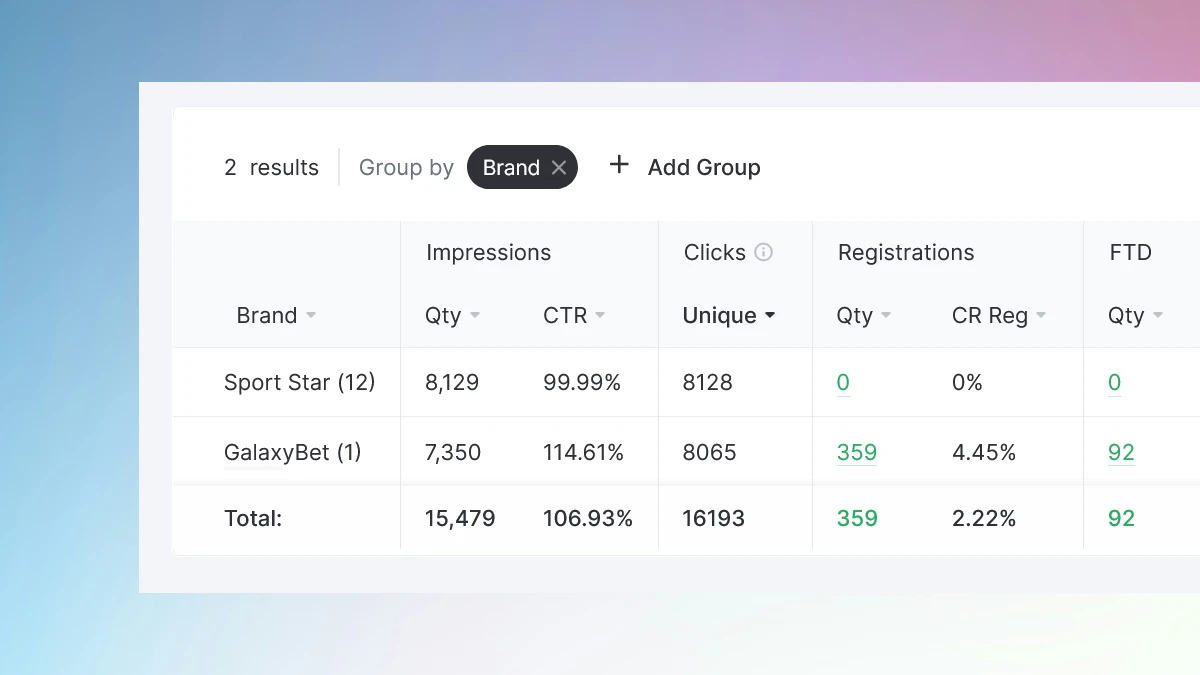
- Reporting shows results by brand, and payouts consolidate at the partner level.
One account. One relationship. Brand-level precision.
That’s the entire trick.
Licensing + marketing rules: don’t be brave, be enforceable
Multi-license operators get into trouble when they treat compliance as a document instead of a workflow.
You don’t need to be a lawyer to understand the operational truth: affiliate marketing is part of your acquisition supply chain, and regulators tend to care about what’s said, where it’s said, and to whom. What you want is not “perfect compliance.” You want enforceable constraints.
So instead of writing long policy PDFs that nobody reads, encode rules as platform behaviors:
- If an affiliate is not approved for a market, they shouldn’t even be able to generate links for that market/brand.
- If a creative isn’t approved for a GEO, it shouldn’t be selectable for that offer.
- If a player comes from a restricted jurisdiction for that brand/license, the conversion shouldn’t silently “count.” It should be rejected or held with a clear reason.
This is where most programs lie to themselves. They run a beautiful partner program, then act shocked when a “creative variant” becomes a compliance issue.
A practical way to structure access control
Think in three layers:
Affiliate eligibility (what markets they’re approved for)
Brand operating scope (where that brand can legally/strategically operate)
Offer-level constraints (what can be promoted in a specific market)
When those don’t match, you don’t “warn.” You block.
The most useful mindset: affiliates don’t get access to brands; they get access to brand+market combinations.
The commission question everyone messes up: portfolio-wide tiers or brand-by-brand?
Here’s my opinion, as someone who’s seen “fair commissions” turn into a permanent mess:
Default to portfolio-wide tiers. Add brand overrides when economics justify it.
If your affiliates qualify for tier upgrades across the whole portfolio, you incentivize cross-promotion and you reduce negotiation fatigue. Affiliates start thinking: “If I push two brands, I tier up faster.” That’s exactly the behavior you want from serious partners.
A clean base tier model can be explained in 20 seconds:
| Tier | CPA (FTD) | RevShare | Qualification |
|---|---|---|---|
| Bronze | €80 | 30% | 0–50 FTDs/month |
| Silver | €100 | 35% | 51–150 FTDs/month |
| Gold | €120 | 40% | 151–500 FTDs/month |
| Platinum | €150 | 45% | 500+ FTDs/month or custom |
Now the part that makes it real-world: brand overrides.
You’ll have brands with different margins, different retention profiles, different bonus cost structures. Pretending they should pay the same is how you “win” a negotiation and lose money for six months.
So you keep the tier framework constant, then adjust where needed:
Brand A (higher margin) might carry +€20 CPA at each tier.
Brand B (sportsbook margins tighter) might prefer slightly lower CPA but higher RevShare.
Brand C (new market entry) might run a temporary uplift tied to quality gates.
Affiliates can handle this if you show it clearly in reporting. They can’t handle it if it’s hidden and explained in Slack after the fact.
Data architecture: what has to be true for this to not become a reporting horror story
If your BI team can’t join data cleanly, you don’t have “multi-brand management.” You have three silos sharing a login screen.
The rule is boring but absolute: brand context belongs in every core table.
Clicks must carry brand_id + offer_id
Conversions must carry brand_id + event_type
Payouts must carry consolidated totals + brand breakdown
The payout “brand breakdown” is the dispute-killer. It turns “you underpaid me” into “here are the numbers per brand, here are the events behind them.”
Even if you pay once per month per partner, you still report per brand, otherwise you’re guaranteed to get dragged into arguments you can’t resolve quickly.
The awkward question: what if a player touches multiple brands?
This is where multi-brand gets political. A player registers on Brand A, then later deposits on Brand B. Who gets paid?
There are three sane models. Pick one, publish it, enforce it.
Brand-specific attribution. Clean, simple, minimal disputes, weaker cross-brand incentive.
Portfolio first-touch. Strong incentive for portfolio promotion, requires identity resolution and strong policy.
Hybrid policy. Brand-specific by default, portfolio rules only when you can prove identity matching and have clear terms.
If you choose portfolio first-touch, do not improvise it. Document the logic in partner terms and make sure your event matching is defensible. Otherwise you’re manufacturing disputes.
My take: most operators should start brand-specific, then graduate to portfolio rules once they’re confident in identity resolution and they have a mature disputes process.
Operations: what changes when you centralize
Centralization is not a “platform switch.” It’s a workflow upgrade.
Affiliate onboarding stops being three separate processes and becomes one portfolio intake:
- Application captures traffic sources + GEO focus + promotion channels + compliance flags.
- Screening happens once, then you grant access to specific brands/markets.
- Commission defaults apply automatically, with overrides only for strategic partners.
- Creative access is controlled by market, not by whatever PDF was attached to an email.
- Your partner manager stops acting like support and starts acting like an optimizer.
And at month-end, payouts become predictable instead of dramatic.
You reconcile at the brand level, but you pay at the partner level. You publish brand breakdowns. You give a short dispute window. You stop relitigating the same questions every month.
That’s how you get “no chaos.”
What to expect from the platform if “multi-brand” is often just marketing jargon?
You’re not looking for “supports multiple brands.” You’re looking for specific operator controls:
- Brand entities with separate offer catalogs and creative libraries
- Affiliate-brand permissions that actually block link creation
- GEO-aware constraints at offer/creative level
- Consolidated payouts with brand-level breakdown
- Reporting that can answer portfolio questions (not just brand dashboards)
- Fraud intelligence that works across brands, not inside a single sandbox
- Audit trails and approval workflows (because you will need them)
If those aren’t real features, you’re going to end up managing “multi-brand” in spreadsheets again. Ask me how I know. 😅
How Scaleo fits in?

Scaleo’s value in a multi-brand environment is that it lets you run one partner relationship while keeping brand-level boundaries intact: separate domains and offers per brand, permissions that determine which brands/offers an affiliate can promote, reporting that breaks down performance by brand while still showing portfolio totals, and a payout engine that consolidates payments while preserving the brand ledger underneath.
That’s the difference between “one program” and “one mess.”
Conclusion: Centralize Operations, Maintain Market Flexibility
Multi-brand casino operation is complex enough without fragmenting your affiliate management across disconnected systems.
The operators who scale efficiently are the ones who centralize affiliate operations—one platform, one team, one data model—while maintaining the brand-specific flexibility each market requires.
This means:
- Unified affiliate recruitment and onboarding
- Consolidated reporting and payouts
- Cross-brand fraud detection and learning
- Portfolio-wide tier qualification
- But brand-specific commission structures, compliance rules, and creatives
It’s the best of both worlds: operational efficiency without sacrificing market adaptation.
If you’re managing multiple brands with separate affiliate programs, you’re creating unnecessary complexity and missing strategic opportunities. Consolidation isn’t just cleaner—it’s more profitable.
Managing multiple casino brands with fragmented affiliate systems? Scaleo’s multi-brand architecture lets you operate 2-20 brands on a single platform, with brand-specific commission structures, license-based access controls, cross-brand analytics, and consolidated payouts. Schedule a demo to see how casino operators manage portfolio-wide affiliate programs without the operational chaos of parallel tracking systems.
FAQ
Can we do one portal without mixing brands?
Yes, if your platform supports brand workspaces and permissions that prevent affiliates from seeing or generating links for brands/offers they’re not approved for. If affiliates can “accidentally” promote restricted offers, your system is not enforcing anything.
Do we need separate tracking domains per brand?
In practice, yes. It reduces debugging time, makes attribution cleaner, and prevents weird cross-brand redirect edge cases. It also makes governance easier when you need to isolate issues.
Can we consolidate payouts across brands with different currencies?
Yes, but do it deliberately: define a payout currency and show the conversion method in reporting. Finance and affiliates don’t care that you used “one payment”—they care that the math is consistent and explainable.
Should tier qualification be portfolio-wide?
Usually yes, because it incentivizes affiliates to promote more of your portfolio. Keep brand-level tiers for special cases where brand economics or audience fit makes cross-promotion unrealistic.
What’s the fastest way to reduce payout disputes in a multi-brand setup?
Brand-level breakdown in payout reports plus event-level evidence behind the totals. Disputes thrive in ambiguity.
What’s the biggest mistake multi-brand operators make?
Centralizing the login but not centralizing governance. One dashboard doesn’t fix chaos if your rules aren’t enforceable.