

Partner marketing is simple to explain and maddening to execute. At its core, it’s growth through other companies’ audiences—co-creating value so both sides win. Done right, it compounds: lower CAC, faster market entry, and credibility you can’t buy with ads. Done poorly? Slow deals, messy attribution, partners who go dark. Let’s keep you in the first camp.
What it is partner marketing?
Partner marketing is a structured motion where two or more businesses collaborate to acquire customers, expand revenue, or increase retention. It includes affiliates, referrals, strategic alliances, influencers with commercial responsibility, marketplaces, and co-marketing. It’s not random shout-outs, one-off webinars, or “let’s see what happens.”
| Motion | Who drives demand | Commercial model | Attribution hygiene | Best when |
|---|---|---|---|---|
| Affiliate | Partner promotes offers | Rev share / CPA | Link + pixel / S2S | High-intent, measurable actions |
| Referral | Partner introduces deals | Bounty or % on close | Deal source in CRM | High ACV / sales-assisted |
| Co-marketing | Both generate leads | Lead split / MDF | UTMs + form source | Category education plays |
| Integration/Tech alliance | Product solves a joint use-case | Influence + marketplace rev | Partner-influence fields | Retention & expansion |
Why it matters in 2026?
Paid channels get pricier. Privacy tightens. Decision makers trust peers more than ads. Partners bridge those gaps: trust on day one, access to niche audiences, and shared resources that stretch your budget. Here’s the bottom line—partner marketing multiplies what already works and exposes what doesn’t. If your onboarding, value prop, or data is shaky, partners feel it first.
Strategy that actually works
Use a four-part framework: Fit → Focus → Fuel → Feedback.
- Fit: Define your Ideal Partner Profile (IPP): audience overlap, complementary product, sales motion (self-serve vs. assisted), and acceptable commercial models. Non-negotiables help you say “no” fast.
- Focus: Rank partners by Potential x Proximity x Proof. Potential = reachable TAM; Proximity = existing relationship, integration, or geography; Proof = cases you can publish within 60–90 days.
- Fuel: Give partners enablement that saves time: one-sheet, 90-second demo, pricing guardrails, copy blocks, and a tracked link. MDF (market development funds) only after the first joint win.
- Feedback: Weekly pipeline review; quarterly business reviews (QBRs) with concrete actions. Celebrate wins publicly; fix friction privately.
The ground is shifting—quietly, then all at once. Partner marketing in 2026 won’t be a bigger version of today; it’ll be structurally different. New privacy rails, server-side measurement, AI co-selling, creator compliance, value-based payouts, and marketplace-native partnerships will reshape how we plan, track, and pay. Here’s what I’m preparing for—and how I’d adapt if I were starting from zero this quarter.
From “partners as a channel” to “partners as an ecosystem function”
The org chart changes first. Partner teams won’t live purely under marketing or sales; they’ll operate as a horizontal function with hooks into product, data, finance, and compliance. Why it matters: you’ll negotiate APIs and data contracts as often as you negotiate commission plans. Successful teams will speak product and security, not just CPM and CTR.
| Old posture | 2026 posture | Practical shift |
|---|---|---|
| Campaign-calendar driven | Use-case & integration driven | Co-build product docs & demo flows with partners |
| Quarterly MDF approvals | Outcome-based MDF with clawbacks | Tie funds to activated use-cases, not impressions |
| Marketing-owned reporting | Shared source of truth | Single measurement spec across partner, sales, finance |
Measurement goes server-side (and modeled)
Browser signals will keep shrinking. Expect higher reliance on server-to-server events, partner APIs, and modeled attribution. This isn’t a downgrade; it’s discipline. Events will carry fewer identifiers but higher integrity. The playbook: fire a lightweight client signal for UX and diagnostics, settle revenue with server events, and reconcile with finance monthly—consistently.
| Signal | Role | 2026 reliability | Use it for |
|---|---|---|---|
| Client pixel / tag | Immediate visibility | ⚠️ Variable | Diagnostics, partner dashboards |
| Server postback/API | Source of truth | ✅ High | Billing, payouts, LTV |
| Modeled assists | Lift/Influence | ✅ Growing | Influence credit, budgeting |
💡 Pro tip: Adopt a single conversion_id and status lifecycle (pending → approved → refunded) across all partners. It’s the fastest way to end attribution disputes and speed payouts.
Value-based commissioning becomes the norm
Flat CPAs were easy; value-based tiers will be fair. In 2026 more programs will pay on contribution to profit (not revenue): first deposit quality (iGaming), net revenue after promo burn, engaged seat expansion, or verified usage milestones. You’ll need cleaner downstream data and clear reversal rules, but retention will improve and fraud will shrink.
| Commission model | When to use | Pros | Watch-outs |
|---|---|---|---|
| Tiered CPA | Simple acquisition plays | Easy to launch | Can incentivize low quality |
| Rev share on net | Recurring spend, variable margins | Aligns incentives | Needs transparent deductions |
| Outcome bounties | Product activation & LTV proxies | Targets real value | More ops work to verify |
💡 Pro tip: Publish your deduction policy (refunds, chargebacks, taxes, bonus credits) in the partner portal and mirror it in invoices. Ambiguity kills trust faster than a late wire.
AI stops being a shiny layer and becomes infrastructure
In 2026, AI won’t just write copy; it’ll operate programs. Expect partner-scoring models (fit + intent + historical yield), anomaly detection for fraud, and co-selling agents that draft intros, prep discovery notes, and surface integration stories by account. Humans still run relationships; agents kill the busywork.
| AI use-case | Outcome | What to feed it |
|---|---|---|
| Partner scoring | Prioritized recruiting & enablement | Traffic quality, geo, vertical, historical payouts |
| Fraud detection | Lower invalid spend | IP/device patterns, velocity, chargebacks |
| Co-selling prep | Faster cycles, better win rates | CRM notes, integration docs, case studies |
Creators evolve into “commercial partners” with brand safety rails
The creator economy matures. Expect more revenue-share contracts, fewer flat-fee promos, and stricter compliance: disclosure automation, brand-safety scoring, and content authenticity checks (yes, deepfake detection will be a thing). Creators who embrace measurable outcomes will graduate from “sponsored” to “partner.”
Marketplaces become primary, not auxiliary
Whether you sell software, financial products, or games, marketplaces will be the partner surface of choice: native listings, featured placements, bundled offers, and in-product referrals. Your partner ops must speak SKU, listing schema, and review velocity. It’s retail media logic applied to partnerships.
Compliance turns from a blocker into a feature
2026-level privacy laws won’t soften. Winning programs will treat consent, data minimization, and audit trails as product features. Document your lawful bases, store consent states alongside events, and let partners view exactly what you store. Counterintuitive but true: transparent programs recruit better partners.
Partner Ops becomes a first-class system
Tooling sprawled; consolidation follows. The stack I recommend centers on one platform that tracks, pays, and reports—no duct tape. Add a shared taxonomy (events, payout statuses), a server-side measurement layer, and simple data contracts. Fewer moving parts, fewer “who gets credit” fights.
| Partner ops layer | Non-negotiables | Why it matters |
|---|---|---|
| Tracking & attribution | Pixel + S2S, dedupe IDs, influence fields | Accurate, auditable conversions |
| Payouts & invoicing | Automated schedules, thresholds, reversals | Cash flow sanity—for both sides |
| Analytics | Funnel, cohorts, LTV, fraud views | Decisions, not dashboards |
| Portal | Assets, links, policy transparency | Fewer tickets, faster launches |
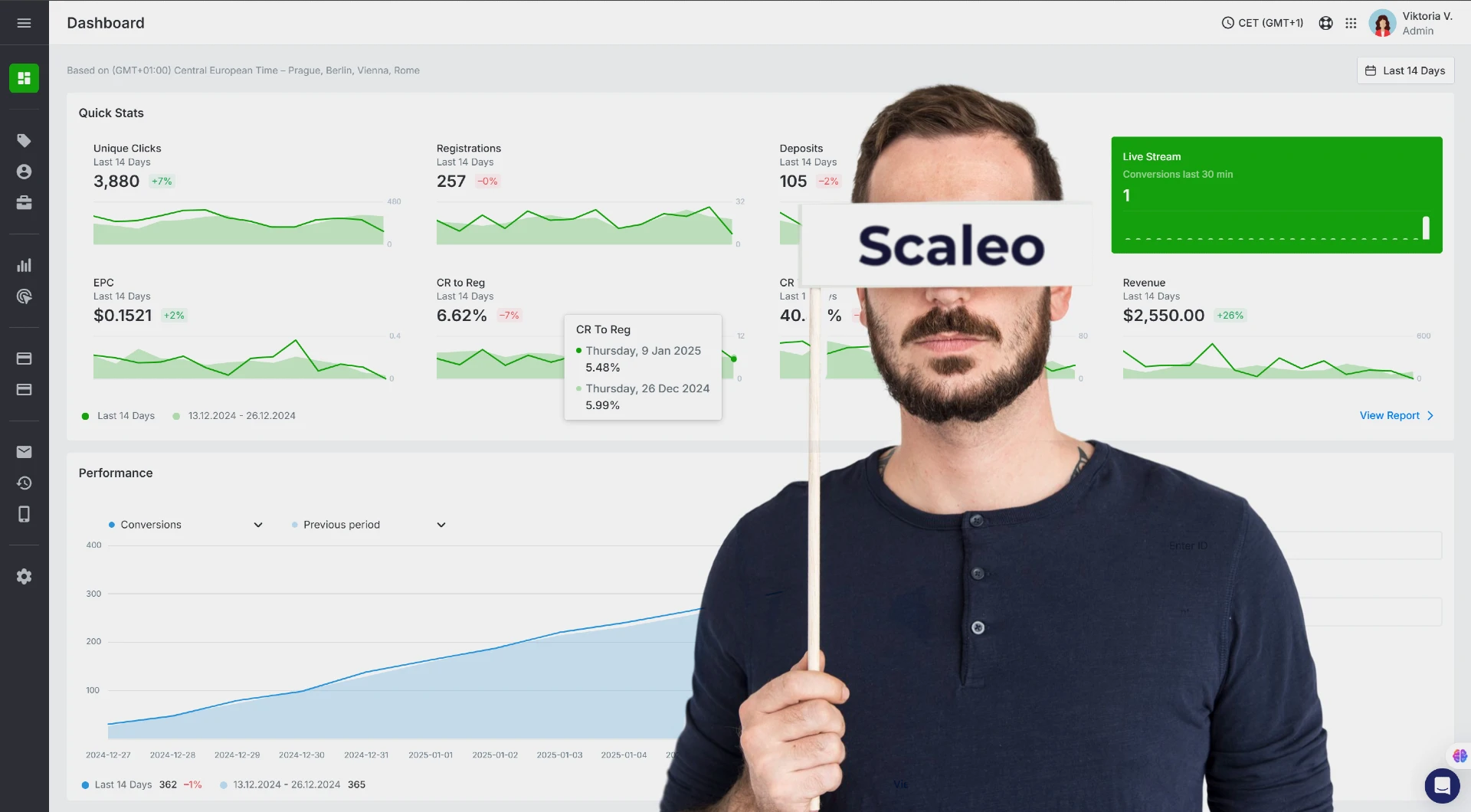
If you need a clean way to get there, Scaleo covers the platform core—server-side postbacks, fraud logic, customizable commissions, invoicing, and a flexible portal—without forcing you into a brittle stack.
Budgeting flips from “spend” to “portfolio health”
Instead of slicing dollars by channel, partner leaders will manage a portfolio: recruit, ramp, retain, and retire. Expect board decks to track active partner rate, time-to-first-revenue, net revenue per partner, and partner-influenced ACV—not impressions purchased. It’s healthier and much harder to game.
What to do now?
- Define a 2026 taxonomy: event names, statuses, payout reasons. Lock it with sales & finance.
- Migrate to dual measurement: client diagnostics + server truth. Test reversals and partial refunds end-to-end.
- Publish your value-based commissioning plan and start piloting on one segment before global rollout.
- Deploy AI where it’s boring: partner scoring, anomaly flags, enablement snippets. Keep humans on relationships.
- Harden the portal: assets, guardrails, and plain-English policies. Transparency is a competitive advantage.
Enablement that turns partners into sellers
Most partner programs fail not for lack of partners, but for lack of energy around them. Make it effortless to talk about you. Give them modular assets they can drop into emails, social, or webinars without rewriting everything.
| Asset | Why it matters | Has it? |
|---|---|---|
| 1-pager with ICP, pains, outcomes | Partner reps need fast context | ✅ |
| Demo-in-a-box (short video + script) | Confidence to present live | ✅ |
| Pricing FAQ (do/don’t) | Avoids discount sprawl | ✅ |
| Tracked links + postback/pixel how-to | Attribution and payouts | ✅ |
| Case studies (logo diversity) | Proof across industries | ✅ |
Attribution, payouts, and the “who gets credit” fight
Have you considered the downstream impact of switching attribution methods? Change it lightly and partners revolt. Here’s the pragmatic setup that avoids most disputes:
- Click tracking: First-party links + cookieless options. Each partner gets unique parameters.
- Conversion tracking: Fire a browser pixel for real-time visibility and a server-to-server postback to settle the ledger. Dedupe by conversion_id.
- Touch model: Default to last touch within a sane window (e.g., 30 days). Add assist credit for verified early touches on high ACV deals.
- Clawbacks: Allow refund/rebill logic; partners trust programs with adult accounting.
KPIs that matter (and the ones that don’t)
| Metric | What it tells you | Action |
|---|---|---|
| Active partner rate | % of partners who drove at least 1 conversion in 30 days | Enable or sunset dormant accounts |
| Time-to-first-revenue | Onboarding friction | Shorten to <30 days with a “first campaign” kit |
| Net revenue per partner | True value vs. vanity volume | Invest where unit economics hold |
| Fraud/invalid rate | Traffic quality & compliance | Dial anti-fraud and QA rules |
| Influence on close rate/ACV | Partner quality over clicks | Feed sales proof and integration stories |
Operational pitfalls (and fixes)
- Attribution disputes: Publish rules. Make them visible in the partner portal. Provide a dispute form with SLA.
- Partner burnout: Too many asks, too little reward. Rotate campaigns, highlight wins, and keep communication crisp.
- Integration fragility: If your API changes, partners suffer. Version it, announce changes early, and provide a sandbox.
- Compliance drag: Set content guardrails and auto-flag risky copy. You’ll save days of back-and-forth.
Tools and resources worth your time
Here’s a pragmatic tool map. Evaluate by whether it makes partners faster and your finance team calmer.
| Category | Purpose | Must-have features | Scaleo covers |
|---|---|---|---|
| Partner/Affiliate Platform | Track, manage, pay partners | Real-time reporting, fraud checks, customizable commissions, S2S postbacks | ✅ |
| Partner Portal | Assets, links, announcements | Self-service creatives, deep links, localization | ✅ |
| Attribution Layer | Reliable conversion truth | Pixel + postback, dedupe, value rules | ✅ |
| Payments | Pay on time | Invoices, thresholds, multiple methods | ✅ |
| Analytics | Decisions, not dashboards | Funnel & LTV views, cohorting | ✅ |
If you’re starting from zero, Scaleo gives you a unified partner marketing stack—tracking, fraud prevention, flexible payouts, funnel and player metrics (for iGaming), and a customizable portal—without duct tape.
Conclusion
Expect more server-side tracking, more value-based commissioning, and tighter links between product usage and payouts. AI won’t replace partner managers, but it will handle 80% of the busywork—prospect scoring, creative variants, anomaly detection—so you can spend time where it counts: relationships and revenue.
Ready to turn partners into your highest-ROI channel? Launch clean, measure honestly, and keep your program human. If you want a platform built for this exact job, Scaleo is where I’d start.
FAQ
What is partner marketing and why is it important?
Partner marketing is structured collaboration between companies to drive acquisition, revenue, or retention through shared audiences and assets. It matters because it delivers lower CAC, faster trust, and expansion into segments you can’t reach alone—especially when paid channels get saturated.
How do I choose the right partners?
Define an Ideal Partner Profile (audience overlap, sales motion, complementary product), then score candidates by Potential × Proximity × Proof. Prioritize partners who can ship a joint win in 60–90 days and have a clear commercial model (rev share, CPA, referral).
Which metrics should I track for partner marketing success?
Active partner rate, time-to-first-revenue, net revenue per partner, fraud/invalid rate, and partner influence on close rate/ACV. Vanity clicks don’t pay bills—cohort revenue and retention do.
What tools do I need to run a scalable partner program?
A partner platform for tracking and payouts, a portal for assets and links, reliable attribution (pixel + postback), and analytics for cohorts/LTV. Scaleo combines these so you can launch quickly and keep finance, sales, and partners in sync.