

Performance-based influencer marketing pays for outcomes—approved leads, qualified activations, revenue—not for impressions or promises. When you wire creator collaborations the same way you run an affiliate program (clear KPIs, first-party attribution, rule-driven payouts), you get creator reach without surrendering financial discipline. That’s the whole thesis: creators operate like partners, finance sees a ledger, and growth scales because the math is honest.
We at Scaleo design for exactly this motion.
What It Is—and Why It Fits B2B?
At its core, this is influencer marketing with an affiliate spine. Each creator receives unique tracking identifiers (links with subIDs, creator-specific coupon codes), conversions flow through first-party identity and server-to-server postbacks, and payouts follow a contract (CPL, CPA, CPS, or Hybrid). For B2B teams, that alignment matters because the funnel is longer, multiple touches contribute, and CFOs care about CAC, payback, and LTV more than vanity reach.
A performance contract turns a creative channel into a controllable acquisition rail. Creators get upside for genuine business value; you avoid paying for top-funnel noise. The result is forecastable CAC, cleaner ROI readouts, and the ability to scale headcount-light.
End-to-End Mechanics
Attribution
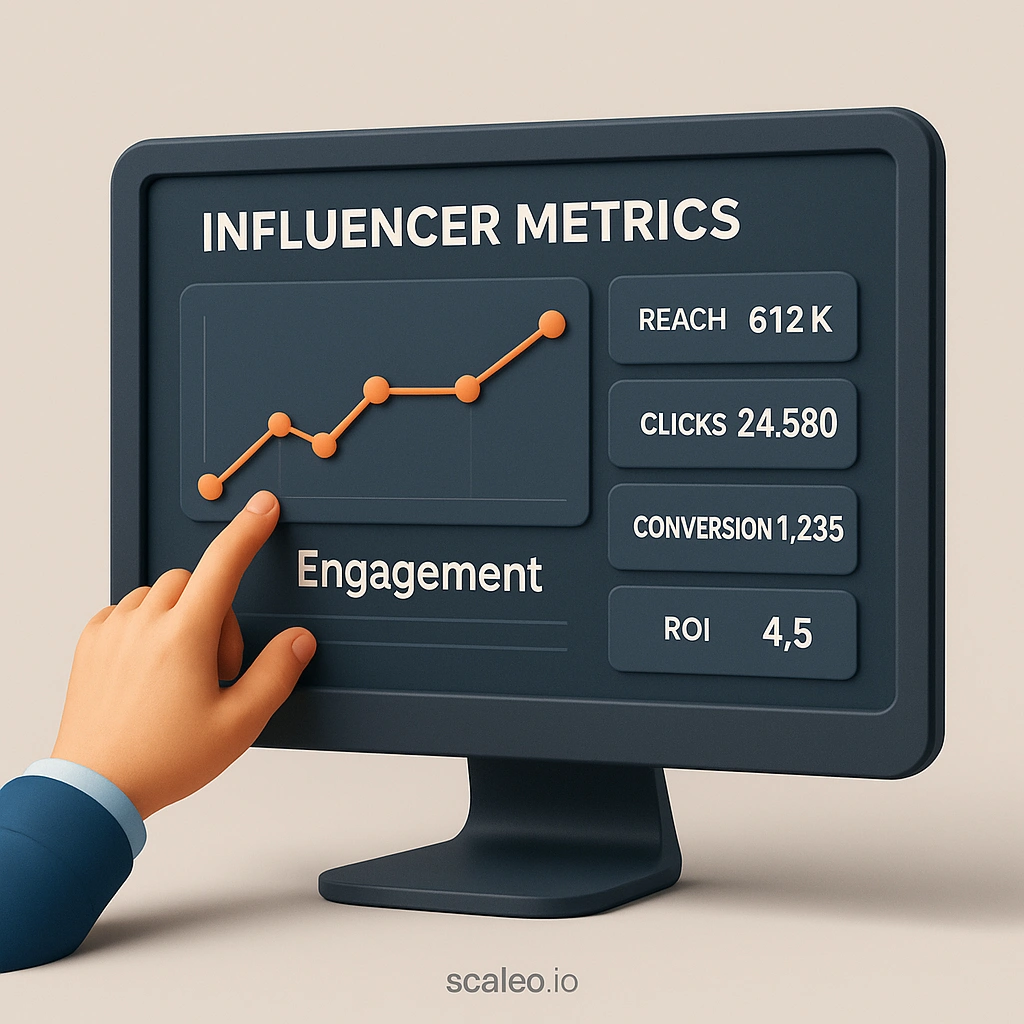
Treat login events and server-side postbacks as your source of truth. Cookies can assist, but the ledger lives on your servers. Unique URLs (with campaign, placement, and content subIDs) separate a creator’s YouTube review from their LinkedIn carousel; promo codes capture view-then-type traffic from podcasts and live demos. When identity is first-party, cross-device journeys stop breaking attribution.
Conversion of record
Pick one primary KPI per campaign—qualified demo, activated trial, KYC-approved first transaction. Secondary interactions (newsletter opt-in, content download) still matter but should not trigger payout; they inform optimization, not economics. A clear “value event” is what keeps the program honest.
Approval logic
Leads must pass firmographic gates and duplicate checks before they count. Think company domain rules, role and seniority filters, country allow/deny lists, and cooldown windows to validate intent. For revenue events (CPS) or activations (CPA), add cohort sanity checks to avoid paying on short-lived or refunded activity.
Payout execution
The platform should encode the rules—rates, caps, floors, reserves, negative carry, clawbacks—so end-of-month doesn’t devolve into screenshots and spreadsheets. In practice, the contract is code.
Pricing Models, Properly Engineered
Different funnels demand different economics. Use models that match value realization and risk.
Payout Model Matrix
| Model | You Pay For | Best Use Case | Approval & Quality Gates | Notes on Risk |
|---|---|---|---|---|
| CPL (Cost per Lead) | An approved lead that meets ICP rules | Top-funnel education, longer sales cycles | Company domain, title/seniority, GEO allowlist, duplicate suppression | Medium risk; must police low-intent signups |
| CPA (Cost per Action) | A product-qualified action (activation, KYC-approved deposit) | Clear “aha” event tied to revenue | Post-event validation period, fraud/bonus-abuse checks | Low–medium; closer to value, still pre-revenue |
| CPS (Cost per Sale/Revenue Share) | Cash value (transaction or NGR) | Fast monetization loops, clear attribution | Caps, floors, refunds & chargeback clawbacks | Medium volatility; smooth with caps/reserves |
| Hybrid | Small fixed + performance (CPL/CPA/CPS) | Long or multi-stakeholder journeys | Same gates as above; fixed part time-boxed | Low risk; lets you recruit creators before data is deep |
Tiering That Rewards Quality
| Tier | Requirements (rolling cycles) | Rate Adjustment | Operational Perks |
|---|---|---|---|
| Bronze | Default on join | Baseline | Standard asset access |
| Silver | ≥ 40 approved CPLs and ≥ 60% approval rate | +15% on CPL/CPA | Early access to promos, higher caps |
| Gold | ≥ 80 approved CPLs and ≥ 65% approval rate and LTV/CAC ≥ 2.5 | +30% on CPL/CPA or CPS bump | Co-branded landers, priority support |
| Elite | ≥ 120 approved CPLs and ≥ 70% approval rate and LTV/CAC ≥ 3.0 | Custom | Dedicated enablement, exclusive offers |
Tier changes should be automated and scheduled. Creators earn upgrades on performance, not negotiation endurance.
Creative & Funnel Architecture That Converts
Creators need a story, not just a link. Message match drives conversion: the promise in the content must echo on the landing page and carry through the form to the activation step. That’s where most B2B programs leak.
Narrative design. Start with a clear problem your ICP feels, show the workflow friction, demonstrate a short path to value, and end with a single call-to-action. Proof elements—mini case snippets, quantified outcomes, or a recognizable logo—should appear above the fold. In technical categories, a brisk screen-share trumps glossy montage.
Landing systems. Build creator-specific pages that inherit UTM/subID context to swap headline, proof, and CTA instantly. Keep forms short; defer enrichment to the approval step. Use server-side logic to prefill audience-specific content modules (industry, role, region) so a data engineer and a growth lead don’t read the same pitch.
Code + link pairing. Links capture most attribution; codes recover podcast and live formats. Your platform should merge both paths into one ledger entry so creators aren’t penalized for channel idiosyncrasies.
Measurement: What to Track, What to Ignore
CFO-grade clarity requires three lenses: efficiency, effectiveness, and durability. Measure all three, or you’ll optimize for the wrong hill.
KPI Framework
| Funnel Stage | Primary KPIs | Interpretation Notes |
|---|---|---|
| Attention | Unique clicks, engaged sessions, time on lander | High CTR with shallow sessions → curiosity, not intent; fix the promise or pre-qualify harder |
| Qualification | Lead approval rate, cost per approved lead | Approval rate reflects brief quality and audience fit; under 40% usually means mis-targeting or form friction |
| Activation | Trial activation rate, demo attendance rate | Low activation with high approvals points to handoff and onboarding gaps |
| Monetization | First purchase/FTD rate, CAC, payback period, LTV/CAC | Payback windows anchor budgets; outliers by creator indicate where to raise or cut tiers |
| Cohort Health | Refund/chargeback ratio, churn at day 30/90 | Healthy cohorts justify extending cookie windows or bumping CPS/CPA |
Finance Snapshot
| Metric | Formula | Why It Matters |
|---|---|---|
| CAC (channel) | (Creator payouts + promo costs) ÷ # paid conversions | Determines how much scale you can responsibly buy |
| Payback | CAC ÷ Avg. gross margin per period | Aligns creator pricing to fiscal reality |
| LTV/CAC | Modeled LTV ÷ CAC | Guides tier promotions and budget expansion |
Fraud & Quality Controls That Protect Margin
Performance programs attract gaming attempts. The antidote is composite evidence—and payout logic wired to that evidence.
Threat Map
| Threat | Observable Pattern | Control | Payout Impact |
|---|---|---|---|
| Lead stuffing | CTR high, approval rate very low, bursty submissions | Domain/role gates, cooldowns, manual queues | Hold until approved; deny unqualified |
| Device farms & proxies | Homogenous user-agents/IP ASNs; low entropy | ASN reputation, device diversity rules | Reduce or hold; flag for review |
| Code abuse | Many code uses without corresponding link views | Link+code merge; require recent view evidence | Cap code-only payout; require proof |
| Duplicate identities | Same person across creators | Email+domain+device dedupe | First-eligible credit; deny duplicates |
| Incent laundering | Volume spikes near payout cutoffs | Velocity caps, subID isolation | Auto-hold and investigate |
Controls should be transparent. When creators can see why a conversion was held or denied, remediation is fast and trust survives.
Influencer Selection: Fit Beats Fame
In B2B, the right creator is an educator with an audience of practitioners or buyers—not necessarily the biggest account. Assess proof of influence over time: click-to-lead ratios, approval rates, and eventual revenue by cohort. Depth beats breadth.
Good candidates include niche LinkedIn educators, YouTube trainers, newsletter operators with engaged lists, and community leads who run events or Slack/Discord spaces. Formats that win: tutorials, teardown videos, webinars, comparative walkthroughs, and narrative case studies. These playbooks sell outcomes, not aesthetics.
Compliance & Brand Safety—Make Policy Executable
Jurisdiction rules, disclosure language, banned claims, and industry-specific phrasing should live in validations, not PDFs. Enforce at upload (assets) and at render time (landers). Each failure should return a reason code—“Missing disclosure,” “Banned claim,” “Wrong GEO”—so the creator can fix it quickly. Log approvals and changes for audit trails. When compliance becomes software, releases move faster and arguments disappear.
Two Short Lists (the only bullets you’ll need)
- Never pay on views or raw clicks; pay on approved outcomes with clear gates.
- Always pair links with codes, use creator-specific landers, and publish tier rules so promotions are earned, not begged.
Why Scaleo Is Ideal for Performance-Based Influencer Marketing
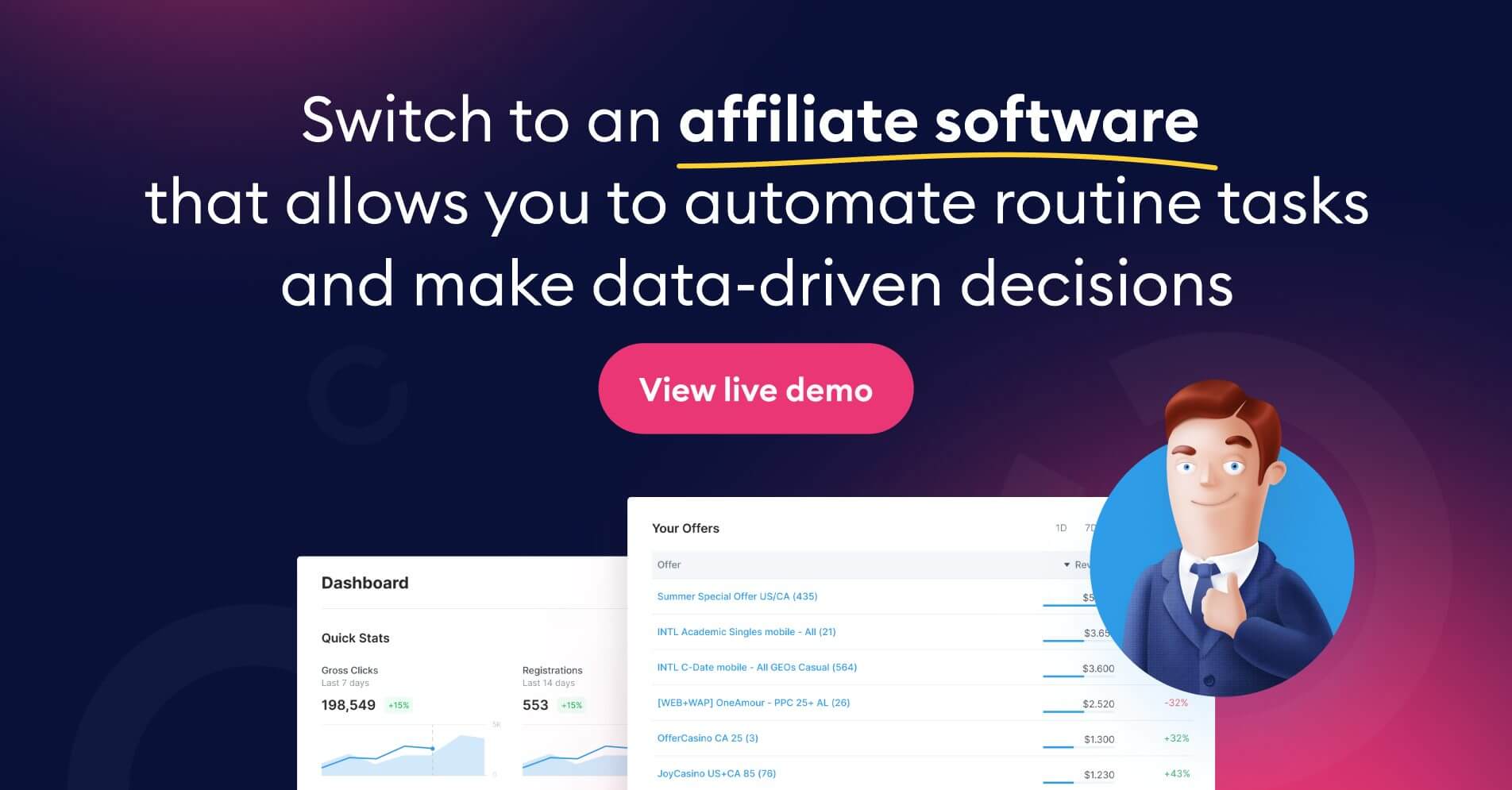
If you already run an affiliate program, creators plug straight into your existing rails. If you don’t, Scaleo gives you those rails—tracking, payouts, fraud control, and partner transparency—without bricolage.

Tracking that survives reality.
First-party identity and server-to-server postbacks anchor attribution; cookies are a convenience layer. SubIDs mark the creator, channel, and content; coupon codes merge with link data so podcasts and live formats don’t lose credit. Cross-device continuity is preserved because the ledger lives server-side.
Dashboards that explain the money.
Creators and operators see the same funnel: clicks → approvals → activations → revenue. Reason-coded payouts show why credit moved—approval gate met, validation window cleared, or fraud rule triggered. Disputes decrease because the scoreboard speaks for itself.
Payouts you can defend.
CPL/CPA/CPS and hybrids, tiered commissions, caps/floors, reserves, clawbacks, multi-currency support—encoded as policy, executed automatically. Tier promotions/demotions happen on schedule based on LTV/CAC and cleanliness, not on email threads.
Fraud & quality fused with finance.
Velocity rules, ASN/device checks, dedupe logic, anomaly detection on CR/EPC, and manual queues for high-value events. Holds and releases tie directly to evidence, which both sides can see.
Creative & link governance.
Central asset hub, deep links, smart links, auto-UTM injection, expiration handling for time-boxed promos, and compliance validators. Landers inherit context and swap modules per audience without rebuilds.
APIs & webhooks everywhere.
Sync with CRM for approvals, push offline conversions back into the ledger, export to your warehouse for cohort science, and trigger finance ops without CSV scavenger hunts.
Closing Perspective
Performance-based influencer marketing isn’t a gamble on charisma—it’s an engineered channel. Give creators a measurable value event, attribute with first-party truth, enforce approvals and fraud rules in software, and pay by contract. Do that, and you’ll get the reach of creators with the accountability of an affiliate program—and a CAC you can defend in any board meeting.
If you want the rails that make this painless—outcome tracking, rule-driven payouts, fraud and compliance guardrails, and partner dashboards your creators will actually trust—try Scaleo free and turn creator momentum into durable revenue.
What Is Performance-Based Influencer Marketing?
It’s influencer marketing engineered like an affiliate program. Creators receive unique tracking links or codes, your platform attributes conversions, and payouts follow predefined rules (CPS, CPA, CPL). The upside: forecastable CAC, cleaner ROI readouts, and scale without ballooning fixed costs.