
Running an affiliate program for a single casino in a single country is easy. Running one for three casino brands, two sportsbook skins, a poker vertical, and five licensing jurisdictions is where things start to break.
Most operators in 2026 are somewhere in between: they have outgrown the “one domain, one offer” model, but they still manage affiliates as if every partner sends the same traffic, to the same URL, under the same rules.
🎯 Ready to Level-Up Your iGaming Partner Operations?
Centralize multi-brand programs, automate payouts, and give partners real-time NGR visibility—without duct-taped tools.
That model can’t survive once you sell into several markets with different licenses, different KYC rules, different tax burdens, and—this is the fun part—different things you are actually allowed to promote. The logical answer is to unify everything into one affiliate layer and make the software do the routing, the capping, and the enforcement. The moment you make software the source of truth, you stop arguing with affiliates and you start scaling.
Why multi-brand/multi-GEO is different
When you operate in more than one jurisdiction, “the offer” is no longer just a landing page and a commission rate. It is a bundle of constraints issued by your license. In one market, you can promote a casino and sportsbook, in another, you can only promote fixed-odds, and in a third, you can’t promote at all—you can only let affiliates send traffic to a lead form.
In one country you must show a responsible-gaming banner and block bonuses for self-excluded players; in another you are legally obliged to block users from that IP range entirely.
If you let affiliates link to “the global site,” someone will eventually send UK users to a Curaçao brand, German users to a non-German license, or Brazilian users to a cashier that does not support PIX. That is exactly the kind of thing regulators and payment processors spot very quickly.
Add brands on top of that and the mess multiplies. Maybe you run a high-roller brand with 50% revenue share and a mass-market brand with a heavy bonus funnel that can only afford 25% on the first 90 days. Maybe you have a crypto brand with fast KYC and a fiat brand with slower bank-grade verification.
Affiliates will always pick the brand with better terms, even if it is not allowed for that GEO. If your affiliate program can’t automatically tell the difference, you will either break compliance or overpay.
Automated routing: the core idea
The solution is simple to describe and tricky to implement: every click from every affiliate should pass through a brain. That brain—your affiliate software—decides in real time where the user is allowed to go based on country, license, device, promo, and, if needed, partner tier.
If a user from Mexico clicks an affiliate link that was originally set up for Brazil, the system should silently send them to the Mexican brand or to a fallback page. If the original offer is exhausted because you hit your monthly CPA cap for Italy, the system should stop sending Italian traffic to that offer and start sending it to a cheaper or compliant variant.
The affiliate should still see their clicks and conversions; they just shouldn’t have to rebuild their links every time your legal team wakes up.
This routing logic usually relies on three signals: IP-based GEO detection, offer availability, and affiliate-specific terms. IP tells you where the player is right now and which license you should serve.
Offer availability tells you whether the operator still wants traffic for that segment this month. Affiliate terms tell you what you promised that specific partner, because large affiliates often run on bespoke deals that override default program settings.
When these three layers work together, you can run several brands and several GEOs from a single program without creating separate dashboards and separate payouts.
Why manual management fails
Some operators try to manage this by emailing affiliates, sending new tracking links, or instructing media buyers to “please stop sending French traffic, we are capped.” That works for a week. Then someone forgets, an ad stays live, French traffic keeps arriving, finance keeps paying, and suddenly you have paid CPA for signups that you were not supposed to accept under the license.
The deeper you go into regulated LATAM, EU, or provincial markets, the less tolerance there is for this kind of disorder. You can’t rely on human discipline when you have hundreds of partners, rotating campaigns, and short-notice regulatory changes. You need routing rules, not email threads.
Automating regional caps and promo exhaustion
The other half of the problem is pacing.
In regulated iGaming you rarely want unlimited traffic for every GEO. Brazil might be open all month, but Ontario might have a monthly CPA budget, Spain might have a limit on bonus-exposed players, and Germany might be capped because of AML checks. If your affiliate platform can apply caps per offer, per country, and per partner, you can leave all campaigns technically “on” while the software hard-stops at the right moment.
The click still resolves, so the user does not land on a 404, but the registration or reward does not get counted toward the capped deal.
This is a lifesaver when you work with big media buyers who dump traffic across several countries in one flight. Instead of negotiating separate links for each GEO and hoping they don’t mix them, you give them one master link.
Scaleo can receive the click, look at the source country, check whether the Italian CPA pool is still open, and if it is closed, send the user to a fallback brand that still accepts Italian users at a different rate. The affiliate still sees conversions, you still acquire users, and you did not break budget discipline.
One affiliate program, many terms
A real affiliate program is never one-size-fits-all. You have legacy affiliates who started with you when you were small; you have high-volume affiliates who demand hybrid deals; you have agencies that syndicate your offers to sub-publishers and need their own sub-ID reporting. If you maintain separate affiliate instances for every brand, you will be duplicating those deals in five different systems.
That makes finance reconciliation painful and kills your ability to see which affiliate truly drives value across the group.
A smarter approach is to run a single program with brand-level and GEO-level overrides. The base deal might be a 30% revenue share.
For Germany you might lower it to 25% because of tax.
For crypto brand you might raise it to 35% for the first 90 days. For a specific affiliate you might give a hybrid 100 EUR CPA plus 10% revenue share for Mexico only. None of that requires creating a new account.

With Scaleo you can apply all of it from one admin, and the affiliate will still log in to one dashboard and see it all separated by brand and country. That keeps partner relations clean—nobody feels “downgraded” because they were asked to join a second platform with worse terms.
Why affiliate marketing becomes more valuable in multi-brand mode?
The more brands and regions you run, the more chaotic paid media becomes. Meta will reject some creatives. Google will limit certain wording. Programmatic will fluctuate in price and sometimes not reach the exact audience you want.
Affiliates, on the other hand, are already segmenting their audiences:
Brazilian Telegram groups, Spanish streaming communities, Mexican tipsters, Portuguese Instagram pages, Polish bonus hunters. When you can accept or reject traffic per country automatically, you can open your program to far more of these micro-publishers without fearing that they will accidentally send you traffic you can’t legally convert.
This is where affiliate marketing stops being “one extra channel” and becomes the growth layer that soaks up demand you didn’t know how to monetize.
A Brazilian publisher can send you 50% Brazil, 30% Portugal, and 20% Angola. You might only want Brazil for Brand A, Portugal for Brand B, and none of Angola. With an automated routing program, you can still work with that publisher. Without it, you would have to block them and lose all of it. Over a year, that difference is massive.
Operating several brands from one Scaleo dashboard
This is the part that operators underestimate.
You don’t just want one login for convenience. You want one source of truth for attribution.
If you are paying CPA on five brands and two GEOs from seven different trackers, you will always be reconciling at the end of the month and arguing with partners who claim different numbers.
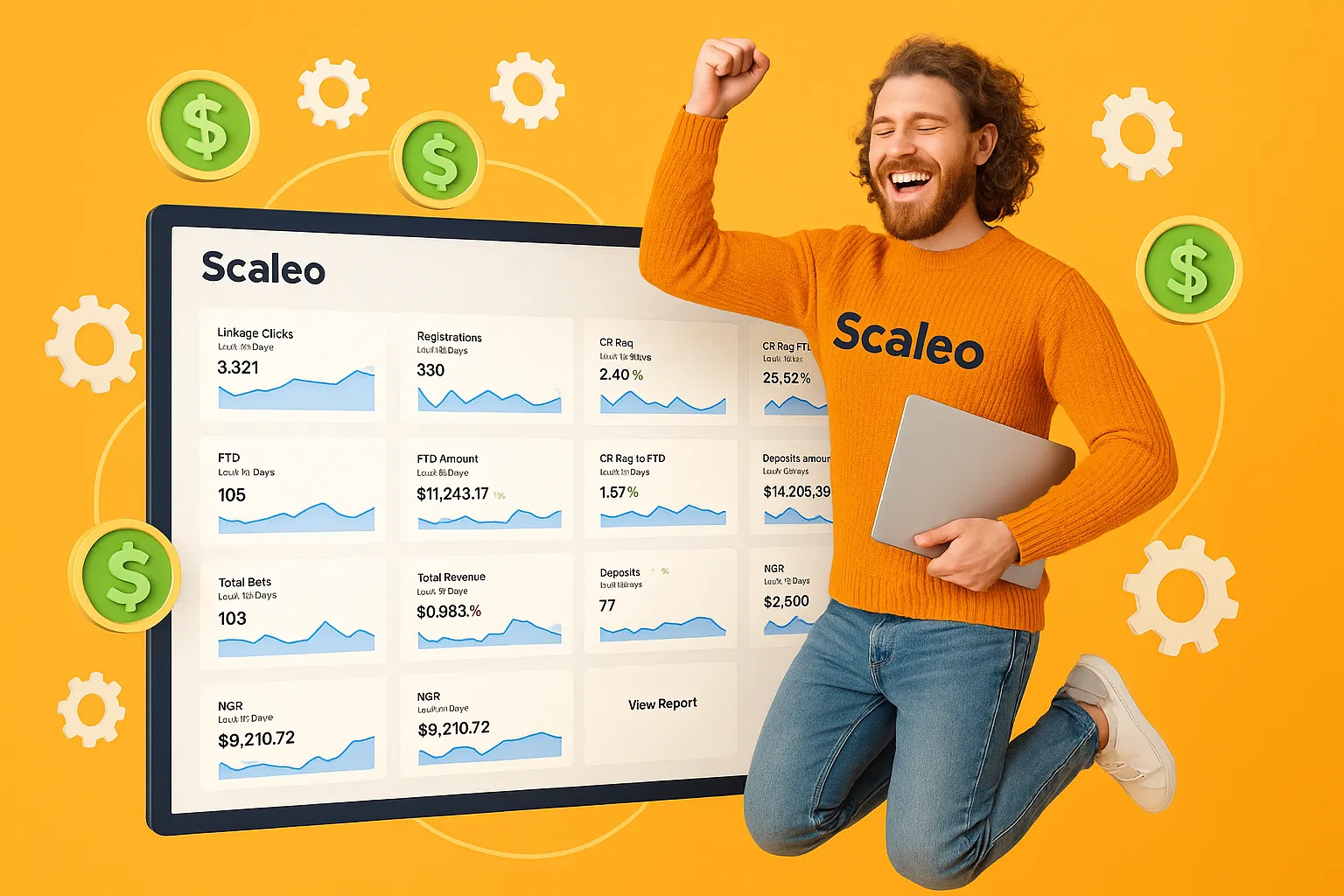
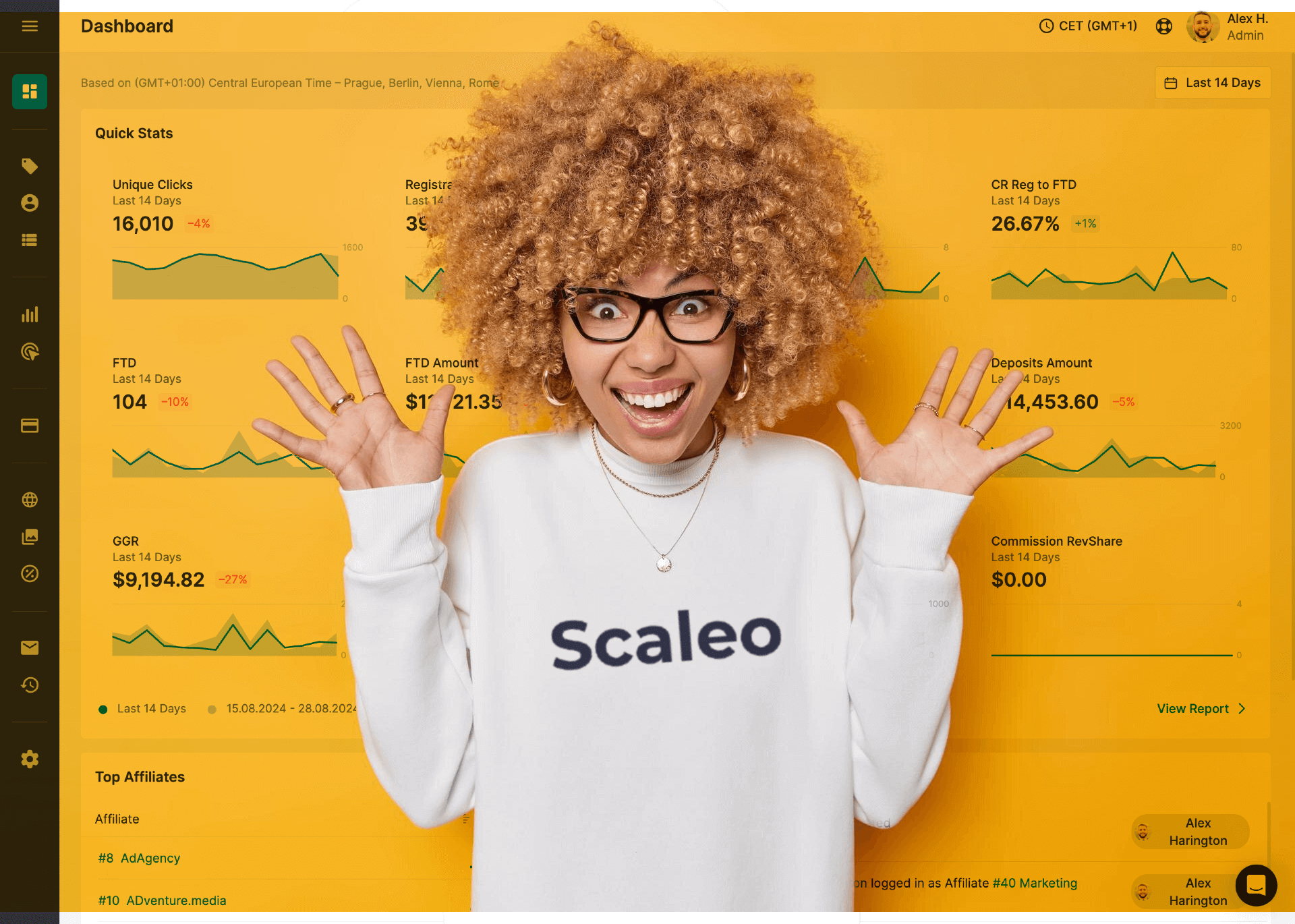
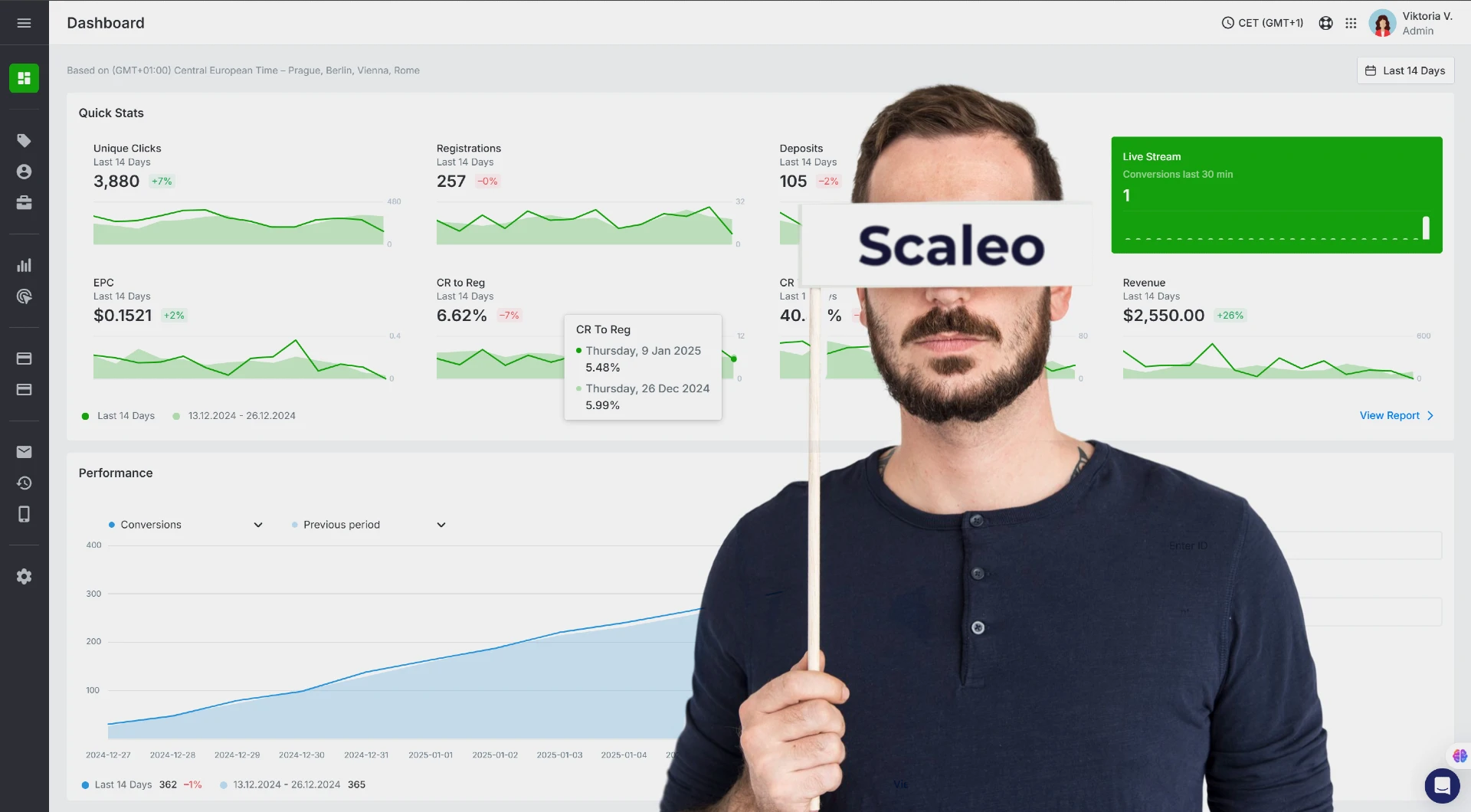
Scaleo lets you consolidate every click, registration, FTD, deposit, bet, and revenue event into the same reporting layer, regardless of which brand or license it ended up on. You can still segment by brand, by market, by campaign, and even by creative. You just don’t multiply platforms.
Because Scaleo is built on cookieless, server-to-server tracking, it does not care whether the user moved from web to app, from one domain to another, or from a generic landing to a country-specific cashier.
The operator’s platform sends the conversion back to Scaleo with the right identifiers, and Scaleo attributes it to the original affiliate. That is exactly what you need in a multi-domain, multi-license setup, because your user journey will rarely stay on one host.
You might send the user to a generic .com, then redirect to .com.br for payments, then open a deep link into an Android app. If you relied on browser cookies, you would lose the trail.
With S2S, you don’t.
Consolidation also matters for fraud and quality control.
When all brands report to the same affiliate brain, you can see patterns: the same affiliate sending high-chargeback traffic to Mexico and trying to push the same users into Brazil; the same agency creating multiple accounts to bypass caps in a restricted GEO; a sudden spike of VPN traffic in a market where you are not allowed to take foreign players. If your brands are siloed, you will spot it months later.
If they feed into the same Scaleo instance, you can cut it off today and adjust their terms globally.
Automating brand selection based on license
A typical 2026 operator will run at least one “global” license (Curaçao, Anjouan, Isle of Man) and one or more local ones (Brazil, MGA, maybe a Mexican permit when it lands).
Each license has a list of allowed countries and, in some cases, allowed products. That list should live in your affiliate platform, not in some PDF in your legal folder. When a click arrives, the platform should match the country to the allowed license, the license to the matching brand or domain, and send the user there. If the country is not allowed under any license, the platform should send the user to a neutral page with educational content or a lead form, so the affiliate does not lose the click.
This is where Scaleo helps again, because you can define offer groups by geography, apply country rules, and keep all links the same for the affiliate.
If, in June, Brazil changes its rule about casino jackpots, you can update the Brazilian offer in Scaleo and all traffic from Brazilian IPs will start going to the updated funnel. The affiliate does nothing. That is what “automating multi-brand routing” actually means in practice.
Handling caps without breaking relationships
Capping is delicate. Affiliates hate when traffic disappears. Operators hate paying for traffic past budget.
The only way to make both sides happy is to make caps visible, predictable, and fair. When everything runs in one program, you can tell an affiliate: your global monthly cap is 200 FTDs.
From that, 80 can be Brazil, 40 can be Mexico, 30 can be Germany, and the rest is uncapped. If Brazil hits 80 on the 15th, Scaleo can start routing all Brazilian clicks to a fallback brand with a lower payout.
The affiliate still earns; you still acquire; you did not blow your budget. And, because everything is in one dashboard, the affiliate can see it and does not have to ask.
Most disputes in affiliate marketing come from ambiguity: “I sent 500 players, you only tracked 380.”
In multi-GEO, multi-license worlds, ambiguity grows fast, because some of those users were probably rejected for KYC or for being in a blocked country. When the software enforces caps and terms, you can point to a log and say: user came from IP X in country Y at time Z, license Y does not accept users from that country; system routed to fallback, payout according to fallback.
Why this matters for owners planning to scale
If you are at the stage where you are still thinking, “We’ll launch a second brand for Brazil,” this is exactly the moment to centralize. Once you have three or four brands live, moving them into a single program will be painful because affiliates will already be used to separate logins and separate payouts.
If you start with one program, you can grow brands and GEOs under it with minimal friction. It also makes your company look bigger: partners see one professional, centralized program, several offers, and local options, not a patchwork of half-launched affiliate areas.
It also changes your ability to negotiate.
A single brand has to tolerate a lot from a big affiliate. A group program can say: we like your German traffic but not your Brazilian one, so we will cap Brazil at 20 FTD and leave Germany open. Because you can enforce it technically, you can negotiate harder commercially.
Why Scaleo is a good fit?
Scaleo was built for exactly this style of affiliate operation. It supports multiple brands and domains, lets you create GEO-aware offers, handles cookieless S2S postbacks from your iGaming platform, and exposes clean, real-time reports to both managers and affiliates.
You can create local-language dashboards, segment partners by vertical or market, run hybrid, CPA, and rev-share models side by side, and, most importantly, automate routing and capping instead of emailing links all day. For a business owner, that means one piece of software becomes the governance layer over your entire partner ecosystem.
You also get a side benefit most people don’t think about: data consistency. When finance, marketing, and affiliate management look at the same Scaleo numbers, they stop arguing about which brand “really” brought which player. You can push those numbers into your BI, match them to NGR from the gaming platform, and know exactly which GEO and which brand is profitable at what commission. Once you have that clarity, scaling to another market is not scary; you already know how to model it.
Conclusion
Multi-brand, multi-GEO affiliate management is not about being fancy. It is about keeping control when regulators, payment providers, and affiliates all pull you in different directions. If you let links, caps, and terms live in people’s inboxes, you will pay too much, acquire players you can’t monetize, and expose yourself legally.
If you let the affiliate platform do the heavy lifting—routing by license, enforcing per-GEO caps, honoring per-affiliate terms—you get the opposite: predictable growth, cleaner relationships, and the ability to add brands without rebuilding your partner ecosystem every six months. That is what “one program, many licenses” should look like in 2026, and that is exactly the setup Scaleo is designed to run.
✅ Ready to Upgrade Tracking, Payouts & Compliance for iGaming Partners?
Consolidate multi-brand affiliate programs and automate payouts. Upgrade to precise attribution, fraud controls, and instant reporting that your finance team will trust.