

Most affiliate programs do not lose attribution because postbacks are “hard.” They lose it because the click ID is captured poorly, stored inconsistently, or returned without enough validation to survive retries, delays, and real production traffic.
Direct answer
Postback URL tracking, also called server-to-server (S2S) tracking, is a conversion tracking method where the advertiser’s server sends a conversion event directly to the affiliate platform using a stored click ID. It is more reliable than pixel tracking because attribution does not depend on the user’s browser firing a script at conversion time.
In practice: a user clicks an affiliate link, the platform generates a click ID, the advertiser stores that ID server-side, and on registration, FTD, purchase, or another approved event, the advertiser sends that ID back in a postback so the affiliate platform can attribute the conversion.
- Best for: iGaming, finance, lead generation, and any program where payouts must be defensible
- Main advantage: survives browser restrictions, ad blockers, cookie loss, and app/webview instability
- Main risk: if the click ID is not captured, stored, and returned properly, the postback cannot rescue attribution later

On paper, postbacks look simple: pass a click ID, fire a server-side request, record a conversion. In production, especially in iGaming and other payout-sensitive verticals, postback tracking becomes the backbone of attribution, fraud controls, payout accuracy, and finance reconciliation.
This guide explains how postback tracking actually works, why pixel tracking quietly fails under pressure, and how to build an operator-grade setup that can survive disputes, audits, and scale.
What is postback tracking?
Postback tracking is a server-to-server conversion tracking method. Instead of relying on the user’s browser to fire a conversion pixel, the advertiser’s backend sends the conversion directly to the affiliate platform, usually together with a stored click ID and event details.
That architectural difference is the whole point. The browser participates at click time, but it does not decide attribution at payout time. Once the click ID is created and safely stored, the conversion can be confirmed between systems without depending on cookies, scripts, or fragile client-side behavior.
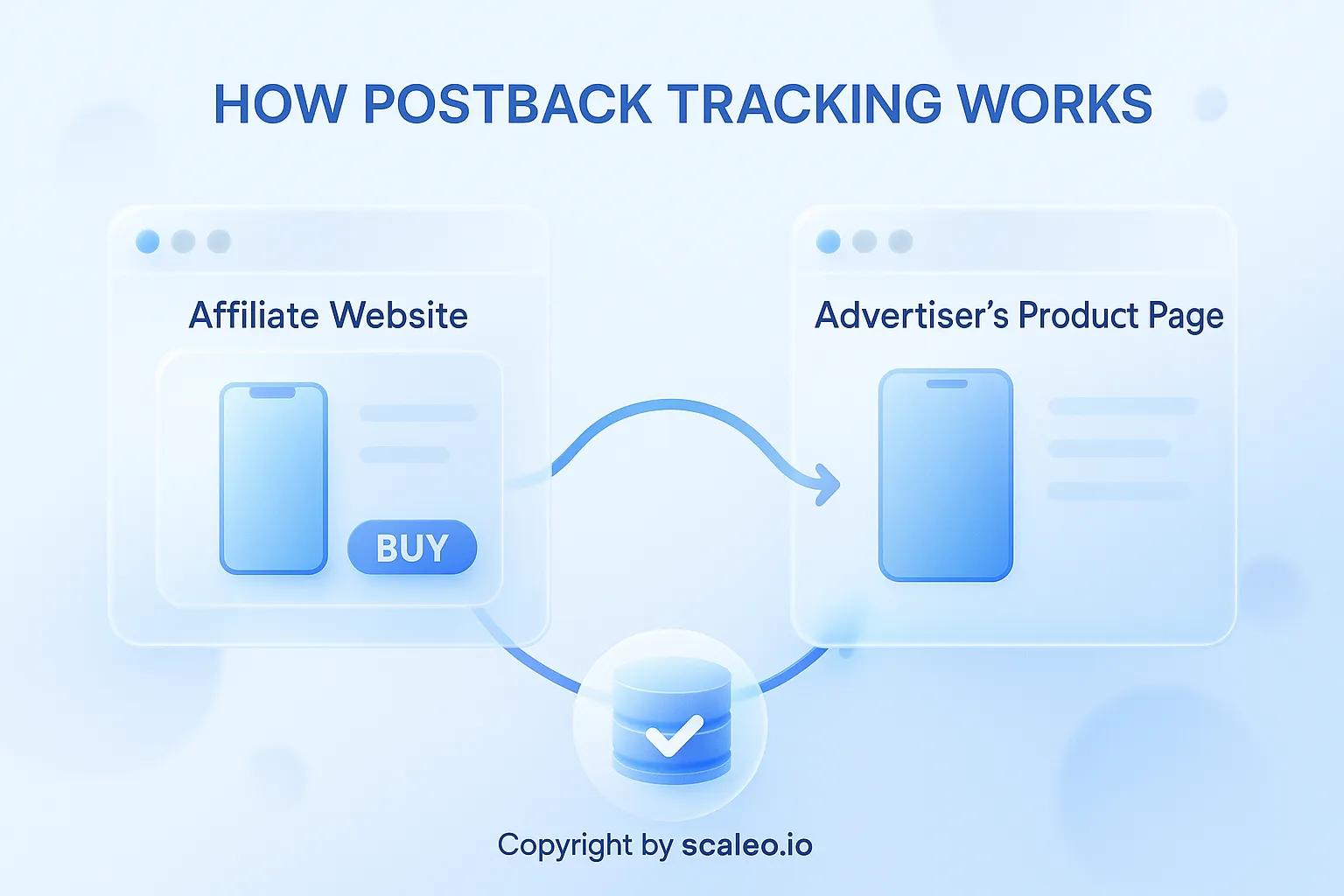
This is why postbacks matter more every year. Browsers now delete cookies aggressively, block scripts, rewrite redirects, and behave inconsistently inside apps and webviews. Postback tracking accepts that reality and removes the browser from the most expensive moment in the funnel: deciding who gets credited and who gets paid.
How does postback tracking work?
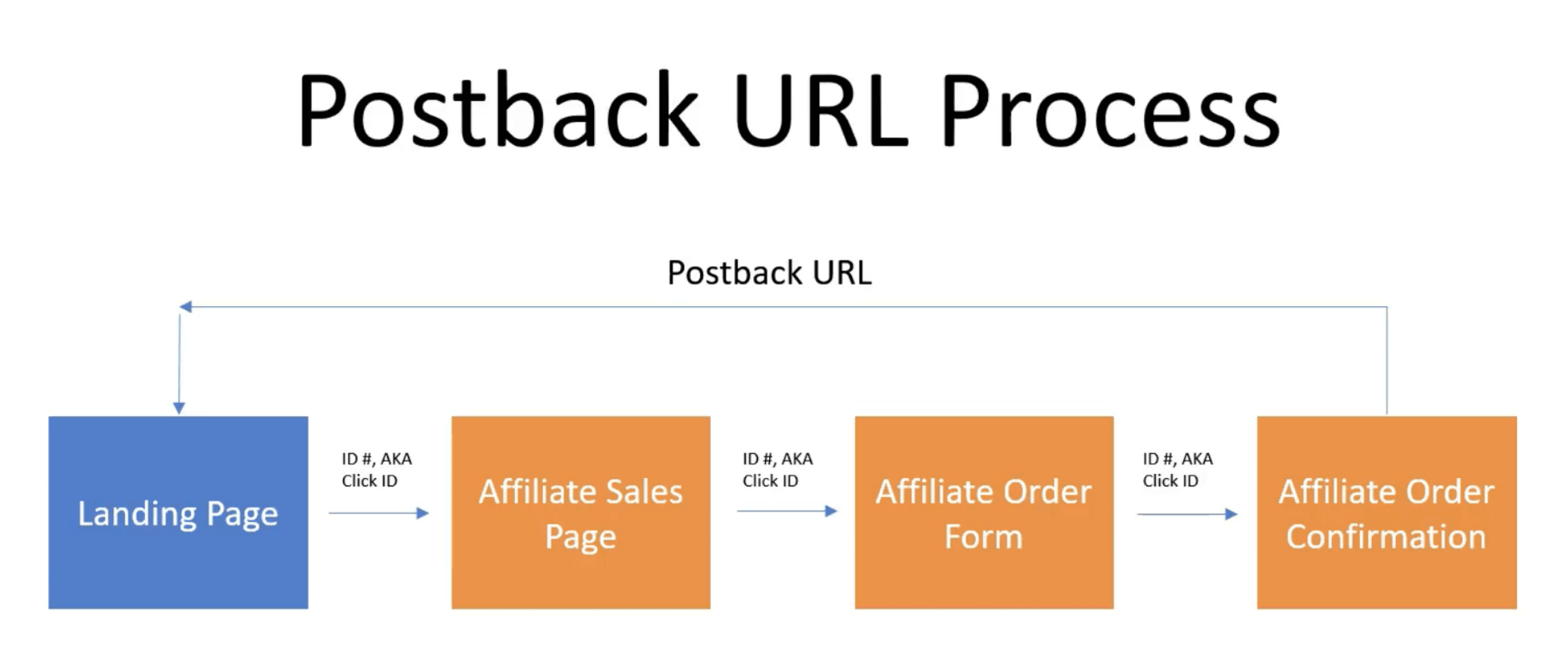
A working postback flow has four steps: generate the click ID, store it server-side, trigger a qualifying conversion event, and send the original click ID back to the affiliate platform in a server-to-server request.
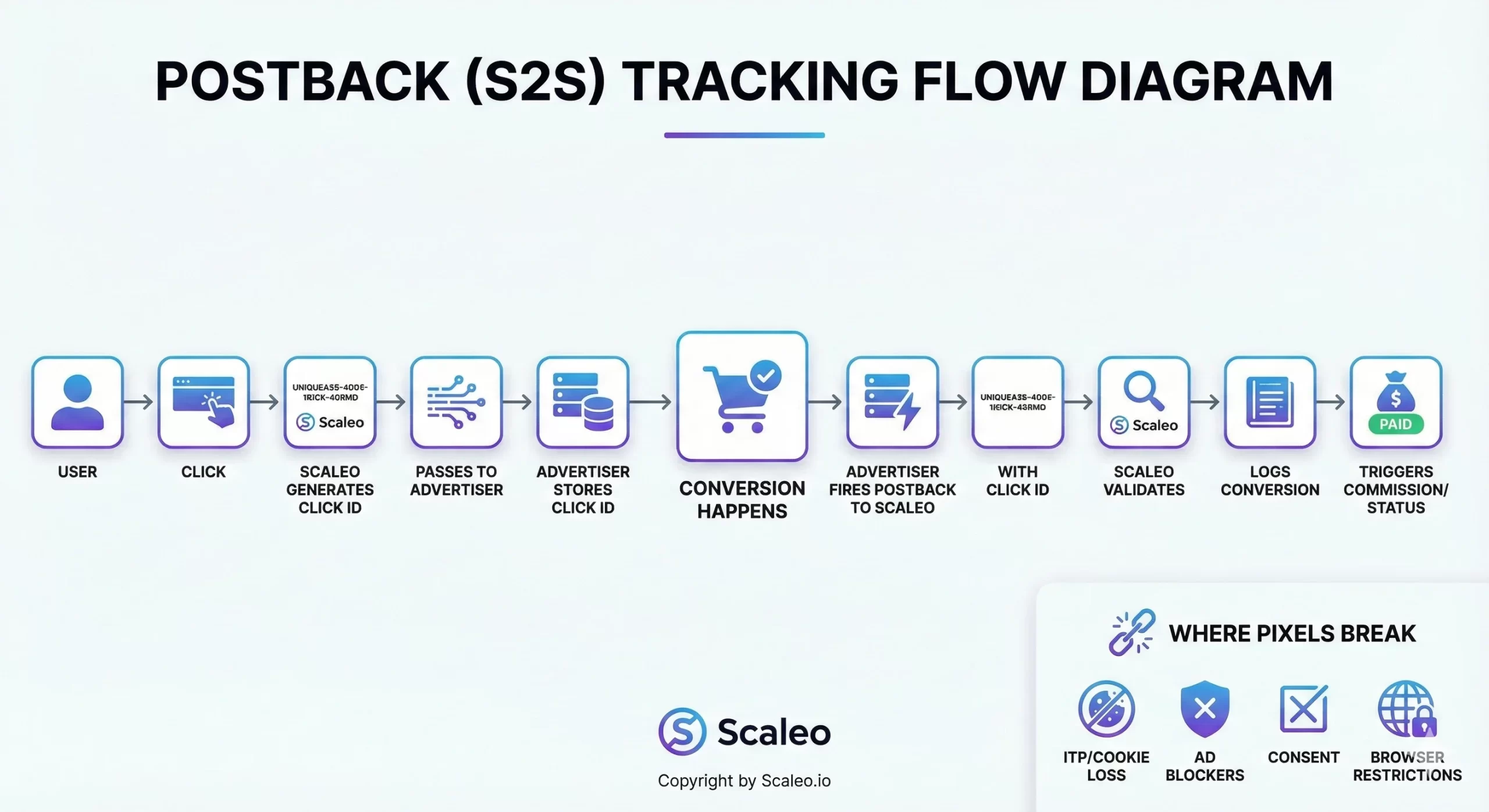
- The user clicks an affiliate link. The affiliate platform generates a unique click ID.
- The advertiser receives and stores that click ID. This must happen immediately and server-side.
- A qualifying event occurs. That could be registration, KYC completion, first-time deposit, purchase, subscription, or another approved goal.
- The advertiser fires a postback. The postback sends the original click ID, event type, payout, transaction ID, and any other required values back to the affiliate platform for validation and attribution.
The clean version sounds easy. The dangerous part is upstream: if the click ID was never stored correctly, or was lost during redirects, registration, app handoff, or session changes, the conversion cannot be attributed later no matter how perfect the postback URL looks.
Postback vs pixel tracking: what is the real difference?
Pixel tracking depends on the browser. Postback tracking depends on backend systems. That one distinction explains almost every difference in reliability, auditability, and payout confidence.
Pixels can still be useful for diagnostics or light funnels, but once conversions affect payouts, compliance, finance reconciliation, or affiliate trust, pixel-only attribution stops being defensible.
| Criteria | Pixel tracking | Postback tracking |
|---|---|---|
| How attribution happens | Browser fires a script or pixel on conversion | Advertiser server sends the conversion directly to the tracking platform |
| Dependency | Cookies, browser execution, page load, client-side environment | Backend systems, click ID storage, server-side event delivery |
| Reliability under browser/privacy restrictions | Weak | Strong |
| Auditability | Limited | High, because requests and responses can be logged server-side |
| Best use case | Secondary signal, debugging, simple funnels | Payout-critical attribution, multi-step funnels, iGaming, finance, enterprise affiliate programs |
| Main failure mode | Silent browser-side loss | Bad click ID persistence or weak deduplication design |
The grown-up architecture is simple: use S2S postbacks as the source of truth, and keep pixels only as a secondary diagnostic signal if needed.
In a sentence: choose pixel tracking when you want a lightweight signal; choose postback tracking when you need attribution you can defend to affiliates, finance teams, compliance teams, and auditors.
Why pixel tracking quietly fails at scale
Pixel tracking rarely fails loudly. It fails silently. A cookie expires. A browser blocks a script. An in-app flow drops the user out of the webview. A conversion page loads too slowly. An ad blocker strips the pixel. Every incident looks minor until the missing data compounds into payout gaps and reporting disputes.
The more dangerous consequence is not just missing conversions. It is bad decision-making based on distorted numbers. Media buyers optimize against incomplete data. Affiliates suspect shaving. Finance stops trusting attribution. The problem looks commercial, but the cause is technical.
That is why server-side tracking has become the default for serious affiliate operations. Not because it is fashionable, but because revenue attribution cannot depend on polite browser behavior anymore.
What breaks in postback setups at scale?
Most postback failures are not caused by the postback request itself. They happen because the click ID was mishandled earlier, or because the system receiving the postback was not designed for retries, duplicates, and event lifecycle logic.
| What breaks | How it shows up | Root cause | How to fix it |
|---|---|---|---|
| Missing conversions | Clicks exist but conversions never match | Click ID not captured or not stored server-side | Persist click ID immediately and validate it exists before event processing |
| Duplicate conversions | Affiliates get credited twice | Retries without idempotency logic | Use transaction_id or event_id and deduplicate strictly |
| Attribution drift | Numbers change later or disputes appear days later | Weak attribution windows or unclear event rules | Define event lifecycle, approval rules, and conversion windows explicitly |
| Currency mismatch | Finance reports do not reconcile cleanly | No currency field or inconsistent normalization | Send currency explicitly or normalize before storage |
| Ghost approvals | Rejected events still look billable | Status handling is missing or inconsistent | Implement pending, approved, rejected status lifecycle |
| Redirect stripping | Click ID disappears before registration or login | Redirect chain or app handoff drops parameters | Audit redirects and validate parameter pass-through across every handoff |
| Retry storms | Endpoint gets hammered and duplicates spike | No backoff logic or unstable endpoint behavior | Retry only on timeouts/network failure, with exponential backoff and request logging |
Scaling does not invent new attribution problems. It simply converts hidden mistakes into expensive ones.
What does a postback URL look like?
A postback URL is just the endpoint plus the parameters needed to identify and validate the conversion. The exact parameter names vary by platform, but the logic stays the same.
https://your-tracker-domain.com/postback?click_id={CLICKID}&txid={TXID}&event_type={EVENT}&payout={PAYOUT}¤cy={CURRENCY}A real request might look like this:
https://your-tracker-domain.com/postback?click_id=12345&txid=abc-789&event_type=ftd&payout=120¤cy=EURThe two fields you should treat as non-negotiable are:
- click_id — ties the conversion back to the original click
- transaction_id / event_id — prevents duplicates and makes reconciliation possible
Anatomy of a postback URL
- Base URL: the endpoint receiving the conversion
- Query parameters: the key-value pairs carrying identifiers, amounts, and status values
- Tokens/macros: placeholders such as
{CLICKID}or{PAYOUT}that the source system replaces with real runtime values
If your macro does not resolve correctly, or if the click ID was already lost before the event, the postback will technically “fire” while attribution still fails. That is why operators should inspect the actual received values, not just whether a URL was called.
Which postback parameters matter most?
Not every parameter is equally important. Some fields are required for attribution, some for finance, and some for troubleshooting. Mature setups send enough data to support all three.
| Parameter | What it represents | Why it matters |
|---|---|---|
| click_id | Identifier assigned at click time | Core attribution key |
| transaction_id / event_id | Unique conversion identifier | Deduplication and reconciliation |
| event_type / goal_id | Signup, FTD, purchase, deposit, renewal, etc. | Correct multi-event attribution |
| payout | Affiliate commission value | Billing and partner trust |
| revenue | Advertiser-side value from the event | Margin analysis and reporting |
| currency | EUR, USD, GBP, etc. | Prevents silent accounting mismatch |
| status | Pending, approved, rejected | Controls post-conversion lifecycle |
| timestamp | Event time | Late conversion analysis and troubleshooting |
| sub_id fields | Placement, campaign, source metadata | Optimization and fraud pattern detection |
If your setup sends only a click ID and payout, it may still “work,” but it will be weak when duplicates, approval changes, finance reconciliation, or fraud analysis enter the picture.
How to set up affiliate postbacks properly
The failure-proof version of postback setup is not about copying a URL template. It is about defining the event model, preserving identifiers end-to-end, and designing for real production behavior.
1. Define what counts as a conversion
Pick events that map to real business outcomes, not vague milestones.
- Registration
- KYC-approved registration
- First-time deposit (FTD)
- Qualified deposit above a threshold
- Purchase or subscription event
The more ambiguous your conversion definition, the more disputes you create later.
2. Capture the click ID on first touch and store it server-side
The click ID must be captured on entry, written to a server-side record, and still be retrievable when the conversion happens. If you “store it in a cookie and hope,” you do not have a real S2S design.
- Capture it on the first landing
- Persist it server-side immediately
- Carry it through signup, login, app handoff, or CRM/PAM flow
- Validate its presence before accepting the conversion path as production-ready
3. Build the postback using the exact parameter mapping the platform expects
Do not guess parameter names. click_id, cid, s2, sub2, txid, and event_id are not interchangeable unless the receiving platform explicitly maps them that way.
4. Implement deduplication before you go live
Your platform should treat the same conversion as the same conversion even if the request is retried.
- Primary dedupe key: transaction_id / event_id
- Fallback dedupe logic: click_id + event_type + time window
5. Handle retries safely
Retries are normal. Unsafe retries create duplicate payouts.
- Retry only on timeouts or network failures
- Use exponential backoff
- Never retry blindly without idempotency protection
- Log every request and response
6. Test the full click-to-conversion path, not just the endpoint
A postback test tool is useful. A real end-to-end test is better. Your team should be able to trace one real click, one stored click ID, one conversion event, one postback request, and one attributed conversion without hand-waving anywhere in the chain.
How to validate a postback setup before affiliates do
A production-ready setup should answer four questions instantly:
- Can you trace one conversion end-to-end by click ID?
- Can you explain why a conversion was accepted, rejected, or delayed?
- Can you replay the same request safely without double-crediting it?
- Can finance reconcile affiliate data against internal event data without manual guessing?
If any answer is “not reliably,” the setup is not ready yet. It may look functional. It is not robust.

Troubleshooting: why is the postback not firing or not attributing?
Most “postback not firing” tickets are not mysterious. They usually come down to parameter mismatch, lost identifiers, unresolved macros, or deduplication blocking a request that looks new only to the human looking at it.
- Wrong parameter name, such as
click_idvscid - Click ID captured on landing but never stored server-side
- Macro not replaced, so the endpoint receives literal text like
{clickid} - URL encoding issues
- Non-200 response from the receiving endpoint
- Duplicate blocked because the transaction ID was reused or omitted
- Redirect chain, app handoff, or login state stripped the original click ID
If you log incoming requests and responses properly, you can solve most postback issues fast. If you do not, every investigation turns into theology.
Security and compliance basics for postback tracking
Reliable tracking should not create a privacy liability. The safest baseline is simple.
- Use HTTPS for all requests
- Avoid sending raw PII such as email addresses or phone numbers in postbacks
- Use a shared secret or request signing pattern where appropriate
- Allowlist known sender IPs when relevant
- Log requests safely and mask sensitive fields if any exist
Clean S2S tracking should improve accountability, not create new risk.
How S2S attribution works in Scaleo
Scaleo supports multiple attribution methods, but for payout-critical tracking, postback tracking is typically the preferred setup because it runs server-side and avoids browser dependency at the moment of conversion.
- On click, a click ID is generated and passed forward
- The advertiser stores that ID server-side
- On conversion, the advertiser returns the click ID and event data to Scaleo
- Scaleo validates, attributes, records, and reports the conversion server-to-server
That is the loop. The hard part is not understanding it. The hard part is implementing it with enough rigor that it survives retries, delays, duplicate events, finance scrutiny, and affiliate disputes.

FAQ: postback URL tracking
What is a postback URL in affiliate marketing?
A postback URL is the endpoint used to send a server-to-server conversion event from the advertiser’s backend to the affiliate tracking platform. It usually includes the original click ID plus event details such as transaction ID, payout, status, or currency.
What is the difference between postback and pixel tracking?
Pixel tracking relies on the browser firing client-side code on conversion. Postback tracking relies on the advertiser’s server sending the conversion directly to the tracking platform. Pixel tracking is easier to deploy, while postback tracking is more reliable and more suitable for payout-critical attribution.
Why is postback tracking better for iGaming and high-volume affiliate programs?
Because it is more resilient under browser restrictions, app/webview instability, privacy changes, and ad blockers. It also produces server-side records that are easier to audit, reconcile, and defend when revenue, commission, and compliance are involved.
What is the most common reason postbacks fail?
The most common reason is not the postback URL itself. It is losing the click ID earlier in the flow or failing to store it server-side in a way that survives redirects, login states, app handoffs, and delayed conversion events.
Which fields are essential in a postback request?
The essential fields are the click ID for attribution and a transaction ID or event ID for deduplication. Beyond that, payout, event type, currency, status, and timestamp make the setup much stronger operationally.
Conclusion
Postback tracking is the grown-up way to attribute revenue. It survives ITP, ignores most browser-side interference, and ties a conversion back to the original click through a server-side event chain that can actually be audited.
Pixels still have a place as a secondary signal. But if your affiliate payouts, CPA optimization, or operator reporting still depend on browsers behaving politely, you do not have a durable attribution system. You have a fragile agreement with software you do not control.
Postback tracking does not make attribution simple. It makes it accountable. And accountability is the only thing that scales.
Quick sanity check before launch:
- Pass the tracker’s click ID into the advertiser flow
- Store it server-side immediately
- Return it in the postback together with transaction ID and event type
- Deduplicate aggressively and log every request/response
- Reconcile attributed events against finance and internal event data before affiliates find the mismatch for you
If you would rather skip token bingo, duplicate payouts, and “why isn’t it firing?” nights, use a platform built for server-to-server attribution from day one.
🎯 Need payout-grade attribution? Scaleo gives operators server-to-server postback tracking, pixel fallback, fraud controls, and reporting built for real affiliate programs — not toy demos. Start your 14-day free trial.