Here’s a stat that’ll make you blink twice: bonus abuse costs the iGaming industry over $1 billion every year.
Yes. Billion—with a B.
Even worse? According to H2 Gambling Capital, up to 15% of all player registrations are tied to fraudulent or abusive behavior.
This isn’t just a leaky pipe—it’s a gushing flood.

Affiliate programs, while lucrative, are a prime target for these abusers. And here’s the twist: they’re getting smarter. Manually spotting fraud? Pointless. It’s like trying to stop a tank with a slingshot. That’s where automated detection systems come in. They don’t sleep. They don’t blink.
And when configured correctly, they’ll catch fraudulent activity before it wrecks your ROI.
Let’s break it down.
Bonus Abuse: Common Patterns and Red Flags
Fraud comes in many costumes. And bonus abuse? It’s a master of disguise.
Here’s what to watch for:
| 👤 Abuse Type | 💥 Description |
|---|---|
| 🧑🤝🧑 Multi-Accounting | One user creates dozens of accounts to claim the same bonus repeatedly. |
| 🎯 Chip Dumping | Players transfer chips or winnings between accounts to cash out unfairly. |
| 🕸️ Syndicates | Organized groups coordinate strategies to exploit promotions at scale. |
But how do you detect it before the damage is done?
Start with patterns. Fraudsters don’t behave like regular players. They move in predictable, irregular ways.
- Dozens of registrations from the same IP?
- Unrealistically fast play-through rates?
- Multiple accounts cashing out in the same timeframe?
Red flags. All of them.
Behavioral Indicators and Statistical Anomalies
Not all abuse is blatant. Some hide in subtle patterns that only statistical analysis reveals.
Watch out for these behavioral blips:
- Velocity patterns: Abusers act fast—registration, deposit, and withdrawal often occur within minutes. That’s a red flag.
- Device anomalies: Same device ID but five different accounts? That’s not a coincidence.
- Geo-IP mismatches: Logging in from Germany, but the account indicates Brazil? Nope.
This is where automated systems shine. They track user behavior over time, not just one session. Scaleo‘s real-time fraud detection tools, for example, instantly flag suspicious activity, highlighting user accounts with anomalous performance, inconsistent traffic sources, or a history of bonus abuse. No need for manual cross-checking, just results.
If you want to fight scam effectively, you need to a system like Scaleo that highlights
Core Technologies Behind Automated Detection Systems
Let’s be real: catching fraud manually in 2026 is like chasing drones with a butterfly net.
Not going to cut it.
Fraudsters today are running automated bots, spoofing devices, manipulating geolocations, and even working in syndicates. So how do you fight automation? With smarter automation.
At the heart of every high-performing fraud detection setup lies a mix of machine learning, rule-based logic, and, increasingly, AI-powered decision engines. Each has its own superpower. Combined, they’re your frontline and your firewall.
Let’s break down each core component and how it actually works.
🧠 Machine Learning: Pattern Recognition at Scale
Machine learning (ML) is the Sherlock Holmes of your system. It doesn’t rely on hardcoded rules—it learns from historical data to spot patterns no human would notice.
For example:
- User signs up.
- Deposits €10.
- Plays one round of roulette.
- Withdraws €50.
- Repeats the same process with different accounts.
Individually, those actions don’t scream “fraud.” But an ML model trained on thousands of such behaviors will connect the dots—and raise the alarm.
ML shines in:
- Detecting behavioral anomalies (e.g. abnormal play frequency)
- Predicting future risk based on historical outcomes
- Clustering fraudulent user groups even if their tactics slightly differ
It uses decision trees, neural networks, and probabilistic models to assign a fraud score to every action. The higher the score, the more likely it is abuse.
This score can trigger automated bans or simply push the user into a manual review queue. It’s flexible, scalable, and sharper over time.
📜 Rule-Based Engines: Old-School Logic, Still Critical
Now, ML gets all the hype.
But rule-based systems are still the dependable backbone. Why? Because you need hard limits—especially in high-stakes iGaming.
These are IF-THEN statements. Here are a few good examples:
- IF the player uses the
same IP for more than 3 accounts → flag for review - IF deposit-to-bonus ratio is
under 10% → block bonus eligibility - IF
login occurs from a blacklisted device fingerprint → auto-ban
These rules act as hard failsafes, especially when time is critical.
And the best part?
They’re customizable. With platforms like Scaleo, operators can define rules tailored to their risk appetite. Want to block all users who register from a Tor exit node? One rule. Done.
The trick is balance. Too strict? You punish legitimate players. Too loose? You’re an ATM for fraudsters. Rule tuning is key—and that’s where AI steps in.
🤖 AI Algorithms: The Brain That Connects It All
Artificial Intelligence doesn’t just replicate human reasoning—it augments it. AI combines the power of machine learning with rule-based systems to make nuanced, context-aware decisions.
Here’s how it works:
- AI reads inputs from multiple data points (IP, session length, deposit size, device type, etc.).
- It references a constantly-updated database of known fraud patterns.
- It weighs this input using pre-trained models AND real-time feedback from your system.
- Then, it decides: allow, review, or block.
This isn’t your average spreadsheet logic. AI makes decisions in milliseconds, at scale, and adapts with every new piece of data.
For iGaming affiliate programs, this means:
- Instant rejection of abusive affiliate traffic
- Automatic adjustment of commission eligibility
- Real-time alerts to your CRM when high-risk players slip in
Scaleo integrates this seamlessly with its affiliate management tools, ensuring fraud signals don’t just get flagged—they get actioned.
🔍 Data Points: The Fuel Behind Every Detection Engine
Let’s talk about inputs. You can’t make good decisions with bad data. That’s why detection systems collect and analyze an extensive range of real-time data points. Some of the most critical:
| 🧩 Data Point | 🕵️♂️ Purpose |
|---|---|
| 🖥️ Device Fingerprinting | Detects users spoofing identities or using emulators across multiple accounts |
| 🌍 IP Tracking | Uncovers proxy usage, VPN manipulation, and geo inconsistencies |
| 🧭 Session Behavior | Analyzes click paths, mouse movement, and action speed for bot detection |
| 📱 OS & Browser Info | Flags old browsers or uncommon combinations used in automation setups |
| 🔐 Account Patterns | Detects account sharing, login overlaps, or suspicious registration clusters |
These data points aren’t just collected—they’re analyzed contextually. A user accessing from a mobile hotspot isn’t suspicious… unless five other new users just did the same within 30 seconds.
This context-aware analysis is what sets smart detection systems apart from cookie-cutter fraud filters.
⛓️ Combining All Three for a Unified Defense System
A modern fraud detection stack doesn’t pick one approach—it blends all three into a layered security system.
Here’s how it works together:
- Rules handle instant, clear-cut fraud (e.g., same credit card across 10 accounts? Boom—banned.)
- Machine learning handles pattern evolution (e.g., changes in affiliate traffic behavior after a new promo)
- AI handles decision-making and escalation logic (e.g., weighing device risk + session anomaly + affiliate history before rejecting commission)
And yes, Scaleo does all of this out of the box.
Ready to pick the best affiliate marketing software?
See the affiliate software in action and get a tailored solution with integrations and a growth plan. Experience the most advanced affiliate software firsthand!
It doesn’t just track affiliate performance—it actively protects your platform using real-time risk analysis.
When analyzing user data across funnels, campaigns, and geos, Scaleo gives you the full visibility you need to cut abuse without hurting legitimate partners.
Bonus fraud isn’t just a criminal tactic—it’s a tech arms race. And if you’re not using the latest detection stack, you’re already behind.
The good news?
You don’t have to build it all from scratch. Let Scaleo do the heavy lifting—automating fraud flagging, identifying repeat abusers, and integrating cleanly into your affiliate workflows.
Integration of Real-Time Fraud Detection Tools with Affiliate Platforms
Detection is great. Integration is better.
The best systems link your CRM, fraud prevention, and affiliate management into a single workflow. And the glue? APIs.
API-based integrations allow real-time communication between your fraud engine and affiliate software—like Scaleo, which flags risky traffic on arrival and feeds back data into your CRM, automatically suspending or limiting user activity.
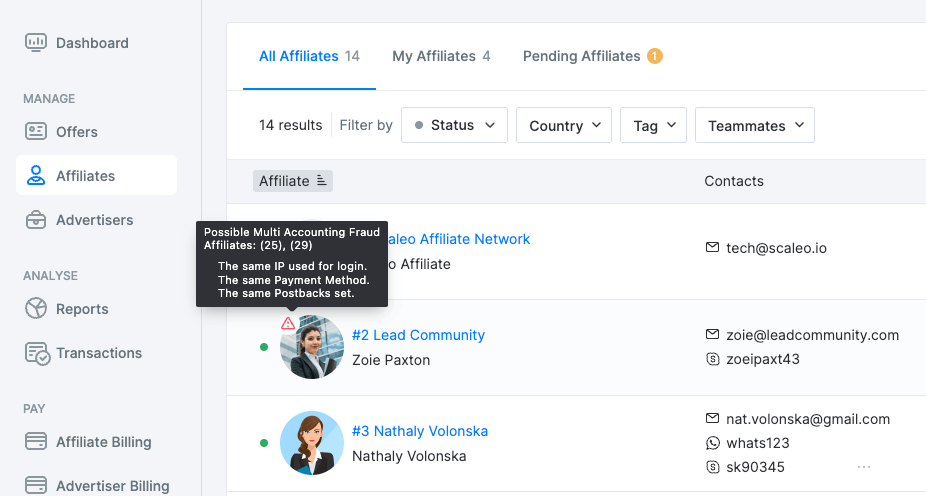
Here’s what seamless integration looks like:
- ✅ Risky registration? Flagged before account activation.
- ✅ Fraud score hits threshold? Affiliate denied commission.
- ✅ Suspicious source? Traffic source ID permanently blacklisted.
It’s a chain reaction—instant, traceable, and scalable.
Implementing an Automated Ban Protocol: Best Practices and Compliance
Let’s talk protocol. No, not the boring kind.
Smart businesses don’t just block—they assess. A tiered system works best:
| 🧪 Risk Level | 🚫 Action Taken |
|---|---|
| ⚠️ Low (Suspicious) | Monitor activity, limit bonuses, add to watchlist |
| ❗ Medium (Likely) | Restrict account, request KYC, pause affiliate payouts |
| ❌ High (Confirmed) | Immediate ban, block IP/device, report to central fraud DB |
But hold up—compliance matters.
- GDPR requires transparency in automated decisions. Let users appeal if needed.
- Responsible gambling? Ensure flagged users aren’t being penalized unfairly for problem gambling indicators.
- Documentation is key. Always have a paper trail of what was detected and why action was taken.
Monitoring and Continuous Optimization of Detection Systems
Fraud evolves. So should your defense.
Automated systems aren’t fire-and-forget. You’ll need:
- 🔄 Feedback loops: Update rules and ML models based on actual outcomes.
- 🧑💼 Human audits: Regular manual reviews to spot missed edge cases.
- 🧬 Behavioral evolution tracking: Fraudsters adapt—so monitor how.
Scaleo offers detailed funnel, KPI, and player reports, so you’re not left guessing. Use those insights to retrain your models and recalibrate risk thresholds. Precision beats paranoia.
Conclusion
Bonus abuse isn’t going away.
In fact, it’s becoming increasingly slick, faster, and more expensive by the day. If you’re running an affiliate program without a real-time fraud detection system, you’re basically handing out blank checks to bad actors.
Allow us to introduce Scaleo—affiliate program software made for iGaming operators who don’t mess around. With real-time fraud flagging, suspicious account highlighting, and seamless integration across systems, Scaleo does more than manage affiliates—it protects your business.
Don’t wait until the damage is done. Try Scaleo now and stop bonus abuse in its tracks.
How to detect multiple affiliate accounts?
Cluster, don’t guess. Tie identities to stable stuff: KYC docs, payout details (IBAN, PayPal, crypto wallet), phone, address. Use Scaleo Anti-Fraud Logic to detect multiple affiliate accounts.
Use device fingerprinting + IP/ASN + user-agent to spot overlaps between “different” accounts.
Look for patterns: same GEO/device logging into many accounts, mirrored funnels, same creatives/tracking links, identical traffic patterns.
Run graph/cluster analysis on all these attributes and auto-flag clusters for manual review and payment hold.