
“EPC” gets tossed around in partner decks and affiliate forums as if it were self-explanatory. It isn’t. Earnings per click can be a payout shorthand, a diagnostic KPI, a forecasting lever, and—when misunderstood—the reason a campaign loses money despite “great EPC.”

This guide strips EPC to first principles, shows how different programs compute it, how to predict it from funnel metrics, how to improve it without guesswork, and where a purpose-built iGaming stack like Scaleo automates the heavy lifting.
EPC, Defined (and Why It’s Not a Payout by Itself)
EPC = Total Commissions Earned ÷ Total Clicks for a period, offer, traffic source, or partner. It’s the average revenue per click produced by your affiliate links. EPC is not a commission type; it’s a result created by your commission model (CPA, RevShare, Hybrid), your conversion rate, and player value.
| Term | What It Is | What It Isn’t |
|---|---|---|
| EPC | Average revenue you earned per affiliate click | A fixed payout; a guarantee; profit |
| CPA | Commission per qualified action (e.g., FTD) | Average per click |
| RevShare | % of player NGR/GGR over time | Immediate per-click value |
| Hybrid | CPA + RevShare mix | Same as EPC |
Networks sometimes publish a normalized EPC (e.g., “7-day EPC per 100 clicks”) to smooth volatility. That’s useful for quick comparisons, but you still need your EPC by traffic slice, offer, and period.
Two Perspectives: Affiliate EPC vs. Advertiser EPC
Affiliates use EPC to rank offers, creatives, and traffic sources. Advertisers track “EPC out” (how much they pay per click to partners) and “EPC in” (revenue per incoming click to the site) to guard margin.
| Role | Core EPC Question | Action Trigger |
|---|---|---|
| Affiliate | “Which offer yields the highest net EPC?” | Shift traffic to offers with higher EPC – CPC spread |
| Advertiser | “What EPC am I effectively paying per partner click?” | Adjust commissions, caps, or creative support |
The Predictive View: How to Model EPC Before You Spend
Don’t wait for a week of spend to discover a weak EPC. You can forecast it using funnel math:
- CPA programs:
EPC ≈ CR(Click→Action) × CPA - RevShare programs:
EPC ≈ CR(Click→FTD) × (Expected NGR × Your %), where Expected NGR accounts for average deposit size, game mix, bonus costs, and early churn. - Hybrid:
EPC ≈ CR × CPA + CR × (Expected NGR × %)
Example (Hybrid): Click→FTD CR = 3%; CPA = $120; 30-day NGR per new player = $180; RevShare = 25%.EPC ≈ 0.03×120 + 0.03×(180×0.25) = 3.6 + 1.35 = $4.95 per click.
Tip — Model with real data: In Scaleo, pull KPI & Player Reports for D7/D30 NGR by partner & vertical and feed those values into your EPC calculator. Lock the winning deal structure with Commission Constructor.
EPC vs. Profit: Mind the CPC
EPC tells you revenue per click. Margin lives in EPC – CPC (your cost per click from paid media or opportunity cost for owned inventory).
| Metric | Formula | Use It To |
|---|---|---|
| EPC | Total commissions ÷ clicks | Compare offers & partners |
| CPC | Media spend ÷ outbound clicks | Control acquisition cost |
| Net EPC | EPC – CPC | Decide scale/kill/iterate |
Example: EPC $2.70 and CPC $1.10 → Net EPC $1.60. If the same offer on mobile has EPC $1.90 and CPC $0.60 → Net EPC $1.30; desktop still wins despite the cheaper clicks on mobile.
Why Network EPC ≠ Your EPC
Public “Network EPC” aggregates everyone’s performance. Your traffic quality, geo, device mix, and pre-sell drastically shift outcomes. Treat network EPC as directional only. Always compute Your EPC by partner, geo, device, placement, and time window.
| Source | Common Pitfalls | Fix |
|---|---|---|
| Network EPC (30–90d) | Smoothed by whales, mixed geos | Replicate with your own slices (geo/device) |
| Your EPC (raw clicks) | Bot/duplicate clicks inflate denominator | Count unique, validated clicks only |
| Your EPC (short window) | RevShare value not realized yet | Track D7/D30/D90 EPC cohorts |
Tip — Tighten your denominator: Enable Scaleo Fraud Prevention (IP/device/browser checks) so EPC reflects human, unique clicks. Use Player Funnel Insights to pinpoint where EPC leaks (LP→Reg, Reg→KYC, KYC→FTD).
Decomposing EPC: The Five Levers
Every EPC number is the product of five controllable levers. Fix the weakest one first:
- Intent Match: Pre-sell and lander must match the offer promise (bonus, volatility, sport, stake).
- Friction: KYC and cashier UX. Seconds added here crush Click→FTD.
- Geo/Device Fit: Offer, payment methods, and creatives aligned to local norms and mobile standards.
- Commission Fit: CPA for fast funnels; RevShare for retention-heavy verticals; Hybrid for balance.
- Fraud Hygiene: Filter bots, bonus abuse, and duplicates or EPC collapses via denominator bloat and clawbacks.
CPA Example
Clicks: 4,000; FTDs: 120 (CR 3%); CPA: $130 → Commissions = 120×130 = $15,600 → EPC = $15,600 ÷ 4,000 = $3.90.
RevShare Example (30 days)
Clicks: 5,500; FTDs: 99 (1.8%); Avg 30-day NGR per new player: $210; RevShare: 25% → Commissions = 99×(210×0.25) = $5,197.50 → EPC ≈ $0.95. (May rise at D60/D90 as players continue wagering.)
Hybrid Example
CPA $90 + 20% RevShare; CR 2.5%; 30-day NGR $160 → EPC ≈ 0.025×90 + 0.025×(160×0.2) = 2.25 + 0.80 = $3.05.
Table: Fast EPC Diagnostics
| Symptom | Likely Cause | Fix |
|---|---|---|
| High CTR, low EPC | Misleading creatives; LP mismatch; KYC friction | Align promise→LP; cut steps; optimize KYC flow |
| Good EPC, tiny volume | Tight geo/device; not enough placements | Add approved sources; duplicate best creatives |
| EPC swings by day | Weekend bias; bonus calendar; sports schedule | Use 7/30-day cohorts; season-proof promos |
| Great EPC, poor profit | CPC too high; slow RevShare realization | Move to lower CPC sources; hybridize payout |
| EPC collapsing over time | Bonus abusers; duplicate devices; clawbacks | Stronger fraud rules; device/IP velocity checks |
Raising EPC the Right Way (Without Guesswork)
- Segment ruthlessly: Compute EPC by geo, device, creative, placement, time window. Scale only the top deciles.
- Match offer to intent: If pre-sell is “low-wager casual,” land on simple games & lighter KYC. If “high-volatility slots,” showcase that.
- Cut friction: Offer local payments; defer document uploads for low-risk first deposits where compliant.
- Commission fit: Move retention-strong partners to RevShare/Hybrid; keep deal-hunters on capped CPA tiers.
- Educate partners: Serve compliant creatives, approved headlines, and a live promo calendar inside the portal.
Tip — Automate the loop: Scaleo Automation can bump tiers, cap CPA, or flag under-performing sources based on EPC, chargebacks, or D7 NGR—hands-off, rules-based.
For Advertisers: EPC Guardrails You Should Enforce
- Define the click: Unique, human, javascript-enabled; exclude auto-refreshes.
- Attribution window clarity: State cookie/session windows and eligibility rules.
- Clawback policy: Document fraud/chargeback/self-exclusion conditions and automate.
- Tiering by quality: Tie commission tiers to D7 NGR, VIP share, or chargeback ratio—not just volume.
- Creative controls: Approve/expire creatives centrally; pause non-compliant sources instantly.
Scaleo tools used: Commission Constructor, User Roles & Permissions, and Invoicing & Payment Automation to keep payouts accurate and on time.
Common EPC Myths—Debunked
- “High EPC means scale immediately.” Not if volume is tiny or CPC > EPC.
- “Network EPC is the ceiling.” It’s an average; strong pre-sell/geo fit can beat it 2–3×.
- “RevShare EPC is always lower.” D60/D90 cohorts often outpace CPA when retention is real.
- “EPC alone is enough.” Pair with CR, NGR/ARPU, chargebacks, and CPC.
Mini EPC Calculator (Mental Math)
Quick sanity check before you launch a test:
- CPA Offer: CR 2.2% and CPA $110 → EPC ≈ 0.022×110 = $2.42.
- RevShare: CR 1.6%, 30-day NGR $190, share 25% → EPC ≈ 0.016×(190×0.25) ≈ $0.76 (track D90).
- Hybrid: Blend both and compare to CPC to forecast margin.
How Scaleo Makes EPC Actionable (for iGaming)
EPC only drives growth when your stack turns numbers into decisions. Scaleo is built for iGaming advertisers and affiliate programs to do exactly that:
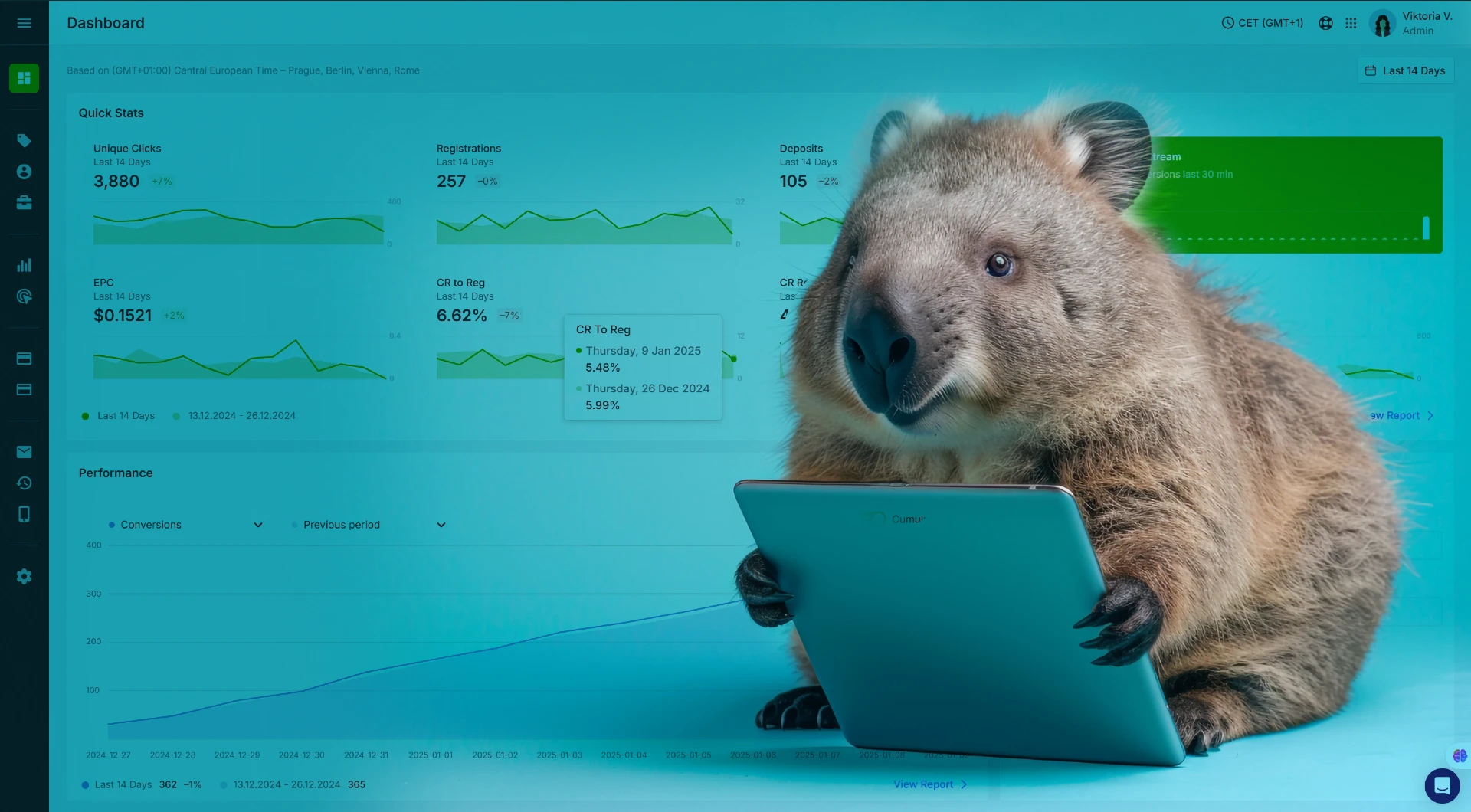
- Dashboard & Reports: Real-time EPC by partner/geo/device/brand; drill into clicks, registrations, deposits, GGR/NGR.
- Player Funnel Insights: Visualize click→reg→KYC→FTD drop-offs and fix the exact stage depressing EPC.
- KPI & Player Reports: Identify partners bringing the highest-value players.
- Commission Constructor: Test CPA/RevShare/Hybrid tiers with geo/device rules and auto-clawbacks.
- Fraud Prevention: IP/device/browser logic removes bot/duplicate clicks.
- Multi-Brand Support: Compare EPC across casinos/sportsbooks in one place.
- Affiliate Content Extensions: Push approved creatives, promos, and landers right into partner dashboards.
- Invoicing & Payment Automation: Pay accurately and on schedule—fewer disputes, happier partners.
FAQs
Is EPC calculated on unique or total clicks?
Best practice is unique, validated clicks. Counting refreshes or bot hits bloats the denominator and depresses EPC unfairly.
Which EPC window should I use—7, 30, or 90 days?
Use all three. 7-day EPC is for fast tuning; 30-day balances recency and value; 90-day is mandatory for RevShare offers with meaningful retention.
What’s a “good” EPC?
It’s relative to your CPC and model. A $1.50 EPC is fantastic at $0.40 CPC and terrible at $2.00 CPC. Track the spread (EPC – CPC).
How to raise EPC quickly?
Align lander to pre-sell, reduce KYC friction, localize payments, deploy the right commission model, and remove bad clicks via fraud checks. Scaleo centralizes these controls.
Conclusion
EPC is the simplest way to express affiliate revenue efficiency—but it’s not a standalone metric or a promise. Treat EPC as an outcome you engineer with the right funnel, geo/device fit, commission model, and fraud hygiene. Measure it precisely, compare it intelligently, and raise it methodically.
With Scaleo, that becomes an operating system—not a spreadsheet ritual—so you can pay for the clicks that matter and scale the partners who deliver them.