

You want a successful affiliate campaign? Fair enough. Let’s answer the most important question: understanding affiliate marketing metrics (what to track, why it matters, formulas, and thresholds) and affiliate tracking methods (how the data is captured reliably in a privacy-first world).
This is a practical guide you can use today to measure affiliate marketing, improve the performance of your affiliate marketing campaign, and know—objectively—what’s working.

Here’s the promise: by the end of this article, you’ll know how to measure affiliate marketing end-to-end, which KPIs prove impact (and which waste time), and which tracking method fits your stack. Sprinkle in affiliate marketing campaign performance tips and some tutorials to make it stick, and you’ll have a playbook that scales.
Successful affiliate campaign: how and what to measure?
Clicks ≠ revenue.
If your dashboards obsess over CTR but ignore payout rules, LTV, or attribution windows—your “wins” can be illusions. Anchor your affiliate marketing measurement to business objectives first (revenue, margin, market entry), then select KPIs and tracking that map to those goals. That’s how you measure the performance of an affiliate marketing campaign without gaming vanity metrics.
The KPI affiliate marketing scorecard
These are the essentials I track in every program, whether you run content partners, paid media affiliates, or creators. Use cohort views (by month and source) and standardize attribution windows so results are comparable across partners. Pro tip: want deeper context? Try a focused Google search like site:www.scaleo.io to surface advanced guides and tutorials.
| Metric | What it measures | Formula (practical) | Use it to decide |
|---|---|---|---|
| Clicks & CTR | Top-of-funnel attention & creative fit | CTR = Clicks ÷ Impressions | Creative/placement testing; not proof of value alone |
| Conversion Rate (CVR) | Landing/offer effectiveness | CVR = Conversions ÷ Clicks | Optimize pages, offers, and device mix |
| EPC / RPC | Revenue per click | EPC = Commissionable Revenue ÷ Clicks | Compare partners apples-to-apples |
| CPA / CPL / CPS | Acquisition cost by goal | CPA = Cost ÷ Conversions | Scale winners, cap losers; payout modeling |
| AOV | Average order value | AOV = Revenue ÷ Orders | Offer bundling and upsell tests for affiliates |
| Refund/Chargeback Rate | Post-purchase quality | Refunds ÷ Orders | Quality controls; adjust partner eligibility |
| Customer Lifetime Value (LTV) | Total value per customer | LTV = Avg Monthly Gross Profit × Avg Lifetime (months) | Set commission caps, justify higher CPA |
| LTV : CAC | Unit economics | LTV ÷ CAC | Scale thresholds, budget guardrails |
| Active Affiliate Ratio | Partner base quality | Active Affiliates ÷ Total Affiliates | Recruitment focus, enablement priorities |
| Incrementality | Lift vs. baseline | Holdouts/Geo-splits or time series | Prove channels aren’t cannibalizing |
| ROAS / ROI | Return on ad/partner spend | ROAS = Revenue ÷ Spend | Budget allocation & payout negotiations |
Track “successful affiliates” not by raw volume but by predictable margin: stable CVR, low refund rate, healthy LTV:CAC, and clean traffic signals. That’s your affiliate marketing success rate—consistency over spikes.
What changed—and why tracking methods matter
Third-party cookies fading?
Yep.
Ad blockers?
Everywhere.
Walled gardens?
More of them.
Outcome: you can’t rely on brittle, last-click, third-party-cookie setups. Modern affiliate tracking leans on first-party storage and server-to-server (S2S) postbacks with hashed identifiers. It’s the only way to keep affiliate marketing measurement accurate and privacy-respectful.

Affiliate tracking methods explained
Choosing the right method is half the battle. Here’s the quick comparison to help you pick, implement, and test properly.
| Method | How it works | Pros | Watch-outs | When to use |
|---|---|---|---|---|
| First-party cookie + tracking param | UTM/click ID stored on your domain | Resilient to 3P cookie loss; simple | Shorter lifetimes; browser ITP limits | Web conversions on your own domains |
| S2S Postback (server-to-server) | Click ID passed to server; conversion fires from backend | Most reliable; ad-blocker resistant | Requires dev work; strict ID handling | Any high-value conversions (sales, FTDs, trials) |
| Hashed user identifiers | Consent-based email/phone hashed | Better match for logged-in flows | Consent and PII governance non-negotiable | Membership, SaaS, iGaming account flows |
| Promo codes / vouchers | Code maps to affiliate | Great for offline/social | Leakage; stacking issues | Creators, podcasts, influencer partners |
| Coupon/Deep links | The link contains campaign ID and deep path | Higher CVR via intent pages | Must maintain redirects/domains | Retail/catalog programs |
| Fingerprinting (probabilistic) | Device/browser signals infer match | Stopgap at best | Privacy risk; often non-compliant | Generally avoid; use only where legal/consented |
Bottom line: prefer S2S postbacks with first-party storage. That’s how you measure affiliate marketing success reliably in 2026, across devices and browsers. If you need a quick mental model: client-side for speed, server-side for truth.
Setup checklist: how to measure affiliate marketing right
Here’s a pragmatic flow you can implement in Scaleo or any modern platform—use it as your campaign monitor affiliate program checklist (no, not the email brand; literally monitor your affiliate program’s campaigns):
- Define business goals: revenue or NGR, margin, and market entry—then map KPIs. This keeps your affiliate marketing success tied to outcomes, not clicks.
- Standardize attribution: last click vs. position-based; set lookback windows (e.g., 30D click / 1D view). Communicate to partners—successful affiliates need clarity.
- Implement S2S + first-party cookies:persist click IDs server-side; send postbacks on conversion and on adjustments (refunds, clawbacks).
- Normalize events: click → signup → trial → purchase → repeat. Track drop-offs to fuel affiliate marketing campaign performance tips that actually matter.
- Segment cohorts by month, country, device, and partner type (content, coupon, or media buyer). Compare LTV:CAC and refund rate by cohort.
- Add compliance & fraud screens: velocity checks, duplicate payment sources, and bot patterns. Don’t pay for noise.
- Report what partners need: clean EPC, CVR, and payout logic. That’s how you create a successful affiliate ecosystem that compounds.
Beyond vanity metrics: what to ignore
High CTR with low CVR?
Pretty ads, poor intent. Huge traffic from a single publisher with a 3× refund rate? Not a win. “View-through” conversions without strict windows and dedupe rules? Be careful. Affiliate marketing campaign performance is earned in the messy middle: attribution clarity, solid postback plumbing, and post-purchase quality.
Real-world benchmarks: what “good” looks like
Benchmarks vary by vertical, but I suggest targets like these for sanity checks (cohort-level, not day-to-day):
| Area | Signal | Healthy Range (directional) | Why it matters |
|---|---|---|---|
| Acquisition quality | CVR (click→goal) | 2–8%+ (lead) / 1–3%+ (sale) | Intent & landing/page fit |
| Economics | LTV : CAC | > 3:1 mature / > 2:1 growth | Room for can grow payouts |
| Traffic health | Refund/chargeback | < 5% consumer / stricter for B2B | Protects ROI and reputation |
| Partner base | Active Affiliate Ratio | > 20–30% active/90 days | Depth over vanity signups |
| Payout sanity | ROAS / ROI | Positive post-refunds | True performance, not top-line |
Cohorts, funnels, and incrementality
To really measure affiliate marketing, think in journeys, not snapshots. Cohorts (by first touch month and partner type) reveal retention and AOV growth; funnel analytics show where to intervene (creative? page? onboarding?). For incrementality, run geo holdouts or time-based pauses with similar traffic sources. If revenue holds steady, that “amazing” partner might be cannibalizing brand demand.
Enable successful affiliates with data
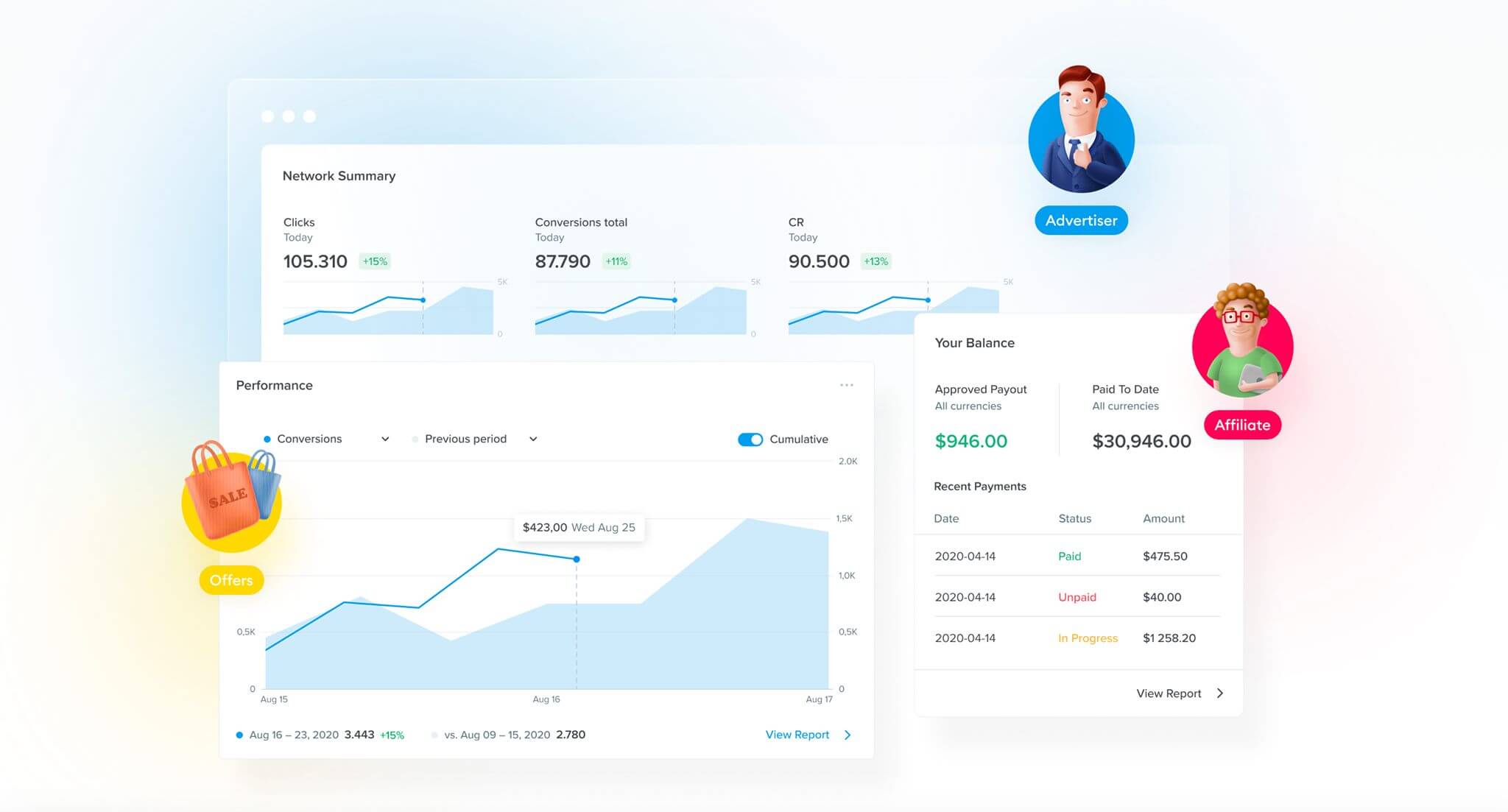
Share what moves the needle: converting geos, devices, best-selling SKUs, and creative that wins. The fastest path to affiliate marketing success is making partners look smart. Consider a lightweight “campaign monitor affiliate” dashboard (again, monitoring the campaign—not the email brand) that surfaces EPC, CVR, and stock status. Successful affiliate programs win by reducing guesswork.
Quick Tutorials to lock it in
- Attribution sanity check: pull two recent cohorts, switch view from last-click to position-based, and note which partners are over/under-credited. Adjust payout rules if needed.
- Postback audit: log S2S failures for a week; fix common causes (missing click ID, timeouts). Your affiliate marketing success will jump just from clean plumbing.
- Quality gate: add a refund-adjustment postback and a 14-day lag on final payout. Protects ROI without burning relationships.
One-page sheet
For a successful affiliate, the order of operations is simple: reliable tracking → transparent attribution → economic sanity → creative iteration. Nail that, and your affiliate marketing campaign performance becomes predictable.
If you want more depth, explore advanced pieces here—try site:www.scaleo.io—and build the muscle. The goal isn’t a dashboard full of green lights; it’s durable growth.
Conclusion: Successful Affiliate Campaign – How & What to Measure?
Whether you’re running a Campaign Monitor affiliate program dashboard or deep S2S integrations, keep the focus on causality, not cosmetics. Measure what funds your growth, and your affiliate marketing campaign performance will follow.
FAQ
How do you measure affiliate marketing success (step-by-step)?
Tie goals to business outcomes first (revenue, margin, LTV). Implement first-party and S2S tracking, standardize attribution windows, and track a core set of KPIs: CVR, EPC, CPA/CAC, AOV, refund rate, LTV, and ROAS. Review by cohort (month×partner type) and adjust payouts/creative based on incrementality rather than raw volume. That’s the playbook for a successful affiliate campaign: how and what to Measure?
Use both: first-party cookies for on-site continuity and server-to-server (postback) as the source of truth. S2S is more resilient to ad blockers and browser restrictions. Add hashed identifiers (consent-based) for logged-in flows. This combination keeps affiliate marketing measurement accurate across devices.
What KPIs should I prioritize for KPI affiliate marketing reporting?
Focus on CVR, EPC, CPA/CAC, AOV, LTV, LTV:CAC, refund/chargeback rate, active affiliate ratio, and ROAS/ROI. These show the performance of your affiliate marketing campaign and help you scale successful affiliates while cutting unprofitable ones. For deeper dives, search site:www.scaleo.io for tutorials and templates.