

Partner ecosystem—you’ve probably heard the term before. It’s a trendy topic at growth team meetings, CEOs, and boardrooms full of investors.
This should come as no surprise, given that ecosystems are expected to account for roughly a third of total worldwide sales by 2025 (according to McKinsey). Or, according to Accenture, ecosystems might provide $100 trillion in value to enterprises and society as a whole over the next decade.

But, what is a “partner ecosystem” exactly? Why should you want one? Is it possible that you already have one in place and just aren’t even aware of it..?
We’ll answer all of your burning questions regarding partner ecosystems here, so you don’t have to nod and grin every time this term is mentioned, pretending you know what they’re talking about.
Ready to dive deeper?
What is a partner ecosystem?
A partner ecosystem is a network of cross-industry partners that collaborate to generate solutions.
If you’re wondering if you’re part of a partner ecosystem, the answer is most likely yes. Do you have any reseller partners? Co-marketing partners? Partners in referrals? Partners in outsourcing?
All of the business partnerships you’ve formed are part of a partner ecosystem centered on your company’s offerings.
According to BGC, most digital ecosystems (83%) involve partners from four or more industries, and more than half (53%) involve partners from at least six industries.
Having said that, the term ‘partner ecosystem’ might signify different things to different people. After all, an ecosystem will always reflect the needs of each company’s unique set of clients.
Therefore, they can appear very different.
An ecosystem could be an app store, a software comparison portal, or simply a list of the companies with which your brand partners.
You can also develop your partner ecosystem strategy by joining an existing one, just as you can construct your own.
In other words, there is no definitive answer. The trick is simply identifying the wide range of benefits that partnerships can provide to your business and accepting that they will not all fit into a single category.
What types of partners create an ecosystem?
The types of partners that can comprise an ecosystem are virtually limitless.
In theory, any of the 15 different forms of strategic partnerships might be included. The players in your ecosystem will be determined by your brand’s clients and their specific requirements.
Breaking down what an ecosystem can look like to acquire a better idea may be useful. As an example, consider SaaS enterprises. Ecosystems are crucial for companies to maintain a competitive advantage in a rapidly evolving environment.
As a result, the partners that comprise a technology ecosystem often fall into three broad categories:
Marketing Partners
These are companies or persons who, either directly or indirectly, assist you in promoting your product and broadening your reach through partner marketing.
In addition to typical marketing partners such as affiliates, they may include:
- Referrers. A referral agreement is a partnership in which the referrer commits to sending clients to your brand in exchange for a monetary reward (often a fee). Referrers in this domain are frequently businesses that offer complementary but non-competing technologies.
- Vendor management consultants. A vendor management consultant assists firms in developing their technology strategy, selecting technology vendors, and implementing that technology. They can be helpful evangelists for B2B technology companies.
- Comparison or listing sites. These industry-specific partners list and, on occasion, evaluate innovations. They frequently have significant power over your end customer.
- Certification providers. Training and certification providers who uphold industry standards for technology solutions can be great advocates for your technology.
- Brand advocates. Service providers who have sway over the products their clients use are examples of industry champions. QuickBooks, for example, is backed by a network of bookkeepers and accountants who utilize the program with their clients.
Distribution partners
These are partners that help you to promote and distribute your product. They include:
- Resellers. Reselling is a type of distribution marketing partnership in which the reseller frequently purchases a product and resells it to the end customer after adding value. Value-added resellers in this industry frequently combine components from several technology brands to create a totally new system that can be sold to the end client.
- White labelers. White labeling is a type of relationship that includes license agreements, distribution marketing partnerships, and even product partnerships. Finally, the white labeler will take your brand’s goods and include them in its offering with its logo.
- Bundlers. A bundler often sells your brand’s product to the end user as part of a package that also includes other related technology solutions. The bundler can be a value-added reseller or a brand that develops and sells supplementary technology.
- Managed service providers. These partners provide services to help your customers implement or manage your technology. Squarespace, for example, partners with independent designers who offer to develop websites for clients utilizing the platform.
- Co-sellers. Co-sellers are partners who collaborate with your brand to identify joint sales and marketing opportunities, allowing you to offer your products concurrently. Co-selling is often associated with lead account mapping, where partners can assist with warm introductions or identify other co-marketing opportunities.
Technology partners
These are partners whose technologies connect in some way with your brand’s technology, such as:
- Joint product partners. Joint product partners collaborate with you to develop a new, joint product that combines both of your technologies.
- App developers or platform extenders. These third parties are similar to product partners but construct their own apps on top of your technology, extending its features. For example, Grammarly (the spelling checker) now integrates with Google Docs.
- Platform providers. Platform suppliers are the technologies on which your technology is based or relies for proper performance. It is critical to have a mutually beneficial relationship with them.
- Product integration partners. These partners’ goods or tools may benefit from being extensively connected with yours, and yours may benefit from being deeply linked with theirs. By allowing both technologies to work together smoothly, consumers of both companies gain from improved usability and expanded functionality.
- Partners in verticalization. Verticalization partners are experts in a certain vertical industry that you cannot access without heavily customizing your offering. They can tailor your offering to match the needs of that segment by selling it alongside other products.
How is a partner ecosystem different from a partner program?
You’ve been wondering if it’s the same thing. We don’t blame you if a partner ecosystem resembles a simple partner program.
There is a significant intersection.
The fundamental distinction is that a partner ecosystem acknowledges the variety of partnerships that can benefit your company. In other words, while every partner in your partner programs will be a member of your partner ecosystem, not all partnerships that could be beneficial to your brand will fall under the purview of a generic partner program.
It’s a relatively new concept, but it’s gaining increasing popularity. According to a 2018 Accenture report we mentioned earlier, 76% of business leaders predict ecosystems will render current business models unrecognizable within the next five years. What’s more, 84% of companies say ecosystems are vital to their strategy.
As a result, a whole new set of tools has emerged to enable this new thinking style. So much so that the category ‘ecosystem management’ appeared on Forrester’s channel software tech stack in 2020. Even more impressive, the number of technologies mentioned in this category doubled between 2020 and 2021!
In brief, a partner ecosystem is built on the assumption that each partner will provide their capabilities and benefits to your business.
This means a thriving ecosystem is comprised of partnerships that span numerous industries and types of partnerships, resulting in a fully comprehensive support structure for the companies involved.
What Are the Advantages of Having a Partner Ecosystem?
A partner ecosystem can provide numerous benefits to your business. Your ecosystem plan could involve a variety of brands and collaboration types.
However, there are a few major advantages that almost any partner ecosystem would provide.
Here are some examples:
- Innovate: When it comes to staying ahead of your competition in a fast-moving market, you’ll have your partners’ skill sets to draw on if you build a strong partner ecosystem around you.
- Disrupt: You can create market-creating solutions that disrupt the current way of doing things by collaborating with cross-industry players.
- Embrace coopetition: Cooperation is facilitated by the growth of the partner ecosystem, which transforms a competitor into a partner, transforming an obstacle into an asset. (Read more about it in this article from Investopedia).
- Expand your reach: Expanding your partner network is an excellent way to gain access to new geo-locations.
- Get in there first: If you do not, your competitors will approach potential partners. By being the first to enter the fray, you can ensure that potential partners are working with you rather than against you.
Are Partner Ecosystems Effective?
Partner ecosystems have the potential to produce incredible results for brands that invest in them. And businesses understand this.
However, brands can struggle to achieve their objectives through ecosystem development.
Accenture identified the following as common roadblocks:
- Although 84% of executives believe ecosystems are essential to their disruption strategy, 37% are unable to balance their current business while exploring the new.
- Although 63% of executives rank ecosystem innovation as their top priority, only 35% rank recruiting partners as one of their top three capabilities.
- Although 58% of companies aimed for a 3-4% growth rate through ecosystem participation, only 40% actually achieved it.
So, does this imply that ecosystems are ineffective? That is not something we would say.
But does this imply that businesses are unpracticed at implementing a successful ecosystem strategy and setting realistic goals?
Absolutely.
Let us not forget that ecosystems are a relatively new concept that has yet to be tried and tested by many. There is still much to be learned. To realize their full potential, they require an entirely new way of thinking as well as adequate resource allocation.
We know what you’re thinking:
Perhaps I should revisit this ecosystem nonsense once someone else has been the guinea pig?’
Wrong!
Perhaps thinking less about the risks of developing a partner ecosystem and more about the risks of not developing one will be beneficial.
In other words, if you don’t create an ecosystem, your competitors will. As a result, all of your potential partners who could have assisted you in innovating will instead be working with your competitors to disrupt the market.
According to Accenture’s research, 40% of companies in 20 industries (worth $26 trillion) are highly vulnerable to disruption.
Let’s face it: if you’re not the disruptor, you’re bound to be disrupted!
But don’t be concerned.
Developing a successful ecosystem strategy is possible, despite the common stumbling blocks we discussed earlier. It simply takes time, resources, and a willingness to adopt an entirely new mindset.
11 Excellent Examples of Partner Ecosystems
Finally, if you still need convincing, consider some brands that are already reaping the benefits of the thriving ecosystems they’ve created. Here are five of our personal favorites.
The Apple App Store
Apple’s partner ecosystem has many different facets. Like AWS and Google Cloud, Apple collaborates with partners that provide value to its customers through consulting, system integration, and other services.
However, Apple’s mobile app store is a thriving ecosystem in and of itself that deserves to be mentioned.
Over a million apps built on Apple’s technology are available in the app store. They work together to keep businesses running (think apps like DocuSign and Box), cities moving (think Uber and CityMapper), and even people housed (think Rightmove and Zoopla).
Apple is able to provide a wealth of value to its customers by allowing third-party organizations to build technologies on top of Apple’s, making it increasingly difficult for individuals to switch to a different operating system. What’s more, the apps can be a valuable selling point. Consider the new social media app Clubhouse, which was only available on iOS for months, leaving Android users out.
Google Cloud Partner Ecosystem
Google Cloud’s partner ecosystem, known as Partner Advantage, comprises thousands of vetted partners from various industries worldwide, all of whom offer services or products related to Google Cloud. Many of these partners have received additional validation bypassing Google’s own certification and becoming ‘Google Cloud certified.’
Google’s open platform enables potential partners to extend Google’s products and develop new solutions and opportunities for Google’s customers. This can range from ready-made solutions to app development, cloud migration assistance, data analytics, or assistance with Cloud strategy.
Google’s partner ecosystem then serves as a resource for consumers, who can search through Google’s partners to find the best solution for their needs.
AWS Partner Ecosystem
The Amazon Web Service (AWS) partner ecosystem is a network of partners who use Amazon Web Service (AWS) to create new solutions and services for customers. As a result, partners can expand the platform’s capabilities and create new opportunities.
The ecosystem, known as the AWS Partner Network (APN), comprises tens of thousands of organizations operating worldwide. These partners are an invaluable resource for customers who require assistance with AWS implementation, management, or customization. As a result, they’re a valuable resource for AWS, allowing it to broaden its reach and meet the needs of new markets.
The AWS partner ecosystem seeks to maximize the opportunity presented by these partners by providing technical and marketing support. They assist their partners in developing, marketing, and selling even better solutions, benefiting both parties.
Other examples include well-known names, such as
- Microsoft Partner Network: Microsoft collaborates with various types of partners, including independent software vendors (ISVs), system integrators, and resellers, to bring their products to customers worldwide. These partners build on, service, and sell Microsoft’s technology in various ways.
- Salesforce’s AppExchange: This is a marketplace for cloud-computing applications built on Salesforce’s platform. These apps extend Salesforce’s functionality in various areas like sales, service, marketing, and more.
- Uber and its driver partners: Uber’s ecosystem consists of its driver-partners who provide the service of driving customers to their destinations. Uber provides a technology platform to connect drivers with riders.
- Google Ads Partners: Agencies, marketing professionals, and online experts manage Google Ads accounts. They help businesses maximize the effectiveness of their online advertising.
- Airbnb and its hosts: Airbnb’s platform connects people looking for accommodations with hosts who have spaces to rent. The hosts are essential partners in Airbnb’s ecosystem.
- Stripe Partner Program: Stripe collaborates with various partners, including extension builders, online consultants, and system integrators, who enhance the capabilities of Stripe’s payments platform.
- Shopify and its app developers: Shopify has an ecosystem of developers who create various apps that merchants can use to enhance their online stores. This includes apps for inventory management, customer reviews, SEO, and more.
- Slack and its software integrations: Slack has an ecosystem that includes software developers who create integrations to enable various other tools to work seamlessly with Slack, enhancing its capabilities.
What Software Powers a Typical Partner Ecosystem?
A partner ecosystem can be powered by various types of software, depending on the specific needs of the ecosystem.
The most common ones are:
| Type of Software | What it Does | Software Provider |
|---|---|---|
| Partner Marketing Software | Tracks affiliate referrals and conversions, calculates commissions, and generates payout reports. | Scaleo |
| Partner Relationship Management (PRM) Software | Manages relationships with partners, keeping track of their performance, goals, and tasks. | Allbound, Impartner, ZINFI |
| Channel Marketing and Management (CMM) Software | Manages marketing campaigns across different channels and partners. | SproutLoud, Zift Solutions |
| Partner Sales Acceleration Software | Provides real-time visibility into the sales pipeline and helps accelerate sales processes. | MindTickle, Highspot |
| Collaboration Tools | Used for day-to-day communication and collaboration. | Slack, Microsoft Teams, Google Workspace |
| Data Sharing and Integration Tools | Integrates different software solutions and enables efficient data sharing. | MuleSoft, Zapier, Dell Boomi |
| Customer Relationship Management (CRM) Software | Manages customer relationships, tracks leads, and manages sales pipelines. | Salesforce, HubSpot, Zoho CRM |
| Learning Management Systems (LMS) | Delivers training and educational content to partners. | Moodle, TalentLMS, Docebo |
Partner Marketing Software: Do You Really Need It?
Thinking about spinning up a partner ecosystem to crack new markets and share innovation juice?
Small alliance, handful of resellers, infrequent promos—spreadsheets and Slack might carry you. Keep the overhead lean, focus on relationship sweat, and you’ll be fine.
Now picture twenty partners, joint webinars every week, co-branded assets in three languages, plus quarterly revenue targets to hit. Manual tracking melts; alignment meetings turn into detective work. That’s when partner marketing software flips from “nice-to-have” to mission-critical.
Good platforms sync lead funnels, auto-credit referrals, serve the latest slide deck, and surface real-time KPIs, so nobody argues over attribution. Collaboration tightens, go-to-market launches hit dates, and your exec team finally trusts the numbers.
Ecosystem at Scale
| 🔧 Need | 📊 Manual Pain | 🚀 Software Win |
|---|---|---|
| Lead tracking | Lost emails, duplicate entries | Unified pipeline, auto‑routing |
| Joint campaigns | Version chaos, missed deadlines | Shared calendar, asset library |
| Performance KPIs | Static spreadsheets | Unified pipeline, auto-routing |
| Goal alignment | Weekly sync marathons | Live dashboards, deal-stage alerts |
Beyond the Tool
A platform won’t rescue a flimsy strategy.
Nail the basics: transparent revenue splits, clear roles (reseller, tech, service), and executive air cover. Onboard partners fast—automation, AI chatbots, self-serve portals—then keep momentum with cross-functional teams who live ecosystem first, silo second.
Conclusion
If coordination still fits on a whiteboard, ride the lightweight stack and save budget.
If growth ambitions outstrip manual processes, invest in partner marketing software before chaos tax eats margin.
Either way, the real moat is mutual value: partners earning, customers winning, and your brand scaling. Tools just make that loop faster and cleaner.
Looking to Tap Into Partner Marketing?
Scaleo is a partner marketing software designed for companies of all sizes. It offers a fully functional 14-day free trial.
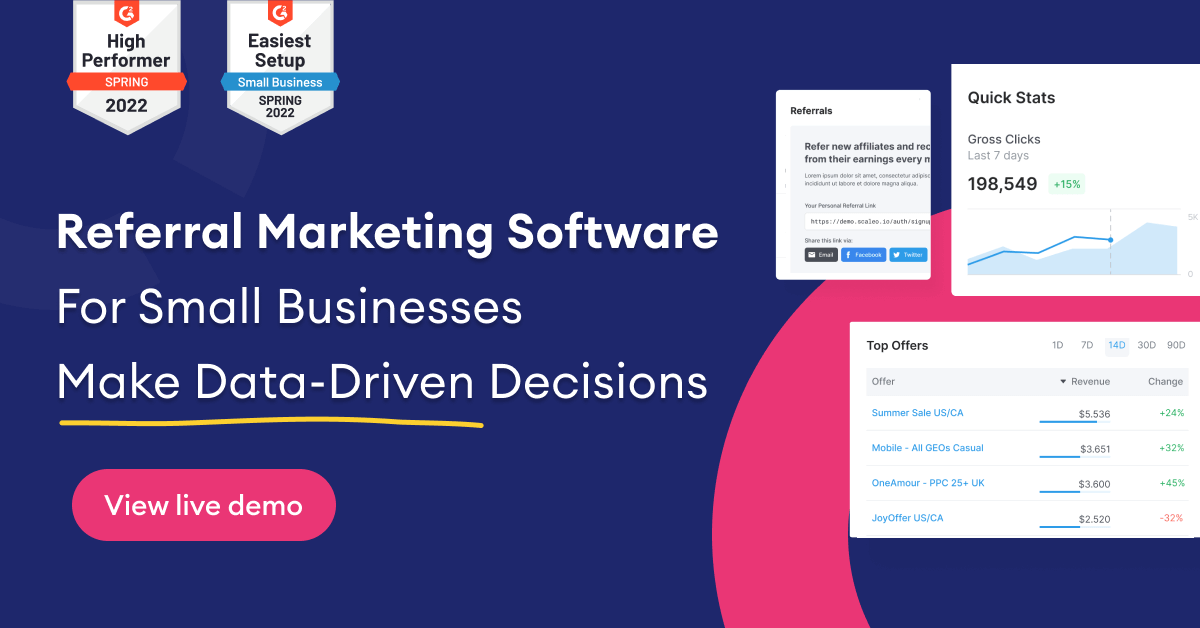
Scaleo offers flexible partner marketing software that is secure and white-label. We provide automation, which is crucial for anyone who needs to boost efficiency without sacrificing accuracy.
Launch your affiliate program with the best-in-class solution
Try Scaleo – a complete affiliate management platform for iGaming, offering flexible commission setups, deep player analytics, fraud prevention, multi-brand control, customization, and automation—all with real-time reporting and API scalability.
We also provide robust security features such as two-factor authentication and encryption to keep sensitive data safe, as well as integration with third-party tools and services, customizable reporting and analytics, and much, much more!
Elevate your network with partner ecosystem management that maps every touchpoint and opportunity in one unified hub. Scaleo’s customizable workflows and analytics turn complex webs of partnerships into a streamlined growth engine.
What is Partner Ecosystem?

An ecosystem could be an app store, a site that compares software, or even just a list of the companies that work with your brand. An ecosystem could be an app store, a site that compares software, or even just a list of the companies that work with your brand. Some brands will also build separate ecosystems for each of their partners instead of seeing them all as part of one ecosystem. All of these ecosystems will be connected to the same brand or product. Some brands will also build separate ecosystems for each of their partners instead of seeing them all as part of one ecosystem. All of these ecosystems will be connected to the same brand or product.