

iGaming content marketing in 2026 isn’t about cranking out posts; it’s about building trust, beating compliance hurdles, and converting intent into verified FTDs and durable NGR.
By 2026, iGaming content marketing has quietly stopped being a growth experiment. It’s infrastructure.
Operators who still treat content as a publishing exercise—blogs, videos, “SEO pages”—feel it immediately in their numbers. Acquisition costs drift upward. Conversion rates stall. Affiliate partners move volume elsewhere. Nothing breaks overnight, but everything becomes harder.
The operators who compound, by contrast, treat content as decision-support media. Their pages answer questions regulators care about. Their videos reduce onboarding friction. Their comparisons set expectations so cleanly that chargebacks drop without marketing ever talking about “risk.”
That’s the bar now.

Why Content Marketing Matters in iGaming?
Engaging your audience is crucial for achieving success in the highly competitive iGaming industry.
Effective content marketing offers several key advantages:
- Build trust: Players need to trust that your platform is safe, fair, and transparent. High-quality content surfaces your licensing, your AML/safer-gambling stance, and your payout logic—credibility on display.
- Engage your audience: In a crowded market, compelling formats (guides, odds explainers, live previews) that speak to intent segments outperform generic blogs.
- Encourage conversions: Clear value propositions, social proof, and friction-aware CTAs move users from curiosity to account creation and deposit.
Yes, “content” is table stakes. The edge is how precisely you match content to journey stage—and how well you measure it.
How iGaming Content Differs
The uniqueness of the gambling category—compliance, stakes, and variable intent—turns content into risk-managed performance media. Here’s the delta versus “normal” content marketing:
| Aspect | iGaming Content Marketing | Traditional Content Marketing |
|---|---|---|
| 🎯 Appeal to Target Audience | Precision to betting interests, game mechanics, promos, and KYC friction by GEO. | Broader problems/solutions; lower regulatory pressure. |
| ⚖️ Regulatory Compliance | Strict regional rules, safer-gambling messaging, bonus T&Cs, affiliate disclosures. | Fewer ad disclaimers; simpler disclosure requirements. |
| 🖼️ Formats | Live odds explainers, bet-building guides, RTP/volatility primers, quick reels, interactive tables. | Blogs, eBooks, static infographics. |
| 🏅 Authority & Trust | Signals include license refs, fairness language, transparent KYC steps. | General brand credibility cues. |
| 🔄 Iteration Cadence | Real-time promo changes, seasonal schedules, regulation-triggered edits. | Slower update cycles. |
Challenges and Opportunities
Compliance isn’t a blocker; it’s a design constraint. The opportunity is translating thrill into informed decisions without overpromising. Use content to make RTP, volatility, rollover, and KYC feel understandable—not scary. That’s how you lower bounce and increase qualified conversions.
Affiliate Content: Your Multiplier
For many operators, the affiliate program is both a distribution engine and a content factory. Because affiliates are paid on outcomes, they produce conversion-minded assets and seed them across YouTube, X, TikTok, and blogs. When partners use approved claims, compliant CTAs, and fresh creatives, their content scales your message without blowing up CAC.

Since a lot of traditional advertising channels (like Google Ads categories or certain Meta placements) are restricted, organic and partner content often carries the load—ethically, clearly, and with the right disclosures.
Try Scaleo — an affiliate marketing software built for iGaming—if you want your partner content machine measured, not guessed.
Why content matters in iGaming (beyond traffic)?
In gambling, content does three jobs simultaneously: it reassures, it instructs, and it pre-qualifies. Miss any one of those, and you pay for it later—usually through lower FTD rates or noisy affiliate disputes.
Players don’t just want entertainment. They want to know:
- whether payouts are real
- how verification actually works
- what bonuses cost them in practice
- whether they’ll regret depositing
High-performing content surfaces those answers early. Not loudly. Clearly.
When content does this well, conversion improves without aggressive CTAs, and support tickets decline because expectations were set before signup.
Creating Compelling iGaming Content
Content that wins deposits does three things: clarifies decisions, shortens friction, and stays scrupulously compliant. Here’s a pragmatic blueprint.
Know Your Audience (Deeply)
- Segments: value seekers, VIPs, casual spinners, sports bettors, casino cross-overs.
- Jobs to be done: understand odds, compare promos, test games safely, deposit confidently.
- Friction points: KYC steps, bonus wagering, payment method trust, RTP/volatility confusion.
Tailor messaging and CTAs to each segment and friction point. “Deposit with Apple Pay in under 60 seconds” beats “Sign up now.”
Storytelling That Converts
Powerful stories frame the decision: “How a weekend bettor turned 3 promos into a month of play—responsibly.” Show outcomes, not hype. Name the guardrails (limits, timeouts) to build trust.
Visuals: Make Complexity Simple
Use quick tables for bonus terms, short reels for game features, and annotated screenshots for onboarding. Players won’t read a wall of text about rollover—show it.
Data-Led Editorial
Editorial calendars should be built from real behavior: what users search, where they bounce, and which creatives drive deposits. Google’s guidance for creating people-first content is a helpful rubric when aligning value with visibility.
iGaming Content for 2026: What’s Working?
Three shifts are defining performance next year. Ignore them and your CR will quietly slide.
- Short-form explainers (20–60s): promos, RTP, and “how to bet” are snackable—embed them on relevant pages, not just socials.
- First-party data loops: build content that encourages account creation and preference capture; feed that back into promos and on-site personalization.
- Entity-rich pages: SERPs reward pages that resolve intent in one place: definitions, tables, FAQs, and comparison modules that Answer-box well.
| Goal | Best Format | Measurement | Notes |
|---|---|---|---|
| Explain promos | 60s reel + terms table | Promo CTR → deposit rate | Clarity reduces chargebacks |
| Educate bettors | How-to + odds calculator | Tool use → FTD | Interactive beats static |
| Game discovery | Feature reels + RTP matrix | Game page time → GGR | Embed demos where allowed |
Affiliate content isn’t optional anymore
For most operators, affiliates are no longer “a channel.” They are distribution infrastructure.
As paid media restrictions tighten, partner content carries the weight. Affiliates produce comparison pages, explainer videos, live demos, and tutorials at a speed internal teams rarely match. The risk, of course, is message drift.
The operators who win here don’t fight affiliate content. They govern it.
They provide:
- approved claims
- clear promo logic
- visible terms
- measurable outcomes
That alignment turns affiliates from traffic vendors into extensions of the content team.
SEO & Analytics: From Visibility to Value
Search is unforgiving. But when your structure matches intent, you win. Here’s the practical layer I deploy with teams.
Keyword Research (Entity-First)
Map entities (games, leagues, bet types, promos) to user intents (learn, compare, sign up). Build clusters that interlink: a hub page (evergreen) and spokes (timely angles). Avoid stuffing; aim for clarity.
For fundamentals, see Google’s SEO starter guide.
On-Page Structure That Snippets Well
- One H1; scannable H2/H3; early “snippet bait” definition for key terms.
- Comparison tables with ✅/❌ where applicable; legit FAQs that answer PAA queries.
- Descriptive alt text; compressed WebP; lazy-load images; fast CLS.
Measure What Matters
Track content to deposits, not just traffic. Attribute via first-party IDs and S2S events. Then prune pages that don’t ladder to FTDs or NGR—ruthlessly.
| KPI | Target Range | Why It Matters |
|---|---|---|
| Click → Signup CR | 5–10% (stable GEOs) | Message-market fit |
| Signup → FTD | 25–40% | Onboarding clarity |
| Promo CTR → Deposit | 8–15% | Offer resonance |
| Chargeback % | <1.5% | Quality & expectation setting |
iGaming Content Services — Worth It?
Bulk content shops often over-rely on generic AI drafts or low-context freelancers. You’ll get volume; you won’t get expertise. For regulated categories, you need writers who understand wagering, RTP/volatility, and bonus rules—and editors who can spot compliance risks. If you outsource, insist on subject-matter samples, compliance familiarity, and transparent sourcing.
Real talk: I’d rather publish one expert page that ranks and converts than five filler posts that dilute crawl budget and confuse users.
Production Efficiency Without Losing Quality
Content velocity matters, but not at the cost of accuracy. Use a light framework to keep teams fast and consistent.
- Calendar with intent & KPIs: every item has a primary intent (learn/compare/convert) and a success metric (FTD, NGR lift).
- Reusable page templates: promo page, game page, sportsbook preview, bonus explainer—with required compliance fields.
- Format variety: quick reels, tables, calculators, annotated screenshots. Interactive when possible.
Quick-Ship Formats (That Still Perform)
| Content Type | Description |
|---|---|
| 📝 Short Blog Posts | Answer specific intent: “how rollover works,” “how to verify KYC faster.” |
| 📊 Infographics | Bonus comparisons, fee tables, payout speed timelines. |
| 🎥 60s Reels | Game highlights, bet builder demos, responsible play tips. |
Hypothetical Scenario: Fixing a Plateau
Picture an operator with solid traffic but flat FTDs. Blog views are up, but deposit rate is stuck at 18%. The team keeps publishing broad “game reviews.” Meanwhile, promo pages are buried, and the KYC flow isn’t explained anywhere.
My fix: ship a promo hub with a top-of-page terms table; produce 60-second reels that show deposit methods and verification steps; add an RTP/volatility matrix; interlink hub → spokes; and instrument first-party IDs with S2S events into Scaleo. Within six weeks, click→signup bumps to 8.5%, signup→FTD climbs to 30%, and chargebacks drop below 1%—because expectations are set clearly and earlier.
Run the Engine in Scaleo
We at Scaleo build for this exact workflow.
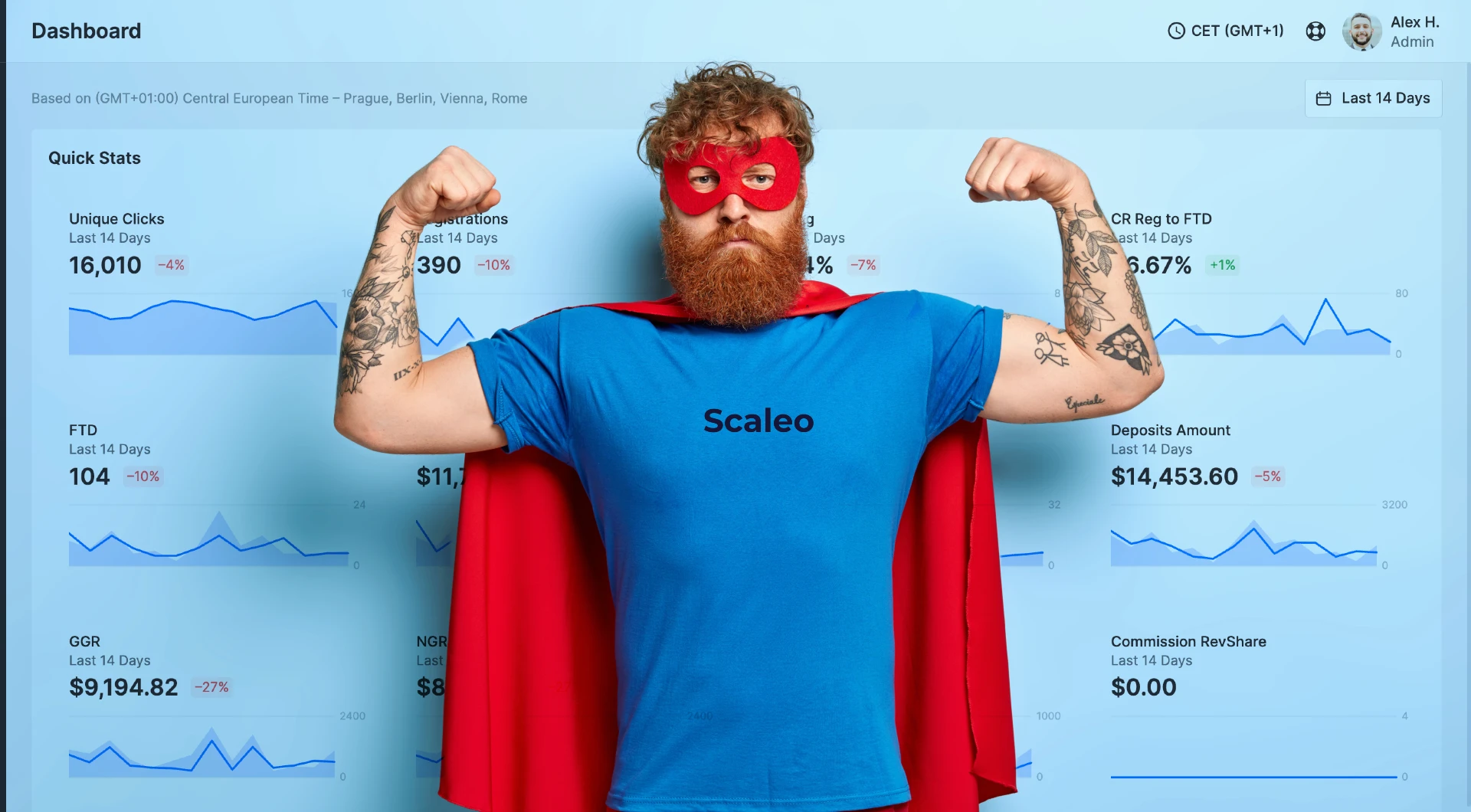
As an iGaming operator, you can tie content performance to partner outcomes without spreadsheets:
- Commission Constructor: reward value (FTD/NGR), not vanity clicks; caps, clawbacks, rule-based overrides.
- Dashboard & Reports: 30+ data points; partner and cohort lenses; “click → registration → deposit” funnel visibility.
- Player Funnel Insights: pinpoint drop-offs; fix pages that stall; prioritize partners that drive LTV.
- KPI & Player Reports: deposits, withdrawals, bonuses, bets, wins, GGR, NGR—evidence for every payout.
- Affiliate Content Extensions: publish promo rules, approved creatives, tools, and links right in the partner portal.
- User Roles & Permissions: granular access for managers/affiliates/advertisers; audit-ready.
- Invoicing & Payment Automation: scheduled invoices, batch payments, line-item clarity—pay correctly, on time.
- Fraud Prevention: real-time Anti-Fraud Logic across IP/ISP/device; rule-driven clawbacks.
- Scalable API: plug CRM, BI, payment systems; keep your data consistent and decision-ready.
| Need | Manual | With Scaleo |
|---|---|---|
| Track content → FTD | ❌ Disconnected | ✅ Funnel report + player KPIs |
| Reward quality | ❌ Flat payouts | ✅ Rules for deposit rate/chargebacks |
| Pay accurately | ⚠️ Spreadsheet risk | ✅ Automated invoicing & schedules |
| Control access | ⚠️ Shared logins | ✅ Advanced roles & permissions |
If you need a sanity check on governance, use regulator guidance as a baseline for content and affiliate controls. It’s worth bookmarking: UKGC advertising & marketing rules.
Ready to link your content to real outcomes? Start a free 14-day trial of Scaleo and watch funnel analytics, Anti-Fraud Logic, and automated invoicing turn “content” into deposits and durable NGR.
What content actually converts in 2026?
Formats didn’t become exotic. They became efficient.
| Objective | Format that works | Why |
|---|---|---|
| Explain promos | Short video + terms table | Reduces misinterpretation |
| Educate bettors | How-to + calculator | Builds confidence |
| Drive discovery | Feature reels + RTP matrix | Sets expectations |
| Reduce friction | Annotated onboarding | Lowers signup anxiety |
Notice what’s missing: long opinion pieces. In iGaming, authority is shown through clarity, not commentary.
Conclusion
iGaming content marketing in 2026 is no longer about storytelling or reach. It’s about reducing uncertainty—for players, partners, and regulators—without killing momentum.
The operators who win are not louder. They are clearer. Their content explains what happens next, measures what matters, and aligns partners around real value instead of vanity metrics.
That clarity compounds.
And when it’s paired with infrastructure like Scaleo, content stops being a cost center and starts behaving like what it really is: a controlled acquisition system.
FAQ
What is iGaming content marketing and why does it matter for casino operators?
iGaming content marketing is the practice of publishing compliant, value-led assets (guides, reels, tools, tables) that help players understand promotions, games, and onboarding. It matters because informed users convert to verified FTDs and generate sustainable NGR—while reducing chargebacks and disputes.
Which iGaming content formats convert best in 2026?
Short explainer videos (20–60s), entity-rich hub pages with tables and FAQs, interactive calculators, and annotated onboarding walkthroughs. The common thread: clarity about value, terms, and steps.
How do I measure the ROI of iGaming content?
Instrument first-party IDs and S2S postbacks for signup → KYC → FTD → GGR/NGR. Track click→signup (5–10% target), signup→FTD (25–40%), and promo CTR→deposit (8–15%). Tie page cohorts to NGR to decide what to scale or prune.
How can affiliates help scale my iGaming content?
Affiliates produce outcome-driven content and distribute it across search and social. With Scaleo, you can publish approved claims and creative assets in-portal, enforce quality gates, and pay for value (FTD/NGR), not just clicks.