
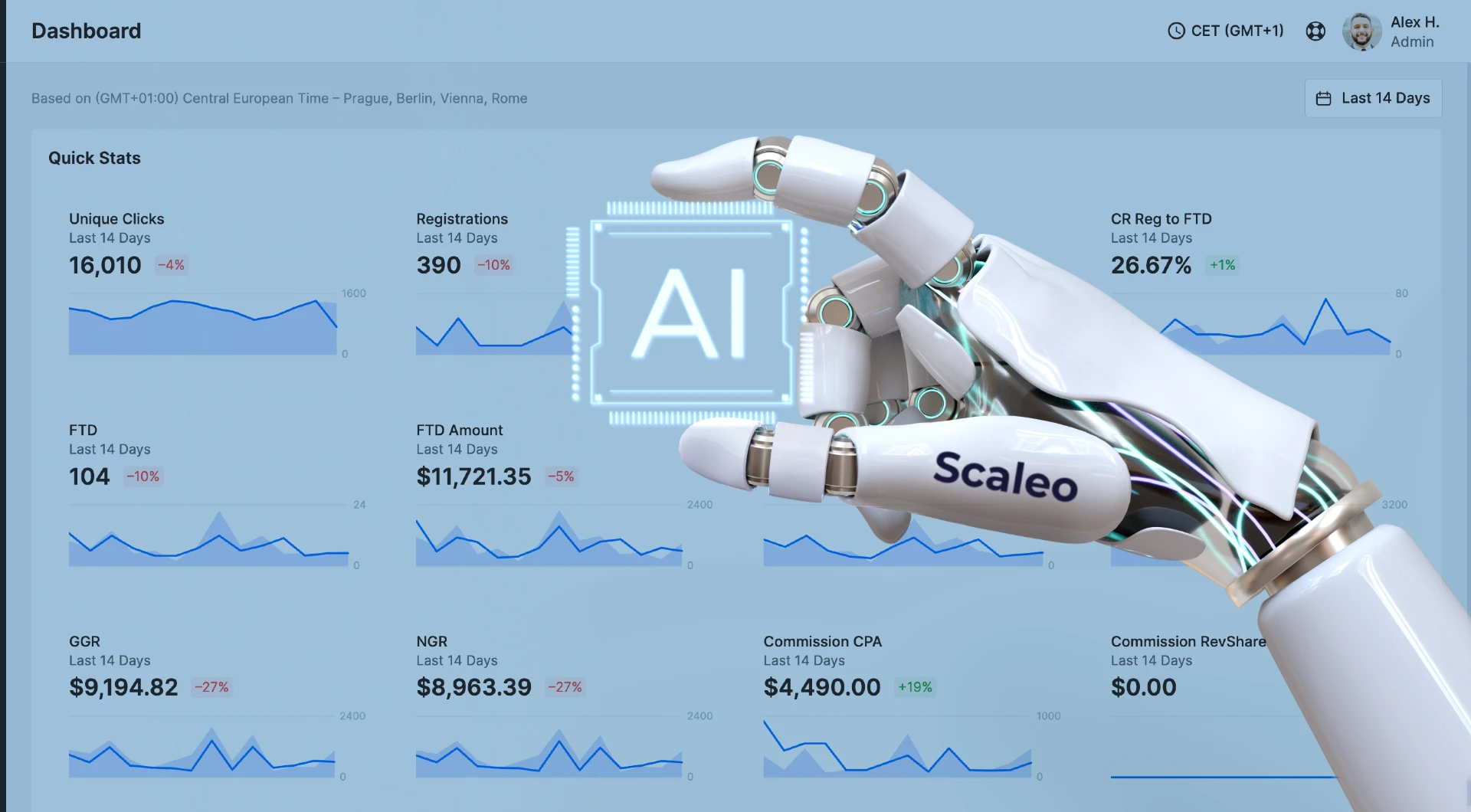
In 2026, B2B affiliate marketing stopped behaving like a side channel and started acting like an operating system. Models that once nudged decisions now run them. Creative that once followed a quarterly plan adapts hourly. And partner programs that once paid for clicks now fine-tune for revenue, margin, and retention in real time.
It’s not hype.
It’s the downstream effect of AI stitched into tracking, pricing, content, and enablement. The operators who treat affiliates as a performance salesforce – measured on pipeline quality, deal velocity, and LTV – are the operators who are quietly compounding.
What does AI actually change?
AI’s impact isn’t a generic “efficiency boost.” It re-architects four pressure points:
- Targeting and fit. Models score partner audiences on ICP match, likely deal size, and buying stage, then route the right offers to the right segments. No more spray-and-pray syndication.
- Offer construction. Price testing, incentive mix, and T&Cs are tuned per partner cohort, often per account. The result is fewer vanity clicks and more qualified handoffs.
- Attribution fidelity. Sequence-aware attribution detects real influence in long B2B journeys. Yes, that top-of-funnel webinar partner deserves a slice of the close.
- Fraud defense. Synthetic traffic and fabricated MQLs don’t survive device, session, and conversion-consistency checks. The model flags, your team audits, and the system learns.
Sounds simple. It isn’t.
But it’s achievable when tracking, CRM, content, and finance speak the same data language and your affiliate stack is built to be automated, not merely reported.
Data pipelines and privacy scaffolding
Let’s face it: without clean data, AI just makes bad decisions faster. The winning programs did two unglamorous things first:
- Built a unified identity. Event streams from websites, partner pages, demo flows, and trials map back to accounts and contacts with deterministic rules, not hope.
- Hardened consent and governance. First-party analytics, country-aware consent prompts, and role-based data access became default. That unlocked safe use of predictive models without tripping legal landmines.
If your affiliate platform can’t ingest and emit events with consistent IDs, you cap your upside before your models even start.
Attribution for complex B2B journeys
B2B conversions don’t happen in a straight line. Multiple touches, multiple stakeholders, and months-long cycles make last-click attribution unusable. AI helps, but you still need a framework you can explain to finance.
| Attribution model | Best for | Limits | Impact in practice |
|---|---|---|---|
| Last-click | Short cycles, low ACV | Ignores assist touches | Simple reporting, distorted payouts |
| Position-based (40-20-40) | Mid-cycle deals | Static weights | Fairer credit to first/last touch |
| Data-driven (AI) | Multi-stakeholder, long cycle | Needs clean volume | Learns true influence, improves ROI targeting |
| Account-based multi-touch | Enterprise motion | Setup complexity | Credits touches per buying group, aligns sales and partners |
Have you considered the downstream impact of switching models mid-year? Your top partners have. Communicate methodology changes in advance, show historical replays, and phase in so that compensation remains credible.
Incentive engineering that aligns with revenue
To be frank, static “5 percent forever” rewards are a 2016 answer to a 2026 problem. Incentives should flex with deal quality, velocity, and expansion potential.
| Incentive design | When it wins | AI signal to use |
|---|---|---|
| Tiered RevShare | Mature partners with stable pipeline | LTV forecasts, churn risk by cohort |
| Hybrid CPA + RevShare | New partners who need cashflow plus upside | Lead-quality scores, cycle-length predictions |
| Milestone bounties | Complex implementations with phased adoption | Product usage milestones, expansion propensity |
| Negative incentives | High-return rates, low ACV leads | Refund propensity, support-burden index |
Run models that predict ACV, ramp time, support cost, and expansion probability. Pay more for what compounds, not just what closes.
Fraud, quality, and compliance in 2026
It’s frustrating when promising campaigns plateau because your funnel is polluted with junk.
AI makes quality control continuous:
- Device and session intelligence. Velocity spikes, shared fingerprints, and headless browsers get buried.
- Lead integrity. Email and domain heuristics plus enrichment catch throwaways before they hit the CRM.
- Contractual guardrails. Policy engines block restricted verticals, keywords, and geos at the link and creative level, not after the fact.
Here’s the bottom line when dealing with disputes: transparent logs end arguments. Keep postback histories, decision reasons, and finance reconciliation in one place so you can say, “Here’s what happened and why.”
Workflow automation: from recruitment to enablement
Picture a partner manager juggling sourcing, legal, onboarding, creative, payouts, and quarterly business reviews. Now picture the same manager with automation:
- AI surfaces partners whose audiences mirror your top quartile accounts.
- Contract templates autofill with the right incentive band, SLA, and brand rules.
- Creative kits assemble themselves: copy, image variations, and UTM schemes tuned to the partner’s channel mix.
- Quarterly reviews write themselves from a shared data model: pipeline added, velocity, win rate, LTV, expansion.
Human judgment still matters. It just stops wasting cycles on paperwork and starts focusing on strategy.
Content intelligence for partners
Content fuels B2B affiliate performance, but guessing which topics convert is expensive. Models analyze engagement by job role, industry, and buying stage to predict which assets will create real pipeline.
- Offer-to-asset routing. CISOs receive compliance checklists; CFOs receive ROI calculators; administrators receive setup tutorials. Same product, different angle.
- Message versioning. Headlines and CTAs rotate by segment until the model finds the winner. Underperformers are parked automatically.
- Localization. Terminology, examples, and regulatory references adjust per region without eroding brand voice.
Small thing, big effect: give partners feed-ready, brand-safe assets that are pre-tagged, pre-approved, and pre-optimized.
Sales alignment and channel conflict
Channel conflict kills trust. AI helps arbitrate:
- Deduping logic. Sequence-aware rules decide whether sales outbound or a partner gets primary credit. The rest get partial.
- Account tiering. Strategic accounts trigger special routing. Everyone knows the rulebook before the first email lands.
- Playbooks by segment. If a partner opens doors in mid-market but your sales team wins the final mile, comp both based on measurable lift.
If the program can’t explain who gets what and why, you’ll lose your best partners to a competitor who can.
Metrics that matter in 2026
Drop vanity metrics. Tweak for compounding ones.
| Metric | Why it matters | AI-ready view |
|---|---|---|
| Pipeline quality score | Stops paying for junk | Account fit, intent, buying group depth |
| Time-to-first-revenue | Reveals enablement gaps | Cohort survival curves |
| Partner LTV-to-CAC | Investment dial for each partner | Scenario modeling by incentive plan |
| Net revenue retention on partner-sourced deals | Measures compounding | Expansion propensity and churn risk |
| Assisted revenue share | Credits real influence | Data-driven attribution by sequence |
Honestly, if your dashboard can’t answer “Which two partners deserve 80 percent of next quarter’s budget, and why?”, it’s not a dashboard. It’s a mirror.
Why Scaleo for B2B affiliate marketing?
This isn’t an pitch.
It’s what B2B teams actually need when affiliates are treated like a precision revenue channel rather than a loose referral list.
What Scaleo is.
A white-label, enterprise-grade affiliate platform designed to run complex partner programs across multiple products, regions, and brands. It’s built for automation, observability, and finance-grade accuracy.
How Scaleo maps to B2B needs?
- Commission constructor for B2B. Build CPA, RevShare, and granular hybrid plans tied to opportunity stage, product line, ACV band, or region. Pay for pipeline quality and expansion, not just first order.
- Account-based funnel reporting. See click → MQL → SQL → opportunity → closed-won, by account and buying group. Sequence-aware views make multi-touch explainable.
- Player-level style KPIs repurposed for B2B. Replace “deposits” and “bets” with ACV, gross margin, onboarding cost, support load, and expansion revenue. It’s the same precision, pointed at B2B realities.
- Multi-brand, multi-geo control. Operate several product lines under one dashboard with separate policies, currencies, and tax rules. Roll up or drill down without exporting CSVs.
- Advanced roles and data governance. Granular permissions for affiliate ops, sales ops, finance, and legal. Field-level export controls and audit logs keep security teams calm.
- Automated invoicing and payouts. Generate tax-compliant invoices, schedule payments via multiple rails, reconcile automatically against postback truth. Finance will thank you.
- Proactive anti-fraud and quality scoring. Device, IP, and velocity checks plus lead-integrity heuristics detect synthetic traffic and low-quality submissions. Your SDRs stop chasing ghosts.
- Full data visualization with a real API. Slice cohorts, build custom partner portals, push data into your lakehouse, or pull attribution into your BI. No vendor lock-in gymnastics.
- White-label everything. Your domain, your design, your assets, your content pages. Partners feel like they’re inside your brand, because they are.
Scaleo benefits at a glance

| ✅ Capability | 🚀 Benefit |
|---|---|
| Hybrid incentives by cohort | Align payouts with predicted LTV and margin |
| Account-based multi-touch | Credible credit for influence, not just clicks |
| Cohort and sequence analytics | See which partners accelerate deals, not just start them |
| Quality and fraud controls | Protect SDR time and CAC, keep finance clean |
| Automated finance ops | Faster close, fewer reconciliation headaches |
| API-first architecture | Fit neatly into your CRM, CDP, and data stack |
| White-label UX | Enterprise-grade partner experience without extra tooling |
If you’re running B2B at scale, that combination is the difference between a noisy partner channel and a disciplined revenue machine.
Implementation blueprint without the buzzwords
Skip the “digital transformation” theater.
Do the work in four moves:
Unify identity and events.
Standardize IDs for accounts, contacts, and opportunities across your site, partner pages, and CRM. Turn on server-to-server postbacks so tracking survives cookies and privacy changes.
Define an attribution you can defend.
Pick a position-based or data-driven model, replay the past six months to show impact, then lock it for at least two quarters. Publish the rules to partners.
Engineer incentives for compounding.
Use hybrid plans with milestone bounties for product activation and early expansion. Let AI propose plan changes, but have humans approve them.
Automate the flywheel.
Template recruitment, onboarding, creative kits, quarterly reviews, and payouts. Free your team for strategy – segmentation, enablement, and partner coaching.
Common pitfalls
- Pretty dashboards, no decisions. If a chart doesn’t reroute budget or change an incentive, it’s decoration. Tie every widget to a play.
- Attribution churn. Changing models quarterly destroys trust. Pick, prove, and stick.
- Paying for clicks in a sales-led motion. If sales close the deals, pay affiliates for assisted revenue and time-to-close lift. Your pipeline will get healthier overnight.
- One-size content. CFOs and admins do not click the same CTA. Segment or starve.
Conclusion
Truth be told, most “AI-driven” partner programs are still spreadsheets with better branding. The ones that win look different: sequence-aware attribution, incentives that reward compounding outcomes, fraud controls that actually gatekeep, and automation that lets humans focus on strategy. If your affiliate stack can measure and pay for what really matters in B2B – revenue quality, velocity, and expansion – partners stop being a cost center and start acting like a revenue machine.
So, which two partners deserve 80 percent of your next quarter’s budget – and can your current system prove it?