
⚡ Key Takeaways
- B2B affiliate programs work best when you pay for verified pipeline progress, not raw lead volume.
- In 2026, S2S tracking, CRM-linked attribution, deduplication, and offline conversion visibility are table stakes.
- Recruit partners based on audience fit and sales influence, not vanity reach.
- Strong B2B programs need clear policies, reliable payouts, and partner enablement assets that reduce buyer risk.
- The fastest way to break a B2B affiliate program is to keep it manual. The fastest way to scale it is to automate tracking, rules, and finance from day one.
Launching a B2B affiliate marketing program in 2026 is not about copying a B2C playbook and raising commission percentages. It is about building a repeatable revenue channel with partners who influence longer sales cycles, complex buying committees, and high-trust decisions.
A good B2B affiliate program should help you generate qualified pipeline, not just more names in a spreadsheet. That means defining what counts as a real conversion, connecting attribution to your CRM, and giving partners a system they can trust and scale with.
Below are 12 practical, field-tested tips to launch and scale a B2B affiliate marketing program this year.
Throughout the guide, you will also see where a platform like Scaleo helps remove manual work and support a more scalable operating model with accurate tracking, automation, and transparent partner reporting.
Define the outcome you will pay for
Paying for vague “leads” is how B2B affiliate programs drift into junk volume. In B2B, compensation should be tied to milestones that sales agrees reflect real commercial progress. Write those definitions before you recruit a single partner, then make them visible in your portal, contracts, and program terms.
| Milestone | What counts | Evidence | Cool off |
|---|---|---|---|
| MQL | Right company size, industry, role, explicit interest | Form data + enrichment | 0 to 7 days |
| SQL | Accepted by SDR or AE, problem and fit confirmed | CRM stage change | 7 to 14 days |
| SQO | Qualified opportunity created with value or timeline | Opportunity ID | 30 days |
| Closed Won | Contract signed and first payment received | Invoice or payment event | 30 to 90 days for clawbacks |
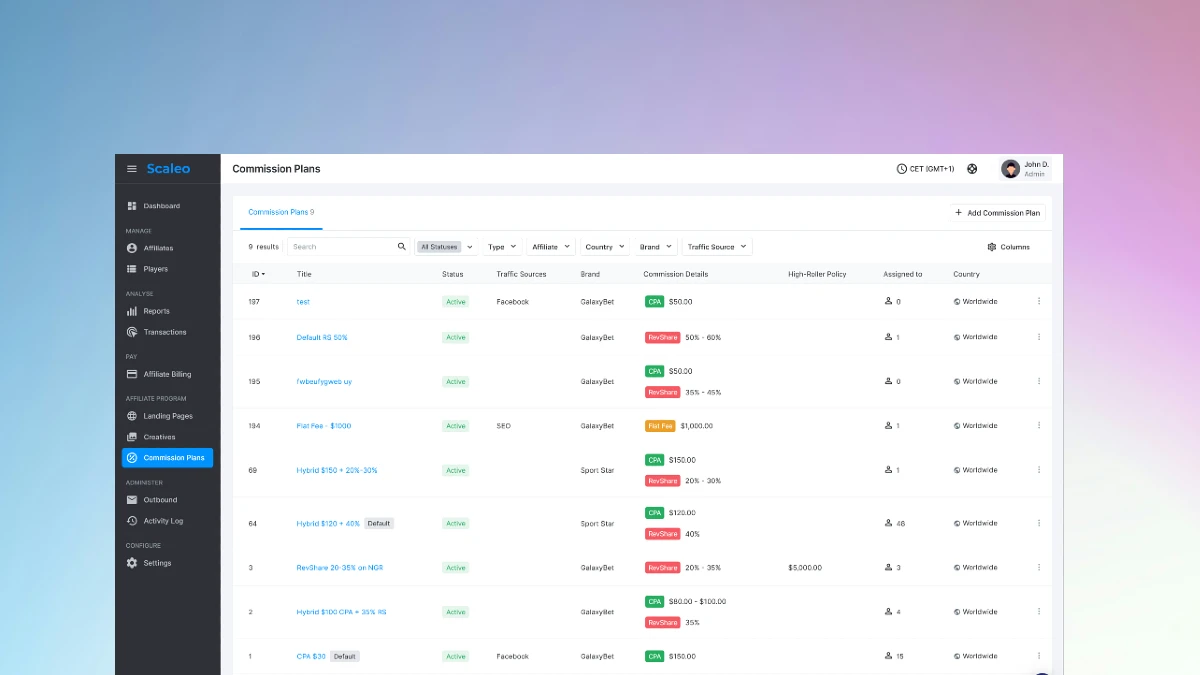
With Scaleo, you can structure milestone-based commissions so payouts are triggered by CRM-verified events, not just form submissions.
Choose a payout model that reflects lifetime value
B2B deals differ by ACV, sales cycle, margin, and expansion potential. Your payout model should reward early influence without forgetting where the real value lands.
- CPL for verified MQLs — only if SDR filtering is strong and follow-up is fast.
- CPA for SQL or SQO — pay when sales accepts the opportunity, not when a form is submitted.
- Hybrid — smaller CPA at SQL plus a share of first-year ACV after Closed Won.
- RevShare only — best for resellers, consultants, or integration partners who influence retention and expansion.
Tier payouts by quality, not just volume. Partners with stronger win rates, faster cycle times, or higher contribution margin should earn access to better terms.
Track like privacy changes and ad blockers already won
Pixels alone are not enough in 2026. A durable B2B affiliate program needs first-party click IDs, CRM-linked attribution, server-to-server confirmation, and clear visibility into offline conversion events such as calls, demos, trials, and POCs.
- Use S2S postbacks for signups, SQL, SQO, and Closed Won.
- Store the click ID on the lead and opportunity in your CRM.
- Deduplicate by company domain and opportunity to prevent double payouts.
- Set attribution windows per milestone, for example 60 to 90 days for SQO.
Scaleo supports S2S tracking, deduplication, and offline conversion ingestion so reporting stays reliable across devices, browsers, and longer sales cycles.
Align with sales before you recruit partners
No affiliate channel survives long if partner leads disappear into a CRM black hole. Sales and partner teams should agree on response SLAs, acceptance criteria, routing logic, and which CRM fields prove commercial progress.
- Service level — every partner SQL contacted within 1 business day.
- Definition of acceptance — which roles, industries, company sizes, and countries qualify.
- Feedback loop — monthly pipeline review by partner: acceptance rate, win rate, cycle time.
Recruit by audience and motion, not just reach
In B2B, reach by itself is a vanity metric wearing a tie. Prioritize partners by buyer fit and the motion they influence: review sites, vertical communities, agencies, consultants, integration partners, marketplaces, and regional resellers. Then map each one to the funnel stage they genuinely move.
| Partner type | Best use | What to supply |
|---|---|---|
| Review and comparison sites | Late stage, vendor shortlist | Competitor matrix, ROI proof |
| Communities and newsletters | Mid funnel education | Playbooks, case studies |
| Agencies and consultants | Solution selling | Implementation guides, margins |
| Integrators and marketplaces | Stack fit and cross sell | APIs, integration docs |
| Resellers and VARs | Regional presence | Enablement kits, deal reg |
Tip: Build a short partner scorecard. Score 1 to 5 for audience fit, content authority, sales influence, and channel conflict risk. Recruit the highest scorers first instead of spraying invites everywhere like confetti.
Equip partners with assets that close risk gaps
B2B buyers do not just ask “Does this work?” They ask “Will this create risk, cost, delay, or political trouble inside the company?” Your partner assets should answer those objections before sales has to.
- 1-page problem-solution briefs by industry and role.
- ROI and payback calculators with editable assumptions.
- Security and compliance summaries for procurement.
- Integration guides, sandbox access, and API docs for technical teams.
- Webinar-in-a-box kits and post-event email templates.
Scaleo lets you host, version, and expire assets in the partner portal so affiliates always use approved and current materials.
Publish clear policies and enforce them automatically
Brand bidding, creative compliance, territory boundaries, deal registration rules, and clawbacks should never live in someone’s memory or Slack history. Write them down in plain language and apply them systematically.
- Brand bidding policy with examples of allowed and restricted behavior.
- Creative approval workflows and expiration dates for time-sensitive claims.
- Territory and vertical limits to reduce channel conflict.
- Clawback conditions for fraud, non-payment, duplicate accounts, or disqualified deals.
Scaleo permissions, rule-based controls, and clawback logic help apply these standards consistently across partners.
Instrument the funnel and improve the weakest stage first
In B2B, partner economics can swing wildly by geo, industry, motion, and buyer readiness. Do not guess where the problem is. Measure click to form, form to accepted SQL, SQL to SQO, and SQO to Closed Won. Then fix the stage leaking the most value.
- Localize forms and commercial terms by region to improve acceptance.
- Shorten demo-booking flows and reduce avoidable security or qualification friction.
- Route leads by expertise, not round robin, to improve conversion from SQL to SQO.
- Share funnel snapshots with partners so they can improve their pre-sell and qualification.
Scaleo reporting helps reveal where partner traffic stalls so you can fix the exact step dragging down revenue.
Automate the finance layer from day one
Manual reconciliation might feel manageable at the start, right up until it mutates into a monthly ritual of spreadsheet sorrow. Accurate statements, clear cooldown periods, tax handling, multicurrency support, and on-time payouts are not “ops nice-to-haves.” They are trust infrastructure.
- Use monthly invoicing with a clear line item per milestone and opportunity.
- Set cool-off periods and visible payout dates.
- Offer multiple payout rails and currencies.
- Provide a dispute workflow with evidence fields so issues are resolved quickly.
Scaleo invoicing and payment workflows help automate statements and disbursements while preserving an audit trail finance teams can actually rely on.
Run a simple operating cadence partners can rely on
A strong cadence makes your program feel real. Partners should know when they will get updates, when they will get paid, and when they can expect strategic changes. Predictability reduces support load and improves retention.
- Weekly — top sources, acceptance rate, largest funnel drop-off, one creative or messaging update pushed to the portal.
- Monthly — partner pipeline review with sales, tier adjustments, payouts executed.
- Quarterly — retire underperforming motions, launch new offers or geos, publish the partner roadmap.
Tip: Schedule a 30-minute monthly partner council. Share roadmap changes, gather product feedback, and spotlight top partners. It builds community and cuts down on scattered one-to-one firefighting.
Launch in 90 days with a phased plan
Speed matters, but chaos is not a launch strategy. A phased rollout lets you go live quickly without sacrificing attribution, partner trust, or financial control.
- Days 1 to 15 — define milestones, tiers, clawbacks, and attribution windows. Implement S2S events and a first-party click ID. Connect CRM.
- Days 16 to 30 — build the partner portal, upload enablement kits, and publish policies. Test tracking with an internal sandbox partner.
- Days 31 to 45 — onboard 5 to 10 high-fit partners across different motions. Verify sales SLAs and acceptance criteria.
- Days 46 to 60 — review quality and economics. Promote partners who hit SQL-to-SQO targets. Adjust caps for outliers.
- Days 61 to 90 — expand to 20 to 30 partners. Automate invoicing. Publish next-quarter offers and the content calendar.
Scaleo centralizes tracking, rules, assets, and payouts, which makes this kind of phased launch realistic for lean B2B teams.
Clicks are input. Revenue quality is output. If you want a B2B affiliate program that survives budget scrutiny, you need metrics that show real economics, not just partner activity.
| Metric | Formula | Why it matters |
|---|---|---|
| Acceptance rate | Accepted SQLs divided by submitted leads | Signals lead quality and sales alignment |
| Win rate | Closed Won divided by opportunities | Indicates fit and sales execution |
| Cycle time | Close date minus opportunity create date | Helps forecast and tier partners |
| Contribution margin | ACV minus partner payout minus delivery cost | Shows true unit economics |
| Payback period | Payouts recovered via gross margin | Controls cash discipline |
| LTV to Payout | Lifetime value divided by total payout | Long-term sustainability check |
Scaleo dashboards let you slice these metrics by partner, geo, motion, and device without drowning in spreadsheet archaeology.
Common pitfalls to avoid in 2026
- Paying for raw leads without validation — this rewards spam and trains sales to hate the program.
- Relying only on pixel tracking — this leaves blind spots across modern browsers and mobile flows.
- Ignoring offline conversions — this under-rewards partners who drive demos, calls, POCs, or event-sourced pipeline.
- Using one-size-fits-all commissions — this misprices value across very different partner motions and deal sizes.
- Paying late or inaccurately — few things kill trust faster.
- Keeping operations manual — eventually your headcount becomes the cap.
How Scaleo future-proofs a B2B affiliate program

A future-proof B2B affiliate program is accurate, automated, and transparent. Scaleo helps provide that foundation:
- Cookieless, S2S tracking — more resilient attribution across browsers and devices, plus offline conversion ingestion.
- Commission Constructor — milestone payouts, tiers, geo and device rules, and clawbacks without engineering bottlenecks.
- Fraud Prevention — device, IP, and velocity checks to protect budgets and keep data cleaner.
- Partner portal and asset control — approved creatives, localized materials, and version control.
- Automation, caps, and pacing — rule-based control that reduces manual administration.
- Invoicing and payments — accurate statements, multicurrency support, and cleaner settlements.
- APIs and webhooks — CRM, billing, and BI connections so sales, finance, and partnerships work from the same source of truth.
Launch checklist for 2026
- Milestones and definitions written and approved by sales.
- Payout model and tiers documented with examples.
- S2S events live for signup, SQL, SQO, and Closed Won.
- CRM fields mapped to partner IDs and stages.
- Policies published for brand bidding, creatives, geos, and clawbacks.
- Partner scorecard and first 20 targets identified.
- Enablement kits uploaded to the portal and localized.
- SLAs agreed for response time, acceptance, and feedback cadence.
- Automation configured for tier rules, caps, and alerts.
- Invoicing and payment rails tested end to end.
Conclusion
A high-performing B2B affiliate marketing program in 2026 rewards real pipeline progress, tracks attribution beyond the browser, and gives partners the clarity and predictability they need to invest seriously. Define what you pay for, connect your tracking to CRM reality, recruit partners by motion and audience fit, and automate the finance layer before manual work starts breeding errors.
Do that well and your affiliate program stops being a side experiment and starts behaving like a real growth channel. On Scaleo, that model becomes easier to run: milestone-based payouts, S2S tracking, fraud controls, partner enablement, and automated payouts in one system. Less operational sludge. More qualified pipeline. Fewer cracks when the program scales.