

Affiliate management services are becoming more and more common these days. Do you want to start an affiliate program and need someone to take care of it? Or did your affiliate program start months ago, and you have now realized that you cannot run it on autopilot and do everything yourself?
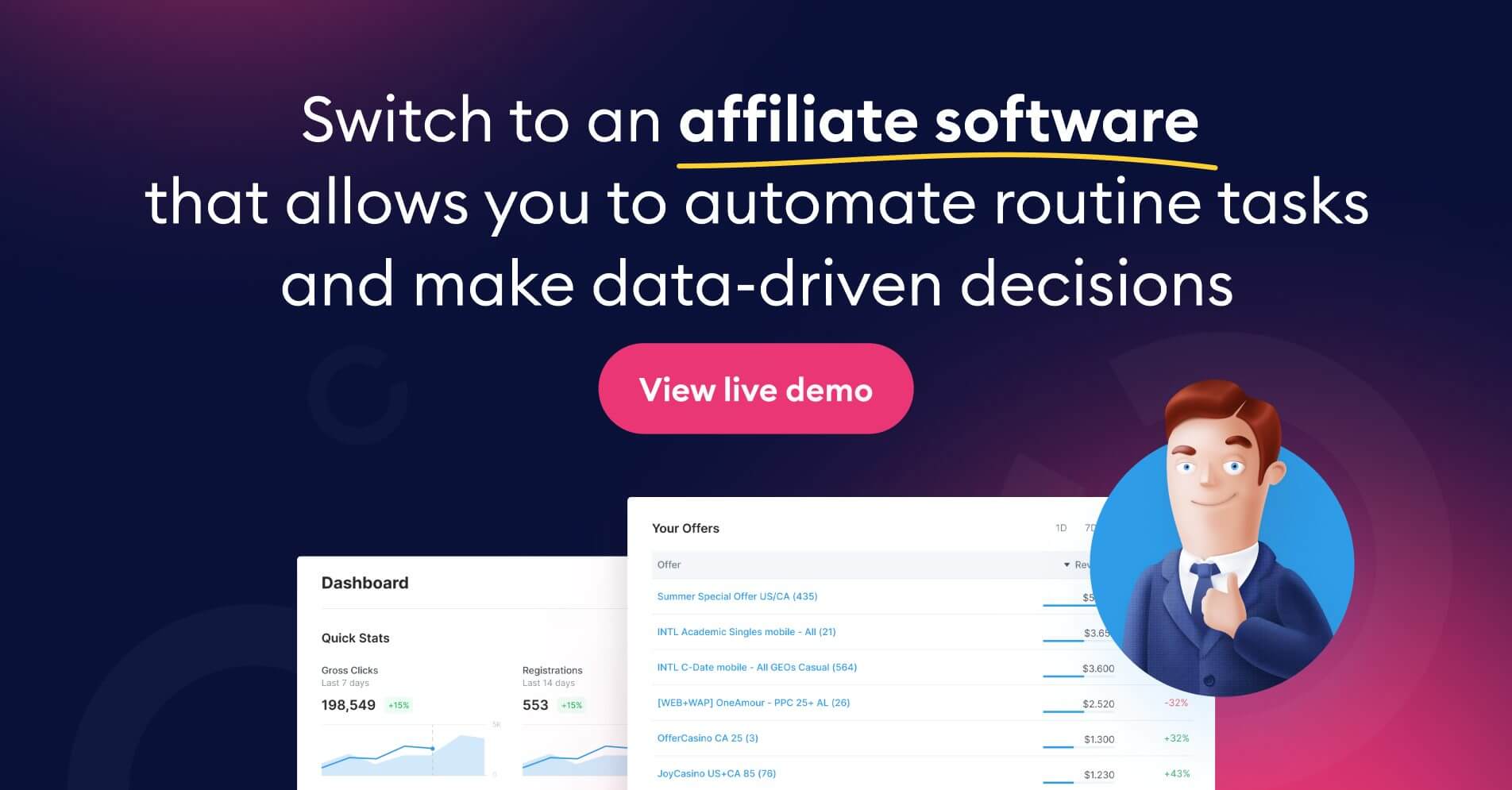
Are you looking for affiliate management software?
You have two primary options in both cases: hire an in-house affiliate manager or outsource one from one of the numerous affiliate management services available online.
Today we are going to look into the pros and cons of outsourcing your affiliate division to an agency manager and why it may or may not be a good idea in both the long and short term?
Some merchants, particularly those with a large product inventory and/or a high volume of sales, may feel that combining the two options provides additional value.
In addition, depending on the network you pick, management services may be provided at an additional cost if you decide to run your program on an affiliate network. This post, however, will concentrate solely on outsourcing.
Before we discuss the pros and cons of outsourcing program management to an agency or hiring a program manager, you should know this. The benefits of outsourced management are endless, but how much you can benefit from them depends on the agency you choose.
What are the 3 key elements to look for in an affiliate management agency?
Credibility
Today, publishers are picky about which affiliate programs they join and what merchants they promote. They are unlikely to join a program that:
- lacks sales
- • It provides no detailed data.
- offers a product or service that they hav no experience with
- lacks customer feedback.
However, they may risk it if they receive an invitation to join the affiliate program from an affiliate manager they know or discover that a reputable agency runs it.
Experience
Experience in affiliate program management is essential and can take many forms. Finding an agency with:
- Experience in your particular business sector,
- experience managing competitors’ programs
- • or prior experience with running an affiliate marketing network or affiliate marketing software, such as Scaleo, that you’ve chosen for your program.
The most reputable affiliate management agencies have a proven track record and experience in most categories, frequently in both management and as affiliates. Their expertise could make a significant difference in how your program begins, and you will benefit from the collective experience of a full team, not just one person.
Expertise
The most important virtue that affiliate management agencies bring to the table is expertise.
Affiliate marketing specialists who understand everything about creating and running an affiliate program like yours make up their teams. Unlike in-house affiliate managers (who may require further training), outsourced managers have already obtained all of the necessary training, and if this is not the case, the agency will take care of it.
Furthermore, when you outsource an agency, you get guidance from a complete team rather than just one expert. An outsourced affiliate manager will not hesitate to consult with his colleagues when faced with a dilemma, lacking specific data, or needing assistance or insights.
Members of the team will also exchange information and discuss drawbacks, opportunities, and best practices.
Now that you know what you should look for and based on what parameters you should judge your potential affiliate marketing management agency, let’s weigh the pros and cons.
The pros of outsourcing an affiliate management agency
Why should I outsource the management of my affiliate program?
Well, because it has some undeniable benefits.
In this day and age of social media and online influencers, what people are saying about your company is more important more than ever.
Because of the modern digital world, the argument for partnering with an affiliate management agency is obvious: it works.
Pro: Connecting with Targeted Affiliates
There are over 360k affiliates in today’s affiliate marketing business, but just 8% of them are so-called top affiliates. The other 92% of registered affiliates are either inactive, fake, or terribly unsuccessful in what they are doing.
Because they are skilled, well-connected in the online world, and have years of experience behind them, outsourced affiliate program managers yield a higher ROI than any other method of online marketing.
Pro: Connecting with Your Target Audience
If you want to reach your niche audience, you must connect with suitable affiliates. Affiliates can act as brand ambassadors, not only generating cold sales. Choosing the correct ambassadors can also help to increase trust between your brand and potential customers.
An experienced affiliate management agency already knows the influencers in your field, allowing you to connect with leading marketers. This generates the proper amount of buzz for your brand, right where it needs to be.
Pro: Promotion/Advertising is Easy
An affiliate management agency ensures that you get the most out of your campaigns by matching you with a successful affiliate and monitoring your affiliate campaigns around the clock. Additionally, they typically utilize state-of-the-art brand-monitoring technology to ensure consistent adherence to your search and display policies.
Furthermore, their accessible data allows you to easily measure your outcome and understand how your managed affiliate programs help your business grow.
Pro: Commitment to Company’s Goals
In a perfect scenario, employees are loyal and fully committed to you and your company’s goals. Thus hiring an in-house affiliate program manager is a viable option.
In reality, Gallup indicates that 85% of the global workforce is disengaged, giving you only a 15% chance of seeing your dream come true. Your new employee is most likely primarily concerned with their paycheck and benefits.
While companies offering affiliate management services may not always align with the corporate culture or goals of their clients, they can be seen as sharing a common interest. The best agencies and managers make their money on the performance component of their agreement, not the fee. They’ll want to grow the affiliate program and boost sales and revenue as much as you do.
Because their reputation is at stake, they will work hard to preserve and consolidate yours. Once they’ve agreed to manage your affiliate program, they’ll be your partners in everything, whether you succeed r fail.
The cons of outsourcing an affiliate management agency
While there are many more undeniable advantages to outsourcing your affiliate marketing wing to an agency, there are also (just like with anything else!) tons of drawbacks.
Here are 2 that, in my opinion, are the most prominent.
Con: Lack of Control & Accountability
This barrier is frequently established by merchants who feel the need to control all aspects of their business. An employee is easier to handle than a third-party service provider. Failure to work assigned hours, arrive on time, or follow instructions can result in reprimand or termination.
That is not possible with an outsourced affiliate program manager.
They may also be unavailable for phone calls or meetings without advance notice. All you can and should do is trust that they will work the agreed-upon hours, keep their end of the bargain, and follow your reporting guidelines. You can have them report weekly or monthly and set a deadline for email responses and affiliate applications.
But what do you really want: another employee waiting for their next paycheck or a professional who understands how to drive performance and understands that they won’t get paid? The fact that you cannot control a remote employee doesn’t mean they will not do their job properly.
As previously stated, you can get better results by inserting a performance-based component in your payment agreement with the agency.
Con: Lack of Product Knowledge
Some merchants are concerned that if the affiliate program manager has never worked for their company, they would be unfamiliar with their products, services, and target audience. This isn’t always the case, but they are definitely not familiar with you and your work culture.
An in-house employee is already familiar with every aspect of your product or service, your company’s goals, and the direction where you are heading.
On the one hand, when the agency you choose takes over your affiliate program, they will designate a manager or a team with experience in your niche, which will hopefully learn more about your company in the process. Even if the manager assigned to your program is unfamiliar with your products or services, they can learn.
Of course, there is no guarantee that your hire’s agency will be competent enough to provide you with an expert in your niche.
Outsourced Affiliate Program Management (OPM):
So… When it works, why it fails, and how to make it pay?
Handing the day-to-day of your partner channel to an external team can either unlock rapid scale—or create a costly black box. The difference comes down to structure: the commercial model you sign, the KPIs you enforce, the tech you own, and the operational guardrails you set from day one. Below is a pragmatic view of outsourced affiliate program management (OPM), built for operators who want control, speed, and provable ROI without growing headcount.
| Model | Core Strength | Cost Structure | Control & Transparency | Best For | Primary Risks |
|---|---|---|---|---|---|
| In-House | Deep brand alignment; direct control of data & margins | Salaries + tools + benefits | Highest (you own everything) | Mature programs with stable growth and strict compliance needs | Hiring velocity, regional coverage, tool sprawl |
| OPM (Fully Outsourced) | Speed to market; pre-built publisher relationships | Retainer, % of partner revenue, or hybrid | Variable—depends on SLAs & data access | New launches, turnarounds, entering new geos/verticals fast | Misaligned incentives, limited visibility, brand drift |
| Hybrid (OPM + In-House) | Strategic control with execution at scale | Smaller core team + outcome-based OPM scope | High (you own data & approvals; OPM executes) | Operators wanting scale without losing governance | Coordination overhead; unclear RACI if poorly defined |
What an OPM Should Actually Do (and What You Must Keep)
OPMs are best used as an execution engine, not a decision maker. Keep strategy, budgets, and data ownership in-house. Delegate repeatable, operationally heavy work with clear KPIs and audit trails.
- Keep In-House: commission policy (CPA/RevShare/hybrid), margin guardrails, brand guidelines, approval rights on partners & promos, and all data ownership.
- Outsource to OPM: partner sourcing & vetting, outreach and deal negotiation within your pre-set ranges, activation playbooks, content/placement QA, fraud monitoring, and weekly performance ops.
Commercial Models that Align Incentives
Misaligned compensation is the #1 reason outsourced channels underperform. Structure your contract so the OPM wins only when qualified revenue grows within your LTV/CAC boundaries.
- Hybrid Retainer + Success: modest base (covers ops) + tiered bonus on net partner revenue (post-refunds, post-fraud), with malus for compliance breaches.
- Geo/Vertical Pilots: 90-day sprints with fixed deliverables (onboarded partners, go-live rate, revenue targets) before expanding scope.
- Clawbacks: contractual clawbacks for invalid traffic, policy violations, or unreconciled discrepancies beyond X days.
Operating System: KPIs, SLAs, and a Ruthless RACI
Treat OPM engagement like a revenue operations function with tight cadences and shared dashboards. No emailed spreadsheets. No opaque “quarterly summaries.”
- Weekly: new partner pipeline, activation rate (% with first qualified conversions), compliance incidents resolved, top placements won.
- Monthly: NGR by partner & cohort, blended CAC vs. target, fraud/invalid rate, time-to-payout, content SLA adherence.
- Quarterly: partner LTV by source, tier migrations, commission effectiveness (CPA vs. RevShare vs. hybrid), geo expansion milestones.
Define RACI before kickoff: who decides commission exceptions, who approves creatives, who signs larger media buys, who owns partner offboarding, who certifies reconciliations. Ambiguity costs margin.
Data & Tooling: Run OPM on Your Stack (Not Theirs)
The program must live on your tracking and analytics stack to keep continuity, compliance, and historical comparability. Give the OPM access; don’t hand over the keys.
- Single Source of Truth: real-time tracking, postback/webhook integrations, cohorted revenue (NGR), and payout automation in one platform.
- Granular Permissions: role-based access for the OPM—manage partners and campaigns without changing global settings or financial policies.
- Auditability: immutable logs for rate changes, manual adjustments, and partner status updates.
Note: Running outsourced teams inside your own platform also shortens onboarding and avoids data silos if you ever switch providers.
Compliance, Quality, and Fraud Controls
Outsourced teams expand surface area. Tighten controls instead of loosening them.
- Traffic Quality: device/IP heuristics, velocity checks, CTIT thresholds, incentivized-traffic flags, and auto-hold rules for anomalous spikes.
- Creative Governance: pre-approved copy banks, dynamic disclaimers by geo, and instant de-list if brand terms or restricted channels are used.
- Payment Sanity: “pay-after-validate” cycles, negative carryover policies, and retroactive adjustments for chargebacks or reversed conversions.
Due Diligence Checklist (Use Before You Sign)
- Vertical & geo case studies with hard metrics: activation rates, time-to-revenue, NGR lift, fraud rates, and partner retention beyond six months.
- Team structure: named senior owner, day-to-day account lead, bench depth for peak periods.
- Publisher graph access: categories, languages, top traffic channels, typical content SLAs, and conflict-of-interest disclosures.
- Data policy: exactly what they can export, how long they retain it, and your right to immediate data transfer on termination.
- Reporting cadence & format: dashboard previews, metric definitions, reconciliation timelines.
How Scaleo Fits into an OPM Engagement
When an outsourced team runs on Scaleo, you keep ownership of tracking, partner contracts, and financial rules while giving the OPM controlled workspace access. You get real-time performance, automated payouts, fraud shielding, flexible commission logic (CPA, RevShare, hybrid, tiers), and NGR-aware reporting—so the channel scales without sacrificing margin or visibility. That’s the point. 🚀
Conclusion
Should you hire an affiliate management agency for your business? How hard is it to find reliable affiliate management solutions in 2025? Unfortunately, there is no definitive answer. It all comes down to a list of pros and cons aligned with your company’s goals, values, and possibilities.
If you live in a country with low local wages, it might not make sense to outsource an agency from another country where the wages are triple. The opposite is, of course, makes more sensible.
If money isn’t an issue, you might still consider if you want to allow people outside of your team (who you cannot control) to have access to your business and whether or not they will be dedicated to your affiliate program or “simply do their job” for the hours they bill. Each company should create a list of its own pros and cons when considering hiring an affiliate agency and decide accordingly.
If you don’t have an affiliate program yet – consider Scaleo’s affiliate management software as a platform for your business. Try it free for 14 days – instant access and no credit card required.
Do you need an affiliate management agency service to run an affiliate program?
How much does it cost to hire an affiliate management agency?
Prices vary depending on your location and volume of work. Some affiliate management agencies provide their services on an hourly rate basis, while others charge a fixed monthly fee with a set of pre-agreed services included in the price. You can expect to pay from a low $XX hourly rate to a high $XXX on a monthly basis. If you need extra services such as affiliate recruiting and onboarding, you may expect to fork out over a 4-figure sum.