

What do affiliate managers do all day?
Short answer: they turn a messy mix of partners, payouts, and policies into predictable revenue.
Long answer: they recruit and vet publishers, negotiate commission plans, enforce compliance, track wires, fight fraud, reconcile attribution, brief creatives, report to finance, and keep the best partners motivated—without overpaying for low-quality traffic.
If you run an iGaming program (or any high-stakes performance channel), this role is the quiet engine behind your LTV.
And yes, the job changed again in 2026.
As privacy rules, app attribution, and first-party data reshaped the workflow. At Scaleo, we observe the same pattern across top programs: managers who make decisions quickly, explain the reasoning to partners, and automate routine tasks are the ones who win.
Why this role matters more than ever
The digital ad market isn’t expanding, but budgets aren’t infinite—every euro needs a receipt. The share of spending moving into measurable, performance-oriented channels continues to rise across Europe and the UK, which is why affiliate programs increasingly feel like a CFO-approved acquisition system. Put bluntly, accountability beats spectacle, and affiliate managers are the ones who wire accountability into everyday decisions.
What great affiliate marketers own (and what they don’t)
| Discipline | Owns it | Supports it | Not their job |
|---|---|---|---|
| Partner recruitment & vetting | ✅ | ||
| Commission design (CPA/RevShare/Hybrid) | ✅ | ||
| Tracking QA & attribution guardrails | ✅ | ||
| Fraud/RG compliance routing | ✅ | ||
| Creative approvals & asset library | ✅ | ||
| On-site personalization for referred users | ✅ | ||
| Core product roadmap | ✅ | ❌ | |
| Legal policy drafting | ✅ | ❌ | |
| Payments operations (wire runs) | ✅ | ❌ |
Legend: ✅ = primary ownership, ❌ = do not own outright. The best teams keep these lines clear to protect speed.
The playbooks that actually move revenue
1. Recruit for fit, not just volume
An exhaustive partner list looks impressive; a right-sized one prints profit. Content sites and reviewers often exhibit higher 30- and 90-day LTVs and tolerate longer cookie windows (assuming your tracking is first-party and S2S). Media buyers scale fast but demand tight CPA and near-real-time transparency. Creators convert on trust; give them copy kits, deep links, and tailored landers by GEO/game category.
2. Price to incrementality
Commission plans are steering wheels. Start new partners on Hybrid (small CPA + lower RevShare) until their cohorts clear your LTV hurdle and fraud/RG checks. Promote quickly when quality is provided, and clean it up when it isn’t. The rule is simple: pay more when they add more, not when they shout louder.
3. Keep attribution honest
Last-click alone invites click flooding and partner knife fights. Use position-based or data-driven models for always-on decisions, with small uplift tests as a truth check. Show partners the rationale inside your platform; “black box” is where trust—and traffic—go to die.
4. Make compliance a speed boost
Policy in PDFs slows teams; policy in software speeds them up. Express GEO, RG, and disclosure rules as validations on creative can’tlanders. If a banner can’t ship without mandatory labels, you cut rework and reduce audit risk.
5. Personalize the on-site moment
A referred visit carries context, including partner ID, campaign, device, and risk posture. Use it. Create safer game rules for groups sensitive to changes, special offers for those seeking adventure, and low-cost incentives when the chance of getting a return is good It’s not “push harder.” Its relevance—with guardrails.
6. Automate the boring; keep humans on judgment
Let automation handle asset approvals, link hygiene discrepancy triage, and send “nudge” emails. Invest human time in pricing, partnerships, and experiments that shift the curve
KPIs that defend the budget
- RR/PB (retained revenue per bonus dollar)—are incentives compounding or leaking?
- Quality-adjusted ROI by partner—payout vs. modeled 30-day value.
- TTFR (time to first return)—after acquisition, do cohorts come back quickly and safely?
- Dispute rate—volume is noise; unresolved disputes are rot.
- Decision latency (p95)—from signal to payout/tier update yesterday’s programs overpay yesterday’s truth.
- Fraud/RG cleanliness index—chargebacks, proxy/device risk, bonus abuse triggers.
Commission design (operator-grade)
CPA is clean but risky: you pay upfront, so cookie windows should be short (7–14 days) unless you’ve proven long-tail incrementality.
RevShare rewards durable cohorts: longer windows (30–45 days) can be fair for content publishers—if your tracking survives modern browser limits and your NGR definition is crystal clear.
Hybrid buys peace: a small CPA + a lighter RevShare until quality is proven, then promote.
NGR clarity matters: GGR minus bonuses, provider/payment fees, chargebacks, taxes/levies, and fraud/RG write-offs. Encode it in your platform so every partner sees the same ledger.
Tools that pros actually use (and why)
- Affiliate platform (we, at Scaleo, live here!): S2S + first-party tracking, multi-touch attribution, model-aware tiers, fraud/RG rules, automated payouts, partner dashboards.
- BI/warehouse: lift tests, partner cohort LTV curves, RR/PB trends.
- Creative stack: pre-approved asset libraries, localization, and dynamic landers.
- Compliance engine: GEO/RG/age rules compiled, not copy-pasted.
- Comms & enablement: doc center for disclosures, copy kits for creators, and change logs partners can reference.
Junior vs. senior vs. head-of-role—who owns what?
| Task/Outcome | Junior AM | Senior AM | Head of Affiliates |
|---|---|---|---|
| Approve creatives per template | ✅ | ✅ | |
| Negotiate CPA/Hybrid/RevShare | ✅ | ✅ | |
| Design tiering & cookie windows | ✅ | ✅ | |
| Attribution model choices | ✅ | ✅ | |
| Fraud/RG escalation policies | ✅ | ✅ | |
| Forecasting & board comms | ✅ | ||
| Tooling roadmaps & automation | ✅ |
No ambiguity, no turf wars. Clear ownership equals faster decisions.
How the role changed in 2026 (and what stays true)
- First-party identity & S2S: cookie folklore lost ground; durable tracking won.
- Creator–affiliate convergence: creators act like measurable acquisition partners when you give them real dashboards and tailored landers.
- Compliance as code: teams ship faster when rules are embedded in the platform.
- Explainability: Partner trust now depends on seeing whether the platform paid (or didn’t). Programs that hide the math lose their best publishers.
None of this changes the core truth: the affiliate manager is a revenue operator. The title says “manager,” but the job is P&L.
Earnings impact, in plain math
Give a manager the levers, and the numbers shift quickly:
- Shift 30% of traffic from blunt CPA to hybrid → reduce overpayment on short-lived cohorts and keep elite partners loyal with upside.
- Enforce attribution beyond last-click → fewer disputes, fairer payouts to introducers, and a better partner mix.
- Personalize on-site for referred users → higher conversion rates without relying on risky incentives.
- Automate approvals and payouts → more time for outreach, better pipeline, cleaner month-end.
Operators who run this cadence consistently see steadier 30-/90-day results and lower burn. That’s not hype; it’s mechanics.
Need Help with Affiliate Management?
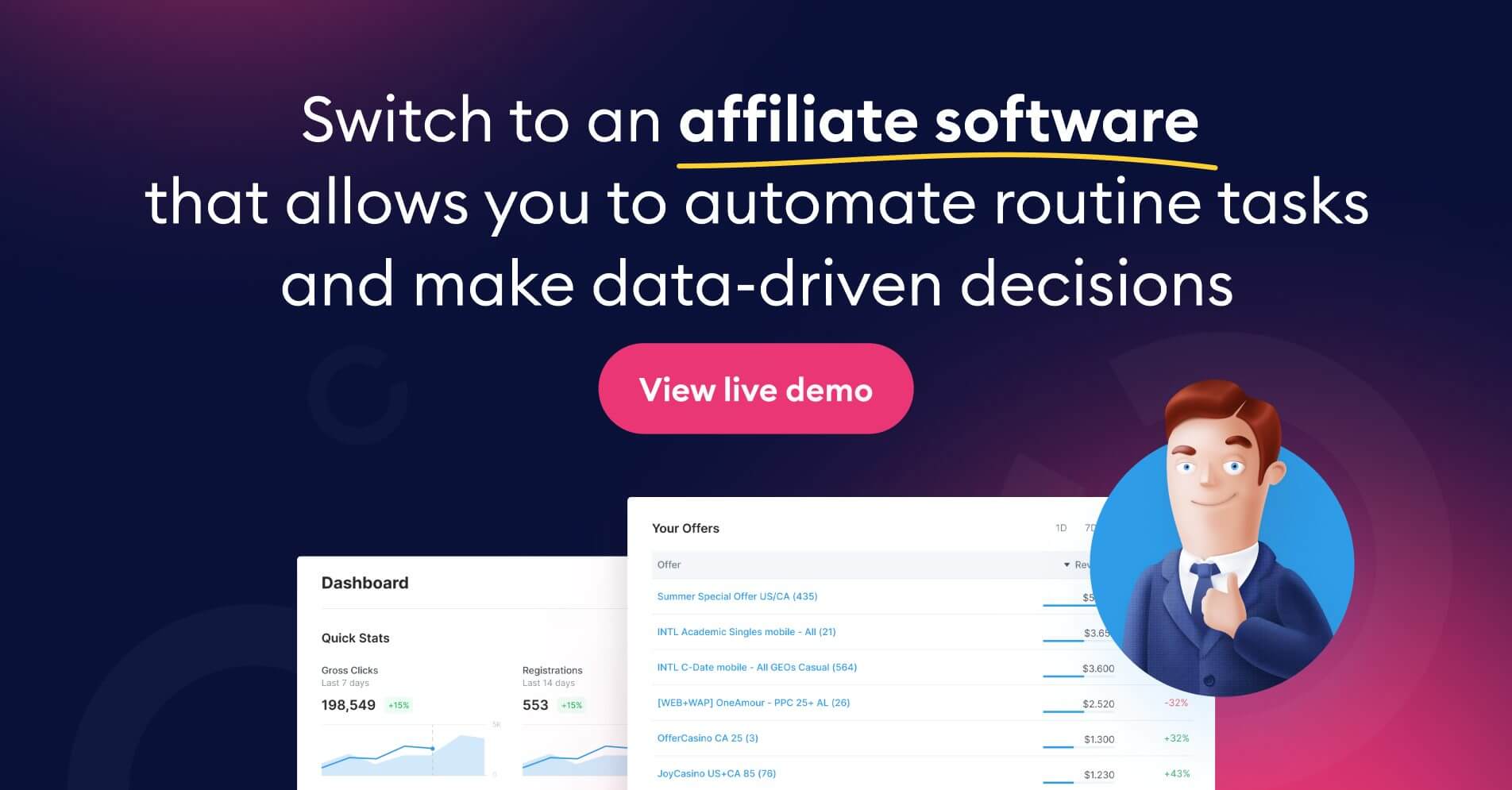
Do you want to take your affiliate marketing to the next level? Check out our affiliate marketing management software! Our partner software makes managing your affiliate partners and tracking your commissions easy. With Scaleo, you can quickly identify which partners are performing best and adjust your strategy accordingly. You can also use our software to track your marketing progress and discover new opportunities.
Don’t miss out on the benefits of our affiliate marketing software—sign up for a free trial today!