
iGaming partner marketing has become an integral part of the industry. As many iGaming entrepreneurs, operators and business owners know: many doors close in front of you when you want to promote your business. That’s why partner marketing remains one of the most robust and reliable sources of steady traffic in 2026.
In this blog post, we look at the key factors iGaming businesses need to consider in order to implement partner marketing and successfully achieve their marketing goals.
Partner Marketing as an iGaming Marketing Strategy
Partner marketing is a performance-based marketing model that has become integral to the iGaming industry. This model rewards partners for promoting online casinos to potential players. The partnerships between online casinos and partners allow both parties to benefit mutually.
- For partners, iGaming businesses offer generous and lucrative commissions
- For casinos, as we have already mentioned, it’s the most reliable and cost-effective source of traffic.
For these companies, partner marketing provides cost-effective advertising, increased reach and visibility, and valuable insights and feedback. On the other hand, partners benefit from passive income, flexibility and independence, and growth opportunities.
Successful partner marketing implementation in iGaming requires choosing the right partners, offering attractive commission structures, and providing resources and support.

The Role of Partner Marketing in iGaming Promotional Strategies
Partner marketing has quietly become the lever that decides whether an iGaming brand grows fast or stays in the “just another casino/sportsbook” bucket. Not because paid media stopped working, but because performance channels alone can’t give reach, trust, localization, and regulatory flexibility at once.
Partners can.
Streamers, content affiliates, comparison portals, media networks, local publishers, payment providers, tipster communities, even software vendors with traffic of their own—each of them sees a segment the operator can’t reach directly at acceptable CPAs.
The trick in 2026 is not “get more affiliates.” It’s “turn every external traffic holder into a measurable, contract-smart, brand-safe partner.”
Partner marketing, when done properly, is the connective tissue between brand, acquisition, and retention. It allows the brand to enter new GEOs faster, test new verticals with borrowed audiences, run co-branded campaigns without reinventing creatives every time, and shift spend to sources that proved they bring players who actually stay. It’s also the only route in many semi-regulated markets where direct ads are capped or unwanted.
So let’s break down how it should work now—at operator level, not guru level.
Partner marketing vs classic affiliate: not the same animal
Affiliates, in the narrow sense, send traffic on a pay-for-performance basis. Partner marketing is broader. It can include revenue-share style deals, yes, but also MGFs with streamers, fixed-fee seasonal placements on comparison sites, inventory swaps with media, co-funded content with payment providers, co-sponsoring local events, and even integrations with communities that live on Telegram/Discord and never touch Google Ads.
A useful way to see it is this:
| Dimension | Classic affiliate | Partner marketing |
|---|---|---|
| Commercial model | Mostly CPA/RevShare/Hybrid | Anything from fixed fee to tiered hybrid with co-op budget |
| Role in funnel | Mostly acquisition | Acquisition, reactivation, and brand building |
| Channels | Blogs, SEO, PPC | Streamers, media, social, apps, fintech, SaaS, comparison portals |
| Negotiation | Standard terms | Highly customized, often seasonal |
| Measurement | Click → FTD | Multi-touch, assisted, sometimes view-through |
| Risk level | Predictable | Varies by partner, needs governance |
That last line is why many operators still hesitate: partner marketing multiplies opportunity and risk. Without structure, you get credit disputes, fraudulent “audiences,” and compliance headaches. With structure, you get a growth muscle.
Why partner marketing works so well in iGaming
First, trust. Gambling and betting are still categories where people like to see validation from someone they already follow. A streamer who plays the same slot every week, a local sports journalist with a podcast, a fantasy-sports Discord admin—when they say “this operator is ok,” people listen.
Second, locality. iGaming is very GEO-sensitive: payment options, events, languages, regulatory lines. Local partners already speak that language, literally and culturally.
Third, content. Partners create streams, clips, guides, odds breakdowns, parlays-of-the-day, bonus hunts. That content has a shelf life and keeps distributing the operator’s brand even when media is off.
Mapping partner types to iGaming use cases
There’s no point treating a Twitch streamer the same way as a price-comparison portal. Their audiences behave differently and need different proof.
| Partner type | Strength in iGaming | What they usually want | How to judge them |
|---|---|---|---|
| Casino/sports streamers | High trust, live engagement, great for launches | Floor economics (MGF), hybrid payouts, custom creatives | View-to-click quality, deposit durability, bonus cost per NGR |
| SEO/content affiliates | Stable traffic, intent keywords, long tail | Clear RevShare or Hybrid, fast reporting | CR by GEO and product, LTV of cohorts, refund/chargeback rate |
| Media/publishers | Reach, branding, local authority | Fixed or mixed deals, co-branded assets | Assisted conversions, brand uplift, signups over time |
| Tipsters/communities | Sport-specific, high engagement, betting mindset | Better odds, special promos, some performance | Bet volume per user, churn after event, fraud markers |
| Payment/fintech partners | Trust, frictionless onboarding | Revenue share on players they refer, co-marketing | Deposit success, payment-method adoption, lifetime value |
| App/social creators | Fast discovery, mobile-native | Trackable links, in-app safe flows | Mobile CR, app installs tied to partner, retention D7/D30 |
A mature operator will run several of these at once, with different pacing and payout logic. That’s partner marketing.
The data problem: one brand, many journeys
The hardest part isn’t recruiting partners; it’s proving everyone’s value without double-paying. In 2026, players jump platforms.
They click a partner link from mobile, watch two streams, Google the brand, install the app later, deposit from desktop. Partner A will say “I drove the awareness,” Partner B will say “I drove the action,” and the operator must show a timeline that both can accept. That implies multi-touch or, at least, layered attribution with a written policy.
A sensible structure for iGaming is:
- give discovery partners credit when they truly were first,
- give performance partners fuller credit when they closed in a short window,
- have a fallback (for example, time-decay) for messy paths.
Write it once, version it, and never change mid-campaign.
| User path example | What happened | Attribution stance |
|---|---|---|
| Streamer → brand search → app install → FTD | Streamer created demand, search closed | Streamer gets credit if within window; search is assisting |
| Odds portal → mobile web → deposit in desktop | Portal brought intent traffic | Portal gets full credit; device change is ignored |
| Social ad → affiliate review → registration → no deposit → email → deposit | Mixed journey | Affiliate gets registration credit, CRM gets deposit assist, but affiliate is paid on validated FTD only |
When partner marketing is measured this way, partners stay longer because they can predict earnings.
Making partner marketing coexist with CRM and paid media
One common mistake is letting CRM and paid media “overwrite” partner-driven users. Example: a streamer brings a wave of traffic; the operator immediately drops a generic retargeting or email promo to the same users, then closes them, then reports to the streamer, “your traffic didn’t convert that well.”
That’s not only unfair, it’s destructive—because the partner loses faith and stops investing.
The better approach is: partner-origin users should be marked as such, and subsequent CRM/promo activity should stay within the commercial logic agreed with that partner. If the partner is on RevShare, CRM can go wild. If the partner is on CPA with a validation window, CRM should not close in a way that hides the source. That’s partner-aware orchestration.
Incentives and co-marketing without chaos
In iGaming, the best partner activations are timed: major tournaments, local derbies, holiday casino drops, new slot launches, app releases. Partners want to align with those because content performs better. Operators, however, need to keep promo spend under control. The workable model is to use short-lived incentive layers on top of the base deal, with automatic reversion and with performance thresholds.
For example, “during the Euro semi-finals, all verified traffic from Partner Group A gets +€20 top-up on CPA, capped at 200 FTD, auto-expires Monday.”
This is clean, measurable, and fair. Partners know when it starts and ends; finance knows maximum exposure; marketing gets the extra push.
This is where many brands fail: they run “special” terms in DMs and forget to record them, then try to reconcile. That’s not a strategy; that’s a future argument.
Partner segmentation: not all partners should get the same stack
A lot of operators still run a flat affiliate setup. That’s leaving money on the table. Partner marketing is more powerful when there’s stratification: top performers, scaling partners, experimental/new channels, strategic/local authorities. Each of these needs a different combination of reporting, economics, and creative freedom.
| Segment | What they need | What they get |
|---|---|---|
| Top performance partners | Real-time data, quick dispute resolution, seasonal boosts | Highest flexibility, hybrid/CPA with validation, custom promos |
| Scaling/new partners | Guidance, pre-landers, content packages | Standard hybrid, stricter windows, more managed onboarding |
| Strategic/local media | Brand-safe creatives, co-op budget, reporting for their sales team | Fixed + performance overlay, white-labeled assets |
| Risky/unproven | Tight caps, strong fraud checks | Low base CPA, small test budget, short attribution window |
By doing this, operators don’t waste time micromanaging low-impact partners and can spend more time on the ones that move needle.
The benefits of Scaleo for iGaming affiliate channel
Partner marketing only works if commercial promises, tracking signals, and creative access all live in one place. That’s the gap Scaleo fills in this context: it’s not just “affiliate tracking.” It becomes the operational desk for every external partner, no matter whether they behave like a classical affiliate or like a media publisher.

For partner-heavy iGaming brands, Scaleo can be set up to do three things that matter a lot in 2026.
First, it allows operators to define different partner classes with distinct commercial blueprints. A streamer can run on a monthly minimum with performance offsets; a comparison portal can run on clean CPA; a local media house can run on fixed-fee impressions plus an on-top commission when their articles actually register players. All of those can sit side by side, but still be reconciled against the same performance ledger.
Second, Scaleo can carry partner context through the entire conversion path. When a user hits from a partner’s Telegram, then installs the app, then deposits on desktop, the server-side pipeline in Scaleo remembers which partner initiated the journey. That context can also be used to show or hide in-app/onsite promo blocks that were reserved for that partner’s audience. This is subtle, but it’s what makes partner-aware CRM possible: “this player came from media X, show them the co-branded message, not the generic one.”
Third, Scaleo gives partners a clearer view of which of their placements actually perform. Not only “you got 43 FTDs,” but “your Twitch placement outperformed your Instagram story,” or “your article about live dealers sits higher in our funnel than your generic bonus page.” When partners can see that level of granularity, they optimize—because now it’s not guesswork. That’s how partner marketing becomes iterative instead of one-and-done.
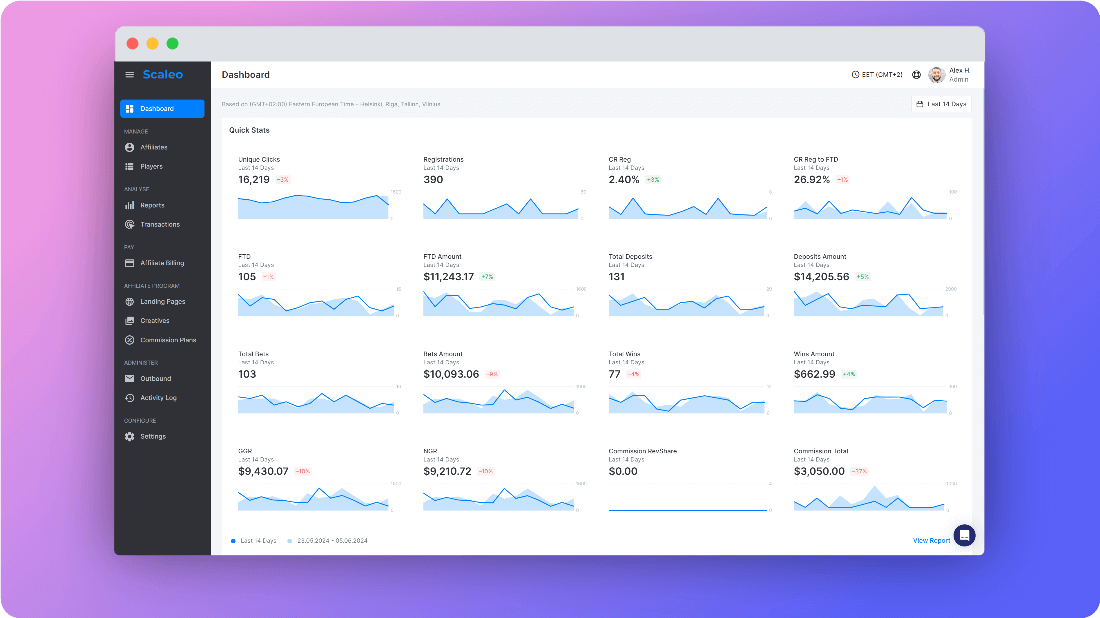
Notice how none of this relies on repeating the same “S2S tracking and flexible payouts” spiel. The value here is orchestration: keeping several partner models, several tracking contexts, and several promo assets in sync, while finance and compliance still see order.
What to watch out for?
Partner marketing creates two temptations. One is to over-customize—to give every partner a special deal, a private creative, a bespoke payout. That doesn’t scale. The other is to over-standardize and force streamers, local media, and high-end content publishers into the same affiliate straightjacket.
That wastes reach.
The sane middle is to have a small number of partner archetypes, each with a documented commercial logic, each supported by the platform, each with approval flows. When a new opportunity appears (“this betting podcast in Portugal can push us hard for a month”), you plug it into the nearest archetype and only tweak what’s essential.
The other watch-out is data contamination. If you let partners send unconsented, VPN-heavy, or bot-inflated traffic into the same reporting pool as your solid SEO affiliates, you will end up doubting all of it.
Partner marketing in 2026 should be tied to traffic quality checks at the point of ingestion: device/IP patterns, GEO mismatch, bonus-abuse markers, consent flags. Partners that fail that get their conversions quarantined with a reason; partners that pass get fast payouts. That clarity is what keeps the good ones.
Conclusion
Partner marketing is no longer “extra.” For iGaming, it’s how brands get into conversations they didn’t start themselves—on streams, in local media, in private groups, in niche sports communities. It’s also how brands cope with privacy limits, ad restrictions, and the fact that not every GEO wants to be sold to by a banner.
But for it to work, it has to be measurable, tiered, compliant, and fast to operate. Otherwise it becomes a collection of side deals and unpaid invoices.
If running all of that in spreadsheets already feels too fragile, it’s time to move partner operations into software that actually understands iGaming.
Launch your affiliate program with the best-in-class solution
Try Scaleo – a complete affiliate management platform for iGaming, offering flexible commission setups, deep player analytics, fraud prevention, multi-brand control, customization, and automation—all with real-time reporting and API scalability.
Scaleo can act as the control room for every external traffic source—affiliates, streamers, media, local partners—keeping their contracts, creative access, performance, and payout logic in one place, while still letting you run different economic models per partner type. That’s what makes partner marketing repeatable.
If the goal is to grow through more than just SEO affiliates, put it into Scaleo and let the platform keep track of who brought what, on which terms, and how much they earned.